



Yoshiwara: History, Location & Legacy of Japan’s Famous District
For more than three centuries, the Yoshiwara was the center of licensed entertainment in Edo — a single walled district where Japan’s most celebrated courtesans, the oiran, lived and worked amid lantern-lit teahouses, seasonal parades, and an entire economy built around refined entertainment. It was the only pleasure quarter officially licensed by the Tokugawa shogunate in the capital, and for generations it shaped Japanese art, fashion, theater, and even everyday language in ways that still echo today.
This guide explains what the Yoshiwara actually was, where it stood — then and now — how it was organized, and, crucially, how it institutionalized the distinction between geisha and courtesan that still defines Japan’s entertainment traditions to this day. We’ll also look at what remains of the district in modern Tokyo, just a short walk from Asakusa, where the living culture it helped create still survives.
It also draws on something most histories of the Yoshiwara can’t offer: the firsthand perspective of Okami Chikage, the proprietress of Miyakodori in Asakusa and the only okami in Asakusa with her own career as a geisha. Her account of how and why geisha came to be set apart from courtesans — a story rooted in the Yoshiwara itself — is the thread that ties this district’s past to the living tradition just down the road.
A note on terminology: the Yoshiwara was a licensed quarter where women known as oiran provided companionship that, by the conventions of the time, included intimate services. We treat this subject as the serious social history it is, focusing on its cultural significance rather than sensationalizing it.
What Was the Yoshiwara?
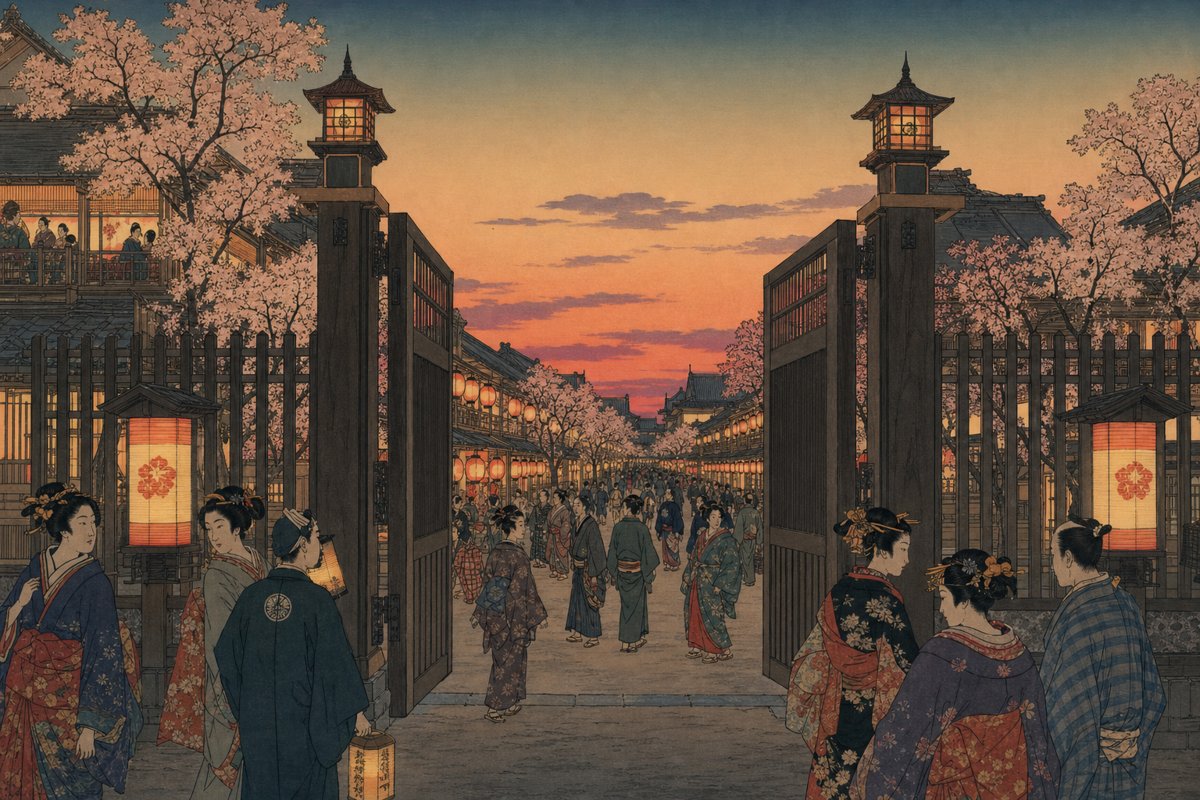
The Yoshiwara (吉原) was the largest and most famous yūkaku — a government-licensed pleasure district, often called simply the licensed quarter — in Edo-period Japan (1603–1868). Established in 1617, it was the only quarter where the Tokugawa shogunate permitted licensed courtesans to work in the city of Edo, today’s Tokyo. Everything inside its walls was regulated: who could enter, who could work, how business was conducted, and even how the women dressed and ranked. It is important not to romanticize this: the Yoshiwara was a licensed prostitution district, and most of the women who worked there did so under years-long indenture contracts, many of them sold into the quarter by impoverished families. The cultural achievements of the quarter and the constrained lives of many of its women are both part of its history.
Its isolation and tight regulation also helped make the Yoshiwara culturally productive. Cut off from ordinary city life behind a single gate and a surrounding moat, it became a self-contained world with its own fashions, etiquette, seasonal calendar, and celebrities. The highest-ranking courtesans, the oiran, were not simply sex workers in the modern sense; they were trained in poetry, calligraphy, tea, music, and conversation, and the most famous among them were the trendsetters of their age — the closest Edo had to fashion icons. (For a full portrait of these women, their ranks, and their training, see our dedicated guide to the oiran of the Yoshiwara.)
From “Old Yoshiwara” to the Edo Pleasure Quarter
The district did not begin where most visitors picture it today. The original Yoshiwara — later called Moto-Yoshiwara, or “Old Yoshiwara” — was established in 1617 near Nihonbashi, in the commercial center of Edo. As the city grew explosively around it, the authorities decided the quarter sat too close to the heart of the expanding capital.
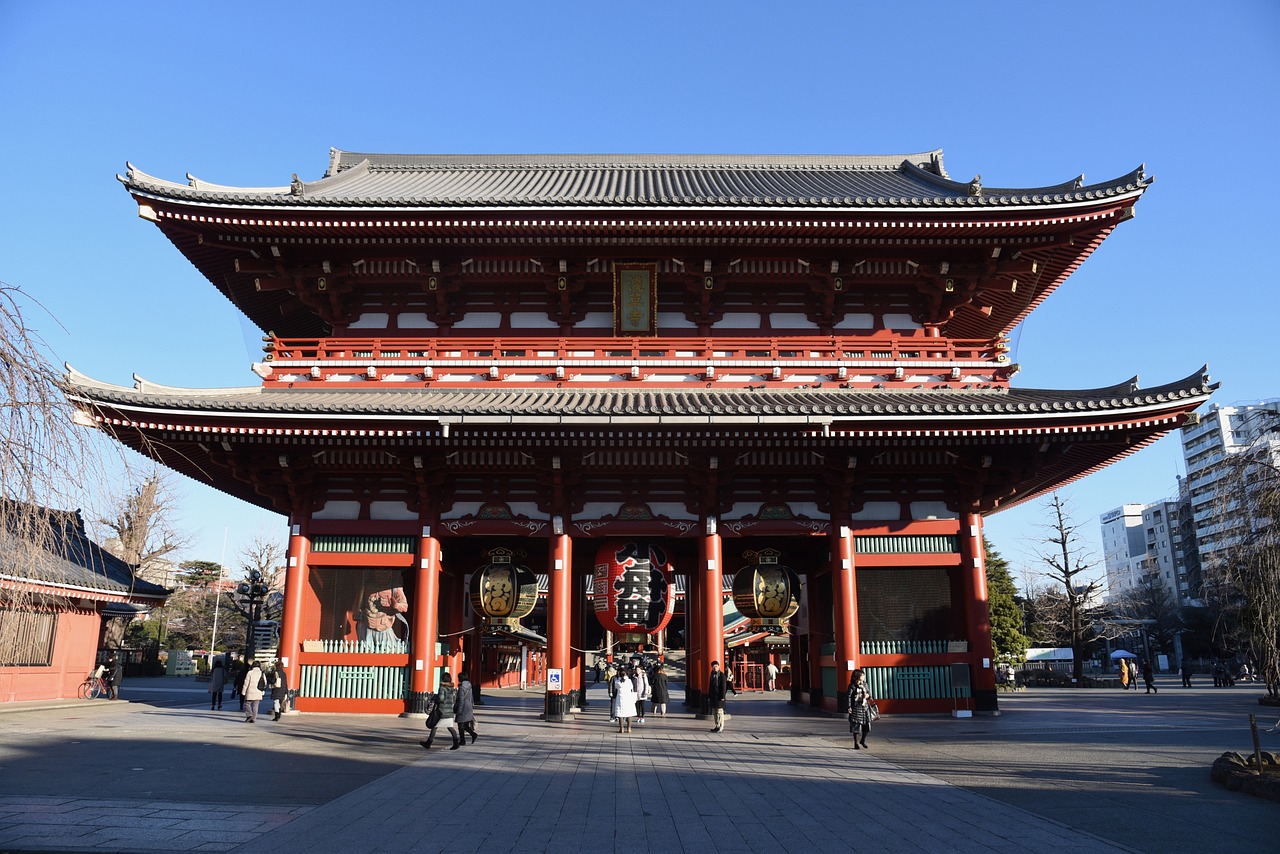
The relocation had already been ordered as the city expanded, and the Great Fire of Meireki in 1657 — one of the most devastating fires in Japanese history, which destroyed much of Edo — set it in motion. In the fire’s aftermath the quarter was rebuilt on a more remote spot in the rice fields north of Asakusa, near Senzoku. This rebuilt district became known as the Shin-Yoshiwara, or “New Yoshiwara” — and it is this Asakusa-adjacent location that would remain the Yoshiwara for the next three hundred years. From 1657 on, then, the Yoshiwara’s story has been bound up with the Asakusa area, the very neighborhood where Tokyo’s traditional entertainment culture still lives.
Where Was the Yoshiwara in Tokyo? Location Then and Now
Geography is one of the most common questions about the Yoshiwara, partly because the district moved once and partly because its modern footprint is easy to miss.
The original quarter stood near Nihonbashi (in the area of present-day Ningyōchō, in Chūō City). After 1657, the New Yoshiwara occupied the fields northeast of Sensō-ji temple, in what is now Senzoku, Taitō City — the same ward that contains Asakusa. The district was a roughly rectangular, walled enclosure surrounded by a moat (the Ohaguro-dobu), with a single main gate controlling all traffic in and out.
Today there is no walled quarter to visit, but the street grid of the old Yoshiwara is still legible in the modern neighborhood, and a handful of landmarks survive (more on those below). The area is quiet and residential now, which surprises many visitors who arrive expecting something dramatic.
How Far Is It from Asakusa Today?
The former Yoshiwara grounds sit only about 1.5 kilometers north of Sensō-ji — roughly a twenty-minute walk from central Asakusa, or a short taxi ride. That proximity is not a coincidence: when the quarter moved north in 1657, its new location placed it beside Asakusa, and the entertainment trades that grew up in the surrounding streets contributed to the development of the local hanamachi, the geisha district that still operates in Asakusa today. From Miyakodori — a teahouse in that very hanamachi — the former grounds are an easy walk north. In other words, you can stand in one of Tokyo’s last remaining geisha districts and reach the site of Japan’s most famous pleasure district on foot.
A History of the Yoshiwara — Rise, Rules, and the Edo Entertainment System
To understand the Yoshiwara is to understand that it was, above all, a system — a carefully ordered machine for hospitality, status, and spectacle. For 250 years it ran on rituals, ranks, and rules that touched everything from how a guest was introduced to how a courtesan walked down the street.
How the District Was Organized
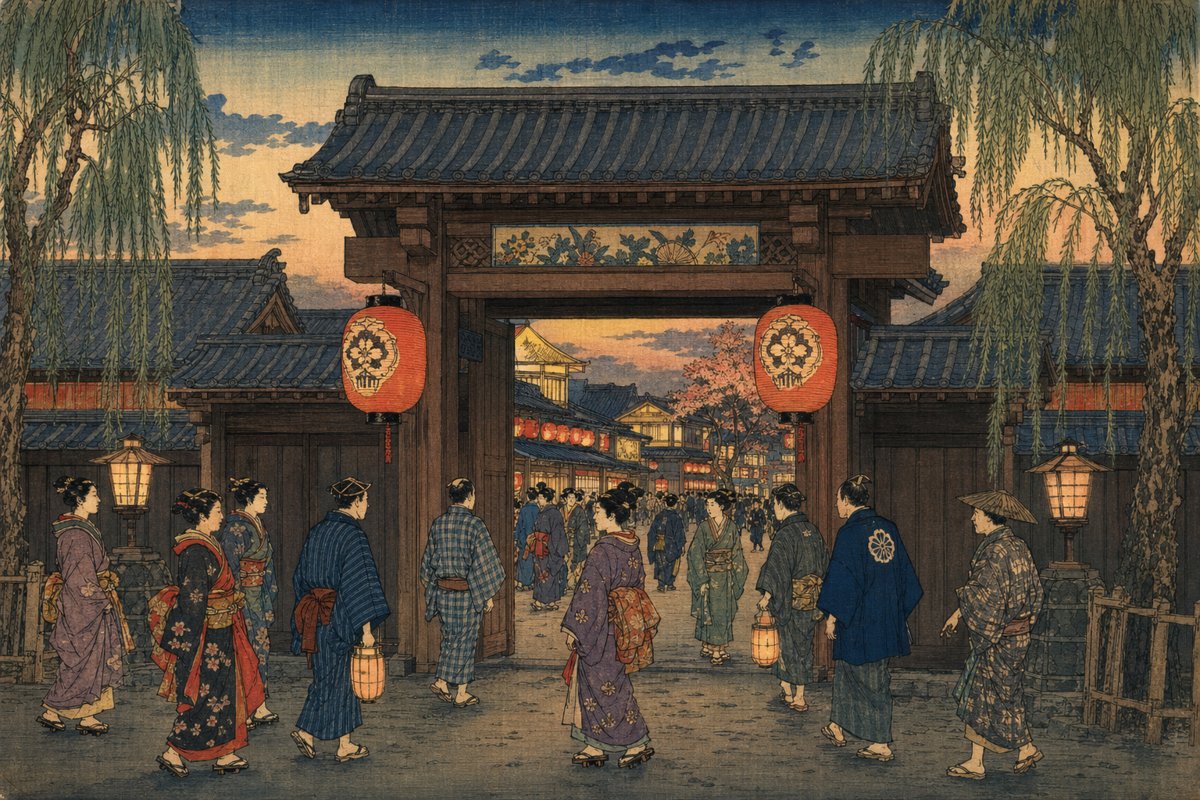
Entry to the New Yoshiwara was through the Ōmon, the great gate — the single official way in or out, which made the district easy to police and gave it the feel of a city within a city. Beyond the gate ran the Naka-no-chō, the central boulevard, lined with cherry trees in spring and lanterns at night, with side streets branching off into the working blocks.
A guest did not simply walk up to a courtesan. The quarter operated through intermediaries: hikite-jaya, the “introducing teahouses” that arranged meetings, vouched for guests, and managed the elaborate (and expensive) etiquette of a first encounter. They also settled the guest’s bill on his behalf — an early form of the tsuke credit the hanamachi still relies on. Higher up the hierarchy, in earlier centuries, banquet houses called ageya hosted the most exclusive courtesans for guests who could afford them. The women themselves were bound to the houses that managed their training, wardrobe, and contracts. The full hierarchy of courtesan ranks — from the legendary tayū of the early Yoshiwara, a top rank that later disappeared, down through the grades of oiran who became the quarter’s highest courtesans in later eras — is a world in itself; the key point here is that the Yoshiwara was stratified at every level, and that structure is what made it function.
The most spectacular expression of this system was the oiran-dōchū, the courtesan’s procession: a top-ranking oiran in full regalia, walking slowly on towering lacquered clogs, escorted by attendants and apprentices, on her way to a formal meeting with a guest at an ageya or teahouse. It was part fashion show, part public theater, and ordinary townspeople gathered to watch.
The Kenban and the Separation of Geisha from Oiran
Here is the part of the Yoshiwara’s history that is least understood outside Japan — and where it connects most directly to living tradition.
The Yoshiwara is where the line between courtesan and geisha was formally drawn — and this is where the firsthand knowledge of Okami Chikage sharpens what general histories tend to blur. Drawing on both her own years as a geisha and her study of the trade’s history, she frames the distinction with unusual clarity. In her telling, a courtesan sold companionship while a geisha sold art: the two were never the same profession — a line that was formally enforced and, to people at the time, rarely in doubt.
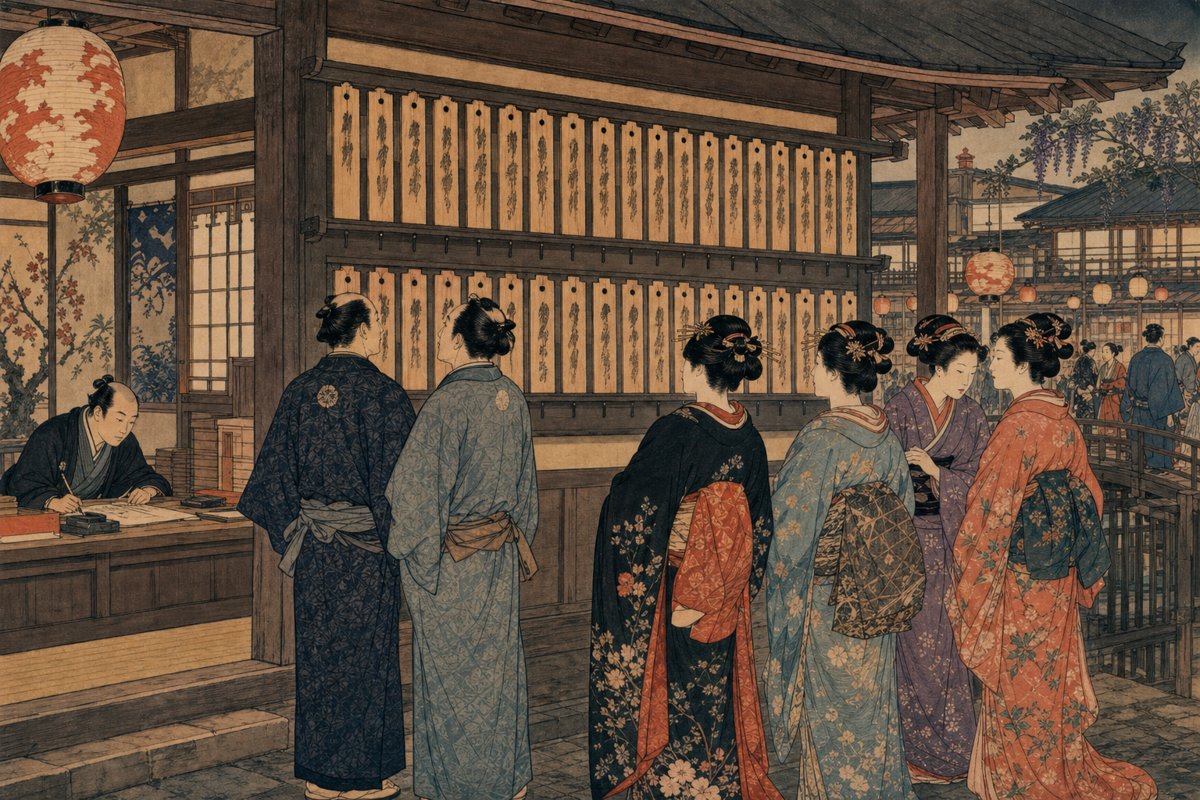
Courtesans were the older institution; geisha emerged later as a separate, specialized role. The pivotal moment came when the authorities officially recognized the geisha working in the Yoshiwara as a distinct profession. Around the same time, a registry office known as the kenban (見番) was established to organize and manage the recognized geisha — the institutional ancestor of the offices that still coordinate geisha districts in Japan today. Because the kenban kept the official register, it was also where the line between the two roles was recorded and kept clear. At the kenban, Okami Chikage explains, the courtesans’ names were posted on an upper board and the geisha’s on a lower one, so that anyone could see at a glance who was a performing artist and who was a courtesan.
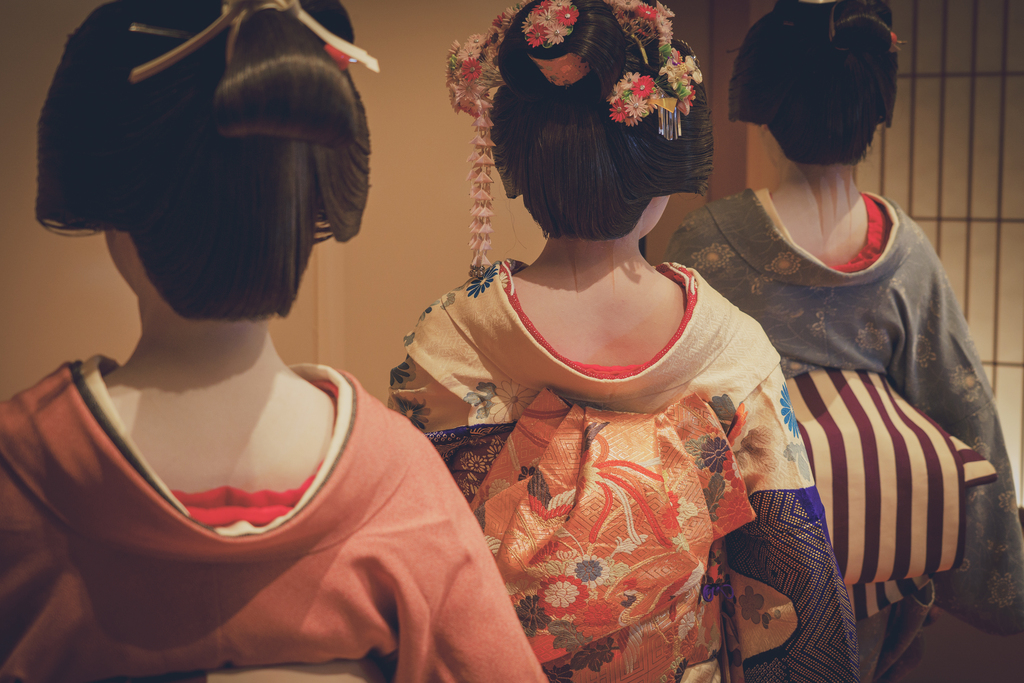
From that separation flowed a set of visual rules that made the distinction instantly readable on the street. The most famous: a geisha tied her obi (sash) at the back, while a courtesan tied hers in front. Small, clear signals like these meant no one needed to ask which profession a woman belonged to.
This matters for more than trivia. The kenban system — the registry that organized and managed the Yoshiwara’s geisha, and through its separate boards kept them clearly distinct from courtesans — is one of the institutional roots of Asakusa’s hanamachi — the geisha district that survives a short walk away. The careful, deliberate distinction between art and companionship that was institutionalized here is the same distinction that defines an authentic geisha experience in Tokyo today. (For how that culture developed beyond the pleasure quarter, see our overview of geisha culture in Japan, or our guide to karyukai and geisha terminology for the full vocabulary of titles and ranks.)
There is one more detail from this period worth keeping in mind, because it explains why geisha existed at all. In the Edo era, guests themselves were often accomplished amateurs — they played the shamisen, sang, and danced. Entertainment was participatory, closer to a refined version of what we might now call a sing-along, and a skilled geisha was the partner who could play, sing, and dance with the guests at the highest level. The better the artist, the more sought-after she became; the word geisha itself literally means “art person.” That demand for genuine artistic skill is what carried geisha culture forward long after the Yoshiwara closed.
Experience the Tradition the Kenban Shaped
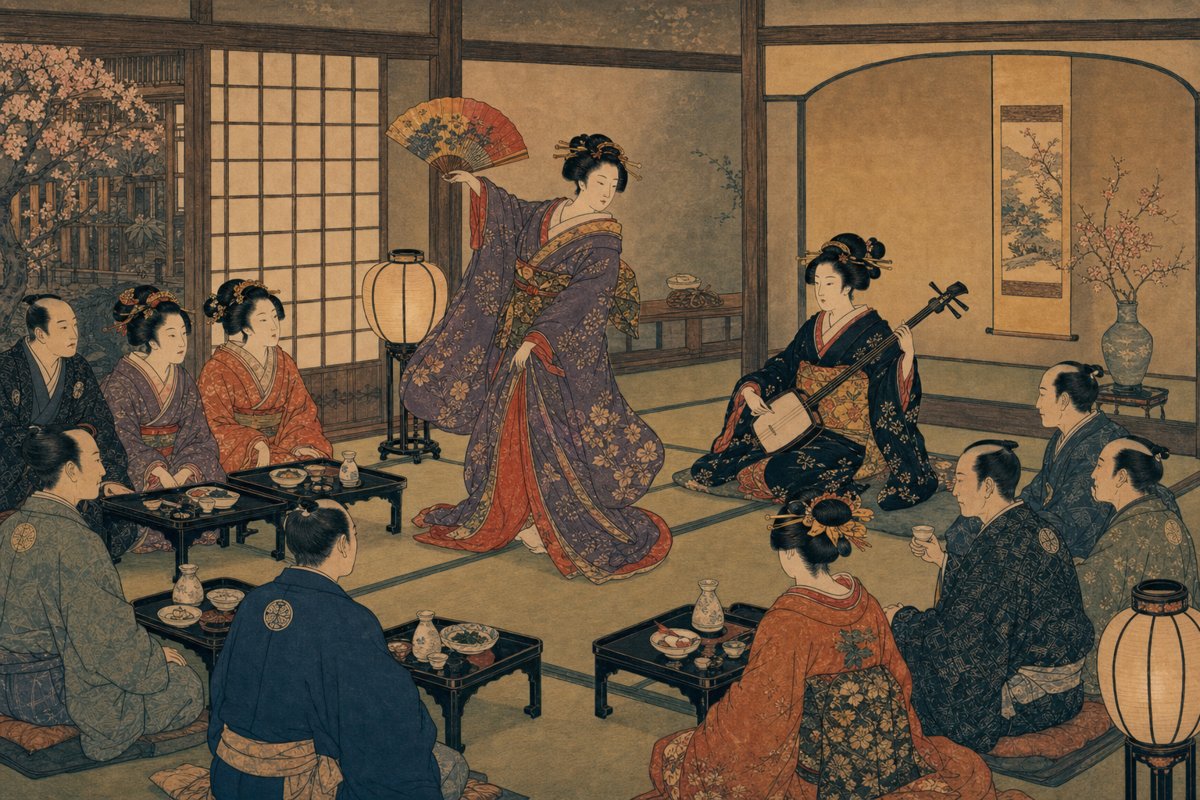
The kenban that registered and organized the Yoshiwara’s geisha — keeping them clearly distinct from courtesans — still coordinates Asakusa’s hanamachi today. At Miyakodori — one of Asakusa’s last machiai-chaya — you can book a private ozashiki (a private gathering with geisha) directly, with an English interpreter, no introduction required.
Request a ReservationThe Great Fires and the Survival of the Yoshiwara
The Yoshiwara burned down many times. The 1657 fire that prompted its move was only the first of several major blazes — the densely packed wooden quarter was perpetually vulnerable, and large fires struck repeatedly over the centuries, including a notable one in 1772. Each time, the district was rebuilt. Its resilience says something about its economic and cultural importance: the Yoshiwara was simply too central to Edo life to be allowed to disappear, and it endured fires, reforms, and changing fashions for over three hundred years before its eventual, deliberate end.
How the two were kept apart: the kenban office listed geisha and courtesans on separate boards, and the obi — tied at the back for one, at the front for the other — made the difference visible at a glance. English subtitles available.
The Women of the Yoshiwara — Oiran and the Pleasure District Hierarchy
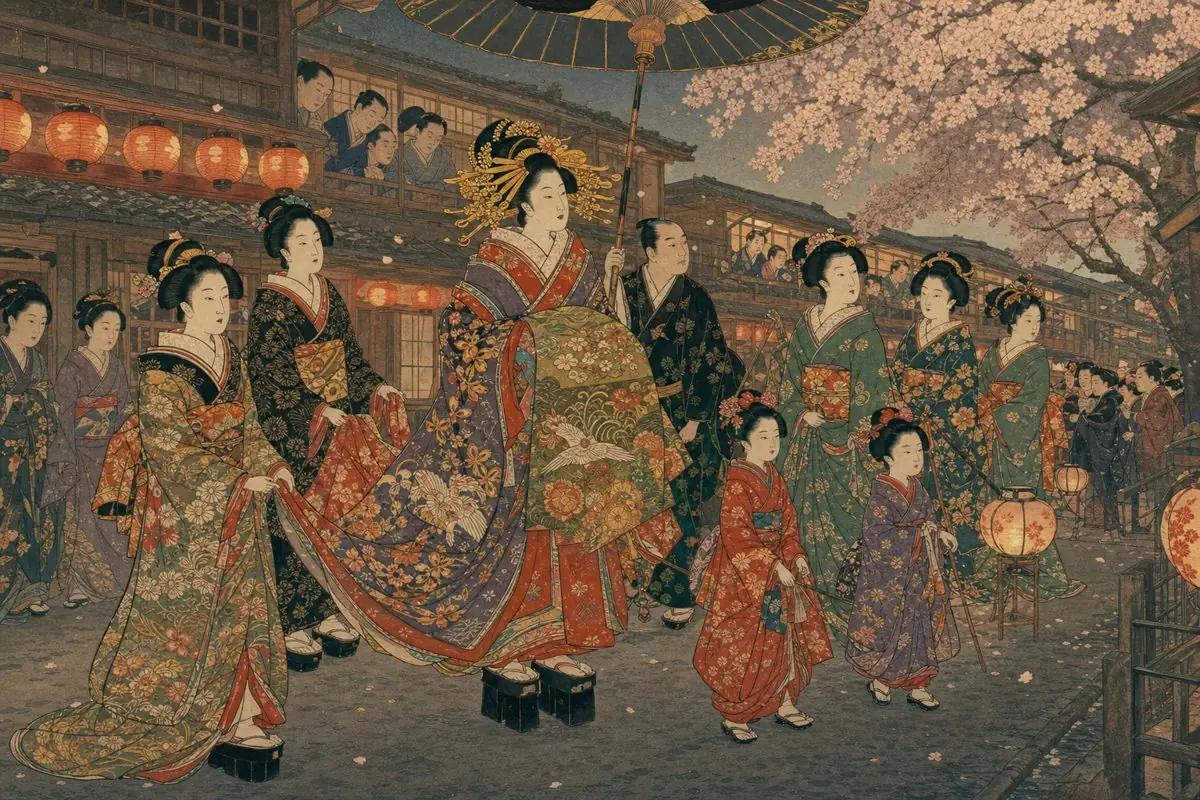
The Yoshiwara is inseparable from the women who lived and worked there. At the top stood the oiran, the elite courtesans whose names were known across Edo, and whose taste in kimono, hairstyles, and accessories set trends that spread far beyond the quarter walls. Below them was a wide hierarchy of ranks, each with its own etiquette, price, and degree of freedom.
Oiran: The Elite Courtesans of the Yoshiwara
The oiran were the most accomplished and expensive courtesans of the Yoshiwara — women trained from a young age in the classical arts as well as the social skills needed to entertain the wealthiest and most powerful men of the era. They were licensed courtesans who provided companionship that included intimate services, but to reduce them to that alone is to misunderstand their place in Edo culture: at their peak, the great oiran were celebrities, artists, and arbiters of fashion. Because their world is rich enough to deserve its own treatment, we’ve covered their ranks, training, daily life, and famous figures in full in our complete guide to the oiran.
The End of the Yoshiwara Licensed Quarter — 1958 and the Prostitution Prevention Law
The Yoshiwara operated continuously, in one form or another, from 1617 until the mid-twentieth century. Its end came not from fire or war but from law. Japan’s Prostitution Prevention Law (売春防止法), enacted in 1956 and brought into full effect in 1958, made licensed prostitution illegal nationwide. With that, the legal basis for the Yoshiwara as a pleasure quarter ended, and more than three centuries of licensed history formally closed.
It is important to be precise about what ended in 1958: the licensed quarter as a legal institution. The closure was a deliberate change in the law, not the slow fading of a tradition. And notably, the artistic profession that the Yoshiwara had helped define — the geisha — was never part of what the law abolished. Geisha were artists, registered through the kenban system as performers rather than courtesans, and their tradition continued. That is precisely why a genuine geisha culture still exists in Tokyo, while the pleasure quarter itself belongs to history.
What did not end. The quarter closed in 1958, but the hanamachi — a different institution with a different job — kept going. These are three Asakusa geisha leaving a tea house, filmed on an ordinary evening.
Yoshiwara Today — What Remains of the Historic District
Visitors who go looking for the Yoshiwara today often expect ruins or a museum. Instead they find an ordinary residential neighborhood in Senzoku, Taitō City. But for those who know what to look for, the past is still present in the street layout and in a few surviving landmarks.
Jōkan-ji — The Temple That Remembers the Yoshiwara’s Women
Not every woman who lived in the Yoshiwara left it. Those who died in poverty or without family were often interred at Jōkan-ji, a temple north of the quarter that became known as the Nagekomi-dera — the “throw-in temple” — a stark name reflecting how the remains of the forgotten were brought there. Today Jōkan-ji stands as a quiet memorial to the thousands of Yoshiwara women whose names history did not record, and it is one of the most moving sites connected to the district. Visiting it is a reminder that behind the glamour of the oiran processions were real lives, many of them hard.
Yoshiwara Benten Shrine and Walking the Former Grounds
At the former Yoshiwara grounds, the small Yoshiwara Benten shrine survives, associated today with a memorial to the women who died in the great Kantō Earthquake of 1923, when many in the quarter perished. Walking the former site is the best way to feel the Yoshiwara’s scale: you can still trace the line of the old Naka-no-chō boulevard and the rough rectangle of the walled district. There is little signage and no crowd — which, for many travelers interested in the real history beneath the legend, is exactly the appeal.
The Yoshiwara’s Legacy in Japanese Culture
Few places have left a deeper mark on Japanese art than the Yoshiwara. The quarter was a great subject of ukiyo-e, the woodblock prints of the “floating world”: masters like Kitagawa Utamaro became celebrated for their bijin-ga portraits of beautiful women, the courtesans of the Yoshiwara prominent among them, and the prints carried the district’s fashions and faces across Japan and, eventually, to the West. The Yoshiwara also fed kabuki theater and Edo literature, supplying plots, characters, and a whole vocabulary of style and desire.
In recent years a new generation has encountered the name through popular culture — most prominently the “Entertainment District” arc of the anime Demon Slayer, which is set in a fictionalized Yoshiwara. If that is what brought you here, the real district has a story no adaptation captures: the Yoshiwara was not just a glamorous backdrop but the engine of Edo’s entire entertainment culture, and the place where the line between geisha and courtesans was institutionalized through the kenban system. That formal separation is one reason authentic geisha still perform in Asakusa today, a short walk from the district the anime reimagines.
The living half of that legacy. The arts the section above traces — dance, shamisen, the banquet room itself — are still performed. Here a geisha dances with a fan while the jikata plays behind her.
Frequently Asked Questions About the Yoshiwara
- Where is the Yoshiwara today?
- The former Yoshiwara is located in Senzoku, Taitō City, in northern Tokyo — about 1.5 kilometers (a roughly twenty-minute walk) north of Sensō-ji temple in Asakusa. There is no walled quarter to visit today; the area is a quiet residential neighborhood, though a few historic landmarks survive.
- Does the Yoshiwara still exist?
- Not as a pleasure quarter. The Yoshiwara operated from 1617 until Japan’s Prostitution Prevention Law took full effect in 1958, which ended licensed prostitution and closed the district as a legal institution. The neighborhood still exists, and sites like Jōkan-ji temple and Yoshiwara Benten shrine remain.
- What was the difference between an oiran and a geisha?
- An oiran was a high-ranking licensed courtesan who provided companionship, including intimate services. A geisha was — and is — a professional artist trained in dance, music, and refined entertainment, formally regulated as a performer and distinct from a courtesan. The two roles were kept distinct in the Yoshiwara through the kenban registry system, and even their dress differed: a geisha tied her obi at the back, a courtesan at the front.
- Who decided that geisha and courtesans were different professions?
- The separation was made official when Edo authorities formally recognized the geisha of the Yoshiwara as a distinct profession. A registry office called the kenban was created to register and manage the geisha — by Okami Chikage’s account, courtesans and geisha were listed on separate boards — and that same kenban system still coordinates geisha districts in Japan today, including the hanamachi in Asakusa.
- Why did the Yoshiwara move to Asakusa?
- A relocation had already been ordered as Edo expanded, and the Great Fire of Meireki in 1657 — which destroyed the original quarter near Nihonbashi — set it in motion. Authorities rebuilt the quarter in the fields north of Asakusa, where it remained as the “New Yoshiwara” for the next three centuries.
- Can you visit the site of the Yoshiwara now?
- Yes. While nothing of the walled quarter remains, you can walk the former grounds in Senzoku, follow the line of the old central boulevard, and visit Jōkan-ji (the temple memorializing the district’s women) and the Yoshiwara Benten shrine. It pairs naturally with a visit to Asakusa, which is a short walk south.
- When was the Yoshiwara licensed quarter abolished?
- The Yoshiwara operated as a licensed quarter from 1617 until Japan’s Prostitution Prevention Law (売春防止法) was enacted in 1956 and took full effect in 1958, abolishing licensed prostitution nationwide and formally closing the Yoshiwara as a legal institution. The geisha tradition the district helped establish was registered separately, through the kenban system, and was never part of what the law abolished — which is why authentic geisha culture continues in Asakusa today.
Experience the Living Tradition the Yoshiwara Helped Create
The Yoshiwara closed in 1958, but the culture it helped shape did not. The careful line it drew between art and companionship — formalized in the kenban system right here in the Asakusa area — is the same distinction that defines an authentic geisha experience today. And that tradition is still alive in Asakusa, just a short walk from the old quarter, where Miyakodori carries it forward.
Founded in 1950, Miyakodori is among the last machiai-chaya (traditional teahouses) in Asakusa — and one where international guests can book a genuine geisha banquet directly, without an introduction. In a private tatami room, you can watch real Asakusa geisha perform classical dance and shamisen, share a seasonal meal, and take part in the same kind of artful, participatory entertainment that geisha have offered for centuries — with an English interpreter present throughout.
If the history of the Yoshiwara has drawn you to the real culture behind the legend, an evening with Miyakodori is one of the most direct ways to experience its living descendant.
Reserve a Private Geisha Banquet in Asakusa
For the district that outlived the Yoshiwara, our Asakusa geisha encyclopedia covers the geisha working there now — what they train in, how an engagement is arranged, and what the kenban actually does.
Join us for an authentic ozashiki (a private gathering with geisha) at Miyakodori — the living tradition the Yoshiwara helped create. Book directly online. English interpreter included in every session.
Request a ReservationYou can also explore the world the Yoshiwara left behind in our guides to the oiran courtesans, the history of geisha in Tokyo, and the Asakusa geisha district that the kenban system helped create.


- Konpira Fune Fune Lyrics and How to Play the Geisha Drinking Game
- Geisha Restaurant Near Me in Tokyo: Authentic Ozashiki at Miyakodori Asakusa
Winter Asakusa Gourmet: Food Stalls & Lunches to Warm You Up
Asakusa’s Recommended Events & Festivals in September
Ozashiki Games: A Complete Catalog & Rules
The Ultimate Guide to the Ozashiki Party: Unlocking the Secrets of Traditional Japanese Entertainment in Tokyo
Authentic Geisha Outfit Guide: Traditional Japan Costume Arts

Your Complete Guide to a Kimono Day in Asakusa: Makeup, Spots & Seasonal Tips
Comment ( 0 )
Trackbacks are closed.
No comments yet.