



Asakusa Miyakodori · Est. 1950
A Private Ozashiki
with Geisha
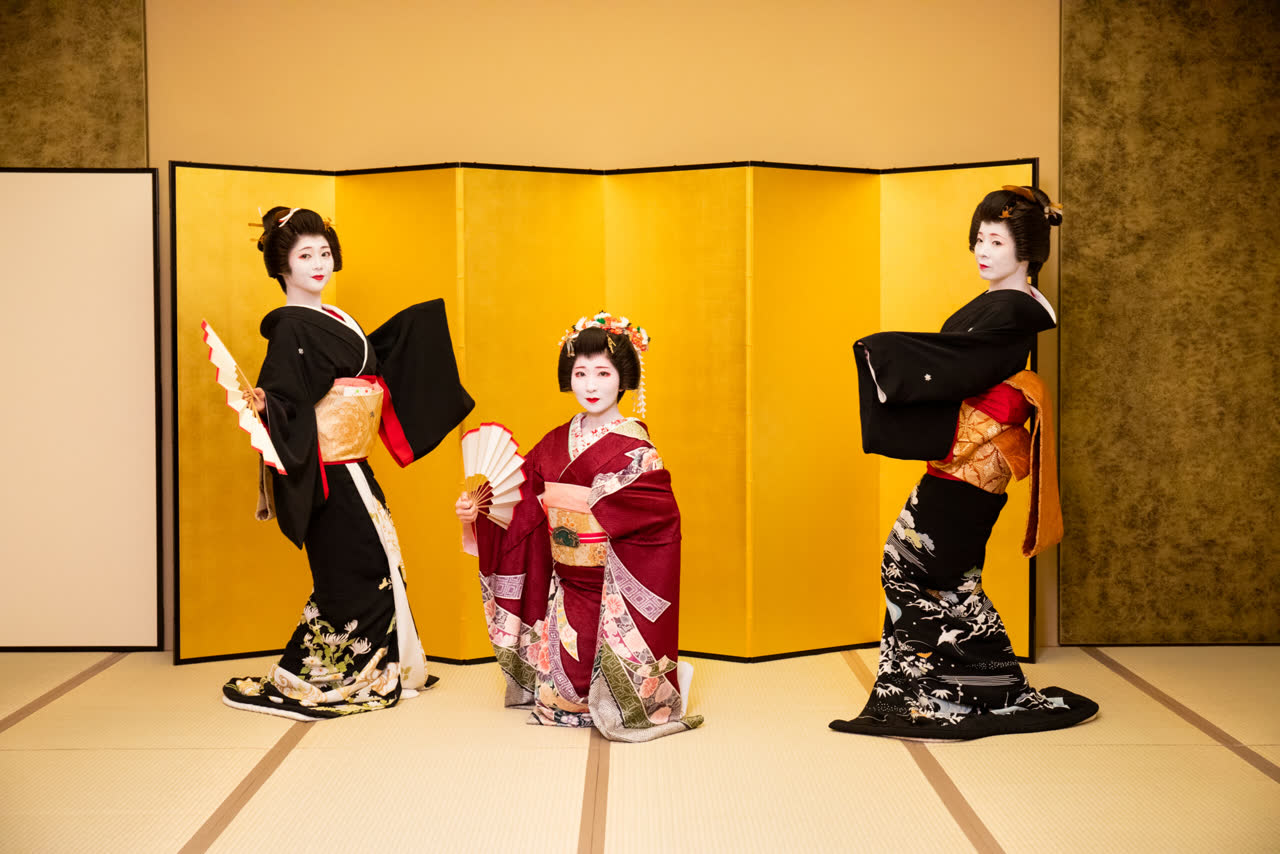
At Miyakodori in Tokyo, you can spend an afternoon or evening in a private tatami room, watching a centuries-old dance performed just meters away and playing traditional games that have entertained for generations.
An ozashiki at Miyakodori is a private geisha banquet in a traditional tatami room in Asakusa, Tokyo — featuring dance, shamisen, games, and conversation with working geisha. No introduction required. From ¥34,000/person.
Last updated September 26, 2026
Perfect for first-time visitors to Japan, special celebrations, and evenings with friends or family.
From JPY 34,000/person · 1-Hour, 2-Hour & 3-Hour Plans
At a Glance
The Experience
What Is an Ozashiki?
An ozashiki (geisha banquet) is a private evening with geisha in a traditional tatami room. The geisha perform, play games, and converse directly with you in a small gathering, rather than presenting a stage show or a tourist attraction.
For centuries, this experience required a personal introduction from an existing patron. Miyakodori changed that. As the only machiai-chaya in Asakusa, we opened the door to guests arriving without one — and today international visitors can book a private ozashiki directly online.
in Asakusa Today
— Okami Chikage
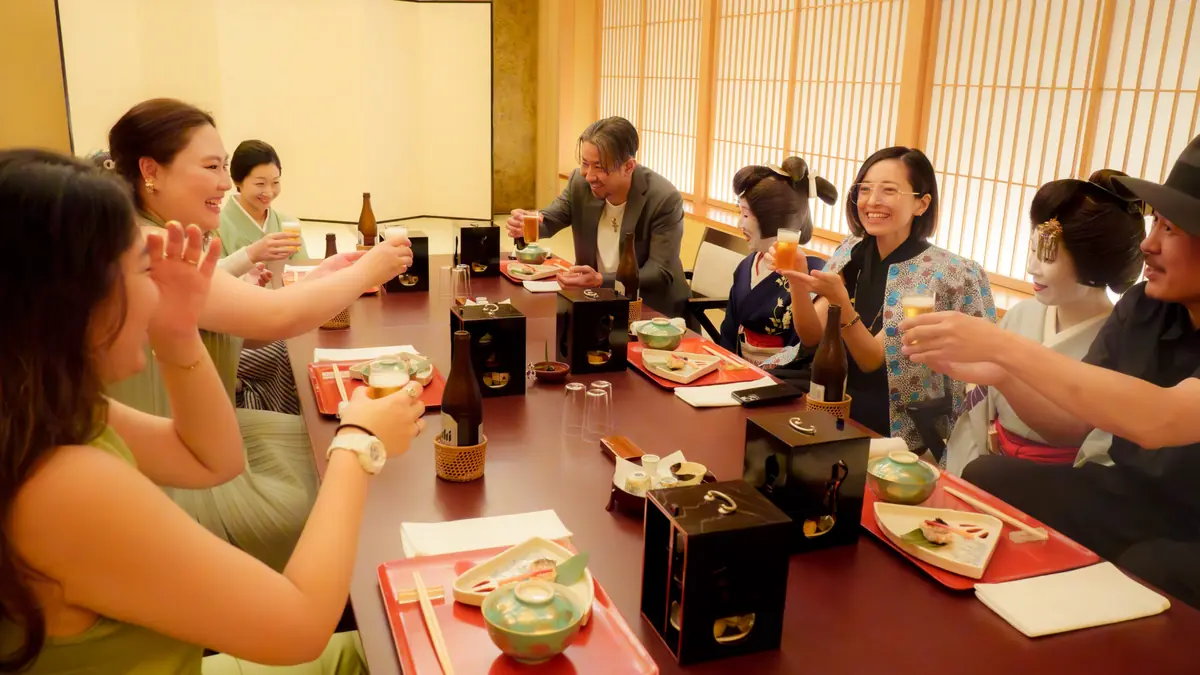
Real guests at a recent ozashiki (geisha banquet) evening at Miyakodori
Your Evening in Three Words
Watch. Play. Talk.
Every ozashiki (geisha banquet) evening at Miyakodori is built around three things.
Watch
Traditional Dance
A classical Japanese dance performed just for you — not on a distant stage, but right in front of you, to live shamisen music.
Play
Ozashiki Games
Centuries-old parlour games with the geisha. No rules to memorize — before you know it, the whole room is laughing.
Talk
Conversation
Speak directly with real geisha through an English interpreter. Ask anything — their training, daily life, the art itself.
Step by Step
Your Evening at Miyakodori
From the moment you arrive until the final farewell, the geisha are by your side. No preparation needed — just come as you are.
Welcome
Remove your shoes at the entrance and step into your private tatami room. Miyakodori has an elevator, and our staff will gladly assist with the few steps at the entrance. If you use a wheelchair or have limited mobility, please contact us before booking.
Elevator available · Staff assistance for entrance steps
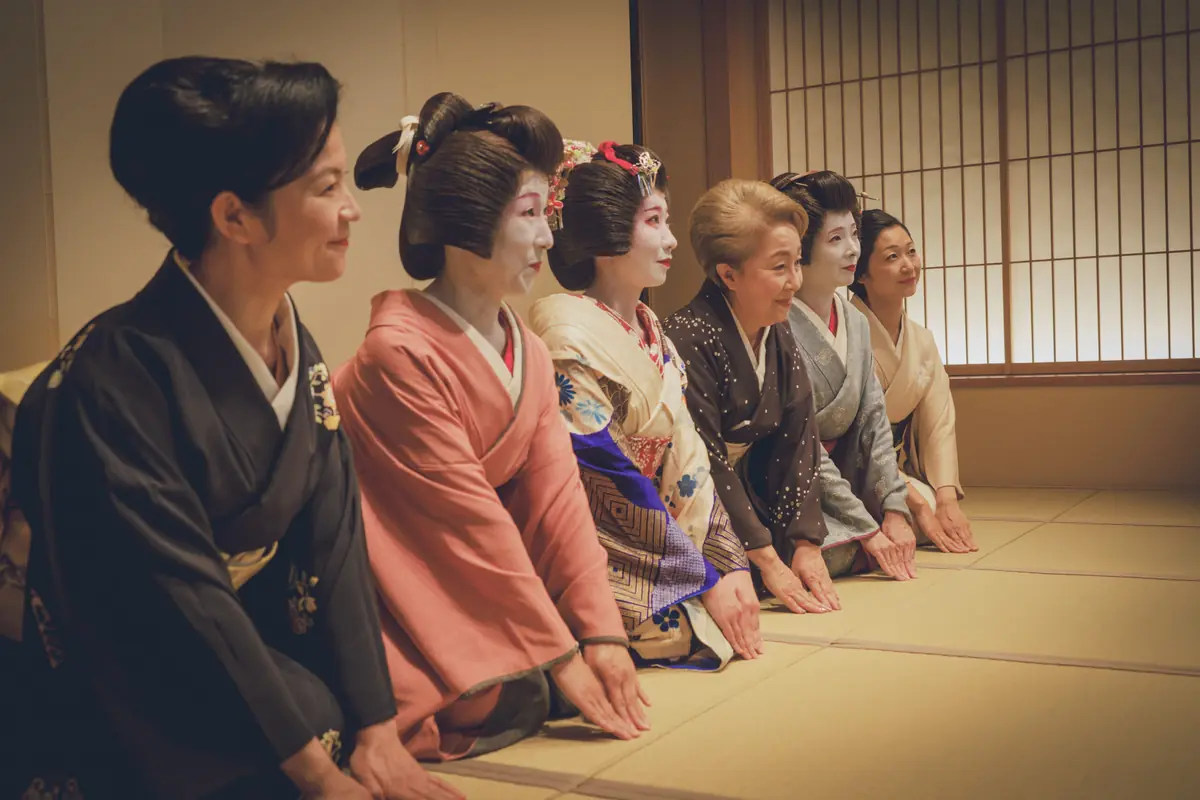
Welcome by the Okami and Geisha
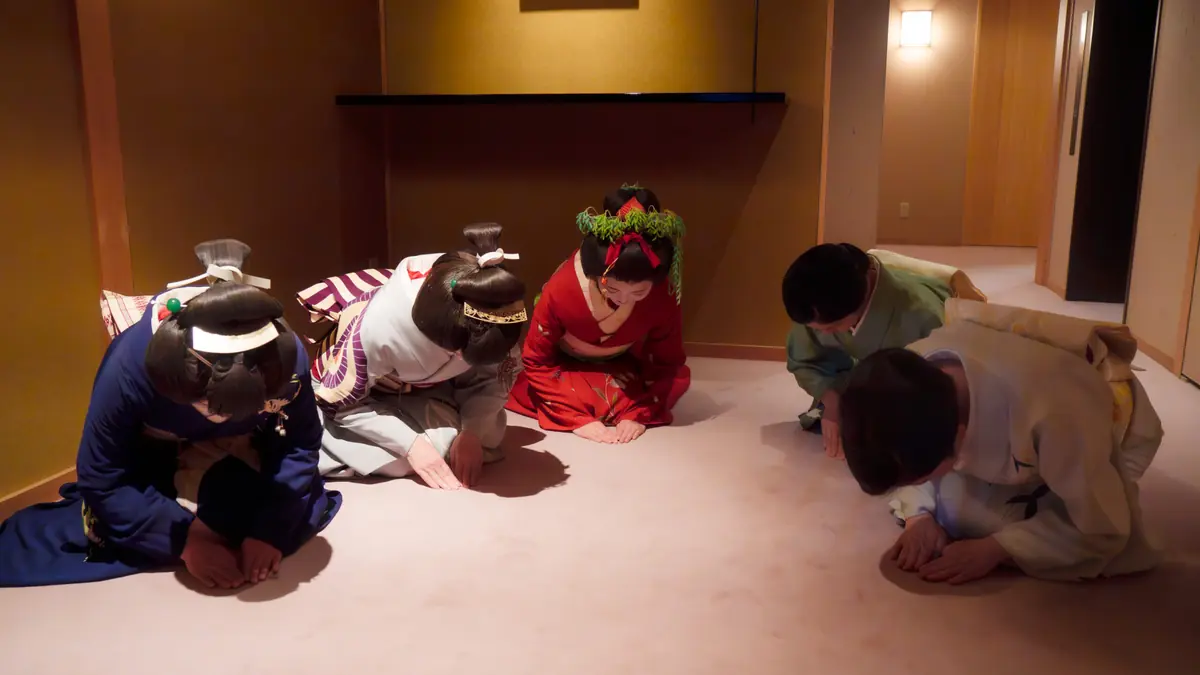
The okami (proprietress) greets you first to begin your evening. The geisha then enter your room, dressed in formal kimono, introduce themselves, and pour your first drink. The atmosphere shifts — your ozashiki (geisha banquet) has begun.
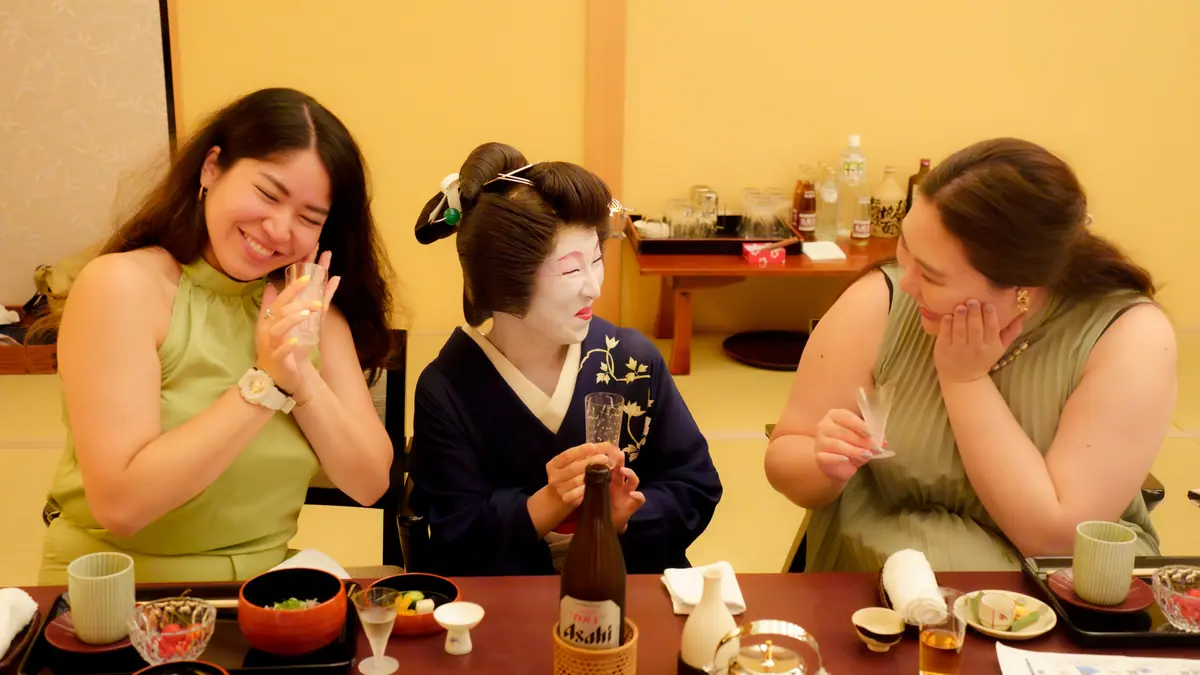
Traditional Dance
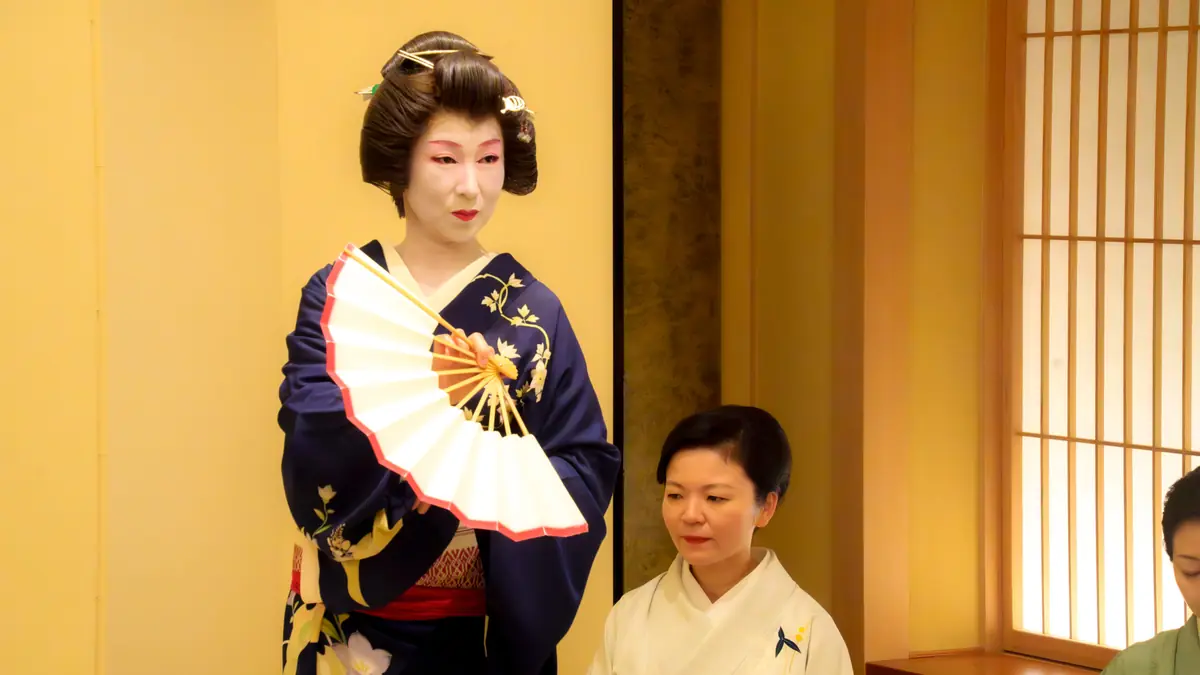
A geisha performs a classical Japanese dance right in front of you to live shamisen music, rather than on a distant stage. You can see each precise movement and hear the strings sounding through the room.
Live shamisen · Traditional singing · Up close
Ozashiki Games
Games are a main part of the evening. You’ll play centuries-old games with the geisha, including fast-paced reflex challenges, full-body rock-paper-scissors, and fan-tossing. The geisha teach you everything, and the games get everyone laughing together.
No rules to memorize · All ages welcome
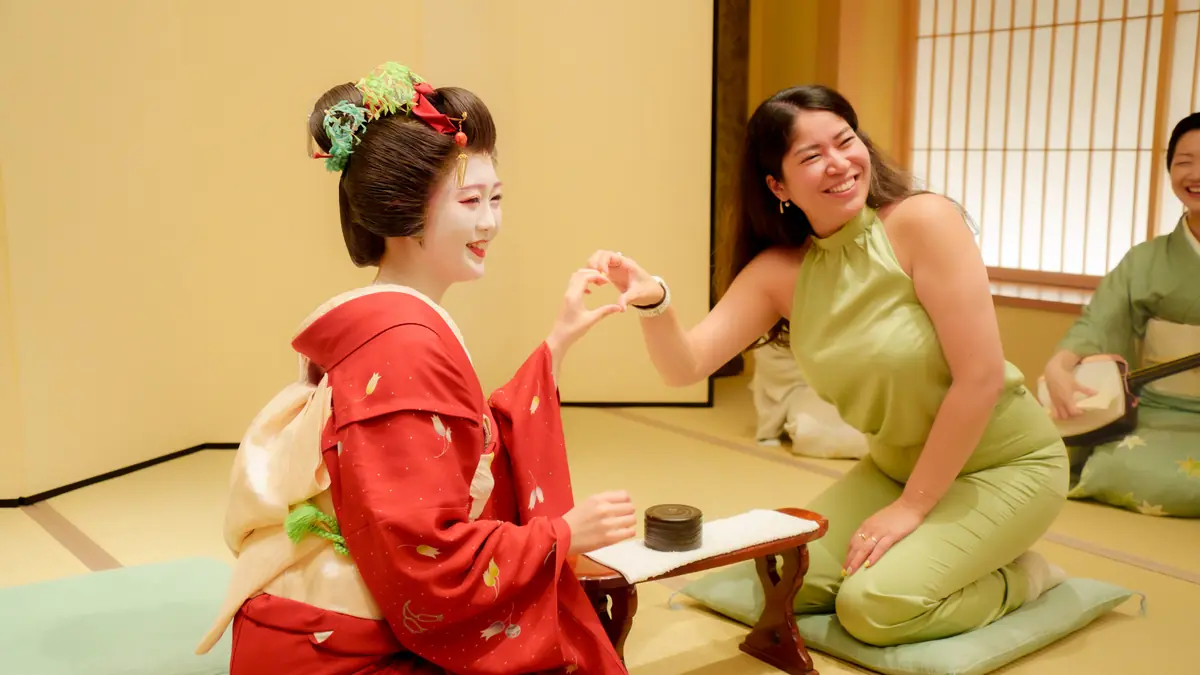
Conversation
Speak freely with the geisha through an English interpreter. You can ask about their years of training and daily life, or about the history behind their art.
English interpreter always present
Farewell
The evening ends with tejime, a traditional clapping ceremony, followed by a photo session with the geisha. You then return to the Asakusa night with photographs to remember your visit to Japan.
Interactive
The Games of Ozashiki
Ozashiki games are centuries-old parlour games meant to help guests get to know one another and laugh together. You don’t need prior knowledge: the geisha teach you every rule, and playing gives you stories to tell afterward.
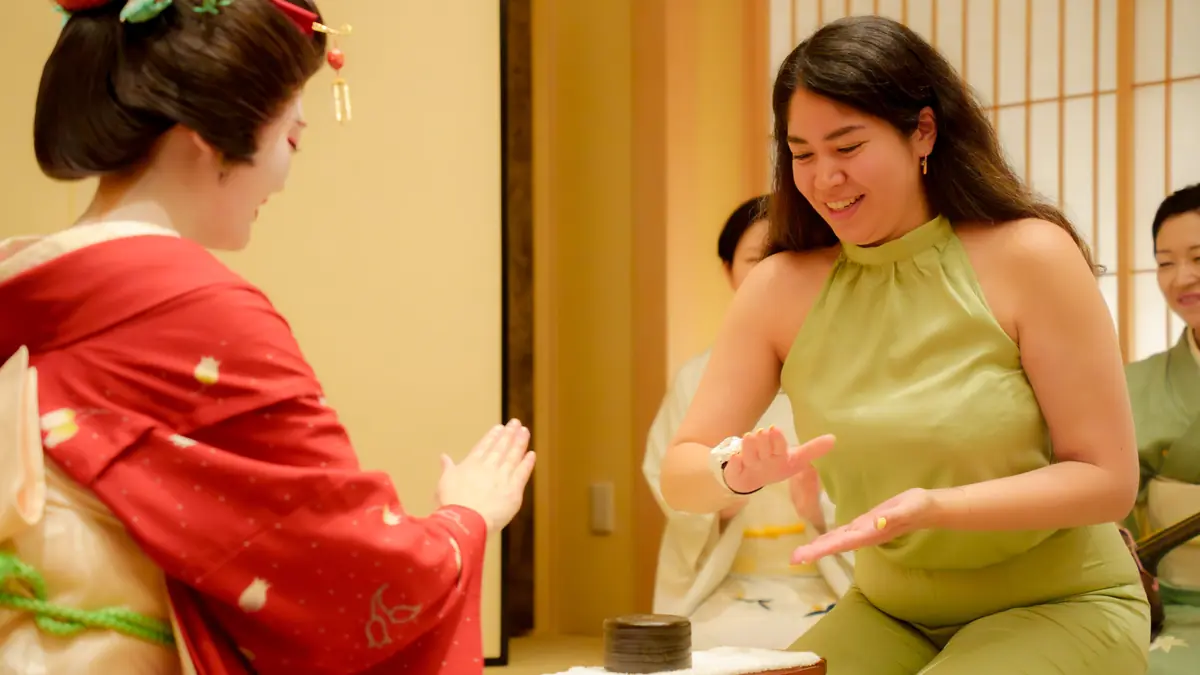
Game 01
Konpira Fune Fune
A reflexes duel set to shamisen rhythm. You and a geisha take turns reaching for the hakama, a small wooden piece set on a kyōsoku armrest — miss the beat and you lose the round. As the tempo rises, so does the tension.
Watch on TikTok →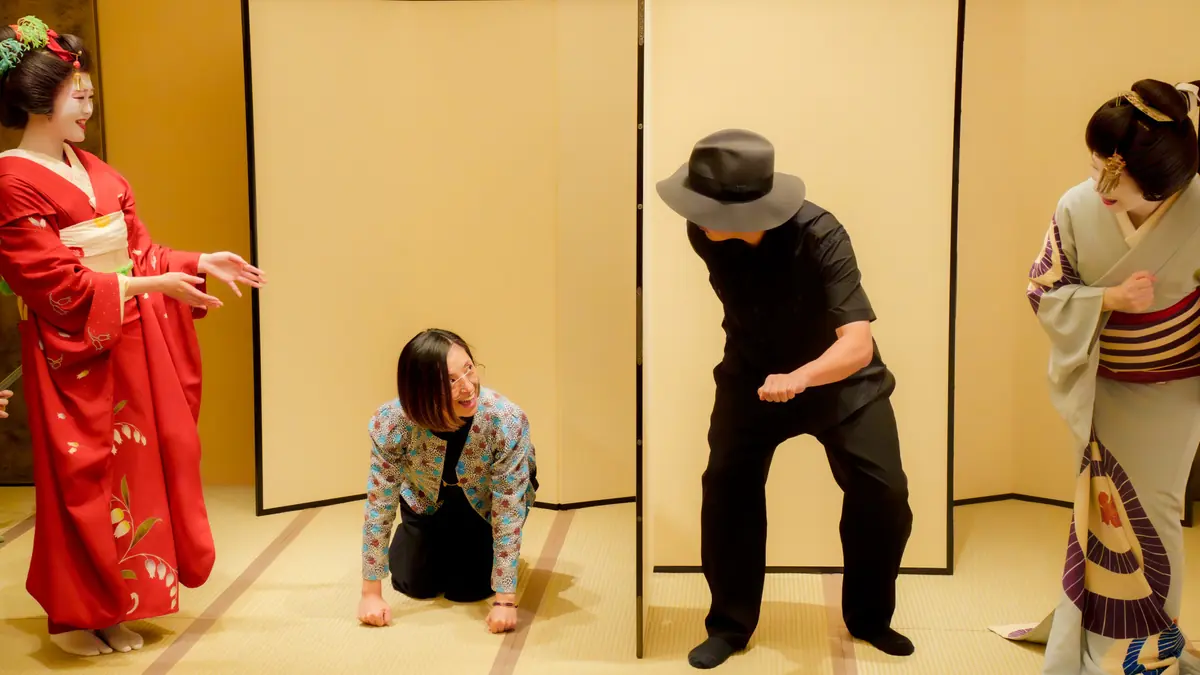
Game 02
Tora Tora
Full-body rock-paper-scissors. Hidden behind a screen, you and the geisha each strike a pose — tiger, warrior, or old woman — then reveal simultaneously. The moment you see each other, someone has won, and usually someone is laughing.
Watch on TikTok →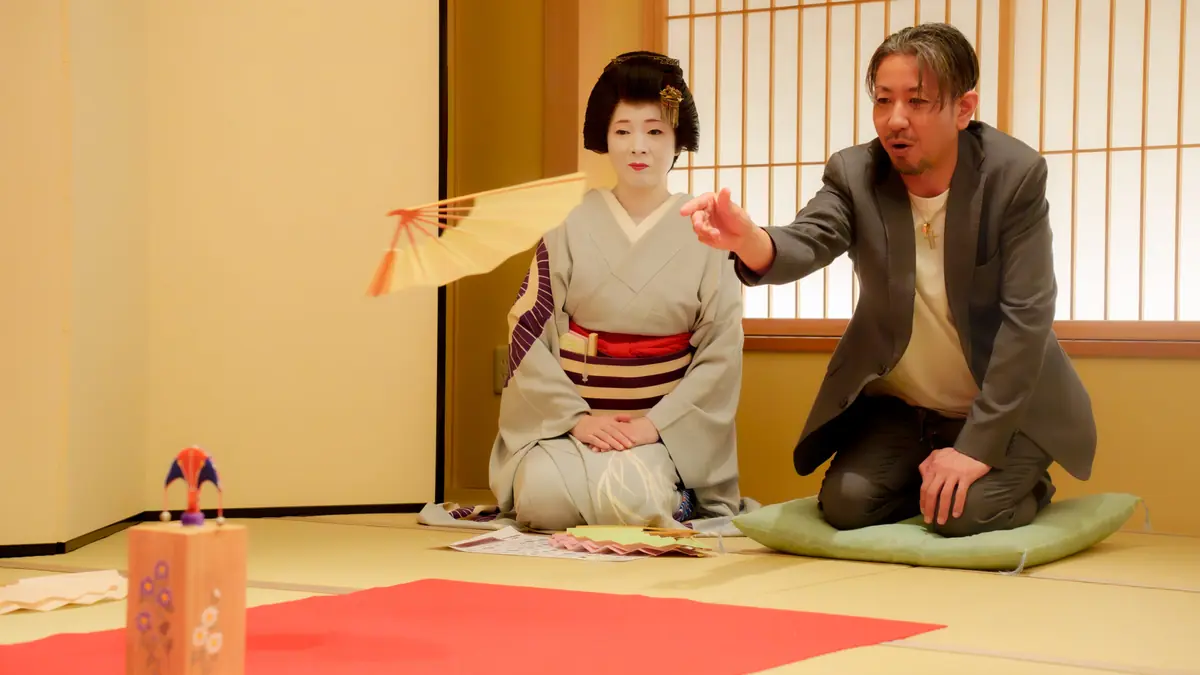
Game 03
Tōsenkyō
The elegant one. Toss a folding fan at a delicate target and score points based on how it lands — rooted in Edo-period parlour culture, the fan almost never lands the way you expect.
These are just a few of the games available. The geisha choose the best ones for your group on the evening.
The Geisha Arrangement
How Many Geisha?
The number of geisha affects both the size and the atmosphere of the evening.
Two Geisha — Intimate
The most personal arrangement: one geisha dances while the other plays the shamisen and sings. Preferred by couples and small parties.
Three Geisha — Balanced
One geisha on shamisen and song, two dancing — the standard for groups seeking the full ozashiki rhythm.
Five or More Geisha
With five geisha, the evening can include one dedicated singer, one shamisen player, and three dancers.
We recommend this arrangement for guests seeking the fullest experience of geisha entertainment.
Each additional geisha: +JPY 45,000 (1-hour plan, daytime seats), +JPY 60,000 (1-hour plan, evening seats, and the 2-hour plan), or +JPY 75,000 (3-hour plan) — added to total. The first geisha you add is JPY 10,000 less than these rates, and an ensemble of five or seven geisha in total is a further JPY 20,000 or JPY 30,000 less.
A Shared Tradition
The Pouring Culture
At an ozashiki, guests take part as well as watch the performances. Pouring sake or beer for the geisha, as they pour for you, is part of the tradition and helps start conversations. By the second round, most guests pour for one another less formally.
Dining at the Ozashiki
A Traditional Geisha Dinner in Tokyo
An ozashiki is a traditional private geisha dinner in Tokyo. Guests share an evening of kaiseki cuisine, dance, shamisen, ozashiki games, and conversation with geisha, rather than watching a stage show over a meal. At Asakusa Miyakodori, registered Asakusa geisha host the banquet in a working machiai-chaya (geisha teahouse), the kind of setting where Tokyo guests have been entertained for generations.
For the complete dinner experience, the 3-hour plan includes a full kaiseki course and free-flow drinks; with the 1-hour and 2-hour plans, which focus on the performance and the games, a seasonal kaiseki dinner can be added. Planning your first time? Our complete guide to the geisha dinner experience walks you through the whole evening, from booking to farewell.
Choose Your Ozashiki Plan
Now that you know what an ozashiki (geisha banquet) evening looks like, choose the plan that fits yours.
1 Hour
Geisha Highlights
From JPY 34,000/person
Dance · Games · Photo session
Most Popular
2 Hours
Geisha Elegance
From JPY 45,000/person
Dance · Games · Conversation · Free-flow drinks
3 Hours
Twilight Gathering
From JPY 106,000/person
Full evening · Kaiseki dinner · Free-flow drinks
Five-or-more geisha arrangement available — see Pricing for details.
Request a Reservation View Full Pricing & PlansSend request → We arrange the geisha → Booking confirmed by reply
What Sets Us Apart
Only at Miyakodori
Taiko-mochi — A Living Rarity
Miyakodori is home to a taiko-mochi — a male entertainer in the geisha world, a rare traditional role preserved in Asakusa and found almost nowhere else in Japan today. Active taiko-mochi exist only within Asakusa’s Hakuyukai guild. Six are currently registered with the Asakusa kenban. Read more →
Okami Chikage — Five Decades in the Geisha Arts
Born into a family of performers — her mother a geisha, her grandfather a shinpa actor — Okami (proprietress) Chikage began training in classical Japanese dance and traditional music from the age of five. She entered the geisha world at 15 as a hangyoku (young geisha) — already a geisha, still in training — advanced to full geisha (ippon) at 18 through the ippon-hirome ceremony, and over the following 27 years (ages 15 to 42) performed Japanese classical dance at major stages including the Kabukiza, the National Theatre, and the Meijiza. At age forty-two she became proprietress of Miyakodori. She holds a master instructor’s license (shihandai) in the Hanayagi school of Japanese traditional dance — the central school of the Asakusa flower district.
Any Dietary Need, Handled with Care
As a machiai-chaya (geisha teahouse), Miyakodori sources cuisine from trusted partner restaurants rather than cooking in-house — meaning many dietary needs, including vegan, halal, and gluten-free requests, can be accommodated with advance notice.
English Interpreter, Always
Every booking includes a dedicated English interpreter who helps you speak directly with the geisha about their training and art, or ask about their daily lives.
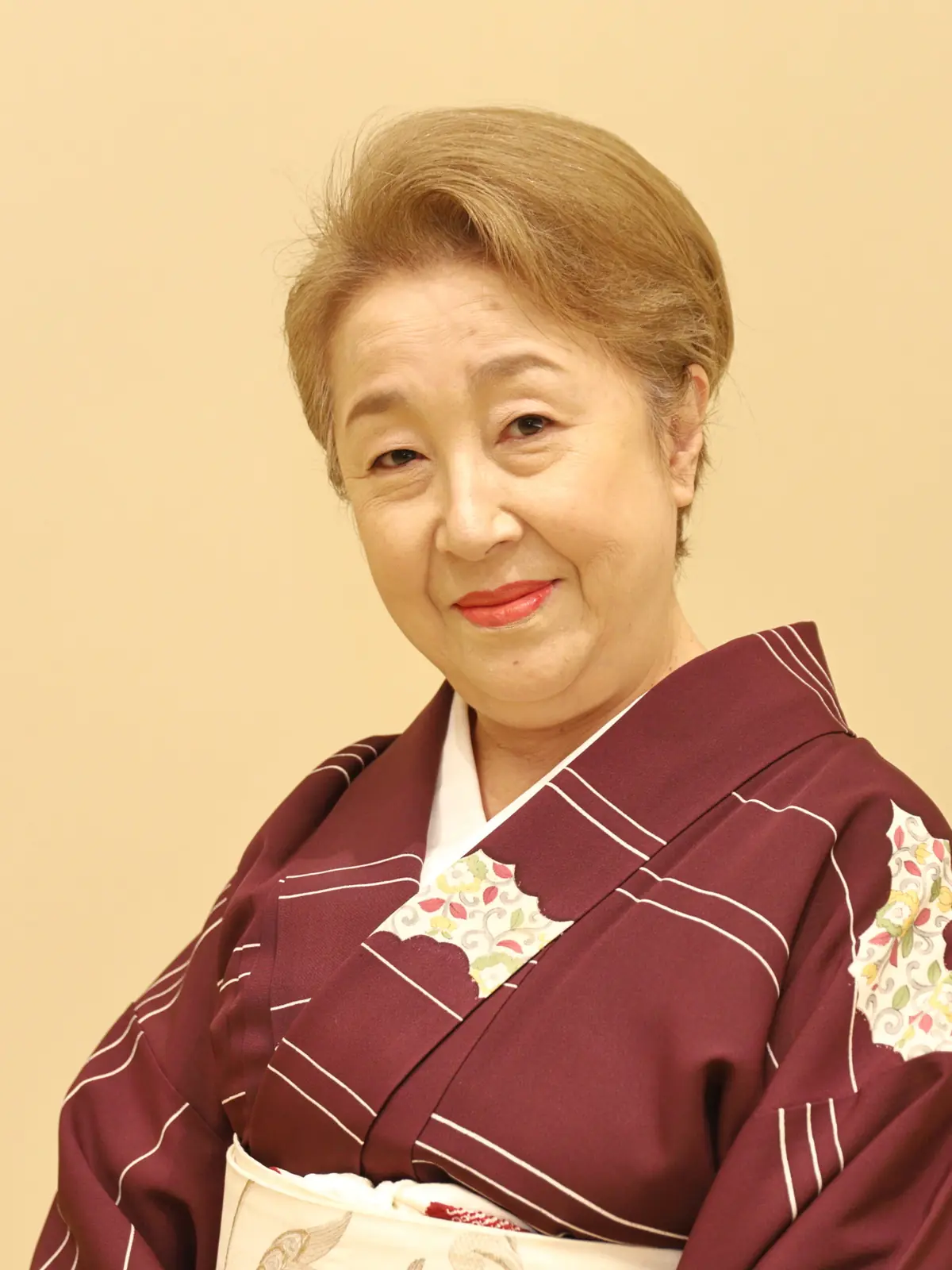
Meet the Okami
Okami Chikage
Five decades in the geisha arts. Master instructor (shihandai) of the Hanayagi school — the central school of the Asakusa flower district.
Before You Book
Things to Know
The answers to the questions most first-time guests ask — open any question for the details.
What should I wear?
There is no formal dress code — casual clothes are perfectly fine. Shoes come off at the entrance, so socks are required for the tatami rooms. Wearing a rented kimono? Even better — many guests love the full atmosphere.
Wear Socks
Shoes come off at the entrance.
No Dress Code
Casual clothes are perfectly fine.
Kimono Welcome
Many guests love the full atmosphere.
Can I bring my children, and can we take photos?
Kids are welcome — the geisha are wonderful with young guests and adapt the evening naturally. For pricing, guests aged 13 and over are charged the full per-person rate, children aged 4 to 12 are charged half price, and infants aged 0 to 3 join free of charge. Capture everything: photos, videos, and social media sharing are all encouraged throughout the evening.
Do I need to know any etiquette or customs?
No. You don’t need to know any rules or customs. The geisha guide you naturally throughout the evening — from the games to the flow of the room.
Do I need an introduction to book?
For centuries, ozashiki required a personal introduction from an existing patron — a custom that quietly excluded most visitors, especially those from abroad. Miyakodori opened that door, so the living culture of geisha can be shared with new generations and international guests alike. You can book directly online, no introduction needed.
Can I cancel or change my booking?
Cancellation is free up to 7 days before your reservation. Because the geisha are arranged in advance for each booking, later cancellations are charged on a sliding scale. To change a date or party size, simply reply to your booking confirmation and we’ll do our best to accommodate you.
| 7 days or more before the reservation | No charge |
| 6 days or less before the reservation | 30% |
| 3 days or less before the reservation | 50% |
| 2 days or less before the reservation | 80% |
| Within 24 hours | 100% |
Common Questions
Frequently Asked
Is this a private experience?
Yes. Your ozashiki (geisha banquet) is held in a private tatami room — it is exclusively for you and your group. You will not share the space with other guests.
Do I need prior knowledge of geisha culture?
Not at all. The geisha and an English interpreter guide you through everything — from the games to the etiquette. Most of our guests are experiencing an ozashiki for the very first time.
Can I attend if I don’t speak Japanese?
Absolutely. Every booking includes a dedicated English interpreter who is present throughout the entire evening, so you can speak directly with the geisha.
How many geisha will perform at my evening?
The standard arrangement is two geisha for the 1-Hour and 2-Hour plans, and three geisha for the 3-Hour plan. For groups of seven or more (1H plan) or six or more (2H/3H plans), the standard adds one more geisha, and one further geisha is added for roughly every two additional guests, up to a maximum of 23 guests. For guests seeking the deepest expression of geisha entertainment, five or more geisha may be arranged upon request — with five geisha, the evening can include dedicated roles for singing, shamisen, and three dancers. Each additional geisha is JPY 45,000 for daytime seats on the 1-hour plan, JPY 60,000 for evening seats on the 1-hour plan and for the 2-hour plan, and JPY 75,000 on the 3-hour plan — added to the total. The first geisha you add is JPY 10,000 less than these rates, and an ensemble of five or seven geisha in total is a further JPY 20,000 or JPY 30,000 less.
Why aren’t all geisha in white makeup?
Asakusa geisha fall into two roles. The tachikata (立方) is the dancer, in full white makeup and a traditional Japanese hairstyle. The jikata (地方) plays the shamisen and sings — with her natural face and a modern updo. When you arrive at an ozashiki and see two distinctly styled geisha, you are seeing the full sound and movement of an Asakusa evening.
Is this an authentic geisha dinner experience?
Yes. Your evening takes place in a private tatami room at a working machiai-chaya (geisha teahouse) in Asakusa, hosted by registered Asakusa geisha — the traditional form of the geisha dinner in Tokyo. The 3-hour plan includes a full kaiseki course dinner, and a kaiseki dinner can also be added to the 1-hour and 2-hour plans.
Is a private geisha experience in Tokyo worth it?
Yes. Your ozashiki is held in a private tatami room for your group only, with geisha performing classical dance to live shamisen just meters away, traditional games, and direct conversation through an English interpreter. For centuries this required a personal introduction; Miyakodori made it directly bookable. Plans run 1, 2, or 3 hours, from JPY 34,000 per person — with per-person pricing lower for larger groups.
Is a private ozashiki worth the price?
It depends on what you’re after. The private ozashiki is a premium, exclusive experience — the room, the geisha, and the whole evening are yours alone, not shared. Because the geisha fee is fixed regardless of party size, the per-person price drops sharply as your group grows: a solo guest pays the most, while four or more guests pay considerably less per person. If a private evening is more than you can arrange this time, our shared-seating Ozashiki Tea House is a 75-minute alternative with three geisha. Even for a first visit, though, the okami still recommends one of the private plans.
Can I have a geisha experience in Tokyo as a foreign visitor, without an introduction?
Yes. Traditionally, an ozashiki required a personal introduction from an existing patron — which quietly excluded most visitors, especially those from abroad. Miyakodori opened that door: you can book a private ozashiki directly online, no introduction needed. Every booking includes a dedicated English interpreter, so there’s no language barrier between you and the geisha.
From Our Guests
What Visitors Say
“This wasn’t a staged or ‘tourist’ version of geisha culture. This was the real thing. Traditional instruments, graceful movement, live singing and dancing. They were true artists!”
— Sarah S. · Google Review
“My son was allowed to watch and play with the geisha. I even had a personal translator to help me because I couldn’t speak the language and was the only western person in the group. Highly recommended!”
— Brian Kelly · Google Review
“My wife and I agree that it is something we will never, ever forget. Highly recommended!”
— J M · Google Review
Arrange Your Evening
ASAKUSA MIYAKODORI · PRIVATE GEISHA EXPERIENCE
Request a Reservation View Pricing & PlansWe reply in English within two business days
Another Option
A Shared-Seating Alternative
If a private evening is more than you can arrange this time, the Ozashiki Tea House is a 75-minute session shared with other guests, with three geisha, live shamisen, classical dance, an ozashiki game, and matcha. Even for a first visit, though, the okami still recommends one of the private plans — there, the room and the geisha are yours alone.
Explore the Ozashiki Tea House →