



Ozashiki Games: A Complete Catalog & Rules
Ozashiki games (ozashiki asobi) are traditional parlor games played during a geisha banquet in Japan. Three games are standard at Tokyo’s Asakusa geisha houses: konpira fune fune (a hand-slapping rhythm game between guests and geisha), tora tora (a rock-paper-scissors game with dramatic costumes and a live shamisen accompaniment), and tosenkyo (an elegant fan-tossing target game with Edo-era origins). Each game is led by geisha, who guide guests into play through what we call facilitation art — making sure no one feels nervous or out of place. The games are not about winning; they are about shared laughter and connection.
What Are Ozashiki Games? (Ozashiki Asobi)
The Three Games at a Traditional Geisha Banquet
Three games form the standard repertoire at a Tokyo ozashiki. Konpira fune fune is the most frequently played: a fast, rhythmic hand game set to the folk song of the same name. It requires no preparation and almost no explanation, which is why geisha reach for it first. Tora tora is the dramatic centerpiece — a costume game of rock-paper-scissors in which guests take on the characters of a tiger, a grandmother, and a samurai warrior named Watōnai, each hidden behind a folding screen. Tosenkyo is the most elegant of the three: guests toss a folding fan at a small butterfly-shaped target, and the way the fan falls determines the score.
All three have been played at Asakusa geisha banquets for generations, and Miyakodori has offered them since the house was established in 1950.
Why Geisha Play Games with Guests
An ozashiki is not a performance to be watched from a safe distance. It is a shared evening, and the games are the simplest way to pull a guest across the line from spectator to participant. The moment a guest takes a first turn at konpira fune fune and bursts out laughing — not because they won, but because they moved on the wrong beat — the room changes. That shift from polite observer to someone actually playing is the whole point.
The geisha knows this. The games are a tool she uses deliberately, not a sideshow she performs between the dancing.
“Kirei na Asobi” — The Philosophy of Elegant Play
Japanese has a phrase, kirei na asobi — elegant play, or refined amusement — that describes what separates an ozashiki game from an ordinary drinking game. The elegance is not in the difficulty. Both konpira fune fune and tora tora can be learned in under two minutes. It is in the way the game is held: the geisha who accompanies you, the live shamisen music, the folding screen behind which you hide your character, the small lacquered cup that is the forfeit. The rules are simple. The surrounding is not.
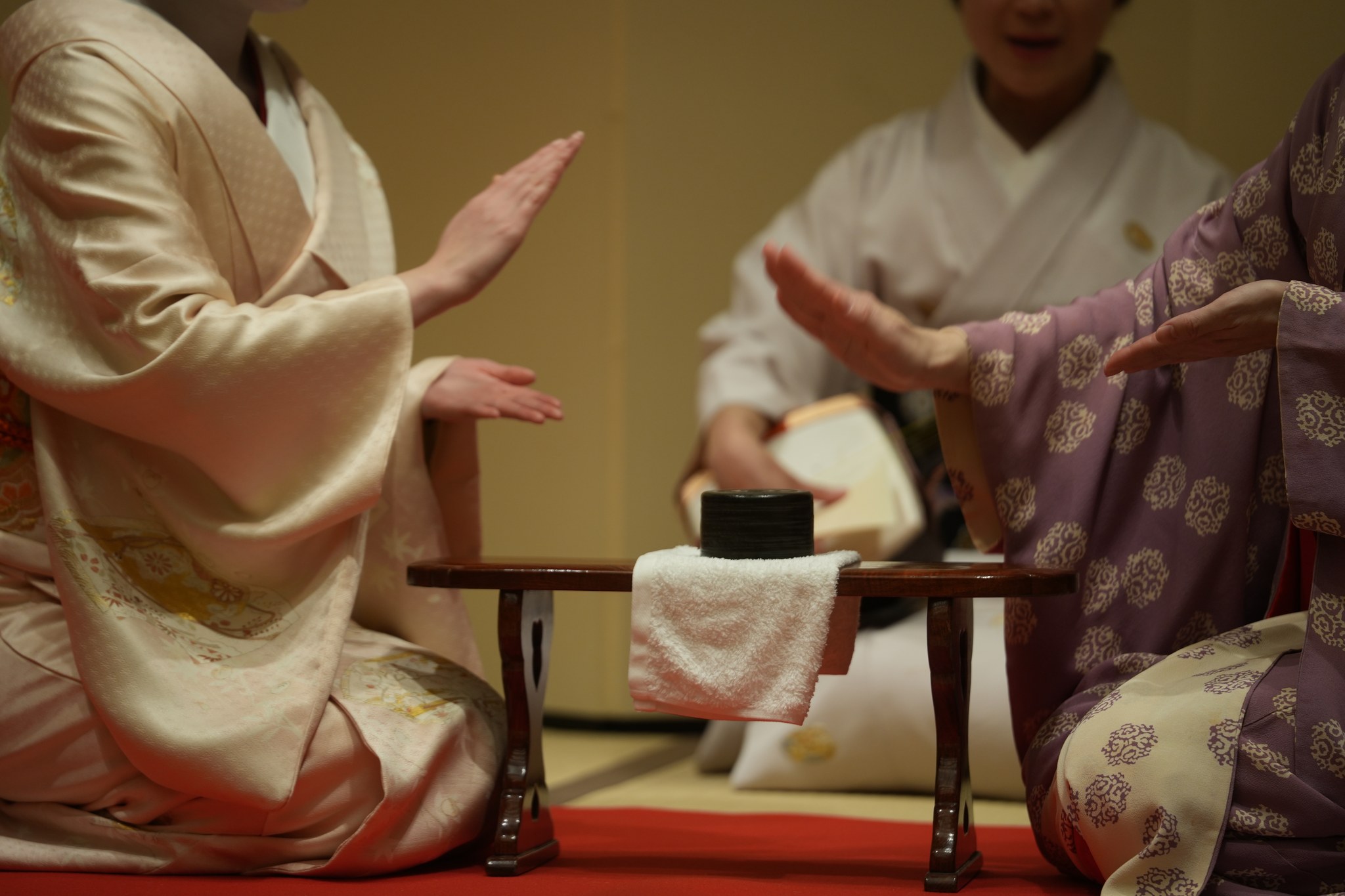
Konpira Fune Fune — The Rhythm Hand Game
Konpira fune fune is the game most associated with a Tokyo geisha banquet. It is deceptively simple, which makes it perfect: even a guest who has never heard of it can be playing, laughing, and losing within three minutes of arriving.
For a detailed guide, including the full rules, the lyrics of the song, and its origins at the Kotohira Shrine in Shikoku, see our complete guide to konpira fune fune.
How to Play — Step-by-Step Rules
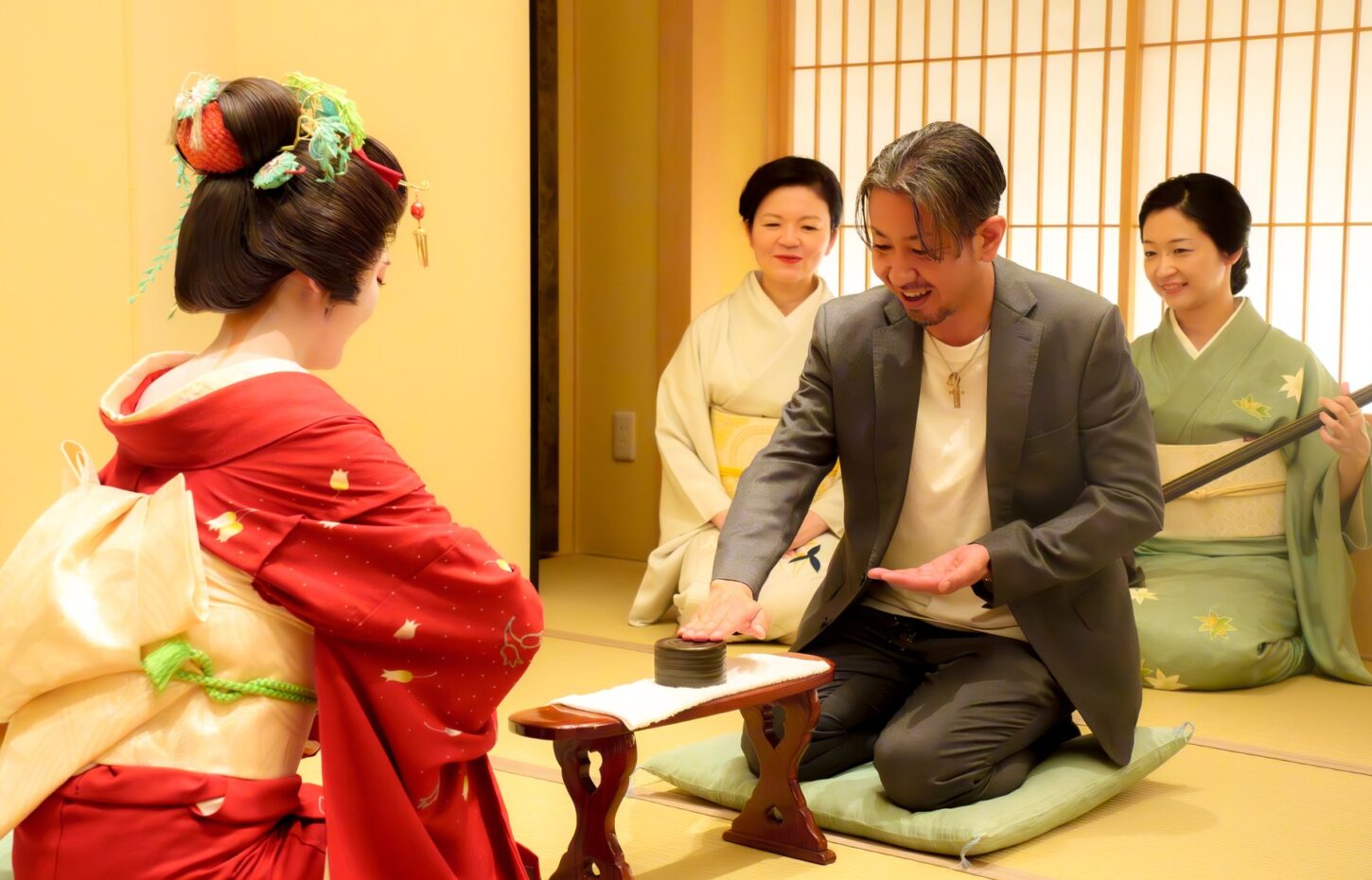
A low wooden armrest called a kyōsoku is placed on the tatami between two players. A small wooden piece called a hakama sits on top of the kyōsoku. On every beat of the song, each player taps the kyōsoku — using an open palm or a closed fist.
The rule is simple: the shape of your hand must match what is in front of you. If the hakama is on your side, you tap with an open palm. If the hakama has been taken to your opponent’s side, you tap with a closed fist. A player may take the hakama and keep it on their side for up to three consecutive turns; on the fourth turn it must be returned. The moment a player taps with the wrong hand shape — open when they should be closed, or closed when they should be open — the game stops and that player drinks the small sakazuki cup as a forfeit.
The game runs for as long as the song continues — which is to say, as long as the geisha wants it to.
Drink options: sake is traditional, but beer or tea is happily offered to guests who prefer it.
(For more on the original folk song and where it comes from, see the Origin and History section below.)
Origin and History
The song konpira fune fune comes from the folk tradition around Kotohira Shrine (Konpira-san) in Sanuki, Shikoku — a shrine famous among sailors and merchants who made the sea crossing between Edo-era ports. The song spread through Japan’s waterways, and eventually into the hanamachi (geisha districts) of Edo, where it became the accompaniment for this particular hand game. At Asakusa, it has been played ever since.
To understand what it feels like to join as a first-time player, see what it feels like to join a real ozashiki game session.
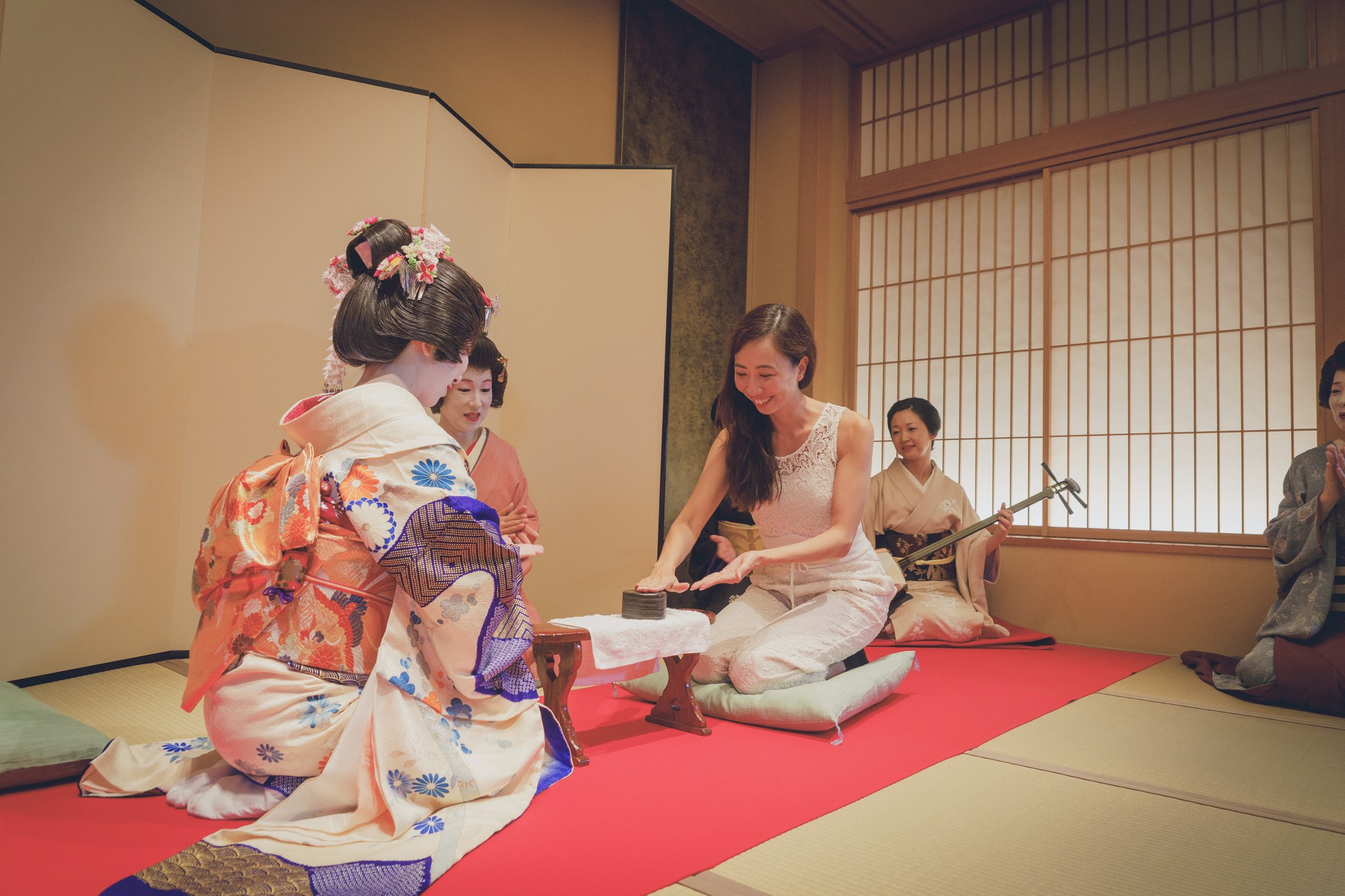
The hakama is a beer coaster; the stand it sits on is an armrest. A geisha runs through the rhythm, and the rule that you may take it three times in a row at most. English subtitles available.
Tosenkyo — The Fan-Tossing Target Game
Tosenkyo is the most visually beautiful of the three ozashiki games — and, as our okami says plainly, the most demanding to host. “Tosenkyo takes a little time to prepare, and the game itself runs longer,” she says. That extra care is exactly why it feels different from the other two.
How to Play — The Basic Rules
A small butterfly-shaped target (teki) is placed on a stand at the far end of a low playing surface. Players take turns tossing a folding fan toward the target. The aim is both to hit the target and to do so in a specific way: the manner in which the fan, the target, and the stand land after the throw determines the score.
Each possible arrangement of the three objects — fan, butterfly, and stand — has a named pattern derived from the fifty-four chapters of The Tale of Genji. These names, called meijō, are part of what gives tosenkyo its reputation as the most literary of the ozashiki games. Mastering the meijō takes practice, but guests do not need to know them to enjoy a round: the geisha keeps score and announces the result.
The scoring is judged on elegance as much as accuracy. A clean hit that sends the butterfly and stand apart cleanly earns more than a glancing blow, and a complete miss can still be graceful.
Accident Stories from the Ozashiki
The game is precise by intention, but not always in execution. Our okami recalls incidents from her years as a geisha: a throw landed with such force that the butterfly target flew clear of the stand entirely, well beyond where it was meant to fall. On another occasion, the fan missed the target and struck the player sitting opposite. Neither ruined the evening. Both got the biggest laughs of the night.
History — Tosenkyo in the Edo Period
Tosenkyo developed in Edo-period Japan (1603–1868) and became a favorite of the city’s literary class — poets, scholars, and artists who appreciated its combination of physical skill and cultural knowledge. The meijō naming system, drawn from The Tale of Genji, placed the game firmly in the tradition of refined court aesthetics even as it moved into the cheerful rowdiness of the hanamachi. It has been played at Asakusa’s geisha houses since the district was active.
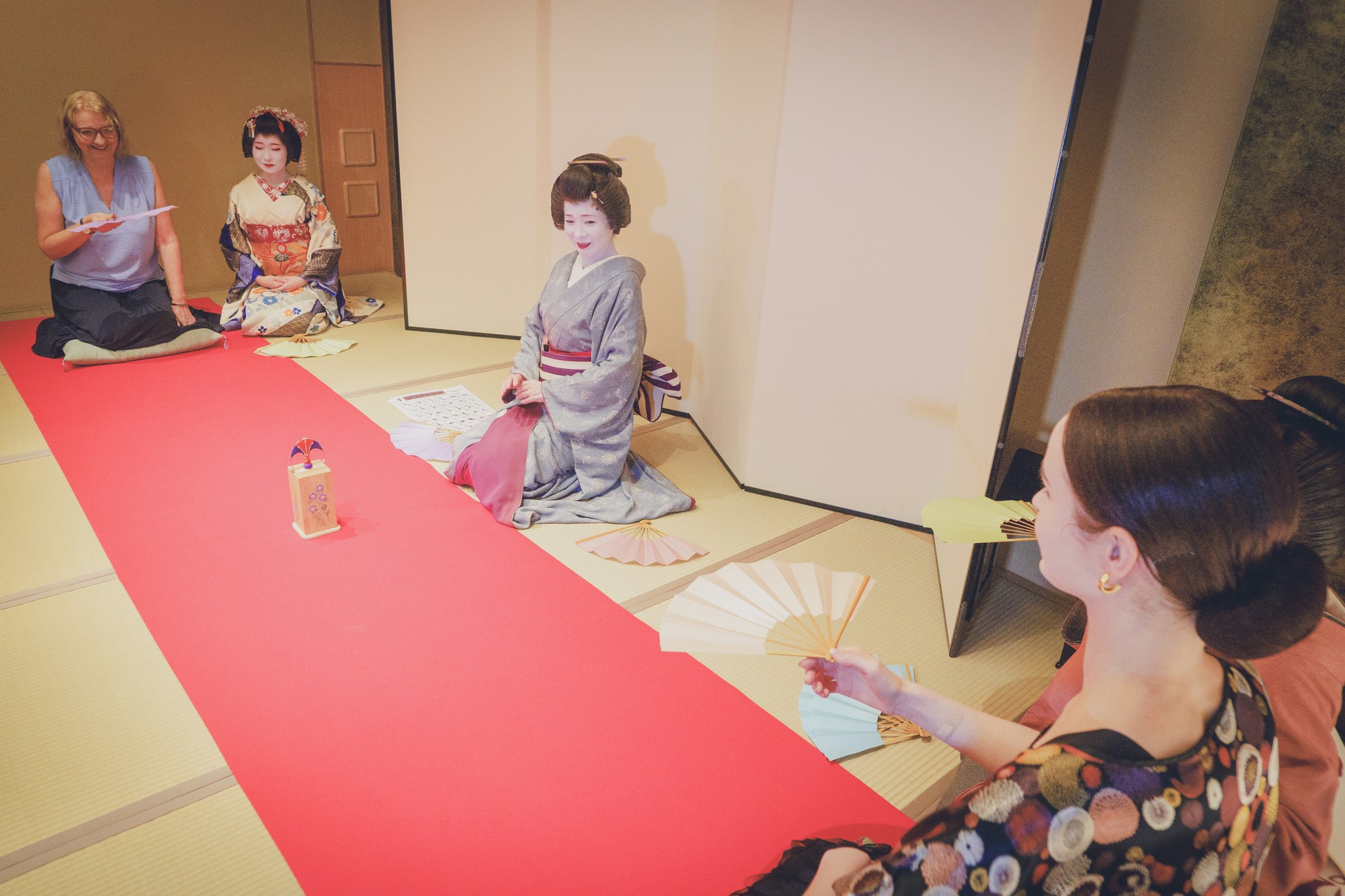
Tosenkyo, played the way guests play it: two players kneeling on the red felt, throwing a folded fan at the target on the stand. The score for each landing appears on screen as it is called.
Tora Tora — The Costume Drama Game
Tora tora is the ozashiki game that guests remember longest. It has everything: costumes, live music, a three-way bluff, and a folding screen large enough to hide behind.
How to Play — Rules and Costumes
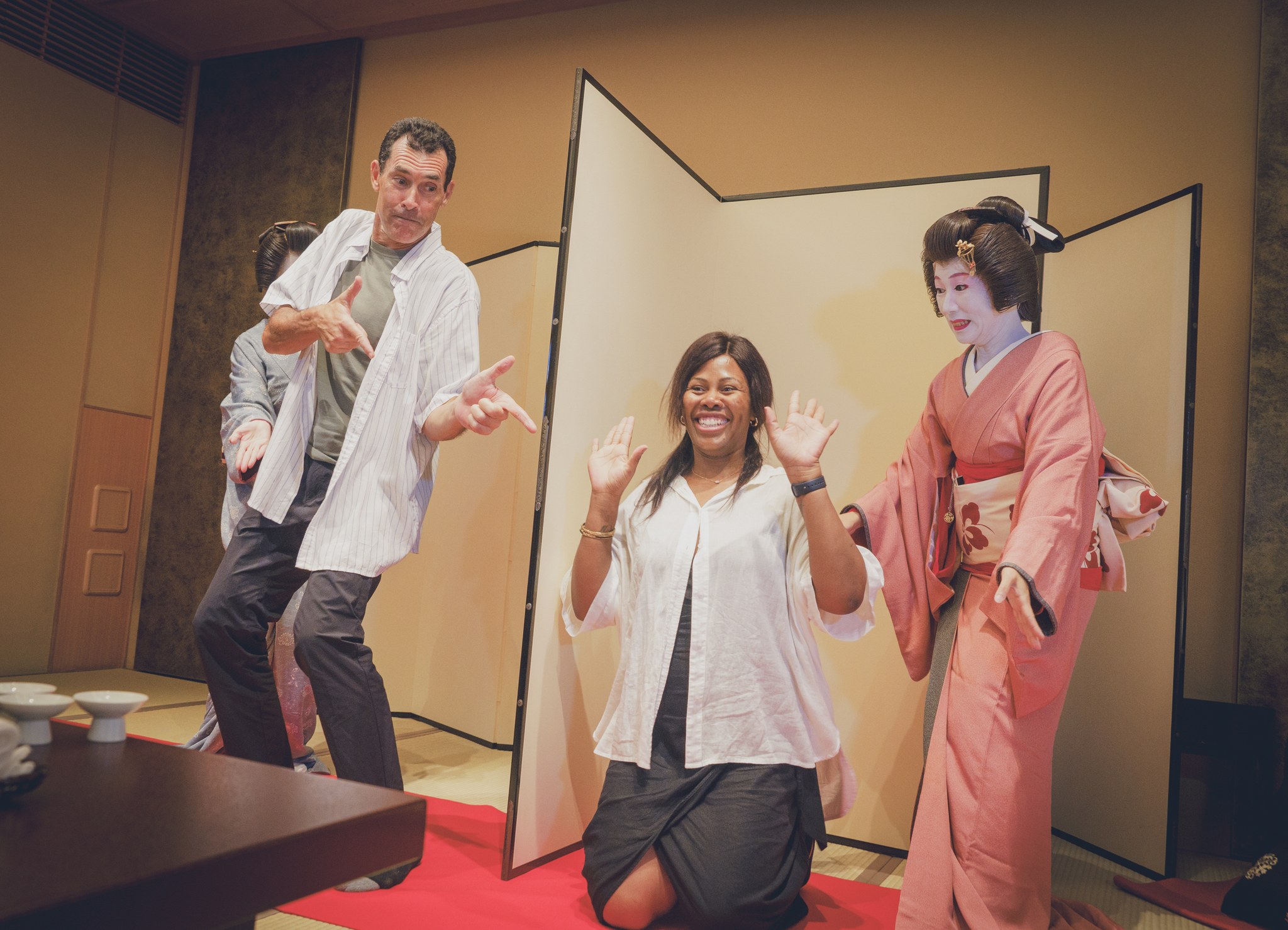
The game is built around the same three-way logic as rock-paper-scissors, but with characters from Japanese folklore: a tiger (tora), a grandmother (obāsan), and a samurai warrior named Watōnai. The relationships between them follow their own narrative logic: the tiger defeats the grandmother (who flees from it), the grandmother defeats Watōnai (because she is his mother, and mothers always win), and Watōnai defeats the tiger with his spear.
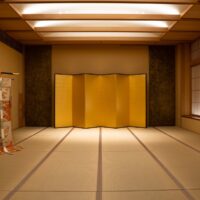
Before the game begins, a two-panel folding screen is placed in the center of the room. Two geisha take up positions at either side of the screen, one facing each player. Our okami describes the setup: “Two geisha stand at both sides of the screen. They explain the three characters, and give the players a quick run-through — something like: here are your three choices.”
After the explanation, the jikata — the geisha musicians sitting to the side — begin to play, and the two geisha demonstrate all three characters by dancing them, each with its own distinct pose and movement, so the players can see exactly what they are choosing.
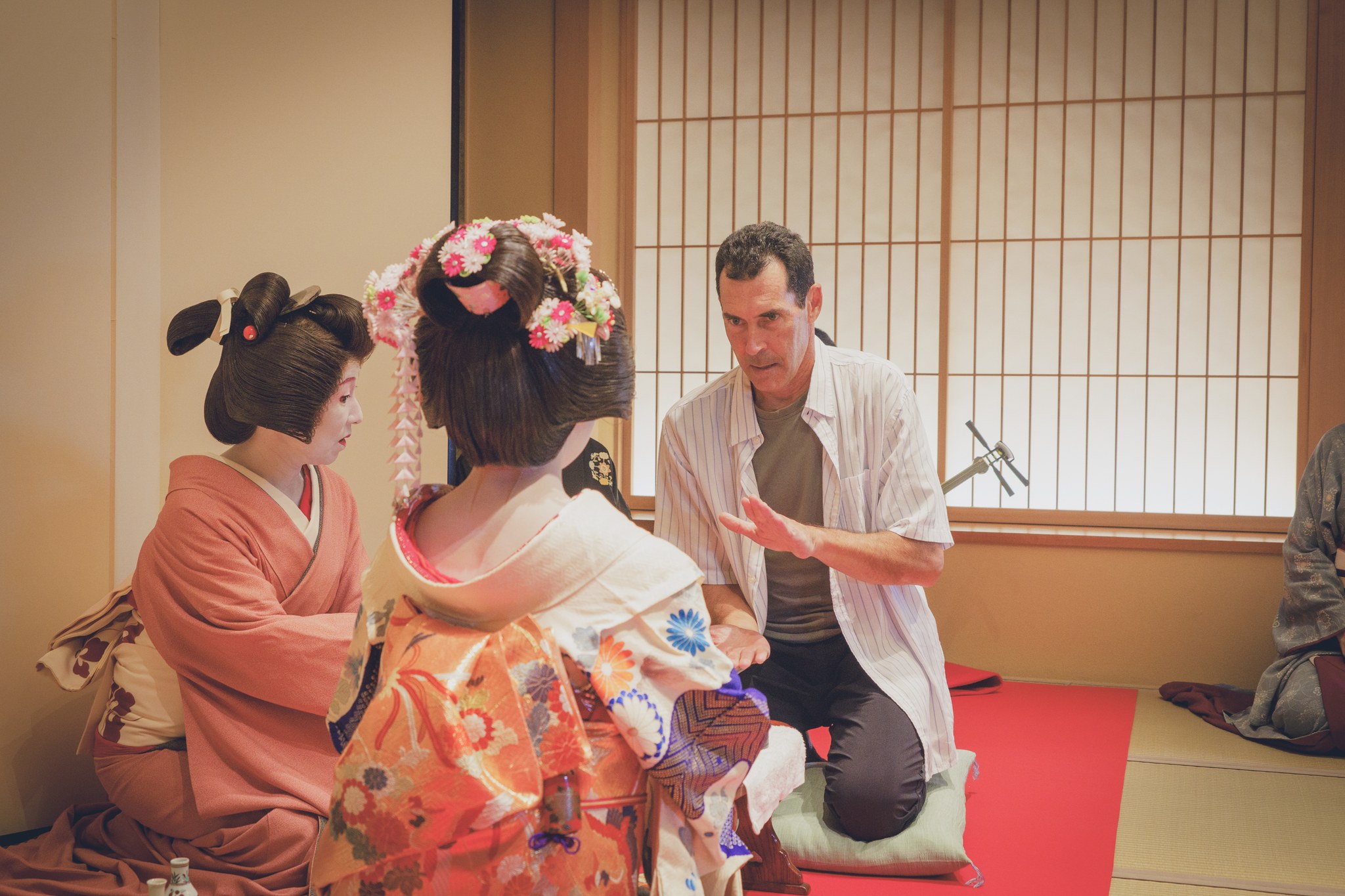
Then the two players — who may be guests, or a guest and a geisha — step behind their respective sides of the screen. On the musical cue, each player emerges with their character: arms out for the tiger, a hunched shuffling walk for the grandmother, a warrior’s stance for Watōnai. The winner of the encounter takes a forfeit drink from the loser. Geisha stand alongside guests to assist with the poses. The players at the screen are too focused to look up; the sideline players are the ones doing the cheering.
The Character of Watōnai
Watōnai is not a random samurai. He is the hero of Kokusenya Kassen (“The Battles of Coxinga”), the most celebrated joruri puppet play of the Edo period, written by Chikamatsu Monzaemon in 1715. In the story, Watōnai is half-Japanese, half-Chinese — a warrior of mixed heritage who fights to restore a fallen dynasty. His signature is the spear, which is what makes him the natural victor over the tiger.
The inclusion of such a specific literary figure in a parlor game tells you something about the era in which tora tora developed. Audiences at the time knew Kokusenya Kassen the way audiences today know a blockbuster film. Watōnai’s character was shorthand, instantly recognizable, and using him in a game was something between a joke and a tribute.
The Three-Way Logic of Tora Tora
| Character | Japanese | Wins against | Loses to |
|---|---|---|---|
| Tiger | 虎 (tora) | Grandmother | Watōnai (spear) |
| Grandmother | おばあさん | Watōnai | Tiger |
| Watōnai | 和藤内 | Tiger | Grandmother |
The three-way cycle is intentionally circular: no character is unbeatable. This keeps the game interesting over multiple rounds and means that simply knowing the rules gives no lasting advantage.
Other Games You May Meet at Miyakodori
Beyond the three above, guests sometimes see a few other games at Miyakodori’s ozashiki. Omawari-san (おまわりさん) is a drum-and-rock-paper-scissors hybrid — the winner of each round strikes a small drum twice, the loser spins in place, and after three losses the loser drinks. It is still part of today’s repertoire. Jōki-nami no Ue (蒸気波の上) is another that appears from time to time. One older game you won’t see today is tōhachi-ken (藤八拳), a hand game once popular in Edo-era ozashiki — it is not part of the current repertoire at Miyakodori.
The Art of Facilitation — How Geisha Set the Stage
There is a phrase used in Asakusa’s geisha world for what a skilled geisha does when she runs a game: she “makes the room” (oheya wo tsukuru). Our okami uses this expression to describe something that is not about the physical space. It refers to atmosphere — the particular quality of ease that a room either has or doesn’t have, and that a geisha can actively bring into being.
“Making the Room” — The Geisha’s Invisible Work
Most guests arrive carrying some version of the same anxiety: What if I don’t know the rules? What if I embarrass myself? What if I do something wrong? The geisha’s job, before a single game is played, is to take that anxiety out of the room.
Our okami is direct about how this works: “The games were originally designed so that anyone can learn them quickly. The rules are easy to grasp by design. So there’s nothing particularly special we have to do.” That might sound like modesty, but it is actually a description of how good design and good hosting interact: when the rules are genuinely simple, the geisha does not need to work to overcome the difficulty. She only needs to create the right mood. “If guests can enjoy themselves without us going out of our way to make it happen,” she says, “that’s exactly how it should be.”
What “making the room” looks like in practice: a geisha plays konpira fune fune with a smile that does not disappear even when she is in full concentration — “smiling, even while being completely serious,” as our okami puts it. The players at the kyōsoku are focused on the beat. The geisha watching from the side are doing the work of delighting: responding, laughing, escalating. “The players are too busy to look up,” our okami observes. “So the geisha on the sidelines are the ones doing the cheering.”
“Never Making You Feel Out of Place”
Our okami captures the philosophy in a sentence: “How do you loosen the tension? For someone who is new and nervous, you simply tell them: you don’t need to have memorized any manners.” That is not a minor concession. It is the whole stance. Guests are not expected to study before they arrive, prepare responses, or know in advance how any of this goes. The geisha knows. The guest shows up.
“If guests can enjoy themselves without us making any special effort,” she says, “that is exactly as it should be — and that’s enough.”
How to Join — You Don’t Need to Know the Rules in Advance
This is the part worth saying once, plainly: you do not need to know how to play konpira fune fune, tora tora, or tosenkyo before you arrive. The geisha will explain everything. The explanations take less time than you expect. The first game begins almost immediately after.
The only thing guests consistently discover, long after the games are over, is that they wish the evening had been longer.
Experience the Facilitation Art in Person
The best way to understand how geisha set the room is to experience it. At Miyakodori in Asakusa, we invite you to join a Private Ozashiki — a real geisha banquet where the games, the music, and the art of facilitation happen around your table.
Book a Private OzashikiOr start with our 75-minute Geisha Tea House experience →
Ozashiki Games at Miyakodori — What to Expect
Miyakodori has been welcoming guests to ozashiki in Asakusa since 1950. The games are a part of every evening — but how they fit depends on which experience you book.
Which Games Are Played in Each Plan
The Geisha Tea House is a 75-minute introduction. It is the entry point we designed for first-time guests who want to meet geisha and try one ozashiki game without committing to a full evening. Within that hour, there will typically be one game — usually konpira fune fune, since it requires no preparation and gets the room moving quickly. The pace is gentle, the format is structured, and the experience has been designed to be comfortable even for guests with no prior knowledge of the ozashiki world.
The Private Ozashiki is the full experience. It runs for two or three hours, with a private group and geisha who stay for the evening. Over that time, more than one game is typically played — the selection depends on the flow of the evening, what the geisha reads in the room, and which games the group gravitates toward. Tora tora and tosenkyo are most commonly played in the Private Ozashiki, because they benefit from the extra time and the easy rapport that builds up over a longer evening.
There is no fixed script. The geisha decides what happens and when. That flexibility is itself part of the art.
The three games above are the ones guests meet most often, but they are not the whole repertoire. O-mawari-san is a drum game whose name works as a pun — it reads as “police officer” and, taken literally, as “the one who goes around.” Two players face each other across a drum and throw rock-paper-scissors; the loser turns a full circle on the spot while the winner beats the drum, and the round repeats, faster each time, until one player has lost often enough to take a forfeit cup. How many beats and how many losses varies from house to house. Which games appear on any given evening is the geisha’s call.
Our okami, who serves as the bridge between geisha and guests throughout every evening, describes her position simply: “I am the one standing between the geisha and the guests.”
| Private Ozashiki | Geisha Tea House | |
|---|---|---|
| Duration | 2–3 hours | 75 minutes |
| Games | Multiple (geisha’s discretion) | 1 (typically konpira fune fune) |
| Geisha | Based on guest numbers | 3 (minimum 2) |
| Tora tora | Yes | Rarely |
| Tosenkyo | Yes | Rarely |
| Best for | The full ozashiki experience | First visit / curious guests |
Sake, Tea, and the Forfeit Cup
Ozashiki games have traditionally included a forfeit: the loser drinks a small sakazuki cup of sake. This is not compulsory. Guests who prefer not to drink alcohol can use tea instead — the geisha will not comment, and neither will anyone else. The cup is a part of the game’s ritual shape, not a drinking challenge.
Photography — What Is Allowed
In the Tea House, photography is permitted with the consent of the geisha. In the Private Ozashiki, the photography policy is more flexible, since the evening is private and the geisha can set her own terms. The simplest approach is to ask when you arrive.
Geisha Numbers and the Play Experience
The Tea House always includes three geisha. The Private Ozashiki scales with your group: more guests typically means more geisha, which also means more people on the sidelines doing the cheering when the games are in play.
Ozashiki Games Across Japan — Regional Differences
Konpira fune fune, tora tora, and tosenkyo are the games most commonly associated with the Tokyo hanamachi, particularly Asakusa. Tokyo has six kagai (geisha districts); Kyoto has five, collectively known as the Gokagai (Gion Kōbu, Gion Higashi, Pontocho, Kamishichiken, and Miyagawacho). Several other cities — Kanazawa, Niigata, and Osaka among them — maintain their own hanamachi traditions, and the games played at each vary by local practice.
Tokyo / Asakusa Style
Asakusa’s ozashiki tradition, like the other hanamachi of Tokyo, traditionally required an introduction from an existing patron. Miyakodori was the first teahouse in Asakusa to openly welcome first-time guests — publicly, and online — without one. That openness extends to the games: the emphasis is on drawing guests in immediately, keeping the mood light, and making sure everyone in the room is included.
Kyoto and Other Regional Variations
In Kyoto’s hanamachi — particularly Gion Kōbu, the most famous — the ozashiki tradition has its own character, shaped by the customs of the Kyoto maiko and geiko. The games played there include some of the same titles but may be presented differently. Tōsen, the Kyoto equivalent of tosenkyo, follows similar principles. Specific regional differences are a subject better addressed by practitioners in each district; Miyakodori speaks from Asakusa’s tradition.
What our okami says of the comparison: “Asakusa and Kyoto are different, but neither is above the other. Kyoto has things you can only experience there; Tokyo has things you can only experience here. I choose Asakusa because I know it best — and because there is a great deal inside it that you cannot understand from the outside.”
Frequently Asked Questions
- What are ozashiki games?
- Ozashiki games (ozashiki asobi) are traditional parlor games played during a geisha banquet. Three games are standard in Tokyo’s Asakusa: konpira fune fune (a rhythm hand game), tora tora (a costumed rock-paper-scissors variant), and tosenkyo (a fan-tossing target game). Each is led by geisha, who guide guests through the rules and keep the room moving.
- How do you play konpira fune fune?
- A low wooden armrest called a kyōsoku is placed between two players, with a small wooden piece called a hakama resting on top. On every beat of the song, each player taps the kyōsoku. The rule: your hand shape must match what is in front of you — open palm when the hakama is on your side, closed fist when it has been taken. A player may keep the hakama for up to three consecutive turns before it must be returned. When someone taps with the wrong hand shape, they drink a small cup of sake (or tea) as a forfeit. The game runs as long as the song continues.
- Do I need to know the rules before my ozashiki?
- No. The geisha explains everything on arrival. Our okami puts it plainly: “The games were designed to be easy to pick up — it’s not something we need to go out of our way to prepare you for.” Guests who arrive knowing nothing play just as well as guests who researched in advance.
- What is tosenkyo?
- Tosenkyo is an Edo-period fan-tossing game. Players toss a folding fan at a small butterfly-shaped target, and the way the fan, butterfly, and stand fall determines the score according to named patterns (meijō) drawn from The Tale of Genji. It is the most literary and visually elegant of the three ozashiki games.
- What is tora tora?
- Tora tora is a costume drama version of rock-paper-scissors. The three characters are a tiger, a grandmother, and a samurai warrior named Watōnai (from the Edo-period play Kokusenya Kassen). Each player chooses a character and reveals it by emerging from behind a folding screen with the corresponding pose, to live shamisen music.
- Do I have to drink alcohol during the games?
- No. The traditional forfeit is a small cup of sake, but tea is a perfectly accepted alternative. No one will comment on your choice.
- Can children play ozashiki games?
- The games themselves have no age restriction, but Miyakodori’s ozashiki experiences are designed for adults. For families or mixed-age groups, please contact us to discuss the best arrangement.
- How long does an ozashiki game session last?
- In the Tea House (75 minutes total), one game takes up a portion of the evening — perhaps fifteen to twenty minutes. In the Private Ozashiki (two to three hours), games may take place at multiple points across the evening, with natural breaks for conversation, food, and music in between.
- Is tosenkyo played everywhere in Japan?
- Tosenkyo is not universal. It is offered at select hanamachi in Tokyo and Kyoto, and its availability depends on the establishment. At Miyakodori, it is available in the Private Ozashiki experience.
- Can I take photos during the games?
- In the Tea House, photography is permitted with the geisha’s consent. In the Private Ozashiki, the policy is more flexible — ask the geisha when you arrive.
- What is “facilitation art” in an ozashiki?
- Facilitation art refers to the geisha’s skill at guiding guests into the room — dissolving nervousness, drawing quieter guests into the game, and creating the particular atmosphere in which a good ozashiki happens. It is not a formal term but a description of invisible work: the geisha “making the room” before the first game begins.
- Where can I experience ozashiki games in Tokyo?
- Miyakodori in Asakusa offers all three games. The Geisha Tea House is the simplest entry point: a structured 75-minute experience designed for first-timers. The Private Ozashiki is the full evening, where multiple games are played over two to three hours with your own private group.
Ozashiki Games, Live and In Person
Don’t just read about the games — play them with a real geisha. Miyakodori welcomes international guests for authentic ozashiki in Asakusa, Tokyo.
Book Your Geisha Experience


Japanese Culture: Traditions, Arts and Living Heritage — Complete Guide
Complete Guide to Asakusa Tourist Spots | From Kaminarimon to Hidden Gems: Top 10 Selections Part 1
How to See a Geisha in Tokyo: 5 Ways Compared (2026)
The Best Kakigori in Asakusa: Top Shaved Ice Shops & Visitor Guide
How to Book a Geisha Experience in Tokyo: Step-by-Step Guide (2026)

Watch the Sumida River Fireworks from Prime Seats – Restaurants with Stunning Views & Meals
Comment ( 0 )
Trackbacks are closed.
No comments yet.