



Oiran Meaning: Who Were Japan’s Highest-Ranking Courtesans?
An oiran (花魁) was a high-ranking courtesan of the Yoshiwara, the licensed pleasure quarter of Edo (old Tokyo). She was trained in classical arts, poetry, calligraphy and ceremony, and her work was companionship, including intimate services, as a licensed trade. The profession ended when the Yoshiwara closed in 1958. No oiran exist today; what you see at festivals and photo studios is a reenactment.
We are Miyakodori, a machiai-chaya (geisha tea house) in Asakusa that has hosted geisha banquets since 1950. The old Yoshiwara stood a short walk from our door, so the question “what is an oiran?” comes up with our guests more often than you might expect. This guide answers it from the ground up: what the word means, how the ranks worked, what an oiran’s life was really like, and how the whole system came to an end.
What Does “Oiran” Mean?
The Short Answer
The word oiran refers to the elite tier of courtesans in the Yoshiwara from the mid-18th century onward. It was not a general word for any woman who worked in the quarter. Every rank below the oiran had its own name, its own price, and its own rules.
- What
- The highest-ranking courtesans of the Yoshiwara, Japan’s most famous licensed pleasure quarter
- Era
- Mid-Edo period (from around the 1760s) until the quarter closed in 1958
- Location
- Yoshiwara, just north of Asakusa, Tokyo (originally near Nihonbashi, moved in 1657)
- Training
- Classical literature, calligraphy, tea ceremony, shamisen, poetry, dance, conversation
- Work
- Licensed companionship, including intimate services
- Do they still exist?
- No. Only reenactments remain.
Where the Word Came From
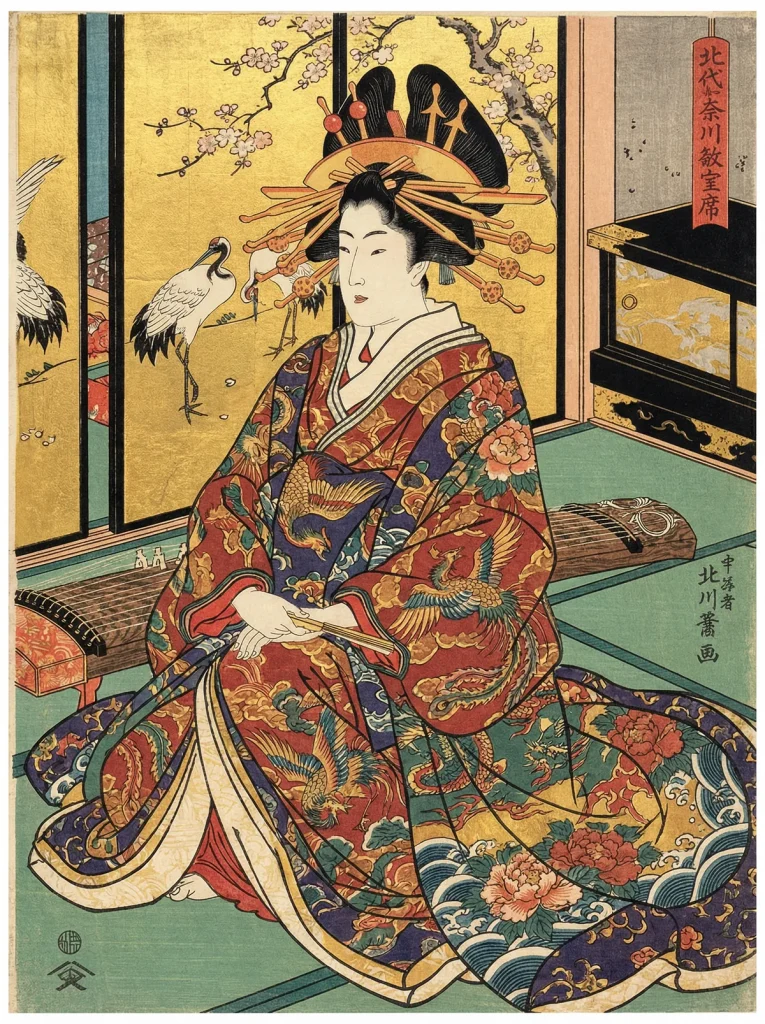
The most widely cited explanation traces “oiran” to the youngest attendants of the quarter, girls called kamuro. They referred to the senior courtesan they served as “oira no nēsan” (おいらの姉さん), roughly “our big sister.” Over time the phrase was shortened to oiran.
The kanji chosen for the word, 花魁, read literally as “the first among flowers.” It is a written flourish added to a spoken word, but it captures how the quarter saw these women: as the finest it had to offer.
Oiran, Courtesan, Yobidashi: What the English Word Doesn’t Capture
English writing about the Yoshiwara tends to use one word, courtesan, for a system that Edo-period Japan graded with real precision, from the kirimise at the bottom, through the chūsan, to the yobidashi at the very top. An oiran belonged to the elite end of that scale. Calling her simply “a courtesan” is not wrong, but it flattens a hierarchy the women themselves lived by.
Oiran vs Geisha: The Difference in Brief
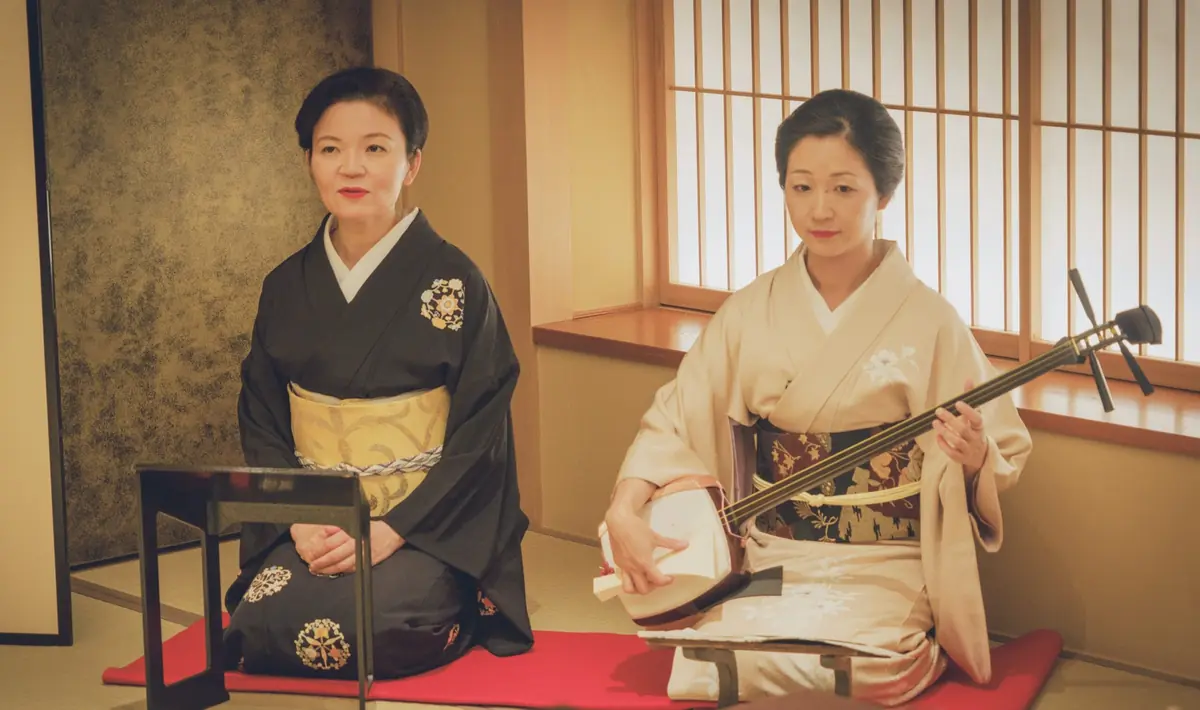
Oiran and geisha were two separate professions. Oiran were licensed courtesans. Geisha are performing artists, trained in music, dance and conversation. The oiran are a closed chapter of history; geisha are still active today, including here in Asakusa.
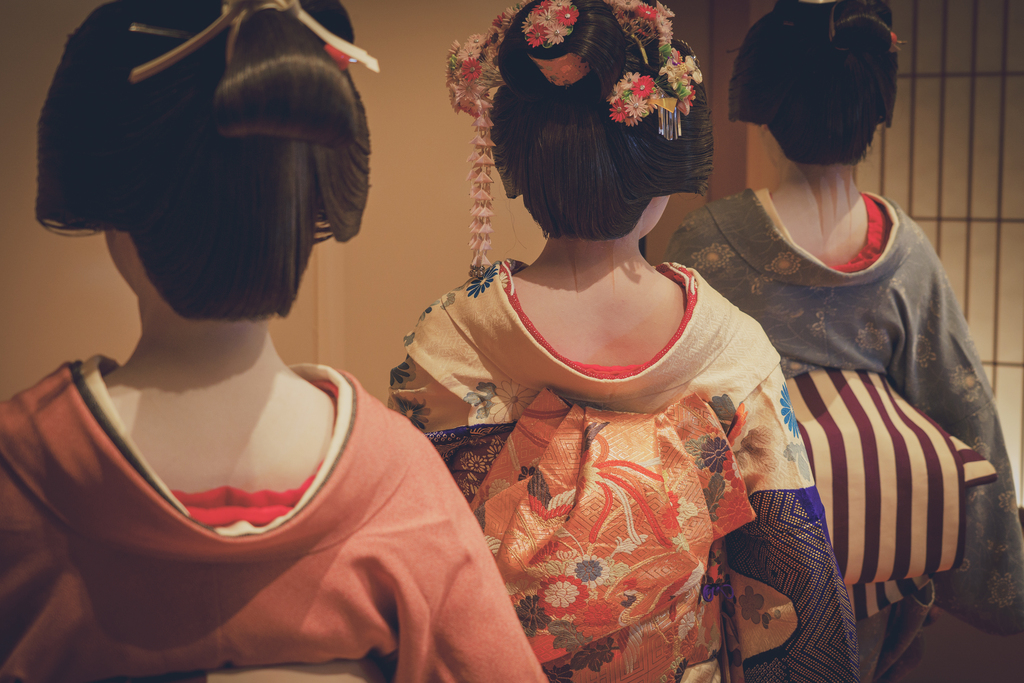
In the Yoshiwara, the two were deliberately kept apart. Geisha tied the obi at the back, while courtesans wore it at the front. The kenban, the registry office that still anchors geisha districts today, listed geisha and courtesans on separate rows of its boards. Courtesans are the older profession; geisha established themselves later as a separate trade. For the full comparison, including the obi, the geta, the kenban records, and how to tell them apart in a photograph, see our dedicated guide, Oiran vs Geisha: What’s the Difference?
Meet the Geisha of Asakusa
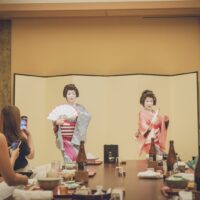
The oiran belong to history, while geisha still perform in Asakusa. At Miyakodori you can request a private ozashiki (a private gathering with geisha) with Asakusa geisha, with English support throughout.
Request a ReservationWhere Did Japan’s Courtesans Come From?
Ancient Roots: Shrine Maidens, Wandering Performers, and the First Courtesans
The history of Japan’s courtesans stretches back long before the Yoshiwara. In ancient Japan, women known as miko (shrine maidens) served the gods through sacred dance and song. Over the centuries, some of these women left the shrines and became wandering performers, traveling between ports and post towns and offering entertainment and, eventually, intimate services.
By the Heian period (794–1185), several distinct types had emerged. The asobi (遊女) worked the waterways of the Yodo River, waiting for clients aboard boats. The kugutsume (傀儡女) were puppeteers who also worked as courtesans, while the shirabyōshi (白拍子), female dancers dressed in male court attire, performed for aristocrats and warriors alike. In this era the work carried far less stigma than it would later; some shirabyōshi became the companions of the most powerful men in the country.
The Birth of the Yoshiwara (1617)
When Tokugawa Ieyasu made Edo the seat of his government, the city’s population exploded, and it was overwhelmingly male. Samurai, merchants and laborers poured into the new capital.
To bring order to the situation, the shogunate granted a man named Shōji Jin’emon permission to open an officially licensed pleasure quarter. In 1617, the Yoshiwara opened near Nihonbashi: a walled enclave where prostitution was legal, regulated and contained.
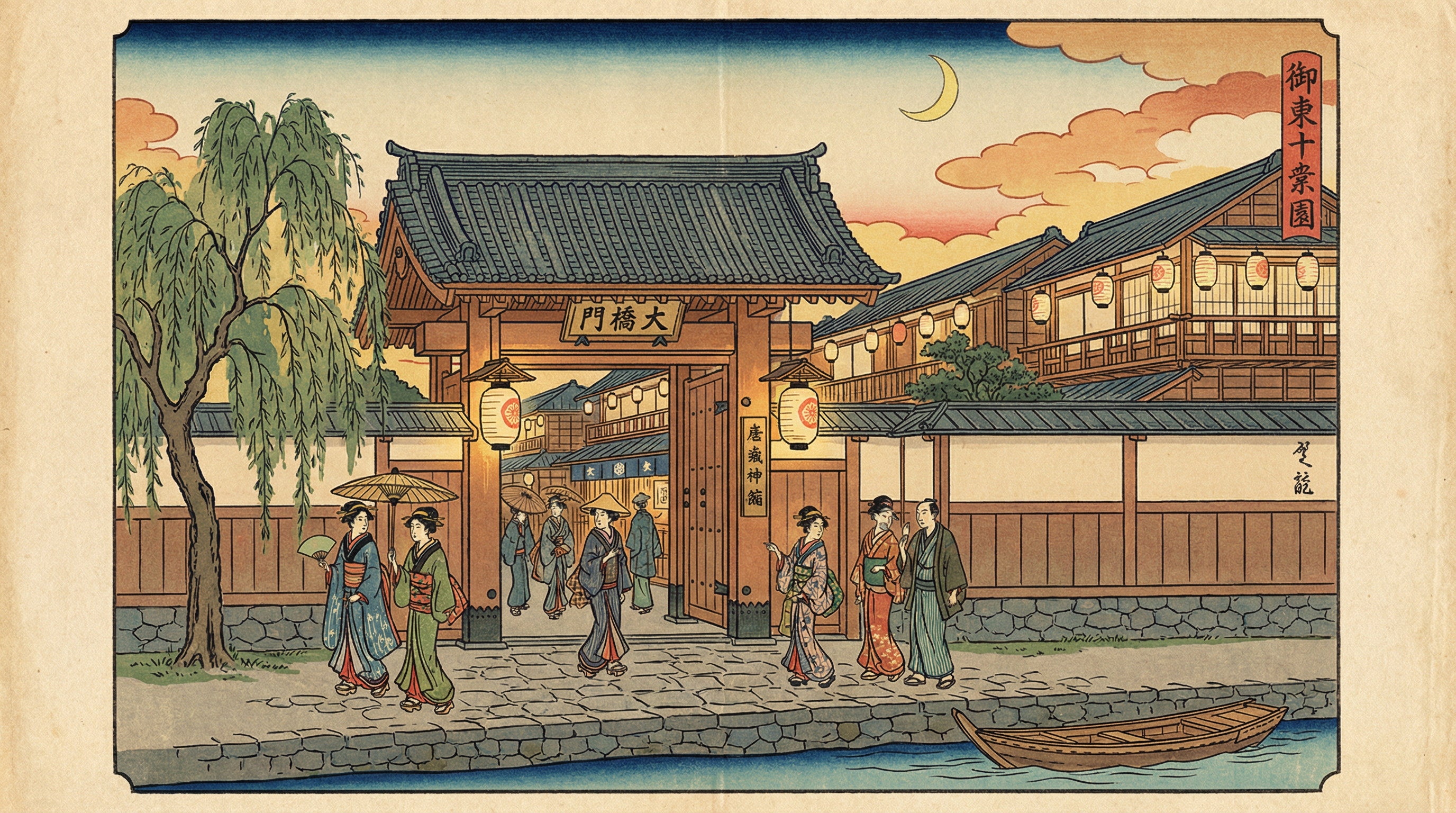
In 1657, the Great Fire of Meireki destroyed much of Edo, and the quarter was moved to marshland north of Asakusa, behind Sensō-ji temple. This “New Yoshiwara” (新吉原) would operate for three centuries. For the story of the district itself and what remains of it today, see our guide to the Yoshiwara.
The Yoshiwara was not the only licensed quarter in Japan. Kyoto had Shimabara, Osaka had Shinmachi, and Nagasaki’s Maruyama was known for courtesans who entertained Chinese and Dutch traders. Outside the licensed quarters, meshimori-onna (飯盛女), officially “food servers” at post-town inns, carried on de facto prostitution that the authorities tolerated but never formally approved.
Oiran Ranks: The Courtesan Hierarchy of the Yoshiwara
The Age of the Tayū
In the early decades of the Yoshiwara, the highest-ranking courtesans were called tayū (太夫). A tayū was among the most educated women of her time. Her training covered classical literature, calligraphy, tea ceremony, flower arrangement, poetry, shamisen and even the board game Go, and she could hold her own in conversation with feudal lords.
A tayū took the seat of honor at a banquet, above the client rather than below him, and she had a say in which patrons she accepted. Beneath her stood the kōshi (格子), courtesans who sat in the front row of the latticed windows where women were displayed to passersby.
From Tayū to Oiran
By the mid-18th century, the Yoshiwara was changing. The samurai class was in financial decline, and fewer clients could afford a tayū. By the 1760s, the tayū and kōshi ranks had disappeared from the Yoshiwara altogether.
In their place rose a class once considered inferior: the sancha (散茶). The name, “powdered tea,” was a pun. Powdered tea does not need to be shaken out of a bag, and sancha courtesans did not “shake off” (turn away) clients the way a tayū could. As the sancha and the ranks that grew out of them rose to the top, a new word came into use for the elite of the quarter: oiran.
Oiran Ranks in Order, from Yobidashi to Kirimise
From the late 18th century, the Yoshiwara hierarchy ran roughly as follows, from highest to lowest:
- Yobidashi (呼出し): The pinnacle. A yobidashi never sat in the display windows. Clients summoned her by name through a teahouse, and she arrived in procession. Only the wealthiest could afford her.
- Chūsan (昼三): A high-ranking courtesan whose daytime fee was three bu, a gold coin unit. Still prestigious, one step below the yobidashi.
- Zashikimochi (座敷持): A mid-ranking courtesan with her own reception room in addition to her private room.
- Heyamochi (部屋持): A courtesan without a separate reception room, who received clients in the room where she lived.
- Kirimise / hashijorō (切見世・端女郎): The lowest rank. These women worked from cramped, tenement-like rooms along the edges of the quarter, for a fraction of an oiran’s fee.
In common usage, “oiran” referred to the top of this list, the yobidashi and chūsan.
The ranking was visible in print, too. The Yoshiwara Saiken (吉原細見), a guidebook published regularly throughout the Edo period, used symbols to show each house’s rank: a solid square (■) for the grandest houses, and simpler marks for smaller ones. Individual courtesans were coded in the same way, with chevrons and dots marking their standing.
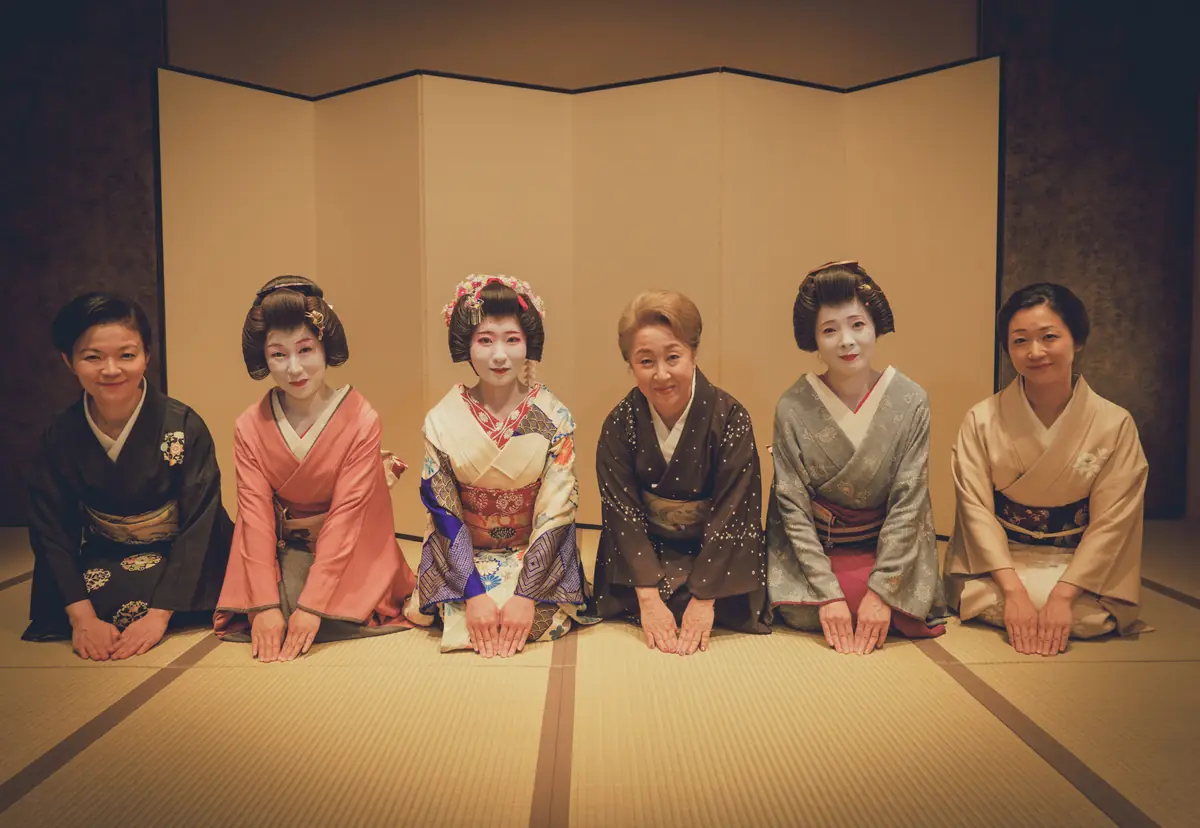
The hanamachi had ranks too — and unlike the list above, this one is still in use. On the left is a hangyoku, the junior grade; on the right, a full geisha. Tokyo does not use the Kyoto word maiko for the younger stage.
How Did a Girl Become an Oiran?
Kamuro: The Child Attendants
A path to becoming an oiran began in childhood. Girls of around ten, often sold by impoverished rural families, entered the Yoshiwara as kamuro (禿). A kamuro served as a personal attendant to a senior courtesan, serving meals, lighting pipes and running errands, and in return she was taught the manners, customs and arts of the quarter.
A select few, chosen for exceptional looks and intelligence, were designated hikkomi-kamuro (引込禿). They were kept out of public view and given an intensive education in shamisen, singing, calligraphy and conversation, groomed from the start as future oiran.
Shinzō: The Apprentice Courtesans
In her mid-teens, a kamuro became a shinzō (新造), an apprentice courtesan. From here the paths diverged sharply.
- Furisode-shinzō (振袖新造): The elite track. A furisode-shinzō did not yet take clients. She served as the attendant and understudy of a senior oiran, learning her skills and building a reputation, and was on course to become an oiran herself.
- Tomesode-shinzō (留袖新造): Those who did not make the elite track began taking clients early, without the prospect of high rank.
- Taiko-shinzō (太鼓新造): Young women whose talent for shamisen, dance and song was valued above their looks. They entertained at banquets with their art. The word “geisha” literally means “person of the arts”, and these were the same arts, but geisha were a separate profession and were kept apart in the Yoshiwara. To learn more about the instrument at the center of this music, see our guide to The Shamisen: Japan’s Three-Stringed Lute.
- Bantō-shinzō (番頭新造): Older women who no longer took many clients and handled management: schedules, supplies, and the supervision of younger women.
The Yarite and the Zegen: The People Who Ran the Yoshiwara
The Yoshiwara was not run by its courtesans. Behind them stood the people who kept the quarter running and profitable.
The yarite (遣手) was a house’s floor manager, almost always a former courtesan, usually over thirty. She oversaw the women’s conduct, judged which clients were suitable, and kept strict discipline. The courtesans called her yarite-baba (遣手婆), a name that mixed respect with fear.
The zegen (女衒) had a far darker role. These brokers traveled the countryside, visiting poor villages and buying daughters from desperate families. They supplied the Yoshiwara with its workforce and were, in all but name, human traffickers.
What did an Oiran do? Rituals, Processions, and Daily Life
Three Visits to Win Her Favor: Shokai, Ura, and Najimi
A courtesan of the highest rank did not simply receive whoever could pay. In the classic account, a client had to earn her favor over three visits.
- Shokai (初会), the first meeting: The client held an elaborate banquet at a teahouse to show his wealth and taste. The courtesan sat at a distance, did not speak to him, and did not touch the food or drink. She was assessing him.
- Ura wo kaesu (裏を返す), the second visit: She sat closer, exchanged a few words, and perhaps shared a cup of sake.
- Najimi (馴染み), the third visit: The client became a recognized regular. Chopsticks and a tray bearing his name were prepared for him. From then on he was expected to stay loyal to her; visiting another courtesan in the quarter could bring penalties.
This protocol was observed most strictly in the tayū era. By the time the oiran ranks had taken over, the rules were often relaxed.
The Oiran Dōchū: A Procession That Stopped the Street
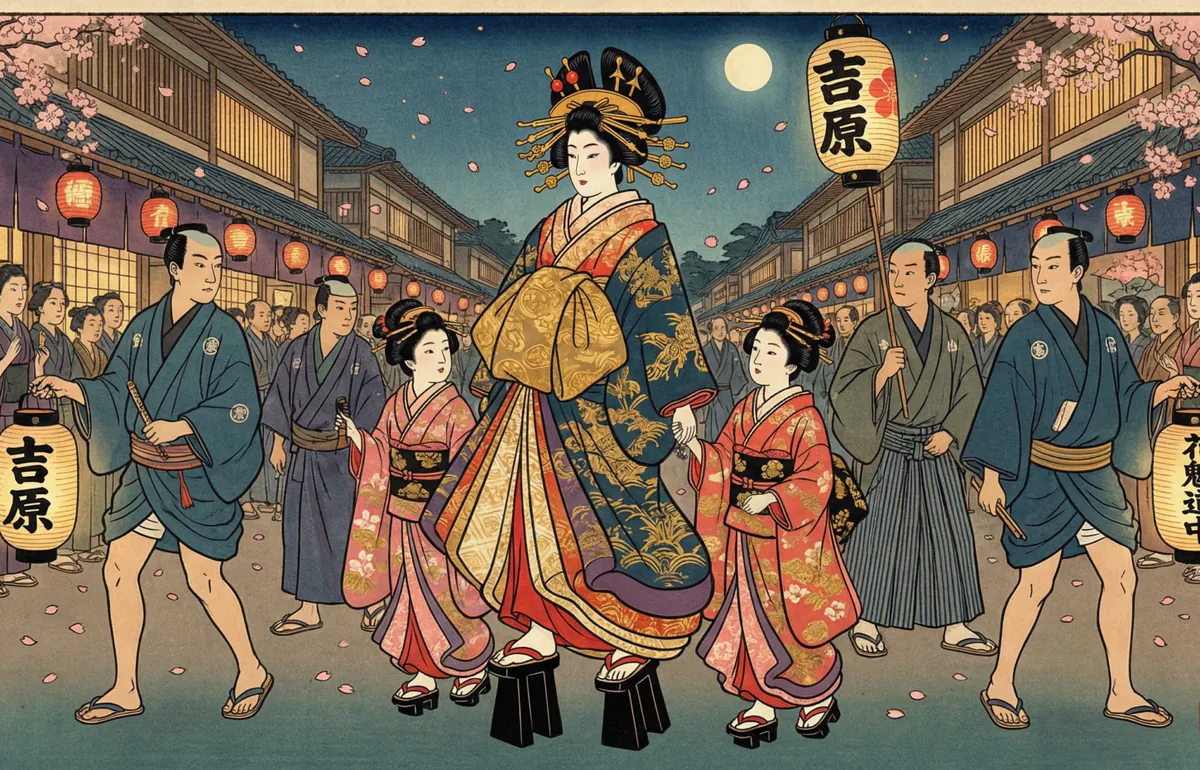
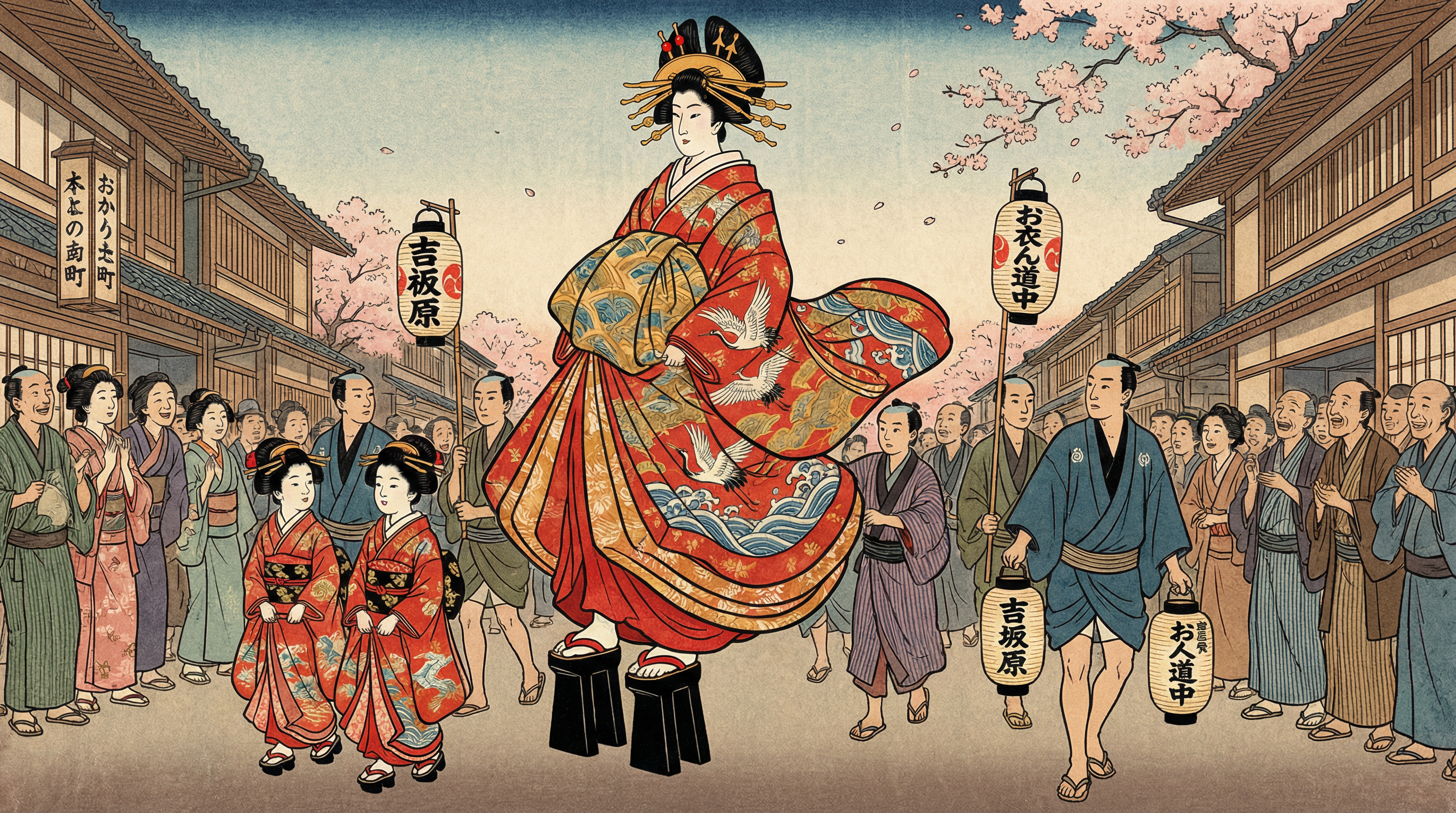
The oiran dōchū (花魁道中) was one of the great sights of Edo. When a top-ranking courtesan was summoned to a teahouse by a regular client, she did not simply walk there. She processed.
Her hair was dressed in the towering date-hyōgo style and set with many tortoiseshell hairpins (kanzashi). Her layered kimono and heavy outer robe are often said to have weighed 20 kilograms or more. On her feet she wore tall black-lacquered geta with three teeth (三枚歯, sanmaiba), which lifted her above the crowd.
Then there was the walk itself: soto-hachimonji (外八文字), a slow step in which each foot swung outward in a wide arc before being set down. It was theatrical and physically demanding, and it took practice to master.
She was accompanied by her retinue of shinzō, kamuro and male attendants carrying lanterns and a long-handled umbrella. The procession was, by design, a moving advertisement: a display of beauty and wealth that told the entire quarter this was the finest the Yoshiwara had.
A Day in the Life of a Yoshiwara Courtesan
Behind the processions lay an exhausting routine. A courtesan’s day began before dawn, around 6 a.m., with kinuginu no wakare (後朝の別れ), the “morning-after farewell” to the previous night’s client. How convincingly she showed reluctance to part was itself a professional skill.
After the client left she slept for a few hours, if a client had not booked her for several days (itsuzuke). From about noon to 4 p.m. came the hirumise (昼見世), the daytime display, when courtesans sat behind the latticed windows. Those not chosen practiced shamisen, wrote letters to clients, or dealt with their own affairs.
In the evening the yorumise (夜見世) began, the main business of the day. The main gate closed around midnight, and a final bell around 2 a.m. marked the end of business. The courtesan stayed with her client until the next morning’s farewell.
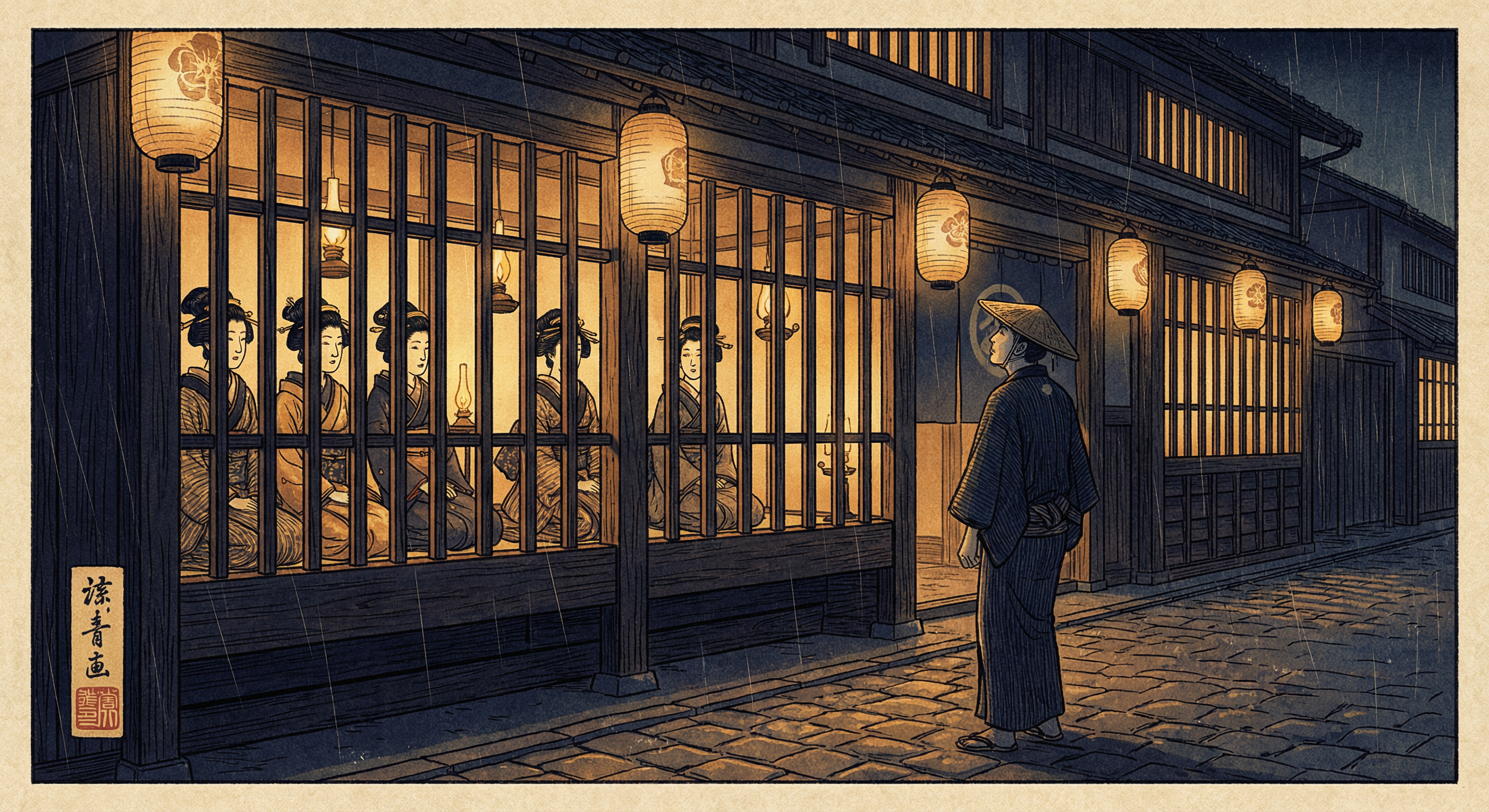
The Reality Behind the Glamour
Debt Bondage and the Ohaguro-dobu Moat
Most Yoshiwara courtesans did not choose their work. They were sold, usually as children, by families crushed by rural poverty. The sale was framed as an advance on wages, but in practice it was indentured servitude that the women could rarely pay off.
To prevent escape, the quarter was surrounded by a moat called the ohaguro-dobu (お歯黒どぶ), named after the black tooth dye worn by married women. For lower-ranking courtesans, conditions inside were harsh: poor food, beatings, and little care for those who fell ill or aged out of demand.
Miuke: The Price of Freedom
For a courtesan bound by debt, the main way out was miuke (身請), being bought out by a patron who paid her remaining debt to the house.
The sums could be enormous. Buying out a top courtesan could cost hundreds to over a thousand ryō, and one buyout in 1775 was reported at 1,400 ryō. Later, in the Kansei era (1789–1801), a ceiling of 500 ryō is said to have been set.
A buyout was sealed with a written contract, the miuke shōmon (身請証文). Surviving examples include a promise that the woman would not be sent back into the trade, and that if the patron later separated from her, he would provide 100 ryō and a house. In theory, miuke offered a new life. In practice, it was open only to the few who attracted a patron of extraordinary wealth.
The Umemotoya Fire of 1849: When Courtesans Fought Back
In 1849, sixteen courtesans of the Umemotoya (梅本屋) house, unable to bear the hunger and violence inflicted by their master, set fire to the building, knowing that arson was a capital crime. Their aim was to make the conditions inside public.
The records of the case include diaries kept by the women, describing their daily treatment in their own words. They remain one of the rare first-hand accounts of the Yoshiwara from the courtesans’ side. The court, aware of how they had been treated, did not impose the death penalty: the four women who carried out the arson were sentenced to exile to a remote island, and the others received lighter punishments.
How Did the Oiran Disappear?
The Maria Luz Incident and the 1872 “Emancipation”
In 1872, a Peruvian ship, the Maria Luz, anchored in Yokohama with Chinese laborers held in slave-like conditions. When Japan moved to free them, the ship’s side argued that Japan itself kept women in bondage in its pleasure quarters.
Embarrassed, the Meiji government issued the Geishōgi Kaihōrei (芸娼妓解放令), an order releasing courtesans and geisha from bonded service. It is sometimes nicknamed the “cattle release” order because of the wording of a related ministry notice.
The emancipation changed little. Prostitution was not abolished; courtesans were redefined as women working “of their own free will,” the houses were renamed kashizashiki (貸座敷, “rented rooms”), and many women, still bound by debt, returned to the same work.
The Yoshiwara in the 20th Century
The Yoshiwara survived the fall of the shogunate and continued through the Taishō and early Shōwa periods with hundreds of houses and thousands of women.
The Great Kantō Earthquake of 1923 brought disaster. As fire swept through the quarter, people fled to the pond at its edge, the Benten-ike, and many died there. The site is now the Yoshiwara Benzaiten, a small shrine where the dead are still remembered.
1958: The End of the Yoshiwara
After World War II, the Yoshiwara became one of the akasen (赤線, “red-line”) districts, where prostitution was tolerated. On April 1, 1958, the penal provisions of Japan’s Anti-Prostitution Law (Baishun Bōshi Hō) took full effect, and the licensed Yoshiwara, 341 years after it first opened, came to an end. The oiran had by then long been a memory, but 1958 closed the world that had produced them.
The institution that did not close. The hanamachi was never part of the licensed quarter — different law, different work — and it kept going. Three Asakusa geisha leaving a tea house, filmed on an ordinary evening.
Do Oiran Still Exist Today?
No. The oiran were a licensed profession of the Yoshiwara, and that profession ended with the Anti-Prostitution Law in 1958. No one has worked as an oiran since. What survives is the spectacle: reenacted processions at festivals, and costume studios that recreate the look.
Where to See an Oiran Procession Today
Oku-Asakusa Matsuri: Edo Yoshiwara Oiran Dōchū (Asakusa, Tokyo)
- When
- Once a year in spring. In 2026 it was held on March 15.
- Where
- Sanyabori Plaza in Sumida Park, a short walk from the site of the old Yoshiwara.
- Good to know
- The closest procession to the Yoshiwara itself, with full regalia and the soto-hachimonji step.
Asakusa Kannon Ura Ichiyo Sakura Matsuri (Asakusa, Tokyo)
- When
- April (April 11 in 2026).
- Where
- The cherry-lined streets about 500 meters north of Sensō-ji.
- Good to know
- This festival long hosted the Edo Yoshiwara oiran procession. Check the organizer’s program for the current year before you go.
Bunsui Oiran Dōchū (Tsubame, Niigata)
- When
- April, under the cherry blossoms. The 81st edition was held on April 12, 2026.
- Where
- Along the Ōkōzu channel in the Bunsui area of Tsubame City.
- Good to know
- One of the best-known oiran processions outside Tokyo, with three women chosen each year to play the oiran.
Edo Wonderland Nikkō Edomura (Nikkō, Tochigi)
- When
- The park stages oiran processions as part of its shows. Times vary by season.
- Where
- Kinugawa Onsen area, Nikkō.
- Good to know
- A theme park recreation of an Edo town, so the procession is staged as part of the show. Check the schedule on the day.
Oiran Photo Studios
A number of studios in Kyoto, Tokyo and Chiba offer oiran henshin (花魁変身), transformation experiences in which visitors are dressed, styled and photographed in full oiran costume. They are a hands-on way to appreciate the hair, the layered kimono and the accessories. For a comparison of oiran, geisha and maiko photo experiences, see our guide to Geisha Photoshoots in Tokyo.
It is worth being clear about what these are: costume experiences. They are separate from the geisha tradition, whose practitioners are working performing artists.
What Continued: The Geisha of Asakusa
The oiran did not survive, but the geisha, who worked alongside them in the Yoshiwara as a separate profession, did. In Asakusa, a small number of geisha still perform at ozashiki (private geisha banquets) in the same neighborhood that once housed the quarter.
Historically, the licensed courtesans of the Yoshiwara provided companionship, including intimate services, as a recognized occupation, while geisha sold their art.
What’s also striking is that the guests of that era were performers themselves. They played shamisen, they sang, they danced. Sitting in the ozashiki with geisha was a little like karaoke today, except everyone in the room was the performer. That kind of guest is rare now, but they still appear from time to time at our tea house.
So an oiran procession at a festival is a reenactment of a profession that no longer exists, while an ozashiki with geisha is a living tradition. For who Asakusa’s geisha are today, including their ranks and roles, see our Asakusa geisha encyclopedia. For practical advice on arranging a geisha experience in Tokyo, including what to expect, see our dedicated guide, and to see what an evening actually looks like, read Experiencing an Authentic Geisha Show in Asakusa.
To go deeper into the history of geisha and courtesans, see our Complete History Guide, and for a broader look at training and customs, Geisha Culture in Japan.
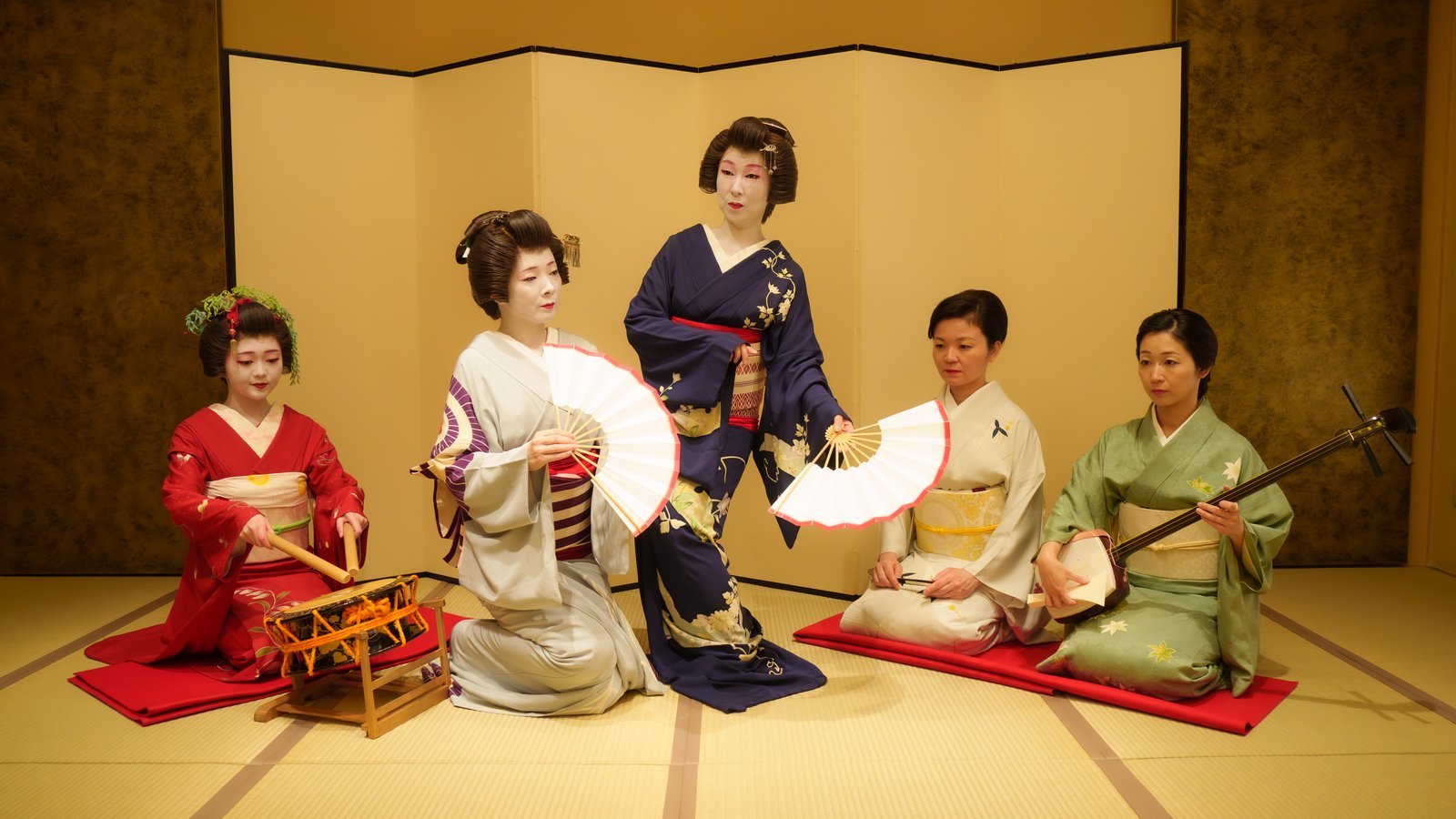
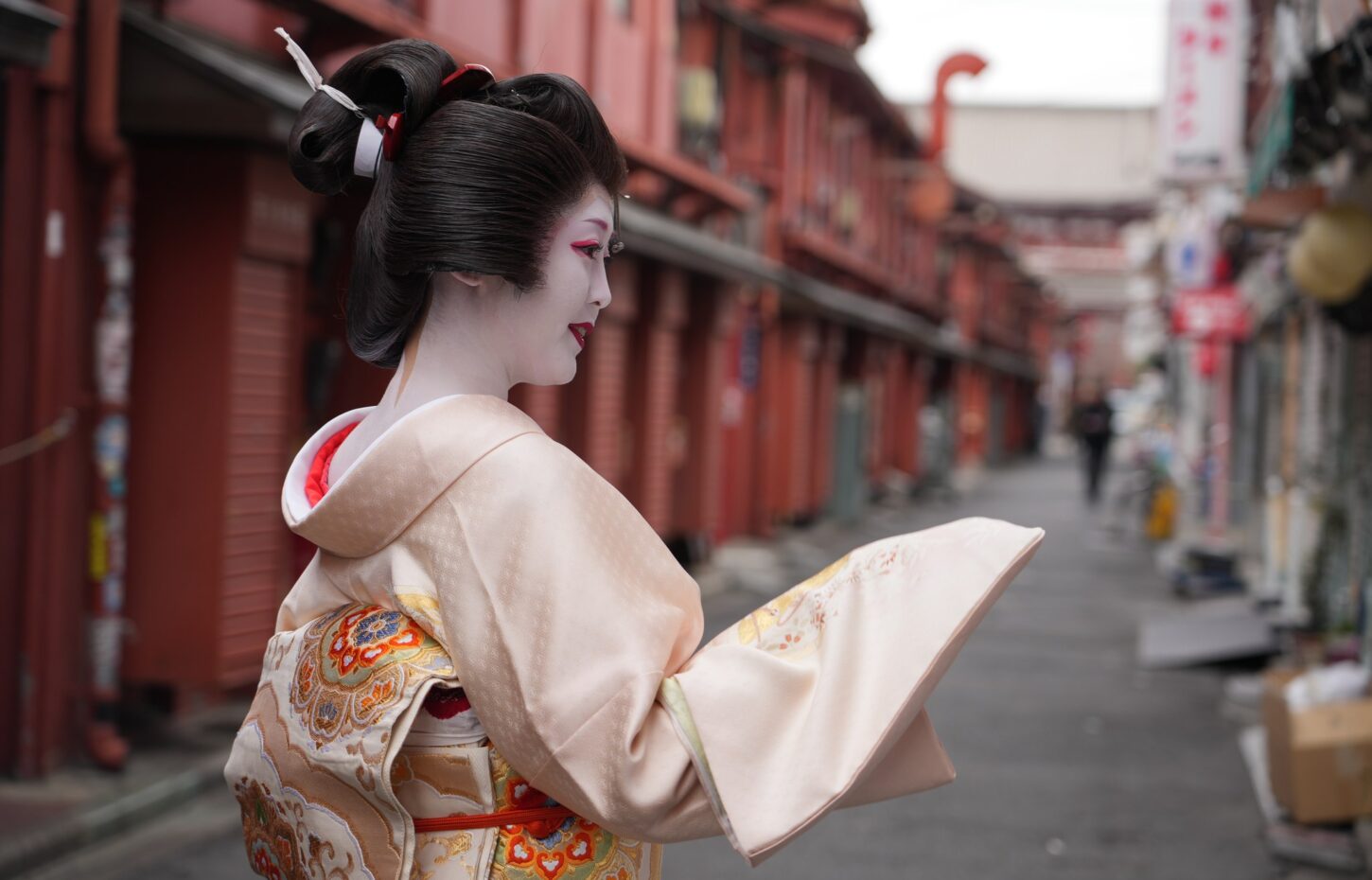
A costume is not a profession. This is a jikata geisha — the one who plays rather than dances — at work in Asakusa, without the white makeup that photo studios treat as the whole point. The difference the next section draws is about the job, not the face.
Frequently Asked Questions
What does oiran mean in Japanese?
Oiran (花魁) was the name for the highest-ranking courtesans of the Yoshiwara pleasure quarter in Edo. The word is usually traced to “oira no nēsan” (“our big sister”), the phrase their young attendants used for them. The kanji mean “the first among flowers.”
Were oiran prostitutes?
Yes. Oiran were licensed courtesans, and their work included intimate services. They were also highly trained in the arts and etiquette, and in the classic account of the early Yoshiwara a client had to meet elaborate conditions before intimacy was allowed.
Do oiran still exist in Japan?
No. The profession ended when the Yoshiwara closed under the Anti-Prostitution Law in 1958. Oiran processions at festivals and oiran photo studios are reenactments.
What were the oiran ranks in order?
From the late 18th century, from highest to lowest: yobidashi, chūsan, zashikimochi, heyamochi, and kirimise. In common usage, “oiran” meant the top ranks, the yobidashi and chūsan. Before that, the highest rank was the tayū.
What is the difference between an oiran and a tayū?
Tayū were the highest-ranking courtesans of the early Yoshiwara, famous for their education. They had disappeared from the Yoshiwara by the 1760s, and the oiran ranks took their place at the top.
What is a kamuro?
A kamuro was a young girl, typically around ten, who served a senior courtesan as an attendant while learning the customs and arts of the quarter. The word “oiran” itself is thought to come from how kamuro addressed their senior.
Is an oiran the same as a geisha?
No. Oiran were licensed courtesans; geisha are performing artists, and the two professions were kept separate in the Yoshiwara. Geisha are still active today. See Oiran vs Geisha: What’s the Difference? for the full comparison.
Spend an Evening with Asakusa’s Geisha
Miyakodori, founded in 1950, is the only machiai-chaya in Asakusa. Request a private ozashiki (a private gathering with geisha) and spend an evening in a tatami room with Asakusa geisha, with English support throughout.
Request a Reservation


- Asakusa Nightlife 2026: A Guide to Tokyo’s Historic Heart After Dark
- Top Rated Traditional Japanese Restaurants Near Me: Authentic Flavors and Sushi
Enjoying Exquisite Shaved Ice in Asakusa! Top 6 Local Favorites Part 2
The Asakusa Geisha District: A Journey Through Time, Tradition, and Authentic Experiences
Asakusa Sightseeing with a Stroller: Family-Friendly Attractions & Gourmet Guide Part 2
A Special Year-End in Asakusa! 5 Hidden Spots to Enjoy While Avoiding Crowds
Asakusa Geisha: Where to Meet Real Geisha in Tokyo
How to Get from Haneda or Narita Airport to Asakusa: A Local’s Guide
Comment ( 0 )
Trackbacks are closed.

No comments yet.