



How Much Is a Geisha Dinner in Tokyo? (Complete Pricing Guide)
At Miyakodori in Asakusa, a geisha dinner starts from ¥34,000 per person (daytime, 4+ guests) and ranges up to ¥300,000 for a solo three-hour evening with a full kaiseki dinner included. The price varies by plan duration, time of day, and group size — a larger group makes the per-person cost significantly more affordable.
In this guide, we break down every plan, every price, what’s included, what costs extra, and why the experience is priced the way it is. Whether you’re planning for two or organizing a private group event, this is everything you need to know before booking.
What Is a Geisha Dinner, Exactly?
Before diving into numbers, it helps to understand what you’re actually booking.
Ozashiki (Geisha Banquet) vs. a Regular Restaurant
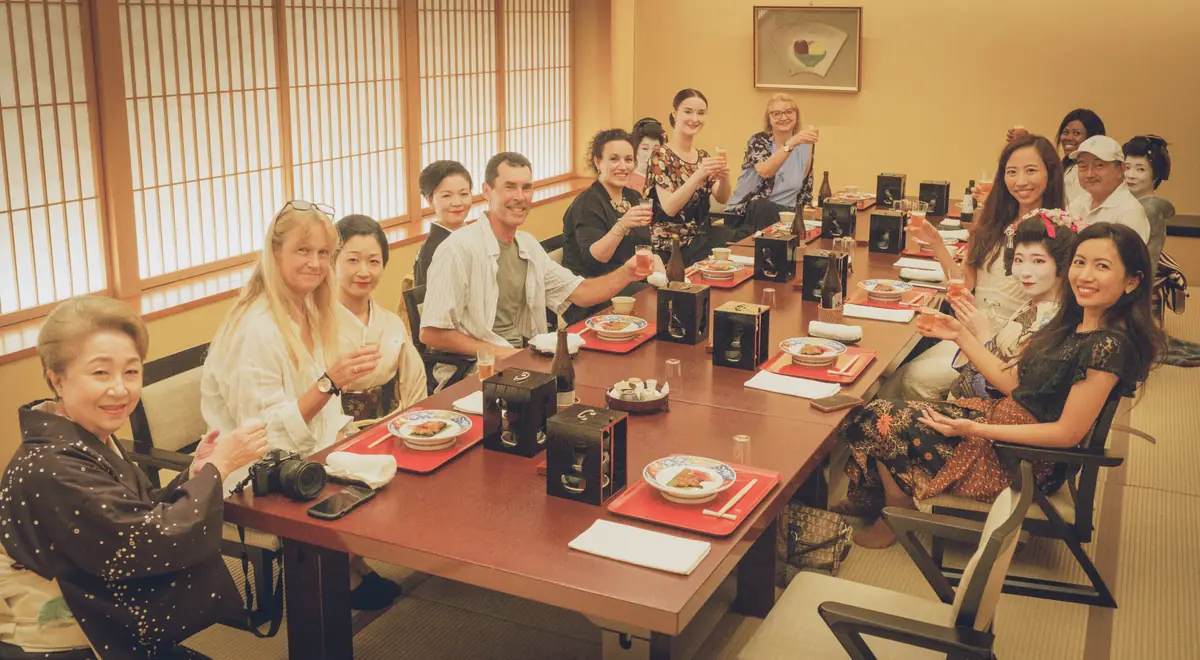
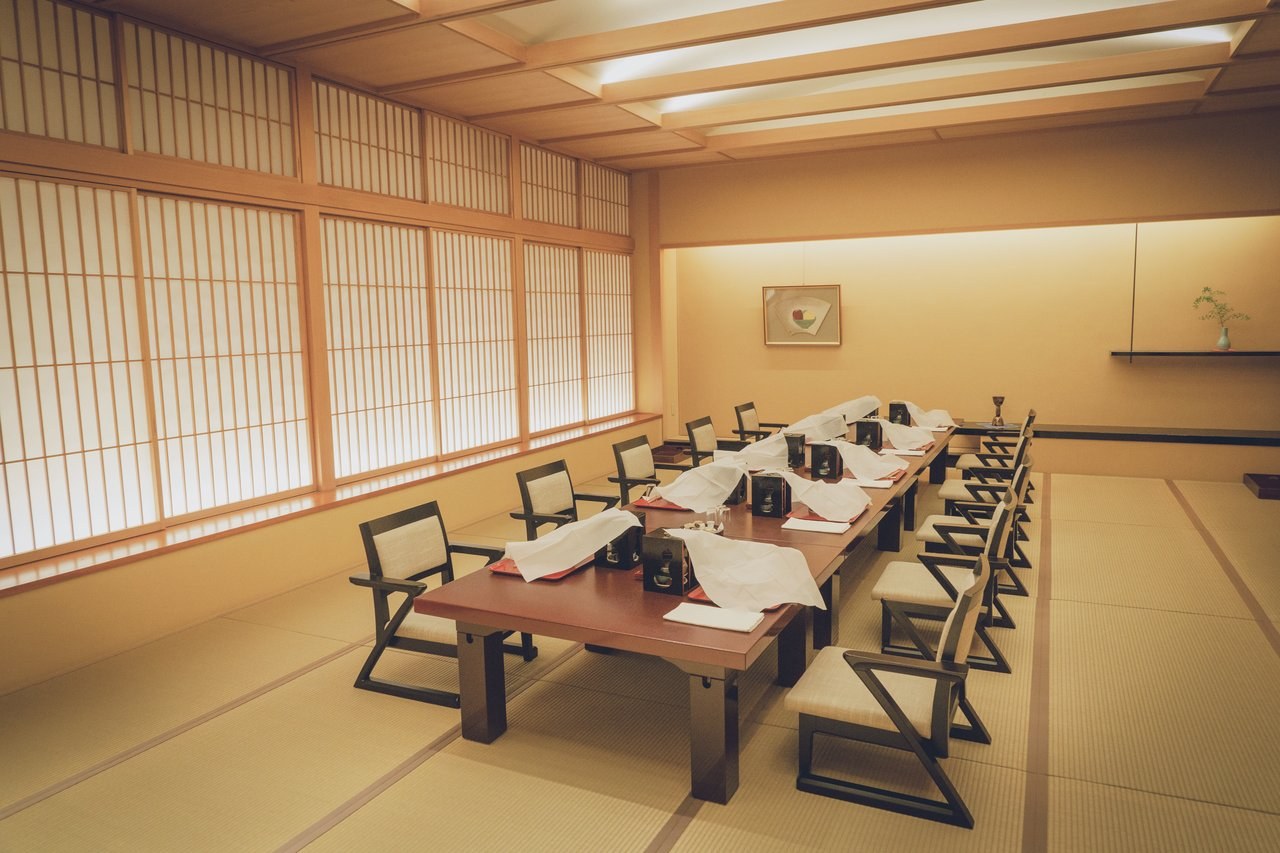
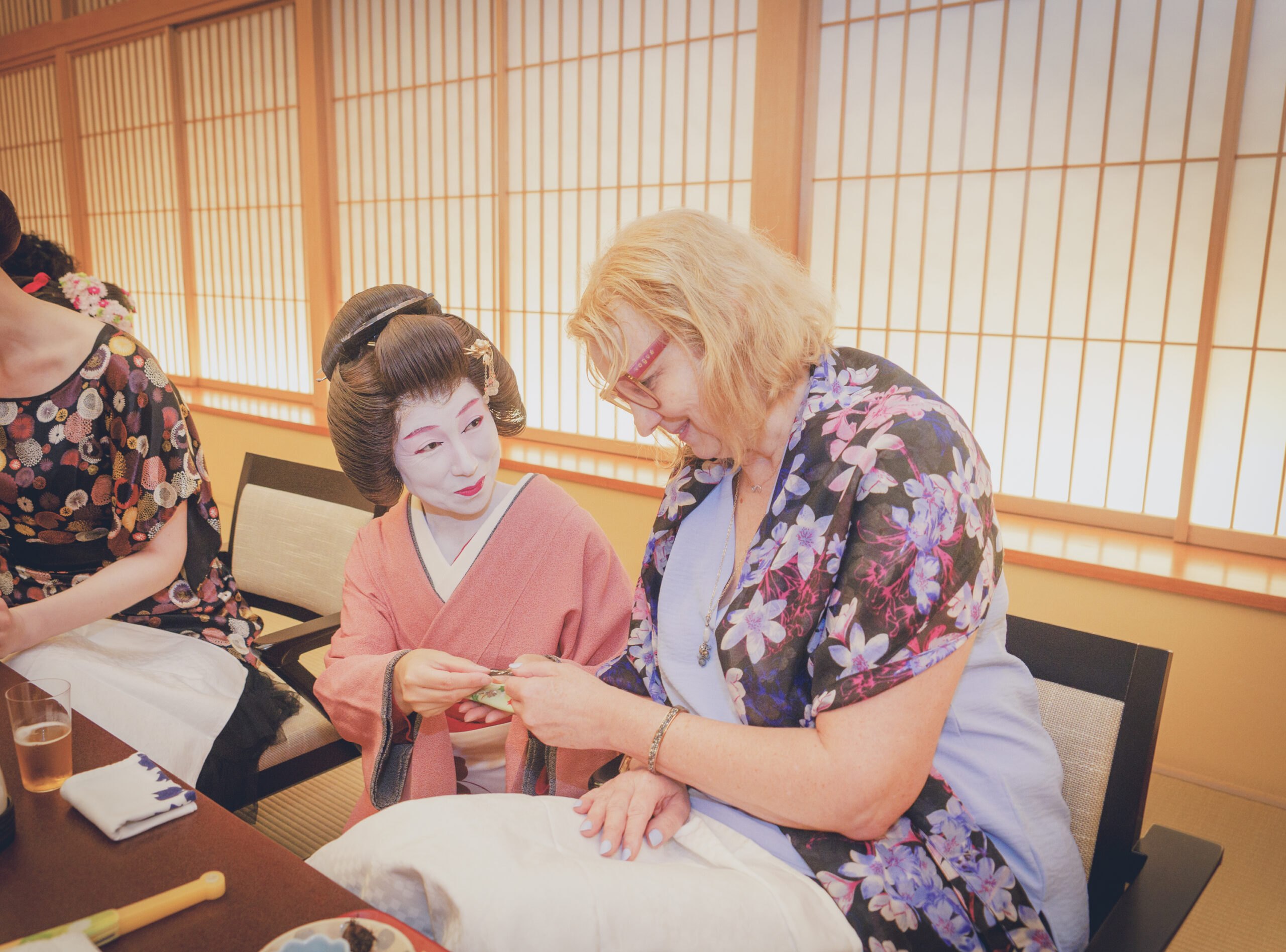
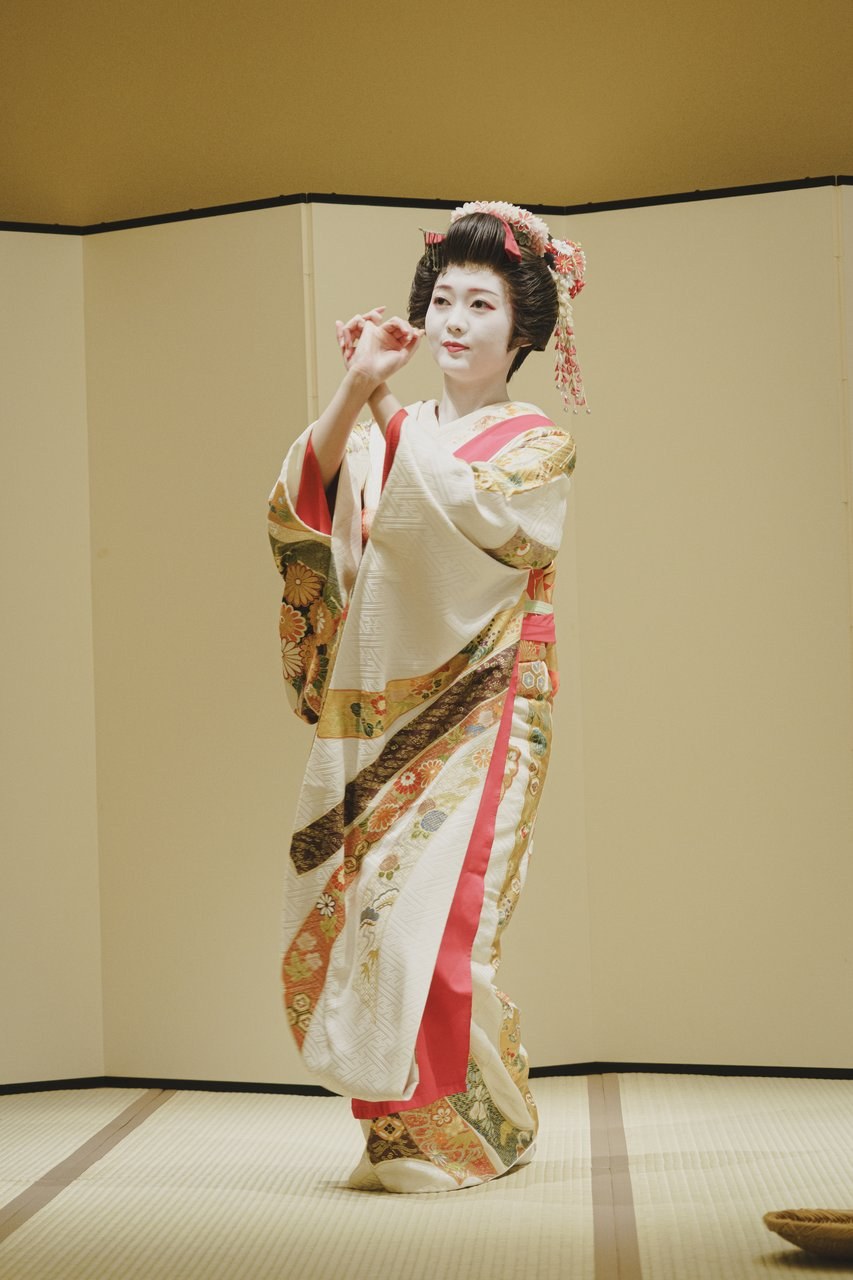
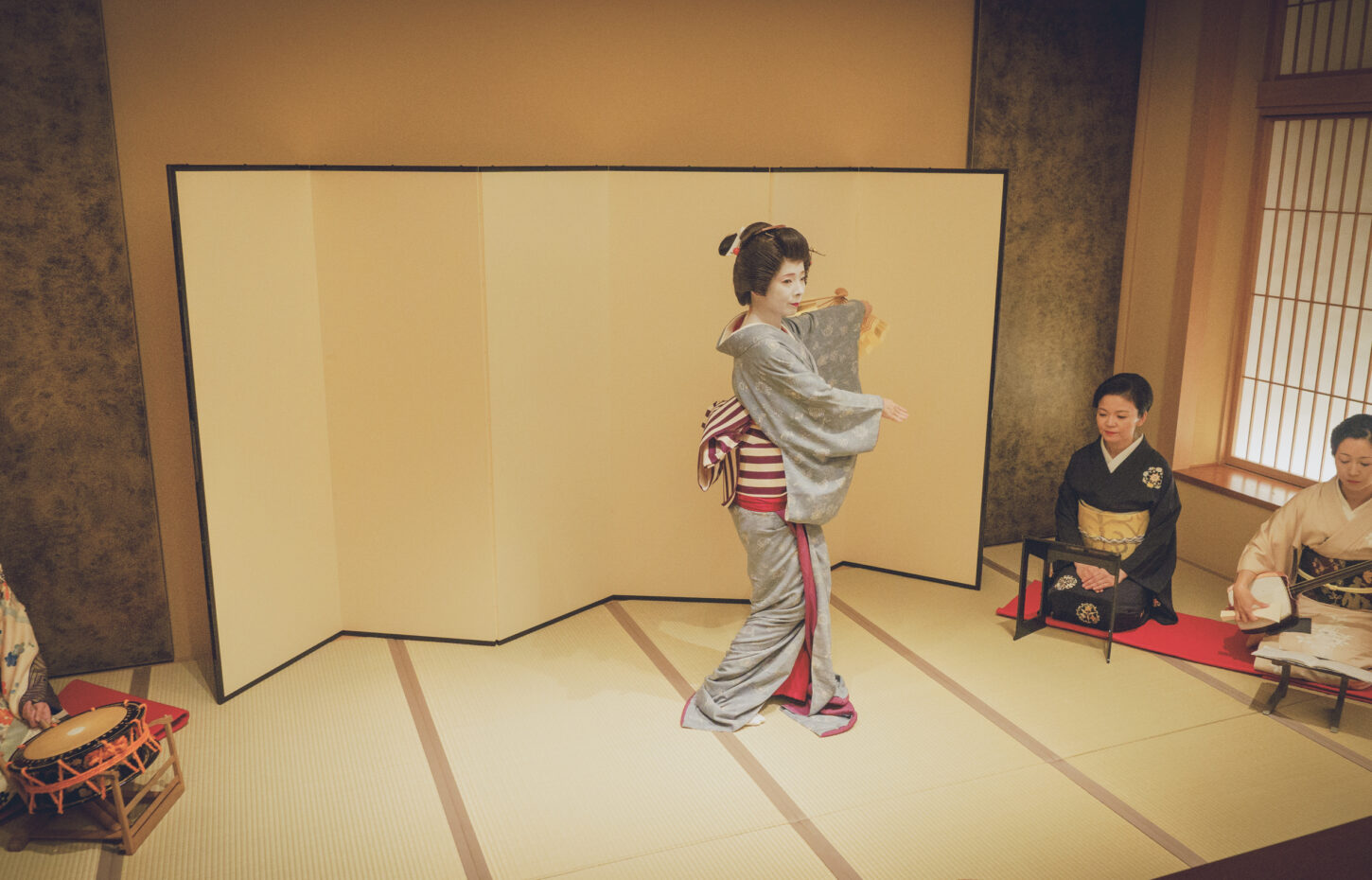
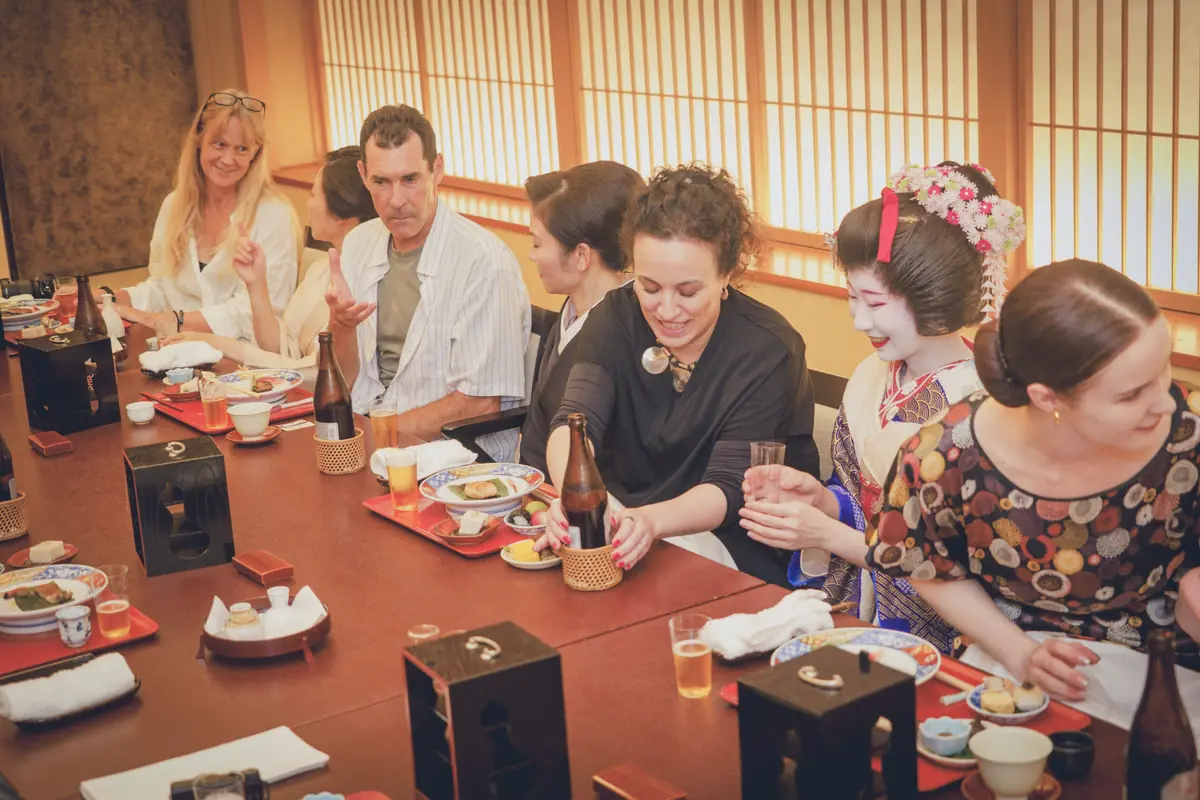
An ozashiki (geisha banquet) is a private dining experience in which guests are entertained by geisha — performing traditional dance, playing shamisen, engaging in ozashiki parlor games, and conversing — in an exclusive tatami room. It is fundamentally different from going to a restaurant, attending a geisha show, or booking a group tour.
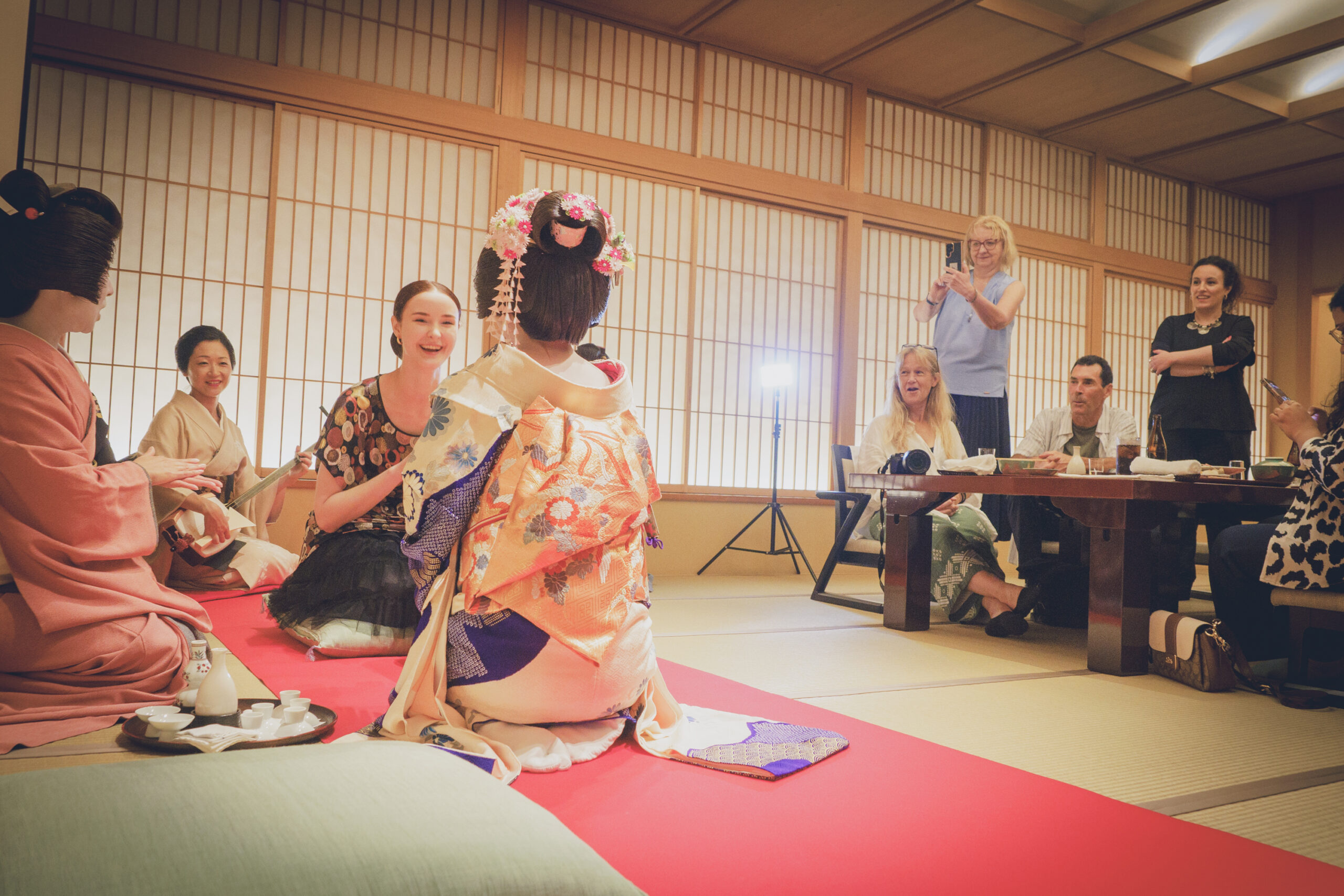
At most other venues, geisha entertainment is a stage performance: guests sit at a distance and watch. At Miyakodori, the geisha sit in the same room, perform in front of you, and then play with you — joining ozashiki games, sharing conversation through an English interpreter, and creating a genuinely interactive experience. This is the distinction between a show and an ozashiki (geisha banquet).
Miyakodori operates as a machiai-chaya — the traditional tea house that arranges and hosts an ozashiki — and it is the only machiai-chaya in Asakusa. Unlike a traditional ryotei (Japanese haute cuisine restaurant), a machiai-chaya does not produce its own food. Instead, it sources dishes from specialist suppliers — kaiseki cuisine, seasonal bento, A5 Wagyu — and arranges the geisha, the private room, and the cultural experience itself. This flexibility means dietary needs such as vegan, halal, or gluten-free menus can be accommodated at a level most ryotei cannot match.
For a deeper understanding of the ozashiki (geisha banquet) experience, see our tatami room & private space details.
What’s Included in the Price?
The short answer: the geisha, the private tatami room, English interpretation, dance performance, ozashiki games, and conversation. Food and some drinks vary by plan.
Here is how each plan handles drinks and food:
1-Hour Plan (Geisha Highlights)
- Drinks: One drink is required per guest (ordered separately, not included in the base price)
- Food: Optional add-ons available (Matcha & Seasonal Sweet, A5 Wagyu, etc.) — not recommended due to time constraints
2-Hour Plan (Geisha Elegance)
- Drinks: Free-flow included — beer, house sake (hot or cold), and select non-alcoholic options
- Free-flow does not include wine, shochu, whisky, premium sake by brand (e.g. Dassai), or paid soft drinks — those are charged separately
- Food: Optional add-ons available (Seasonal Bento, A5 Wagyu, Kaiseki Course) — must be requested at least 2 days in advance
3-Hour Plan (Twilight Gathering)
- Drinks: Free-flow included (same range as above)
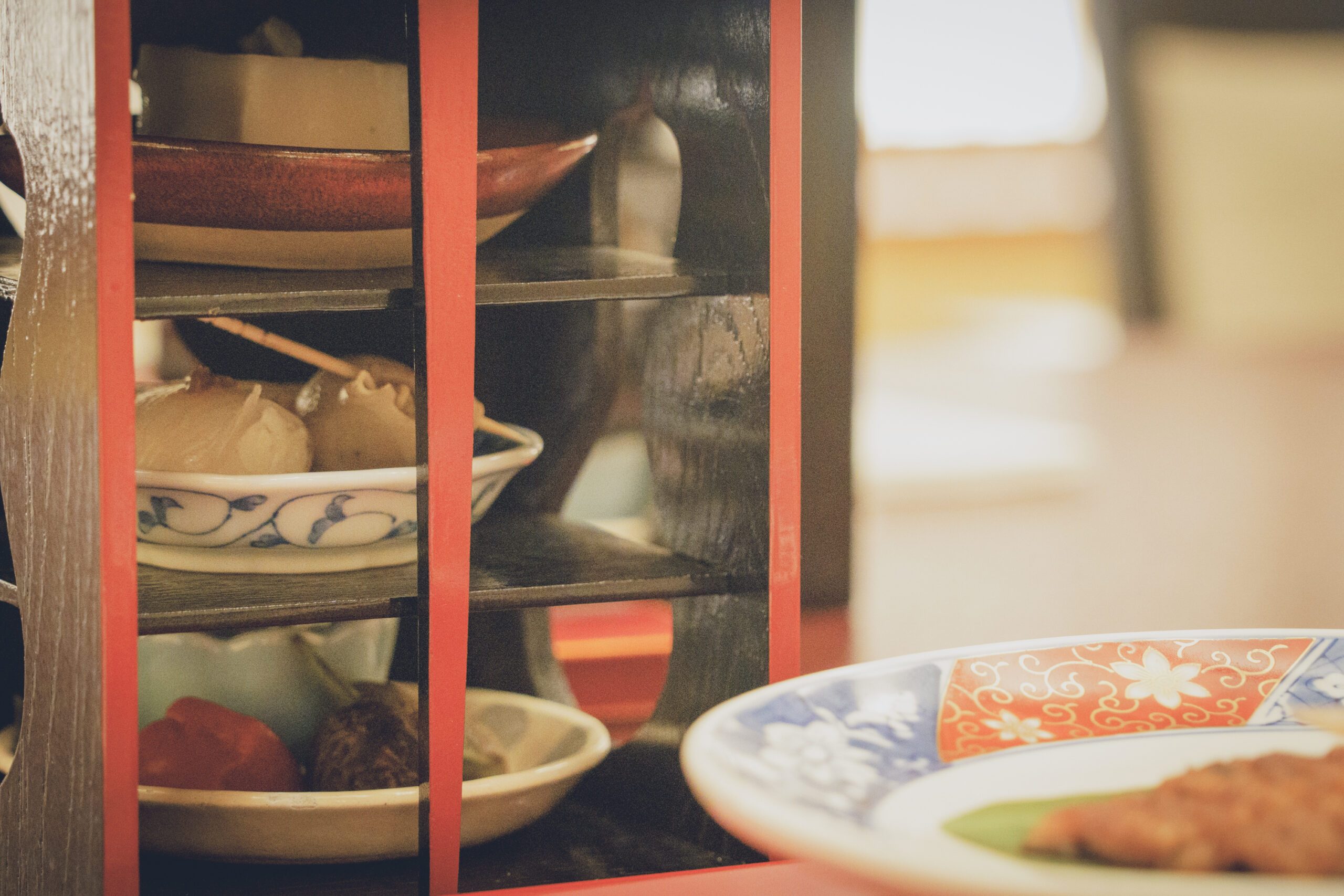
- Food: Full kaiseki course is included in the base price
Miyakodori Geisha Dinner Pricing (Full Breakdown)
For Miyakodori’s complete pricing page, see Miyakodori’s full pricing page. All prices below are per person, tax included.
1-Hour Plan — Geisha Highlights
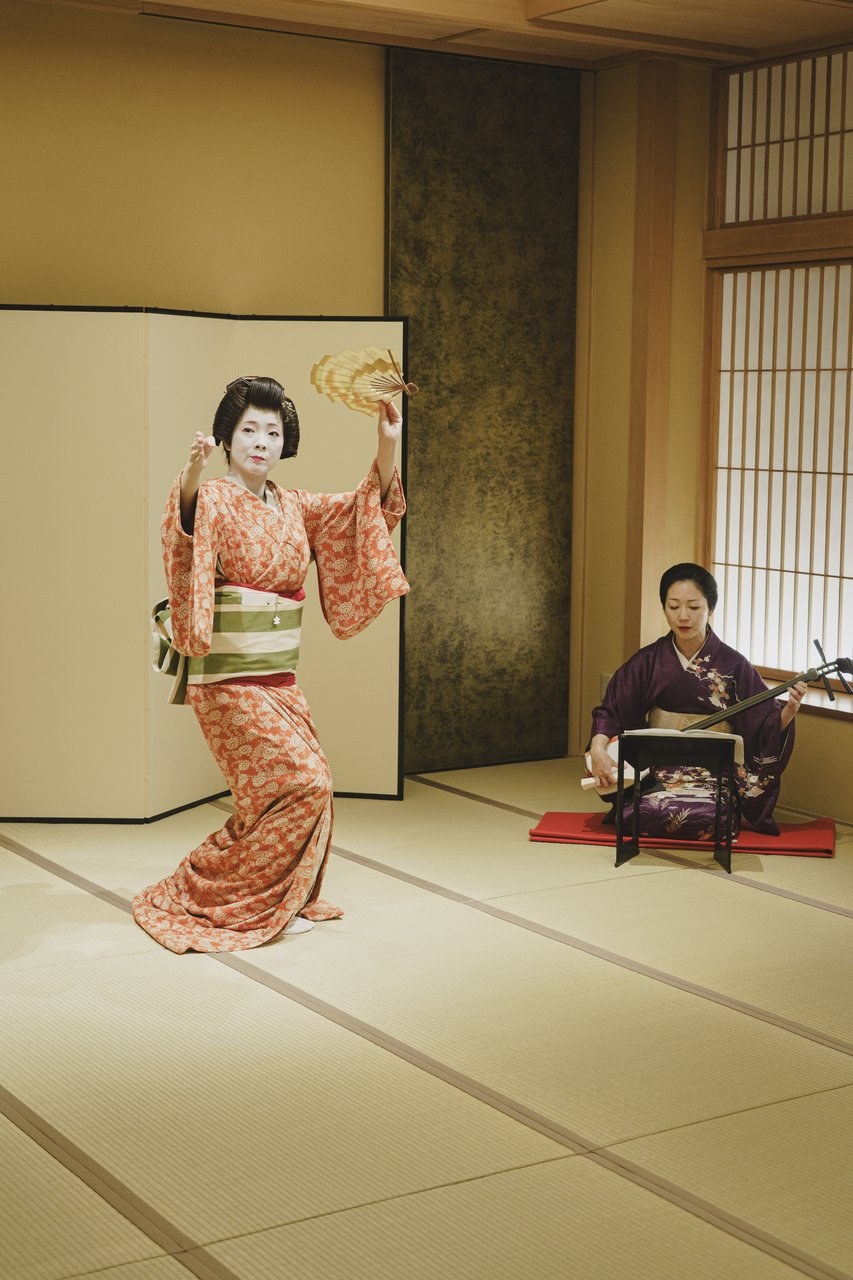
The 1-hour plan is designed as an introduction to geisha culture — enough time for a welcome, a traditional dance performed to live shamisen, and a round of ozashiki parlour games.
Schedule overview:
- Geisha arrival & introduction
- Traditional dance with live shamisen accompaniment (~15 min)
- Ozashiki games (~25 min)
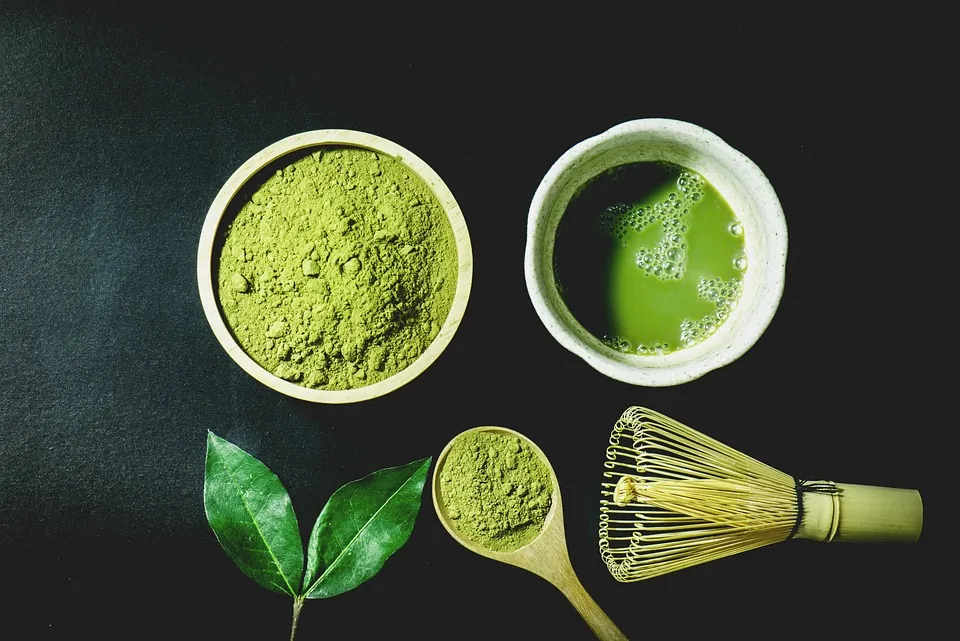
- Optional: Matcha & seasonal sweet
- Commemorative photograph & Tejime (ritual clapping ceremony)
Pricing (per person, tax included — daytime, sessions start 14:00–17:00):
| Guests | Price per person |
|---|---|
| 1 guest | ¥121,000 |
| 2 guests | ¥63,000 |
| 3 guests | ¥44,000 |
| 4+ guests | ¥34,000 |
One drink per guest required (ordered separately). 2 geisha attend; groups of 7+ have 3 geisha. Evening sessions (starting 17:30–20:00) are also available at ¥140,000 for 1 guest, ¥73,000 per person for 2 guests, ¥52,000 per person for 3 guests, and ¥40,000 per person for 4+ guests.
2-Hour Plan — Geisha Elegance (Most Popular)
The 2-hour plan is Miyakodori’s signature experience and the most widely chosen option. It allows enough time for dance, games, free conversation, and a genuine connection with the geisha.
Schedule overview:
- Geisha arrival & introduction
- Traditional dance with live shamisen (~15 min)
- Ozashiki games (~45 min)
- Free conversation with the geisha, English interpretation included (~20 min)
- Commemorative photograph & Tejime
Pricing (per person, tax included — same rate for daytime and evening):
| Guests | Price per person |
|---|---|
| 1 guest | ¥153,000 |
| 2 guests | ¥81,000 |
| 3 guests | ¥57,000 |
| 4+ guests | ¥45,000 |
Free-flow drinks (beer, house sake, select non-alcoholic) included. Food add-ons available with 2-day advance notice. 2 geisha attend; groups of 6+ have 3 geisha.
At Miyakodori, the 2-hour plan is the experience we most often recommend. The extra hour beyond the 1-hour plan allows the conversation and the games to breathe — you move from spectator to participant, and the evening takes on a genuinely different quality.
3-Hour Plan — Twilight Gathering
The 3-hour plan is Miyakodori’s most immersive offering. A full kaiseki multi-course dinner is served alongside the geisha experience, and the evening unfolds at a pace that mirrors a traditional ozashiki (geisha banquet) from Asakusa’s golden era.
Schedule overview:
- Geisha arrival & kaiseki dinner begins
- Traditional dance with live shamisen (~15 min)
- Ozashiki games (~60 min)
- Extended conversation & cultural exchange (~45 min)
- Commemorative photograph & Tejime
Pricing (per person, tax included — Evening only from 17:30):
| Guests | Price per person |
|---|---|
| 1 guest | ¥300,000 |
| 2 guests | ¥179,000 |
| 3 guests | ¥130,000 |
| 4+ guests | ¥106,000 |
Full kaiseki course & free-flow drinks (beer, house sake, select non-alcoholic) included. Minimum 3 geisha attend; groups of 6+ have 4 geisha. Evening sessions only. Solo guests are welcome: ¥300,000 in total for one guest.
Ozashiki Tea House — Matcha with Geisha (Budget-Friendly Entry)
For those who want to experience geisha culture at a more accessible price point, Miyakodori offers the Ozashiki Tea House: a 75-minute shared experience held on Monday, Wednesday, and Friday afternoons starting at 15:00.
Unlike the private plans above, this is a shared session (other guests may be present). It includes a live shamisen performance, traditional dance, a Q&A with the geisha, an ozashiki game (Konpira Fune Fune), matcha and seasonal Japanese sweets, and a photo session.
Price: ¥17,600 per person (tax included) — special campaign price (regular price ¥22,000)
One drink per guest required (ordered separately). Online booking available until 14:00 on the day; after that, phone or walk-in welcome.
- Ozashiki Tea House — ¥17,600/person — 75-min shared session with geisha; matcha & sweets included. A recommended entry point for first-time guests.
- Private Ozashiki (1–3 Hours) — from ¥34,000/person — the full geisha banquet experience in your own tatami room, with live dance, shamisen, games, and conversation. This is the experience we recommend for guests who want the real thing. See the private ozashiki details.
Ready to reserve your private geisha dinner?
Reserve your private ozashiki (geisha banquet) at Miyakodori — no introduction required. Check availability and send your request today.
Why Does the Price Per Person Change by Group Size?
The pricing structure at Miyakodori — where solo guests pay far more than groups of four — is not arbitrary. It reflects the actual economics of a geisha experience.
Regardless of how many guests book, the minimum number of geisha who attend is fixed: two for the 1-hour and 2-hour plans, three for the 3-hour plan. The geisha’s time and the room are reserved for the entire session. If you book alone, you are still receiving the full commitment of the geisha (two, or three on the 3-hour plan) and the private room — the cost simply isn’t shared across multiple guests.
To see this in practice: for the 2-hour plan, two guests each pay ¥81,000, totalling ¥162,000 for the session. Four guests each pay ¥45,000, totalling ¥180,000. The per-person rate drops significantly, while the overall experience — the same two geisha, the same tatami room, the same 2 hours — remains unchanged.
In short: the more guests you bring, the more affordable the per-person rate becomes.
Understanding Geisha Staffing — From 2 to 7
The number of geisha present doesn’t just affect the cost — it shapes what the experience feels like. Here is how the different configurations compare.
1 geisha (dance only, pre-recorded music)
Not recommended. Without a live musician, the performance lacks the core of what makes an ozashiki (geisha banquet) distinctive — the intersection of live dance, live shamisen, and live song.
2 geisha — the minimum for a complete performance
This is the standard configuration for 1-hour and 2-hour plans. One geisha performs as the jikata (musician), handling both shamisen and vocal accompaniment simultaneously. The other performs as the tachikata (dancer). The result is a complete performance: live music, live singing, live dance — all in one room, in front of you.
In our experience, two geisha is the threshold at which the art form works. It is the minimum that makes the performance genuine.
3+ geisha — where the art begins to shine
With three geisha, the jikata still handles music while two tachikata perform. The difference is subtle but meaningful: two dancers can express slightly different interpretations of the same piece — different postures at moments of stillness, different nuances of expression, different emotional shadings. The repertoire of pieces that can be performed also expands. Guests who have experienced both configurations consistently note that three feels more complete.
We describe the difference this way: two geisha makes the art work; three or more makes the art shine.
5 geisha — the experience at its most expressive
With five geisha (two jikata, three tachikata), the vocal and shamisen duties are divided between specialists. Each musician focuses entirely on a single discipline, which deepens the expression considerably. Three dancers performing simultaneously creates a layered, full-room presence that guests describe as overwhelming in the best sense. When guests ask us what the optimal configuration is, five is our answer.
7+ geisha
Even more immersive — the dynamic shifts again, and the experience begins to resemble the full-scale ozashiki (geisha banquet) gatherings of earlier eras.
Most Miyakodori bookings involve 2 geisha. For guests who want to deepen the experience, we recommend requesting 3 or more. Additional geisha can be arranged at booking — see the add-ons section below.
Optional Add-Ons That Affect the Total Cost
Several options can be added to your base plan, each with its own pricing and availability conditions.
| Add-On | Price | Conditions |
|---|---|---|
| Matcha & Seasonal Sweet | ¥1,800/person | All plans; must order for all guests |
| Seasonal Bento | ¥7,500/person | 2-hour plan recommended; 2-day advance notice; not suitable for 1-hour (time constraints) |
| A5 Wagyu Beef | ¥12,000/person | All plans; must order for all guests |
| Kaiseki Course | ¥18,000/person | 2-hour plan; 2-day advance notice; not applicable to 3-hour (already included) |
| Additional Geisha | +¥45,000/geisha (1H daytime) / +¥60,000/geisha (1H evening and 2H) / +¥75,000/geisha (3H); the first geisha you add is ¥10,000 less | By request at time of booking |
| Extension (+60 min) | ¥26,000/person | Subject to same-day availability |
A few practical notes:
- Food add-ons for the 1-hour plan are technically available but not recommended — the session is short enough that adding a full meal creates time pressure.
- The Kaiseki Course add-on is not available with the 3-hour plan because kaiseki is already included in the base price.
- Additional geisha must be requested at the time of booking. They cannot be added on the day.
- The Extension is subject to availability and confirmed on the day of your visit.
Beyond the Base Price: The Culture of Goshugi
There is one more element of a geisha evening that costs money — but only if you choose. It is also the element that, more than any other, distinguishes a guest who understands geisha culture from one who is simply visiting.
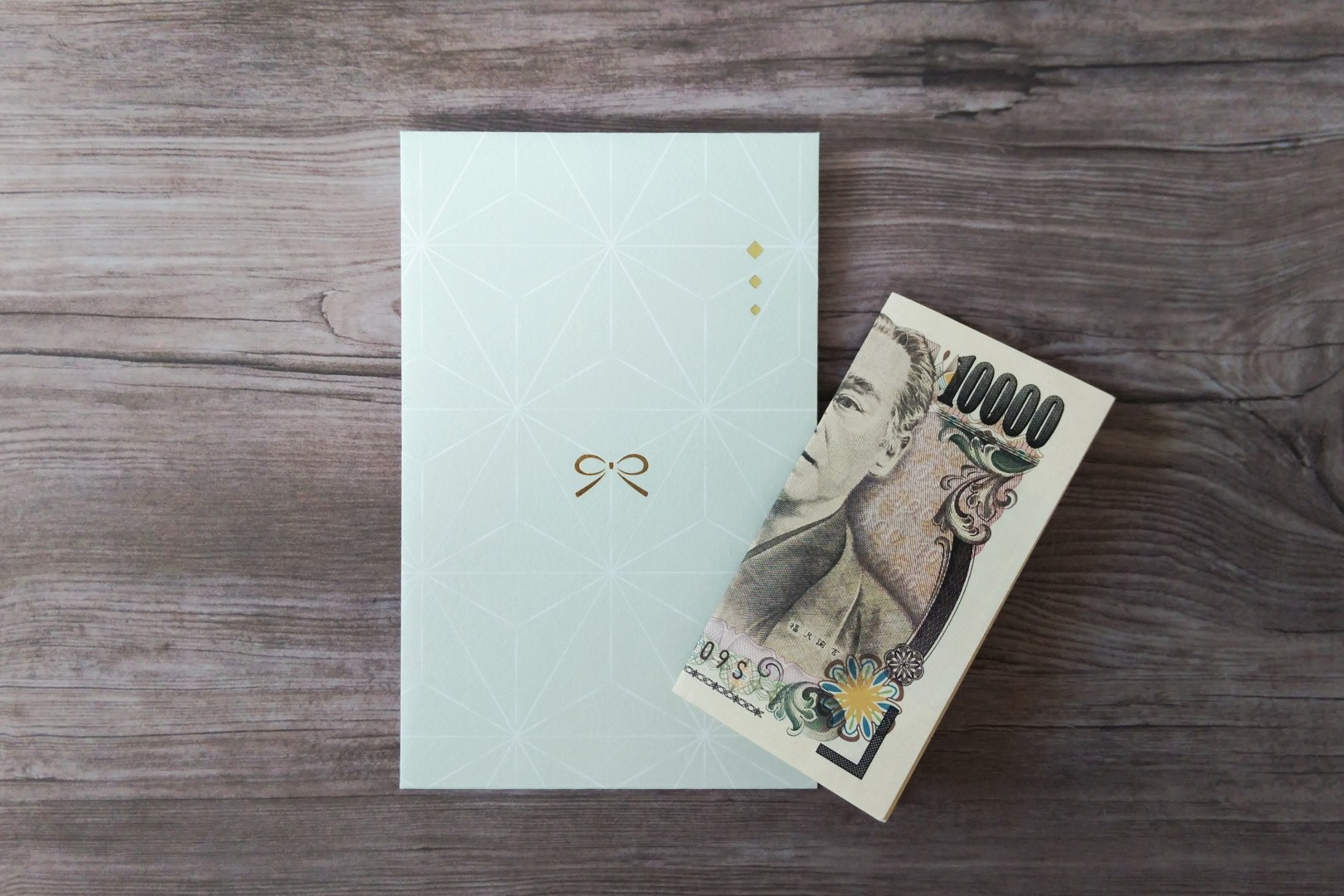
Goshugi (御祝儀) is a traditional monetary gift that guests present to the geisha — a practice that has existed in geisha houses for generations. It is placed inside a pochi-bukuro (ポチ袋 — a small decorative envelope) and offered after the geisha have performed. The guest who prepares goshugi is known, in the language of the flower district, as an “iki (粋) na okyakusama” — a sophisticated, tasteful guest. The phrase carries genuine respect.
Goshugi is not a tip in the Western sense. The table below clarifies the difference:
| Goshugi (御祝儀) | Tip | |
|---|---|---|
| Timing | After the performance — during the first half of the evening | After the experience ends |
| Meaning | A gesture of cultural appreciation; a gift prepared in advance for the geisha’s art | Compensation for service received |
| Given to | The geisha, via the establishment | Restaurant staff (okami, attendants, etc.) |
| Amount | ¥3,000–¥10,000 per geisha | Discretionary |
How much to prepare: ¥3,000–¥10,000 per geisha is the general guideline, with ¥5,000–¥10,000 per geisha being the more common range. If two geisha are attending, preparing goshugi for both is customary.
How to give it — the right way: Do not approach a geisha directly and announce your intention. Instead, quietly let the okami (proprietress) or an attendant know that you have prepared something. They will guide the timing and ensure it is handled gracefully. At Miyakodori, the okami will often prompt you at the right moment.
Three ways to prepare:
A. The establishment provides a pochi-bukuro; you place the cash inside and present it.
B. You hand your cash to the establishment beforehand; they place it in a pochi-bukuro and return it to you; you present it to the geisha.
C. If you are unable to prepare cash on the day — as is common for guests arriving from countries where card payments are the norm — Miyakodori will advance the amount, place it in a pochi-bukuro, and have it ready for you to present. The goshugi amount is then added to your final bill.
Option C exists because “I don’t have cash” should never be the reason you miss the chance to participate in one of geisha culture’s most meaningful traditions. At Miyakodori, first-time international guests can experience the full etiquette — not just observe it.
Goshugi and tipping are separate gestures. Many guests offer both: goshugi to the geisha, and a tip to the establishment’s staff at the end of the evening. Neither is mandatory. Both are welcome.
What sets an ozashiki at Miyakodori apart
- The only machiai-chaya in Asakusa. A machiai-chaya is the traditional tea house that arranges and hosts an ozashiki — and Miyakodori is the only one in Asakusa.
- An okami who was an active geisha. Chikage, the Okami of Miyakodori, has 27 years of experience as a geisha — in the hanamachi ever since her debut in 1969. She is the only proprietress in Asakusa with direct experience as an active geisha.
- Hōkan (Taikomochi) can be invited. Hōkan are Japan’s only male geisha, and Asakusa is the only hanamachi with formally registered hōkan. Inviting a hōkan to perform is part of what an ozashiki at Miyakodori in Asakusa can offer.
- No introduction required. An ozashiki has traditionally been arranged through an introduction from an existing patron. Miyakodori takes reservations directly, including from first-time and overseas guests.
- English-speaking interpreter. An English-speaking interpreter accompanies every private plan.
Is a Geisha Dinner Worth the Price?
This is the question most guests are quietly asking when they read a pricing guide. We will try to answer it honestly.
What you are paying for:
At the 4-guest rate, the 2-hour plan costs ¥45,000 per person. That covers a private tatami room, two geisha for two hours, English interpretation throughout, a live shamisen and vocal performance, multiple rounds of ozashiki games, and conversation. In Tokyo, a comparable private dining experience at a premium restaurant — no entertainment, no performance, no cultural interpretation — costs a similar amount.
The rarity factor:
In 1960, there were approximately 1,060 geisha in Asakusa. Today, around 20 remain. Of the 300 ryotei (traditional restaurants) that once served the flower district, just one still hosts geisha evenings. As of August 2026, that makes two places in Asakusa where you can spend time with geisha: that ryotei, and Miyakodori — the only machiai-chaya in Asakusa, which has opened its doors to first-time guests with no prior introduction required.
The experience you are booking is not something that can be found elsewhere in Tokyo, or in Japan, on the same terms.
The nature of the experience:
What sets an ozashiki (geisha banquet) apart from attending a geisha show or cultural performance is the direction of the interaction. A show is one way: you watch, the performers perform. An ozashiki is not a show.
At Miyakodori, after the geisha dance, the same geisha sit across from you and play. You participate in games where the outcome depends on both of you. You talk. You lose rounds and the geisha laugh with you. The relationship between guest and geisha is bidirectional — a dynamic that simply cannot be replicated in a theatre-style setting.
In our experience, this is what guests remember most. Not the dance, which is beautiful, but the moment when the dynamic shifted from performance to participation.
The 200-year perspective:
The games played at an ozashiki (geisha banquet) today — the same games played at Miyakodori — have not changed in at least 200 years. The guest sitting in that tatami room is seeing, in almost every essential detail, what a Japanese guest saw two centuries ago. The building is different. The decade is different. The experience is not.
It is unusual to find something genuinely 200 years old that is also, as one guest put it, this much fun.
The goshugi dimension:
There is also this: a geisha dinner at Miyakodori is not simply a transaction. The possibility of preparing goshugi, of learning the etiquette, of being guided by the okami through a tradition that predates anyone in the room — this is an invitation to participate in a culture, not merely to consume it. That layer of engagement has no equivalent in other dining experiences.
For more about Miyakodori’s history and the people behind the experience, visit About Miyakodori and its history.
You may also find our Complete Experience Guide and Complete Knowledge Guide useful context before booking.
Practical Booking Information
How to Reserve at Miyakodori
Reservations are made through Miyakodori’s own online reservation form. All bookings are handled as requests — confirmation is not instant. The establishment reviews each request and responds, typically within two business days, to confirm availability and finalize details.
Credit card information is required at the time of booking for all plans.
Cancellation Policy
| Cancellation Timing | Fee |
|---|---|
| 7 days or more before | Free |
| 4-6 days before | 30% of total |
| 3 days before | 50% of total |
| 2 days before | 80% of total |
| 1 day before or day of | 100% of total |
Please note: the 2-day and 1-day rates are different (80% and 100% respectively — it is not 100% from 2 days before). Plan changes and cancellations should be communicated as early as possible.
Payment & Important Notes
- All prices shown are tax included — no additional service charges apply beyond what is listed
- Operating hours: 14:00–20:00 (last seating); closed Saturdays, Sundays, and national holidays
- Food add-ons requiring advance notice (Seasonal Bento, Kaiseki Course) must be specified at least 2 days before the session
- Additional geisha must be requested at the time of booking, not on the day
Frequently Asked Questions
Q1. How much does a geisha dinner cost at Miyakodori in Asakusa?
Prices start from ¥34,000 per person for the 1-hour daytime plan with four or more guests, and reach ¥300,000 for a solo 3-hour booking. The 3-hour Twilight Gathering starts from ¥106,000 per person for groups of four or more (evening only). The most popular option — the 2-hour plan for four guests — is ¥45,000 per person, inclusive of free-flow drinks.
Q2. What drinks and food are included — and what costs extra?
It depends on the plan.
The 1-hour plan does not include any drinks in the base price. One drink per guest is required and charged separately. Food add-ons are technically available but not recommended for a 1-hour session.
The 2-hour plan includes free-flow drinks: beer, house sake (hot or cold), and select non-alcoholic options. The free-flow does not cover wine, shochu, whisky, branded sake (such as Dassai), or paid soft drinks — those are charged as ordered. Food is not included in the base price but can be added: Seasonal Bento (¥7,500/person) or Kaiseki Course (¥18,000/person), with 2-day advance notice required.
The 3-hour plan includes both free-flow drinks and a full kaiseki multi-course dinner in the base price. No food add-on is needed (or available).
Q3. Why is the price per person higher for solo or small groups?
Because the minimum number of geisha is fixed regardless of group size. For the 1-hour and 2-hour plans, two geisha attend no matter how many guests are present. For the 3-hour plan, the minimum is three geisha. Since the cost of engaging those geisha does not decrease when there are fewer guests, the per-person rate rises as the group size falls. More guests means the same total cost shared among more people — which is why bringing friends or colleagues makes a significant difference to the per-person rate.
Q4. Can I book a geisha dinner for just one person?
Yes, on every plan. A solo booking means you have the geisha entirely to yourself (two on the 1-hour and 2-hour plans, three on the 3-hour plan) — a genuinely rare and intimate experience. The cost for one guest is higher (¥121,000 for 1 hour in the daytime or ¥140,000 in the evening; ¥153,000 for 2 hours; ¥300,000 for 3 hours, including kaiseki and free-flow drinks), but the experience is undivided.
Q5. Is a credit card required, and when do I pay?
Credit card details are required at the time of booking for all plans. Payment is processed after the experience. Reservations are made as requests through our online reservation form, with the establishment confirming availability, typically within two business days.
Q6. Are there any hidden charges or service fees on top of the listed prices?
No. All prices are tax-inclusive and no additional service charge is added automatically. The only costs beyond the listed base price are: any food or drink add-ons you select, the mandatory one drink per guest on the 1-hour plan, and any optional items (Extension, Additional Geisha) that you choose to include.
Q7. What is the cancellation policy for a geisha dinner at Miyakodori?
| Cancellation Timing | Fee |
|---|---|
| 7 days or more before | Free |
| 4-6 days before | 30% |
| 3 days before | 50% |
| 2 days before | 80% |
| 1 day before or day of | 100% |
Note that the 2-day and 1-day rates are different — cancelling two days before incurs 80%, not 100%.
Q8. Can I request more geisha for a more impressive experience?
Yes. Additional geisha can be requested at the time of booking for any plan. The cost is +¥45,000 per additional geisha for daytime seats on the 1-hour plan, +¥60,000 for evening seats on the 1-hour plan and for the 2-hour plan, and +¥75,000 on the 3-hour plan. The first geisha you add is ¥10,000 less than these rates, and an ensemble of five or seven geisha in total is a further ¥20,000 or ¥30,000 less. This must be arranged in advance — it cannot be requested on the day.
If you are looking for the most expressive configuration, our recommendation is five geisha in total (two jikata, three tachikata), where the musical and performance roles are fully divided among specialists.
Q9. How far in advance do I need to book?
As early as possible is always advisable. For food add-ons requiring preparation (Seasonal Bento, Kaiseki Course), a minimum of 2 days’ notice is required. For Additional Geisha, the request must be made at the time of booking. For general reservations, Miyakodori accommodates requests on relatively short notice when availability allows — but weekends are not available (the establishment is closed Saturdays, Sundays, and national holidays), so weekday planning is essential.
Q10. Is there a more affordable way to experience geisha at Miyakodori?
Yes. The Ozashiki Tea House — Matcha with Geisha — is a 75-minute shared session held on Monday, Wednesday, and Friday afternoons at 15:00. At ¥17,600 per person (a special campaign price; regular ¥22,000), it includes a live dance performance, shamisen music, a Q&A session with the geisha, the traditional ozashiki game Konpira Fune Fune, matcha and seasonal Japanese sweets, and a photo session. Unlike the private plans, this is a shared session — other guests may be present. One drink is required separately. This is the entry point we recommend for guests who want to understand what an ozashiki (geisha banquet) feels like before considering a private experience.
Q11. Is tipping expected at a geisha dinner — and what is goshugi?
There are two separate, entirely optional gestures, and many guests are glad to know about both. The first is goshugi (御祝儀): a traditional monetary gift presented to the geisha after they have performed. The second is a tip to the establishment — the okami (proprietress) and the staff who arrange your evening. They are different gestures with different recipients, and either is warmly welcomed from guests who wish to offer it.
Goshugi is the more culturally meaningful of the two. It is given during the experience — specifically after the geisha have danced — as a proactive gesture of appreciation for the art itself, rather than a retrospective evaluation of service. It is placed in a pochi-bukuro (a small decorative envelope) and offered through the establishment, not directly to the geisha. The guest who prepares goshugi is known as an “iki (粋) na okyakusama” — a sophisticated, tasteful guest — a phrase of genuine respect in geisha culture.
The amount is ¥3,000–¥10,000 per geisha, with ¥5,000–¥10,000 per geisha being the more common range. If two geisha are attending, preparing goshugi for both is customary. If you do not have cash on the day — as is common for guests arriving from countries where card payments are the norm — simply let the okami know in advance: at Miyakodori, the establishment will advance the amount, prepare the pochi-bukuro, and add it to your final bill, so you can take part in the full etiquette even without cash in hand.
Separate from goshugi, a tip to the establishment’s staff is also appreciated and welcomed from those who would like to give one — for example, simply handed to the okami at the end of the evening. At Miyakodori, both goshugi (to the geisha) and a tip (to the establishment) are offered by guests who wish to mark a memorable evening, and both are received with gratitude.
Begin Your Geisha Evening in Asakusa
Ready to experience Tokyo’s most authentic geisha dinner? Miyakodori opens its doors to guests worldwide — no introduction required. Send your reservation request today.


- Japanese Culture vs American Culture: A Traveler's Guide
- What Is a Geisha? A Direct Answer from Asakusa
The Best Kakigori in Asakusa: Top Shaved Ice Shops & Visitor Guide
Enjoy Delicious Kakigōri in Asakusa! 6 Recommended Local Shops Part②
What Is a Geisha? A Direct Answer from Asakusa
Tokyo Experience Gifts: Unforgettable Cultural Gift Ideas in Japan
Popular Spots to Go Out in Kimono! Introducing Areas like Asakusa, Kamakura, Kyoto, and More
The Geisha Experience in Tokyo: Planning Your Visit to Asakusa
Comment ( 0 )
Trackbacks are closed.
No comments yet.