



Geisha Experience in Tokyo: Private Ozashiki in Asakusa
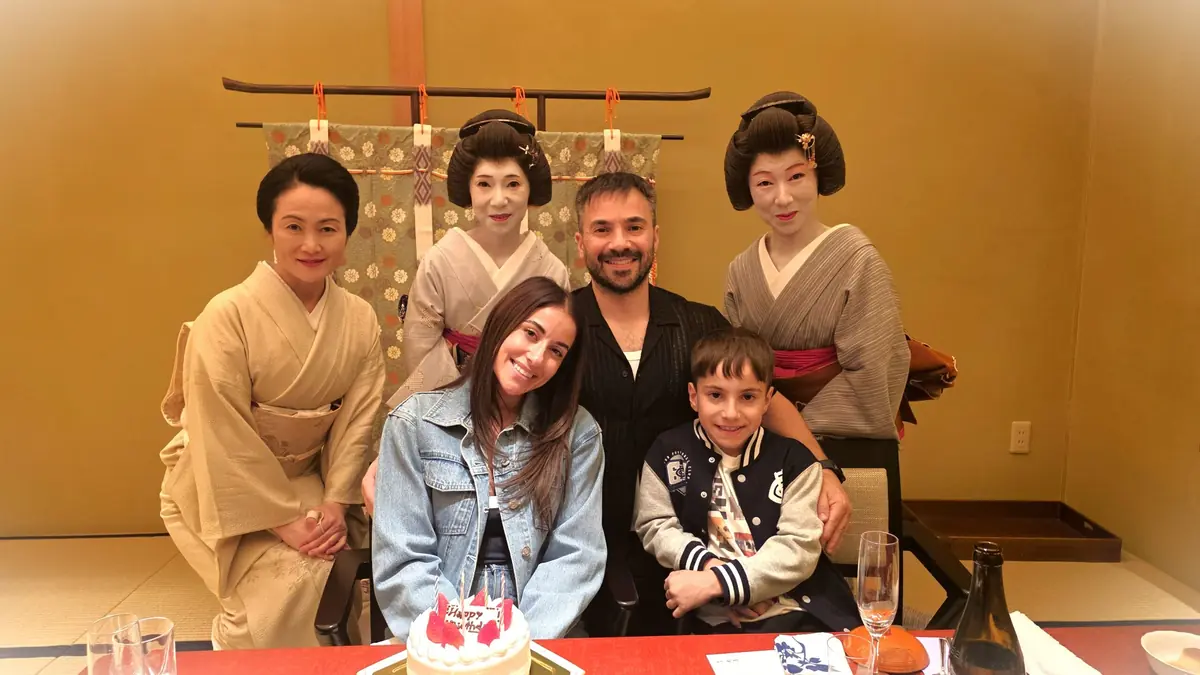
A geisha experience in Tokyo can take several forms — from a stage performance to a quick photo session in rented kimono — but its most traditional is the ozashiki: an intimate, private gathering in a tatami room where geisha perform classical dance and music, lead ozashiki games, and share conversation with their guests. It is a living tradition, carried from the old hanamachi of Edo into the present day. At Miyakodori — a traditional machiai-chaya (geisha teahouse) in Asakusa established in 1950 — international guests can request a private ozashiki evening directly online, with English interpretation included throughout.
That last point matters more than it sounds. For most first-time visitors, the worry is not the price or the etiquette — it is the fear of an awkward, silent evening in a language they do not speak. At Miyakodori, an English interpreter sits with you from the first greeting to the closing clap, so nothing is lost and no one is left guessing. This guide explains what a real ozashiki is, how it differs from a stage show, who it suits, what the plans cost, and exactly how to request a reservation in Asakusa.
Geisha Experience in Tokyo: At a Glance
Here is what to expect from a private ozashiki geisha experience in Asakusa.
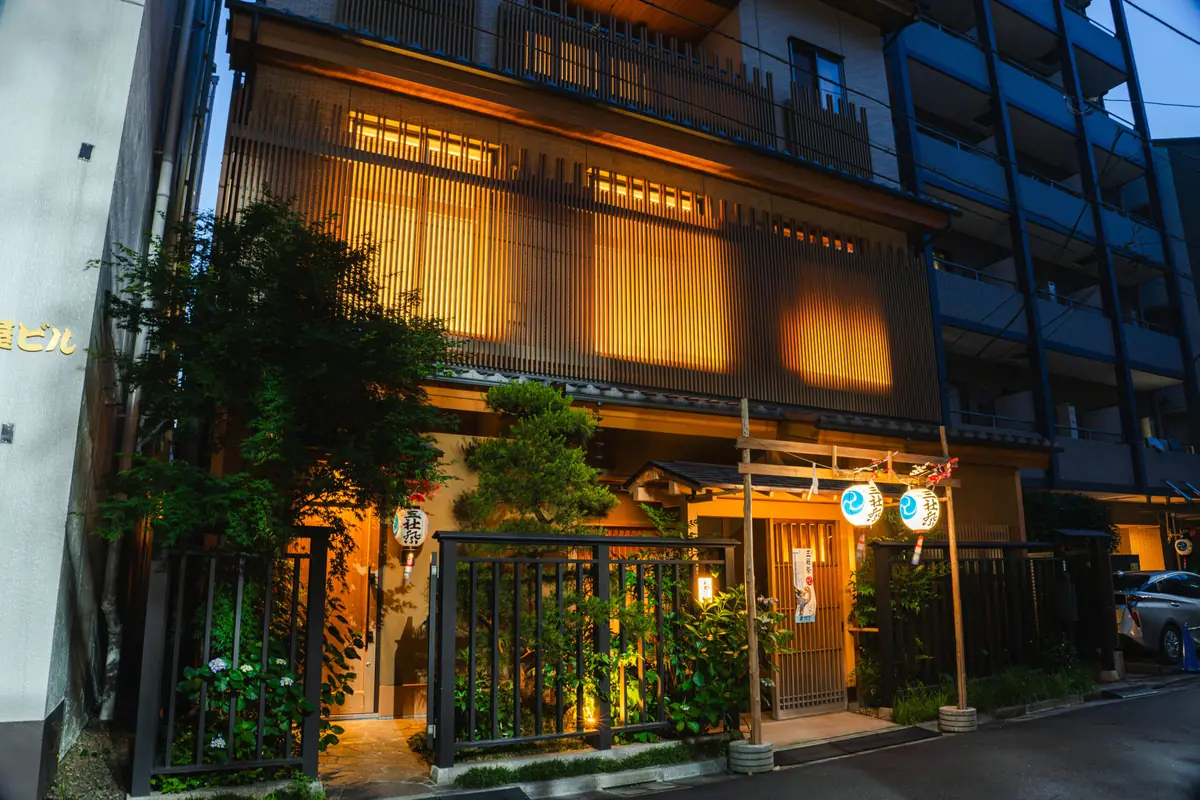
| Details | |
|---|---|
| Location | Miyakodori, Asakusa, Tokyo (hanamachi district) |
| Style | Private tatami room — not a stage or theater |
| Geisha | 2–3 active geisha of the Asakusa hanamachi (registered at the kenban) |
| Language | English interpretation included throughout |
| Duration | 1 hour / 2 hours / 3 hours (2 hours recommended) |
| Food | Optional — kaiseki included on the 3-hour plan; meals on shorter plans arranged through partner restaurants |
| Pricing | From ¥34,000 per person (varies by group size and duration) |
| Booking | Direct online reservation request — no introduction required |
| Best for | Couples, groups, solo travelers, cultural enthusiasts |
| Not the same as | Stage geisha shows, makeover experiences, Kyoto-only packages |
What Is a Geisha Experience in Tokyo?
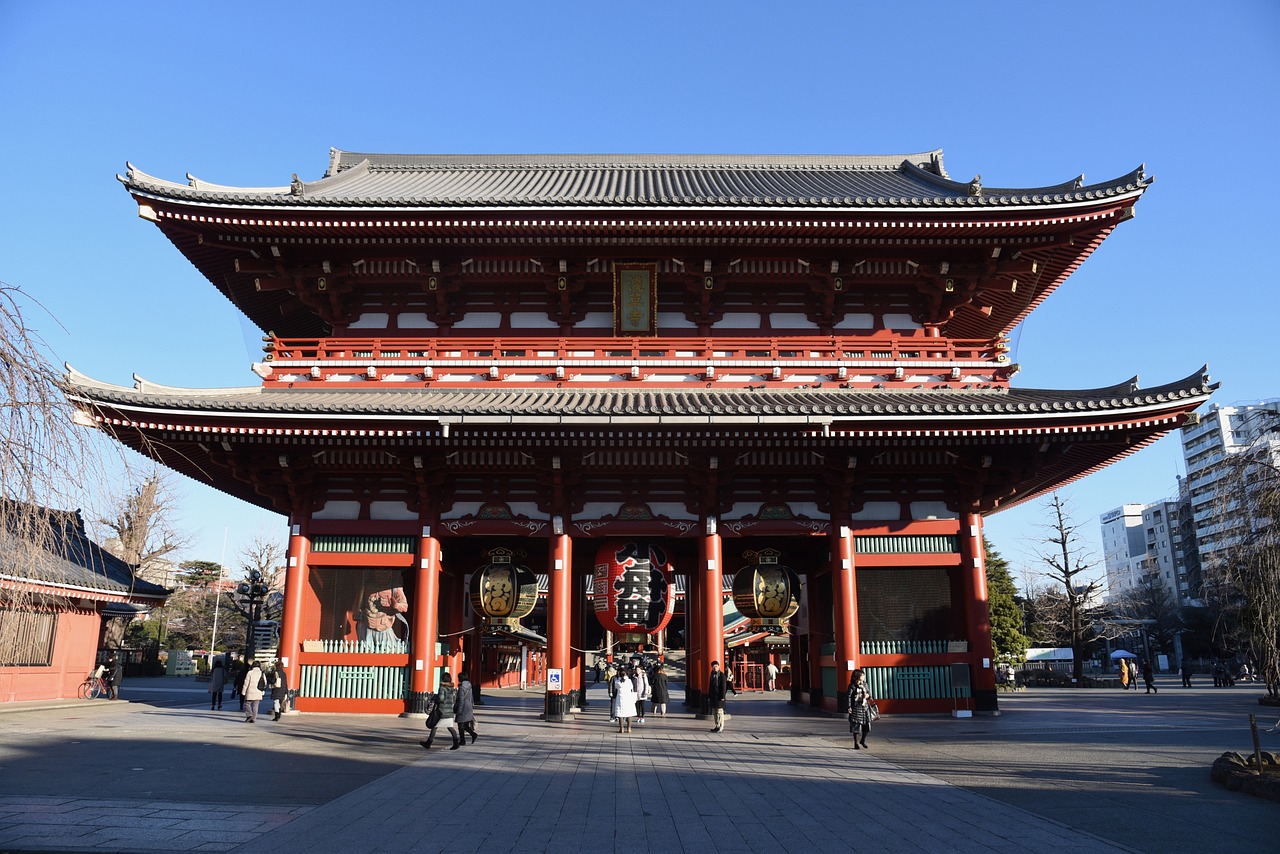
Tokyo has several active geisha districts, and Asakusa is one of its most historic and accessible hanamachi for international visitors. Its small but active community has operated since the Edo period. Tokyo geisha are often overlooked by visitors who assume the culture belongs only to Kyoto, yet Asakusa has kept its own living tradition of dance, music, and ozashiki hospitality alive into the present day.
Can You Experience Geisha in Tokyo, or Only Kyoto?
Many travelers picture Kyoto when they hear the word “geisha,” and it is true that Kyoto’s districts are the most famous. But Tokyo has its own geisha culture, and Asakusa is its heart. Where Kyoto is associated with miyabi — refined, courtly elegance — Asakusa carries iki, the spirited, down-to-earth sophistication of old Edo.
For a long time, joining an ozashiki anywhere meant being introduced by an existing patron — the ichigensan okotowari custom, where first-time guests without a referral were politely turned away. Miyakodori chose to open that door. To help carry the culture forward, the teahouse welcomes first-time and international guests directly, with no introduction needed. (For a wider view of the city’s districts, see our guide on where to see geisha in Tokyo.)
What “Ozashiki” Means
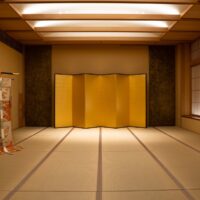
An ozashiki (お座敷) is a private gathering in a formal tatami room where geisha perform traditional arts and engage with guests through dance, music, and ozashiki games. It is not a show you watch from a distance; it is an evening you share at the same table.
This is also where one common misunderstanding should be cleared up. Geisha are professional artists and hosts trained in traditional dance, music, conversation, and hospitality — not performers who simply appear on stage. They are cultural hosts and skilled artists, and the ozashiki is built around their craft and their company, not around a spectacle. (If you want the full background first, read our complete geisha guide.)
Stage Show vs Private Ozashiki
Here is a quick comparison between a stage geisha show and a private ozashiki banquet — the settings and the guest’s role are fundamentally different.
| Stage Geisha Show | Group tour experience | Private Ozashiki at Miyakodori | |
|---|---|---|---|
| Setting | Theater or large hall | Group tour venue | Private tatami room (no other guest groups) |
| Guest role | Audience — observe from seats | Observer in a group | Participant — same room as the geisha |
| Geisha distance | On stage, at a distance | In a performing area | Seated with you at the same table |
| Language | Often no translation | Varies | English interpretation throughout |
| Booking | Instant OTA purchase | OTA purchase | Reservation request — no introduction needed |
| Best for | A quick cultural overview | Group sightseeing | Authentic ozashiki immersion |
None of these formats is “wrong” — a stage show is a fine way to glimpse the art if your time is short. But they answer different questions. The simplest way to put the difference: you do not just watch geisha; you share the room with them.
What Happens During a Real Ozashiki
A real ozashiki follows a natural flow — from the moment the geisha arrive to the final tejime clap — with conversation and interaction woven throughout, not boxed into a single “performance slot.”
The Flow of an Evening
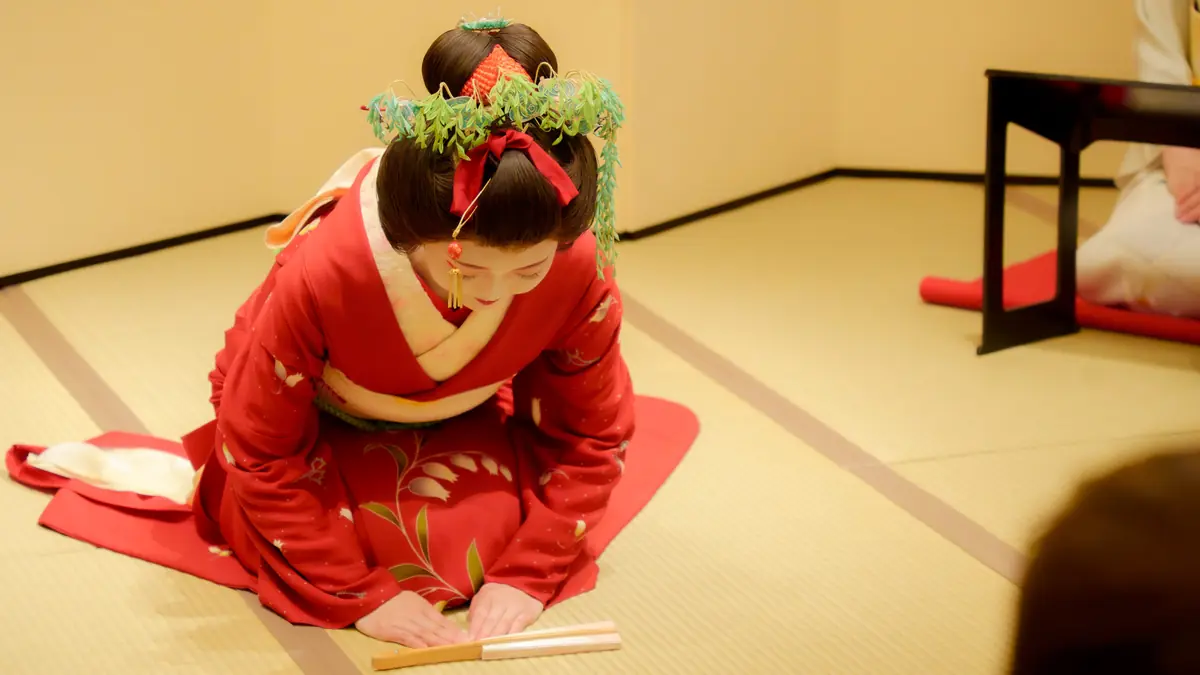
- Arrival and formal greeting (aisatsu). The geisha enter and greet you in the traditional way that opens every ozashiki.
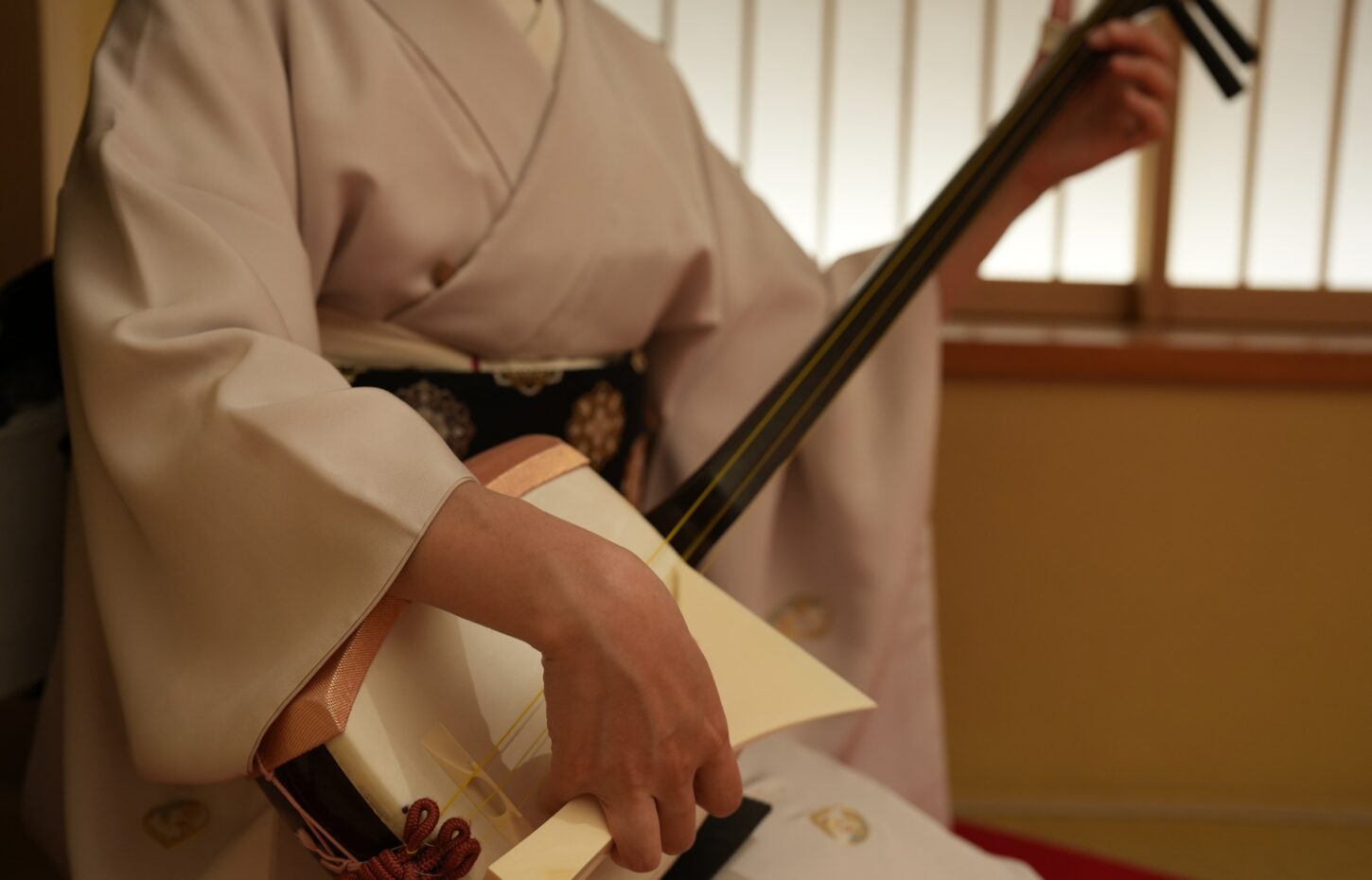
- Traditional dance. A classical dance is performed, accompanied by live shamisen or music.
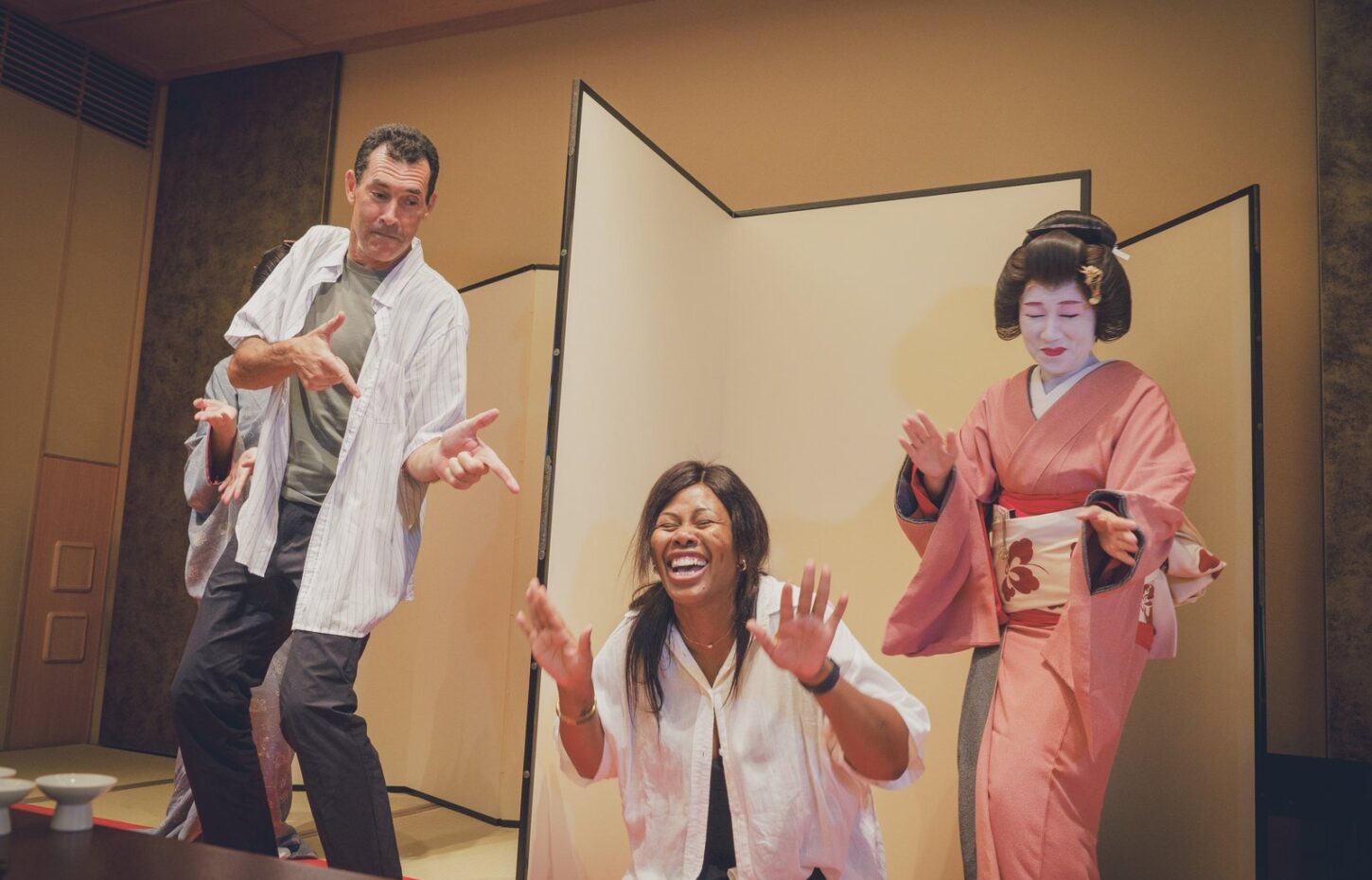
- Ozashiki games with guests. You play together — konpira-fune-fune, tora-tora, tōsenkyo and others. These are simple, funny, and easy to join with no Japanese needed.
- Drinks and conversation. Drinks are served if desired, and conversation continues throughout — questions about the kimono, the training, the white makeup, anything you are curious about.
- Commemorative photo and tejime. A keepsake photo, followed by the tejime (the formal closing clap) that ends the evening.
Geisha are present from the first moment to the last. There is no “performance time” kept separate from “guest time” — the whole evening is shared.
The okami of Miyakodori, who made her debut as a geisha in 1969, is candid about why time matters:
“These days, I’ve come to feel that one hour is short. To really come to know the geisha — and a place like this — I think you want at least two hours. With two hours, there is room for more ozashiki games, for real conversation both ways, for another dance, and even for guests to handle the fan, the drum, or the shamisen themselves.”
— Chikage, the Okami of Miyakodori (source: primary interview, foreign guests and future vision, 2025-12)
The spirit of the room matters as much as the program. Asked what makes a memorable guest, the okami describes something she calls kirei na asobi — “beautiful play”:
“What makes a guest ‘cool’ at our ozashiki? It’s not about money. It’s the smartness of how you play — graceful, refined, not overly forward, and someone who quietly knows the etiquette of the tatami room without making a show of it. We call it kirei na asobi — ‘beautiful play.’ That kind of guest, the geisha will always want to see again.”
— Chikage, the Okami of Miyakodori (source: primary interview, ozashiki manners, 2026-03)
The Geisha You Will Meet
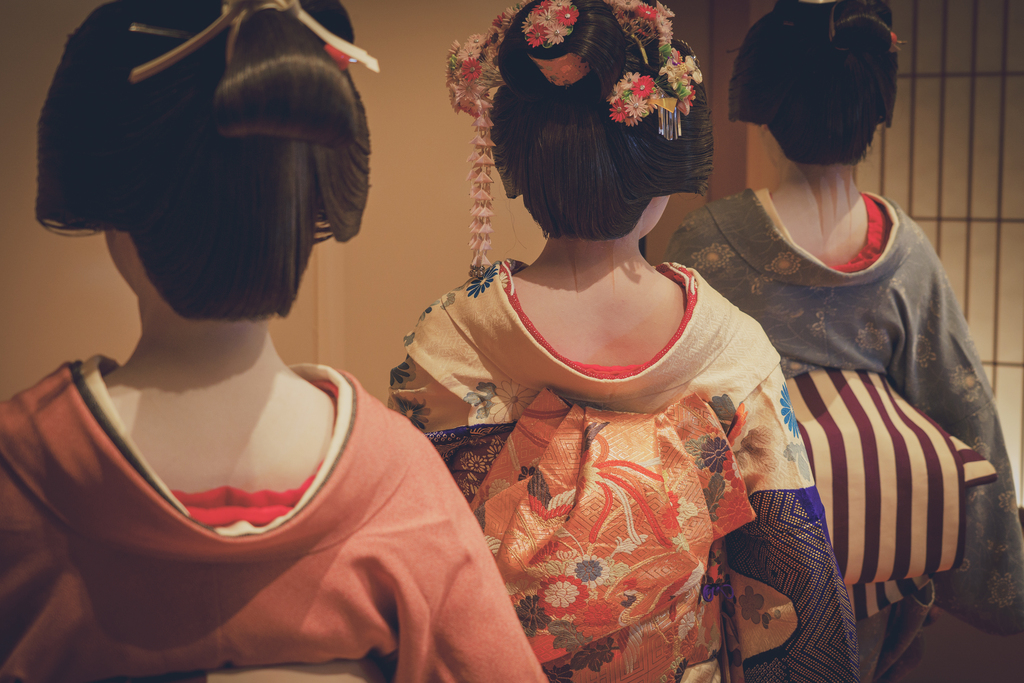
The geisha invited to Miyakodori are working artists of the Asakusa hanamachi, each with her own path into the profession.
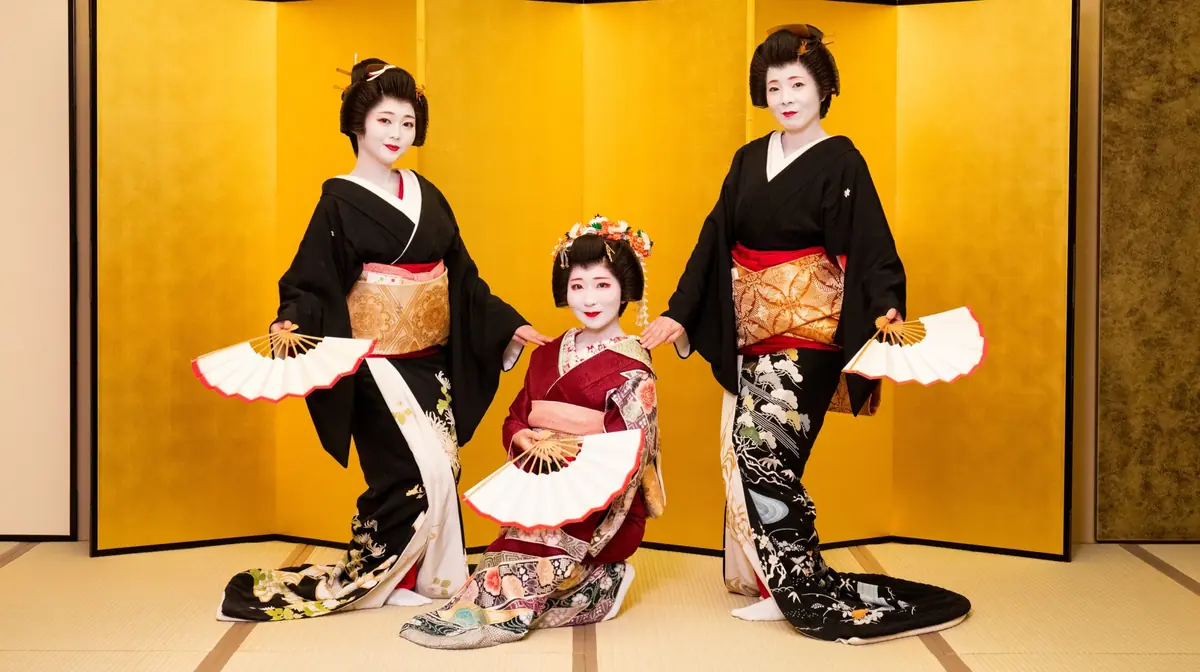
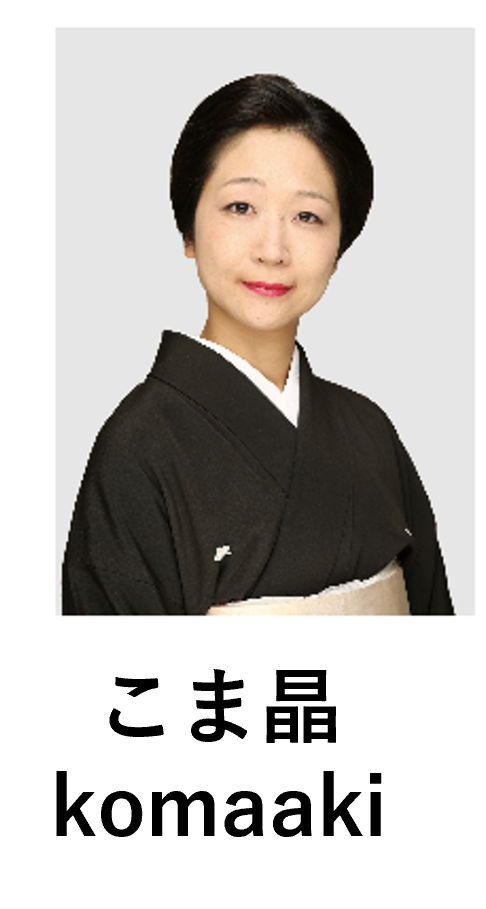
Komaaki is a jikata — the geisha who plays shamisen and sings — and previously trained as a tachikata (dancer). She came to the profession as an adult: she had admired Kyoto’s maiko as a child but did not know Tokyo had geisha at all, until she saw Asakusa geisha in formal black kimono on the street and realized this world existed in her own city.
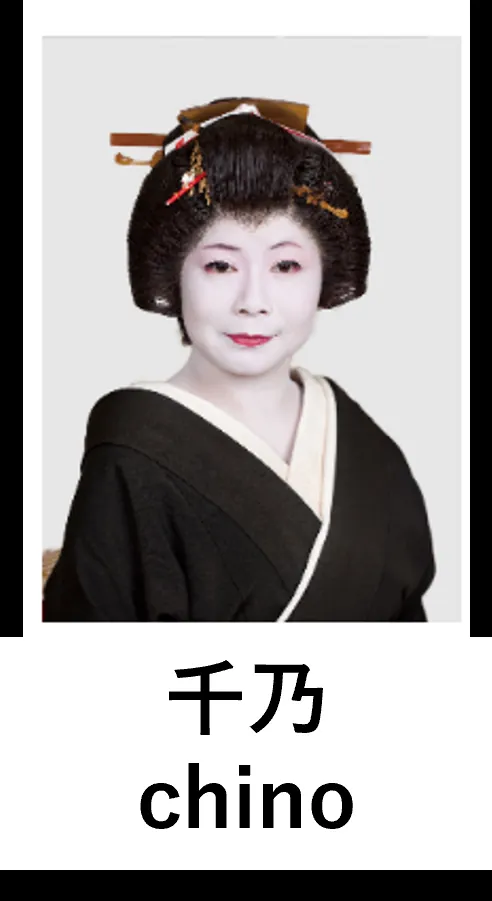
Chino traces her wish back to a kindergarten recital, where she watched other children perform classical Japanese dance. The feeling stayed dormant for years and then, at eighteen, “opened like a seed waking up.” She became a geisha so she could keep dancing as her life’s work.
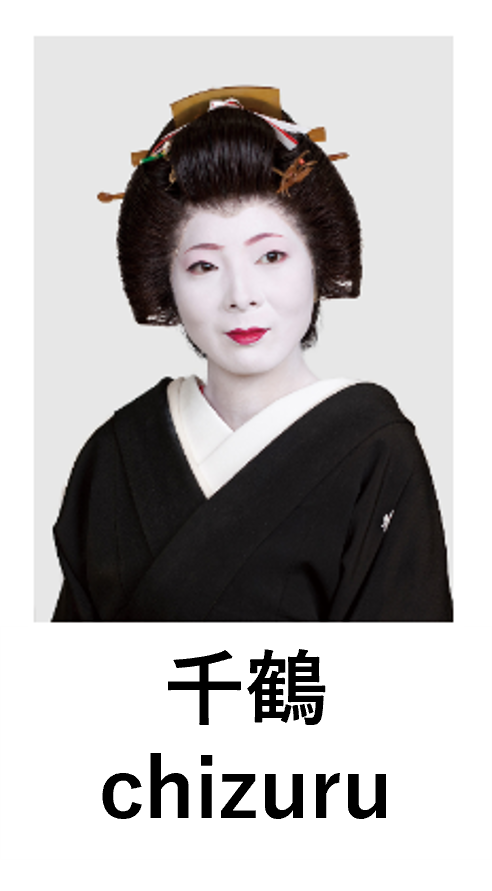
Chizuru trained at Miyakodori and speaks warmly about the guests who have supported her since her debut. She practices, she says, so that those guests can feel “I’m glad I cheered this one on” — a relationship of growing up in front of the people who watch over her.
A note on how this works: geisha at Miyakodori are independent professionals registered at the Asakusa kenban (the district’s registry office). Miyakodori invites them for each ozashiki; they are not employed staff. This is the traditional structure of the hanamachi, and it is part of what makes the evening authentic rather than staged.
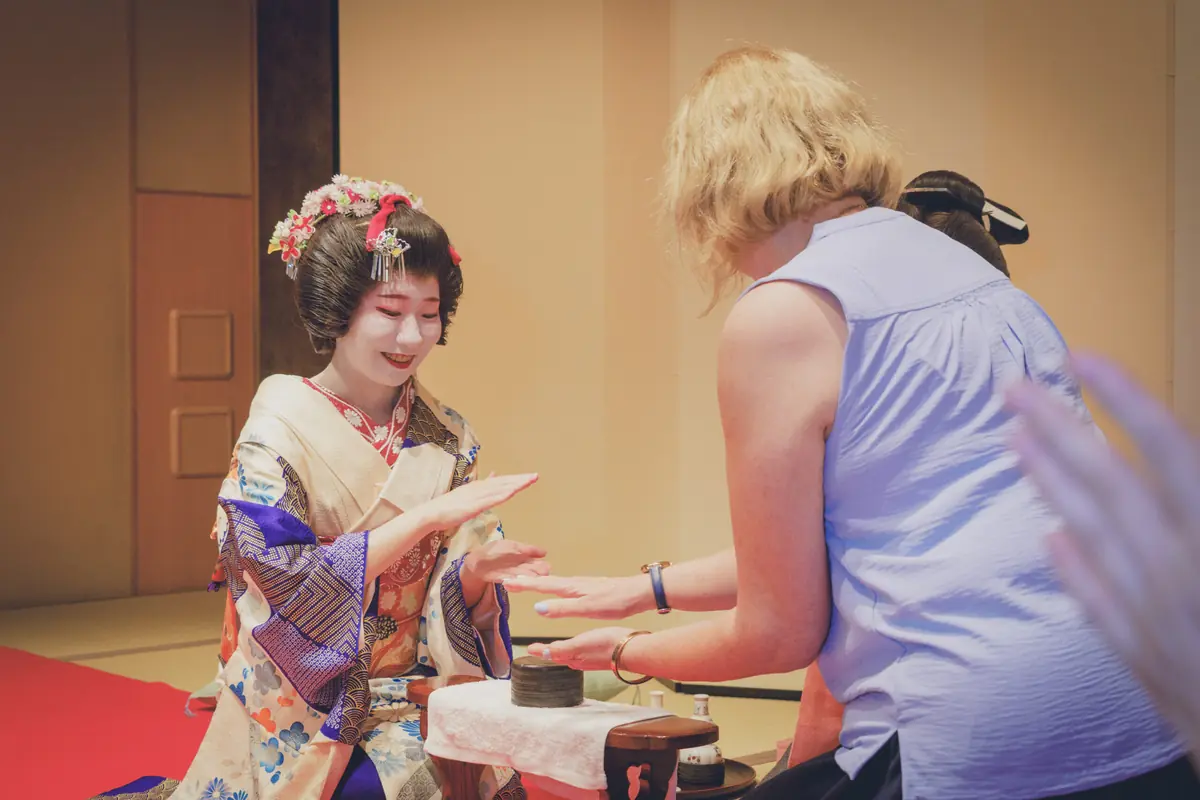
Come and play these games yourself: this is what the room looks like from the guest’s side.
Who This Experience Is Best For
A private ozashiki suits anyone seeking a meaningful, unhurried cultural encounter — not just a photo opportunity.
- Couples — an intimate, fully private setting; a memorable way to mark an anniversary or special trip.
- Small groups (3–6) — the cost per person drops as the group grows, and ozashiki games become more lively with more players.
- Solo travelers — 1-person plans are available for every duration, and the English interpreter removes the language barrier entirely.
- Cultural enthusiasts and frequent visitors to Japan — a far deeper experience than standard sightseeing, with skilled artists and genuine conversation.
- First-time visitors to Japan — most plans welcome newcomers; no prior knowledge of geisha culture is required to enjoy the evening.
Why Choose Miyakodori in Asakusa
Miyakodori is the only machiai-chaya in Asakusa openly accepting direct online reservation requests from international guests — without an introduction and without an intermediary. The okami sums up the goal simply:
“When people think of Asakusa, I want them to think of Miyakodori. Whether they’re from Japan or anywhere in the world, I want them to know that Miyakodori is the place to enjoy a real geisha banquet.”
— Chikage, the Okami of Miyakodori
Four things set the experience apart:
- Established in 1950. More than seventy years in the Asakusa hanamachi, with the okami still leading the teahouse today.
- Direct booking for international guests. No introduction or referral is required — first-time guests are genuinely welcome. Guests now come from across Europe, the Americas, and Asia.
- English interpretation throughout. From the first greeting to the tejime, conversation and games are fully supported, so the language barrier never gets in the way.
- Flexible food arrangements. As a machiai-chaya, Miyakodori does not run its own kitchen, which means meals can be arranged through trusted partner restaurants — including vegan, halal, gluten-free, and full kaiseki options.
Plans, Duration & Pricing
Three plans are available — from a 1-hour introduction to a 3-hour kaiseki banquet — each with working geisha present from start to finish.
Which Plan Is Right for You
| Plan | Duration | Best for | Includes |
|---|---|---|---|
| Geisha Highlights | 1 hour | A first glimpse, or a tight schedule | Dance, one game, greeting; two geisha (three for larger groups); one drink required (charged separately) |
| Geisha Elegance | 2 hours | A full first-time experience (recommended) | Dance, games, free-flow drinks; two geisha (three for larger groups) |
| Twilight Gathering | 3 hours | Celebrating, dinner, and deep immersion | Kaiseki cuisine plus free-flow drinks; three or more geisha |
For most first-time guests, the okami recommends the 2-hour plan: an hour passes in a moment, while two hours leave room for more games, more conversation, and a second dance. Where the occasion allows, she also suggests three geisha rather than the standard two: a third adds depth to the dancing and live music and makes the ozashiki games livelier still. Two geisha are standard for the 1- and 2-hour plans (the 3-hour Twilight Gathering already includes three), and a third can be added to the shorter plans on request.
Pricing Overview
The rates below are per person and vary by group size and plan. The one-hour plan runs in the daytime (14:00–17:00 start) or in the evening (17:30–20:00 start), and its rate depends on the time slot: the table below shows the daytime rate, while an evening start is ¥73,000 per person for 2 guests and ¥40,000 per person for 4+ guests. The two-hour plan is available in the afternoon or evening, and the three-hour plan is evening only (from 17:30).
| Plan | 2 guests / person | 4+ guests / person |
|---|---|---|
| Geisha Highlights (1 hour, daytime) | ¥63,000 | ¥34,000 |
| Geisha Elegance (2 hours) | ¥81,000 | ¥45,000 |
| Twilight Gathering (3 hours) | ¥179,000 | ¥106,000 |
The price per person decreases as the group grows, because the geisha fee is fixed regardless of how many guests attend. Full plan-by-plan rates, group sizes, options, and the cancellation policy are on our full pricing details page.
A note on choosing honestly: if a brief cultural showcase is what you are looking for, stage-style performances offer that at a lower cost. If you want to share the room and the evening with the geisha themselves, a private ozashiki is the option worth its price.
Request a Reservation at Miyakodori
Ready to experience a private ozashiki? Submit your reservation request — English support throughout. Confirmation typically within two business days.
Before You Book
Most first-time guests arrive with questions — here are the most common ones, answered directly.
| Question | Answer |
|---|---|
| What should I wear? | Smart casual is fine — no formal attire is required, but please avoid beachwear or sportswear, as this is a formal cultural occasion. You will remove your shoes to enter the tatami room, so clean socks are a good idea. |
| Can I take photos? | Yes, with the geisha’s consent. A commemorative photo is included. Please ask before photographing during a dance. |
| Is English spoken? | An English interpreter is present throughout — no Japanese is needed. |
| Can I come alone? | Yes. Solo 1-person plans are available for every duration. |
| Can families with children join? | Please ask at the time of reservation, and we will advise on suitability and age. |
| Is dinner included? | The 3-hour Twilight Gathering includes kaiseki cuisine. The 1- and 2-hour plans can add food as an option (please book at least 2 days in advance). |
| Can I cancel or change my reservation? | Yes — a cancellation policy applies, and the full terms are on our pricing page. Because each booking is confirmed by request, please let us know as early as possible if your plans change. |
| How do I pay? | A credit card is required to confirm your reservation, held as a guarantee against cancellation. The payment itself is settled on the day of your visit, along with any drinks or options not already included in your plan (for example, the required drink on the 1-hour plan). |
| Do I need to tip? | Tipping is entirely optional. At checkout you will find an optional gratuity line you are welcome to use if you wish — always appreciated, never expected. |
How to Request a Reservation
Reservations at Miyakodori are made by request — availability is confirmed within a few business days, not instantly.
- Choose your plan and a preferred date.
- Submit a reservation request through our online reservation form (an English form is available).
- Receive confirmation with the details (typically within two business days).
- Arrive at Miyakodori in Asakusa at your scheduled time.
For a fuller walk-through of the process, see our step-by-step reservation guide.
Access: Asakusa 3-23-10, Taito-ku, Tokyo
Hours: Monday–Friday, 14:00–20:00 (last seating); closed Saturdays, Sundays, and national holidays.
Request Your Geisha Experience in Tokyo
Book a private ozashiki at Miyakodori — established in Asakusa since 1950. English interpreter included. No introduction required. Direct online reservation request.
Frequently Asked Questions
What is a geisha experience in Tokyo?
A geisha experience in Tokyo means spending an evening with professional geisha in a private tatami room, sharing traditional dance, music, ozashiki games, and conversation. Unlike a stage show, you sit at the same table as the geisha rather than watching from an audience. For a deeper walk-through, see our detailed experience guide.
Where can I see real geisha in Tokyo?
Asakusa is one of the main centers of Tokyo’s geisha culture, home to a small but active hanamachi. At Miyakodori, a traditional machiai-chaya in Asakusa, international guests can request a private ozashiki directly online — no introduction or local connection required.
Can international guests see real geisha in Tokyo?
Yes. At Miyakodori, first-time and international guests are welcome to book a private ozashiki directly, with an English interpreter present throughout. No introduction is needed, and no Japanese is required to enjoy the evening fully.
How much does a geisha experience in Tokyo cost?
Miyakodori offers three plans: 1 hour, 2 hours, and 3 hours. Rates range from ¥34,000 per person to ¥300,000 for a solo three-hour evening, depending on duration and group size, because the per-person price falls as the group grows (the geisha fee is fixed). For two guests, the 1-hour plan starts at ¥63,000 per person; full pricing is on the pricing page.
What is the best geisha experience in Japan?
The “best” depends on what you want: a theater performance offers a quick glimpse, Kyoto’s historic districts offer the most famous setting, and a private ozashiki offers the closest, most personal encounter. For travelers who want a private, participatory evening with working geisha, English support, and direct online booking, Miyakodori in Asakusa is a strong fit. It is a private ozashiki, not a group show — you share the room rather than observe it.
How long is a geisha experience in Tokyo?
Plans run 1, 2, or 3 hours. The okami recommends at least two hours, since a single hour passes quickly and two hours allow for more games, conversation, and dance. See how long a geisha experience lasts for more detail.
Is dinner included in a geisha experience?
Only the 3-hour Twilight Gathering includes kaiseki cuisine as standard. The 1- and 2-hour plans can add food as an option, arranged in advance through partner restaurants — useful for vegan, halal, or gluten-free needs.
Is Miyakodori a private geisha experience?
Yes. Each ozashiki at Miyakodori is fully private: your own tatami room, your own dedicated English interpreter, and no other guests sharing the evening. It is not a group tour or a shared-seating show.
Is a geisha experience appropriate for first-time visitors to Japan?
Yes. Most plans welcome first-timers, no prior knowledge is needed, and English-speaking guests are supported throughout. Many guests are visiting Japan for the first time, and the evening is designed to be easy and comfortable to join.
Still have questions? Ask us in English.
Related Guides


- Geisha Restaurant Near Me in Tokyo: Authentic Ozashiki at Miyakodori Asakusa
- Geisha Drinking Game: Culture, Fun, and Tradition
Must-Visit Theaters in Asakusa Sightseeing! From Spotting Same-Day Tickets for Casual Enjoyment to Famous Long-Established Venues
5 Ways to Enjoy the Night in Asakusa | Illumination, Houseboat Dinner, Hidden Izakaya
What Is the Tora Tora Game? Rules, History, and How to Play
Geisha Instruments: The Music Behind the Ozashiki
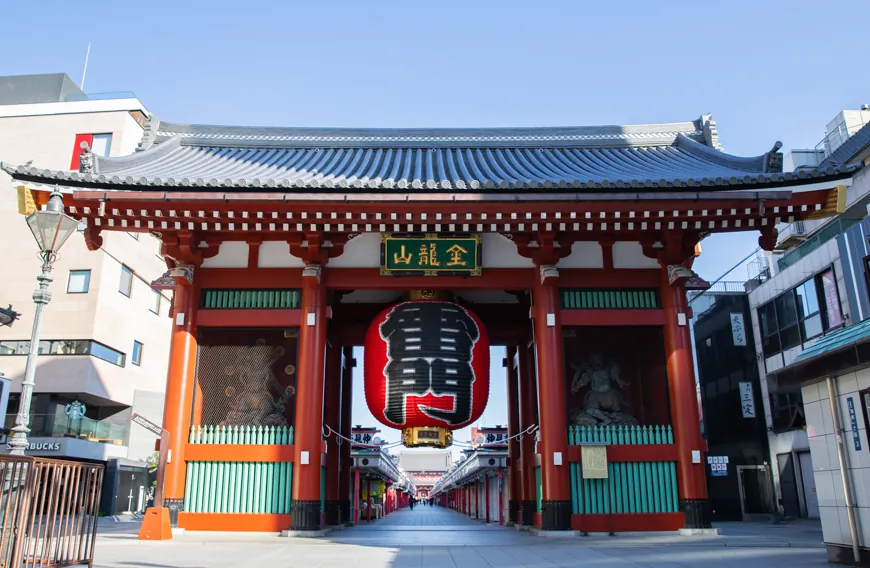
Complete Guide to Winter Asakusa Sightseeing! Recommended Spots, Gourmet, and Events Thoroughly Covered
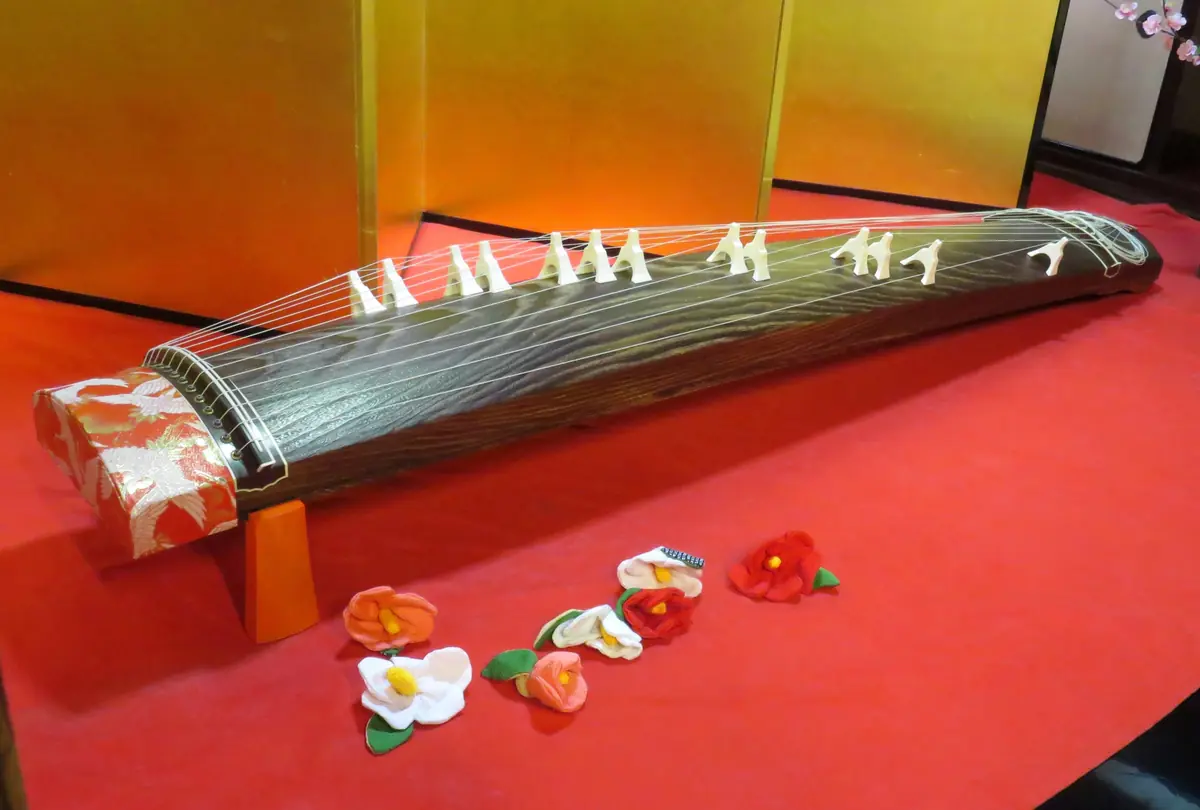
Enjoy Autumn in Asakusa! Recommended Food Walk & Momiji Model Course with Kimono
Comment ( 0 )
Trackbacks are closed.
No comments yet.