



Oiran vs Geisha: What’s the Difference? (Answered in Asakusa)
If you have ever looked at two women in white makeup and elaborate kimono and wondered which one is the geisha, you are asking the question almost every visitor to Japan asks. The confusion is understandable. The answer is not complicated.
A geisha sells art. An oiran sold companionship. One is a performing artist. The other was a courtesan of the licensed pleasure quarter. They lived in the same city, sometimes worked in the same neighbourhood, and dressed in ways that look similar to an untrained eye — but they were never the same profession, and Edo-period Japan went to considerable lengths to make sure nobody mixed them up.
We are a tea house in Asakusa where geisha still perform, a few streets from where the Yoshiwara pleasure quarter once stood. Here is the difference, from the neighbourhood where both histories actually happened.
Oiran vs Geisha: The Short Answer
| Comparison point | Geisha (芸者) | Oiran (花魁) |
|---|---|---|
| What they sell | Art — music, dance, conversation | Companionship, including intimate services |
| Profession type | Performing artist | Highest rank of licensed courtesan |
| Trained in | Shamisen, song, classical dance, banquet games | Arts and letters, alongside her primary role |
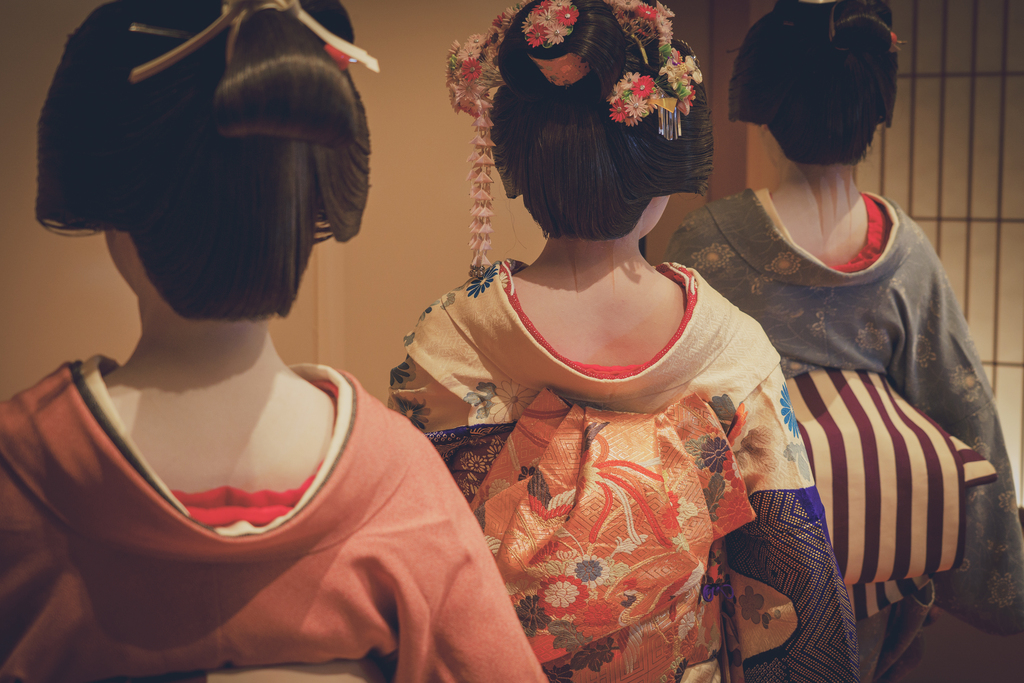
| Obi (sash) | Tied at the back | Tied at the front |
| Footwear | Ordinary zōri or geta | Towering three-toothed geta |
| Where they worked | Hanamachi — tea houses and banquet rooms | The Yoshiwara, a walled licensed quarter |
| Do they exist today? | Yes — a living profession | No — the profession ended in 1958 |
If you remember only one thing, remember the obi. Geisha tie the sash at the back. Courtesans tied it at the front. That rule was deliberate, it was public, and Asakusa’s geisha still observe it today.
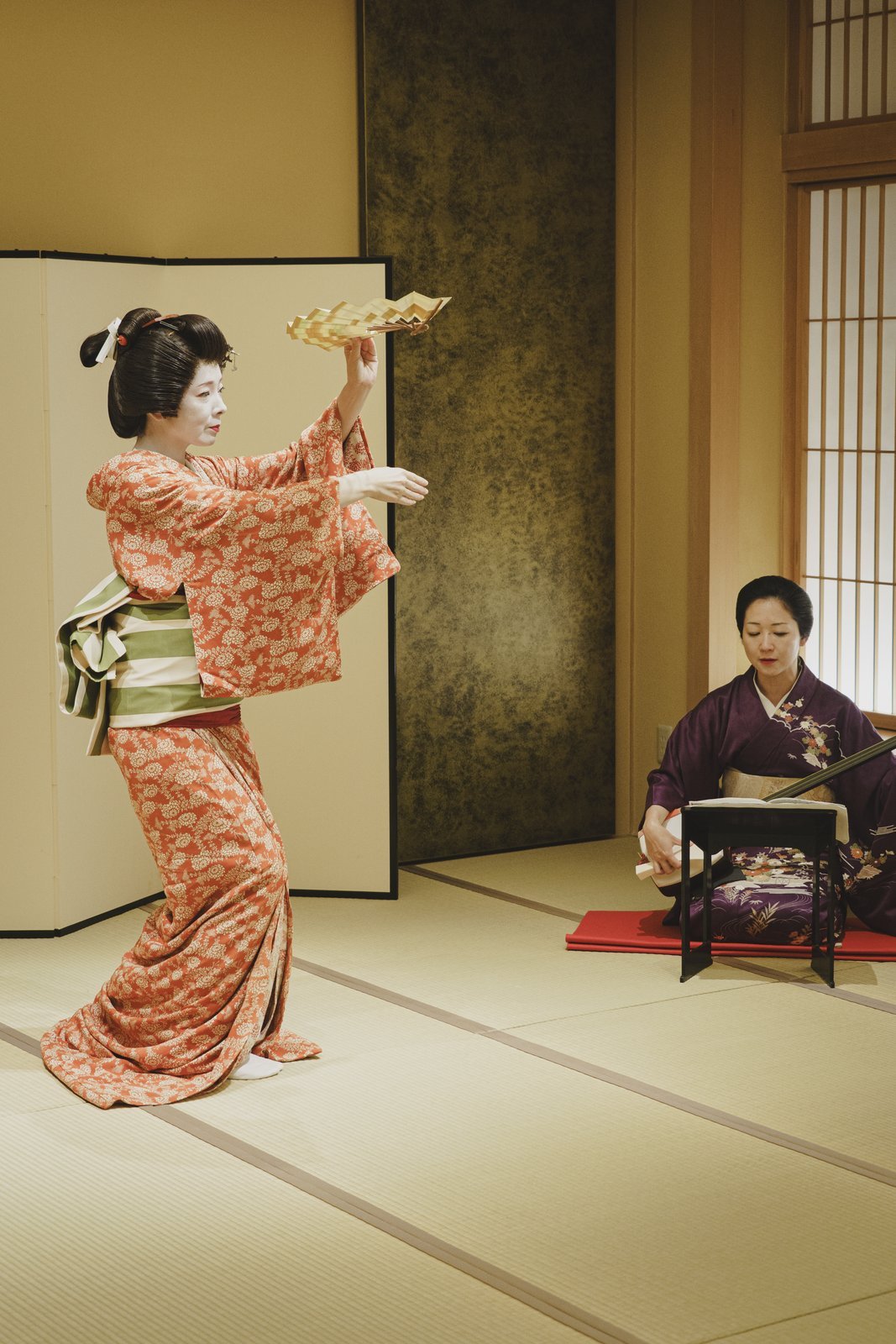
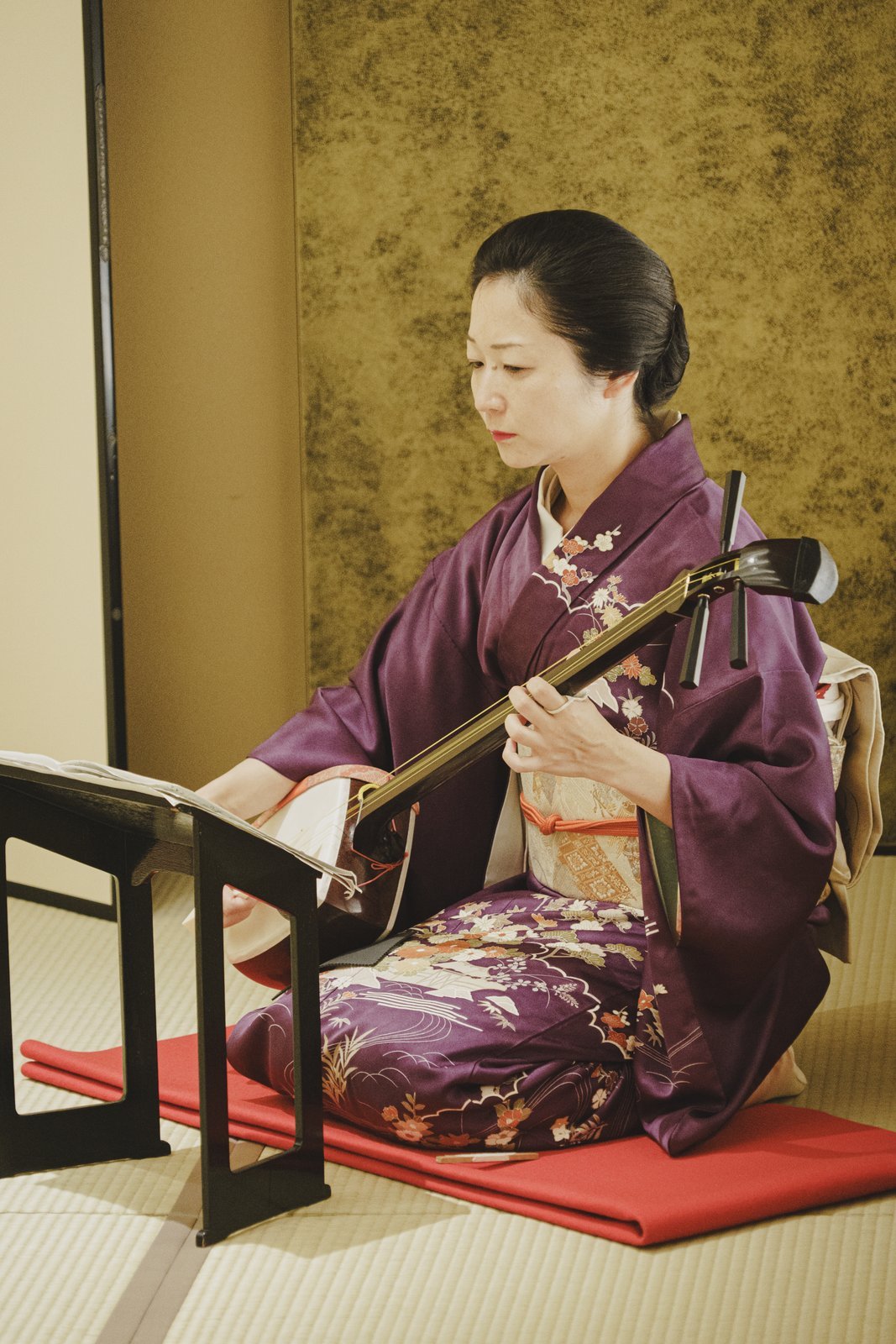
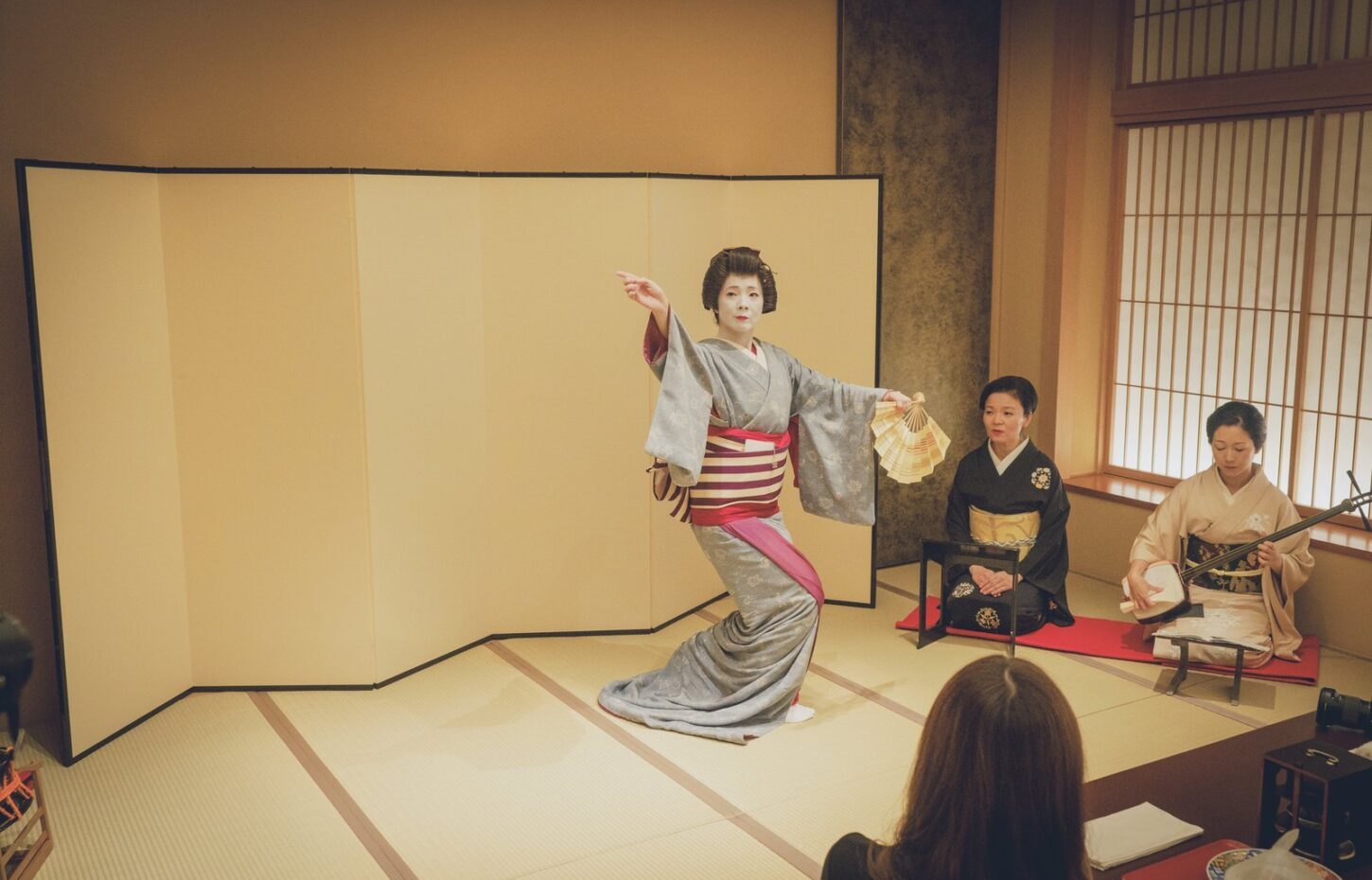
Not every geisha wears the white makeup. The table above lists white makeup as one of the things the two professions look like they share, but a jikata geisha, who plays the shamisen rather than dancing, often works without it. The look is not the profession.
Why Do People Confuse Them?
The confusion is almost entirely visual, and it comes from three things they genuinely share: white makeup, formal kimono, and ornamental hairpins.
Western films and novels compressed the two into a single exotic figure, and the internet inherited the mistake. We see where that lands. Some overseas guests arrive at our tea house believing that geisha work is sexual, or that these are women who were sold into it and endured hard lives. It is not a hostile assumption — it is simply what they have absorbed. Part of our evening is explaining, plainly, that none of it describes the profession as it exists today.
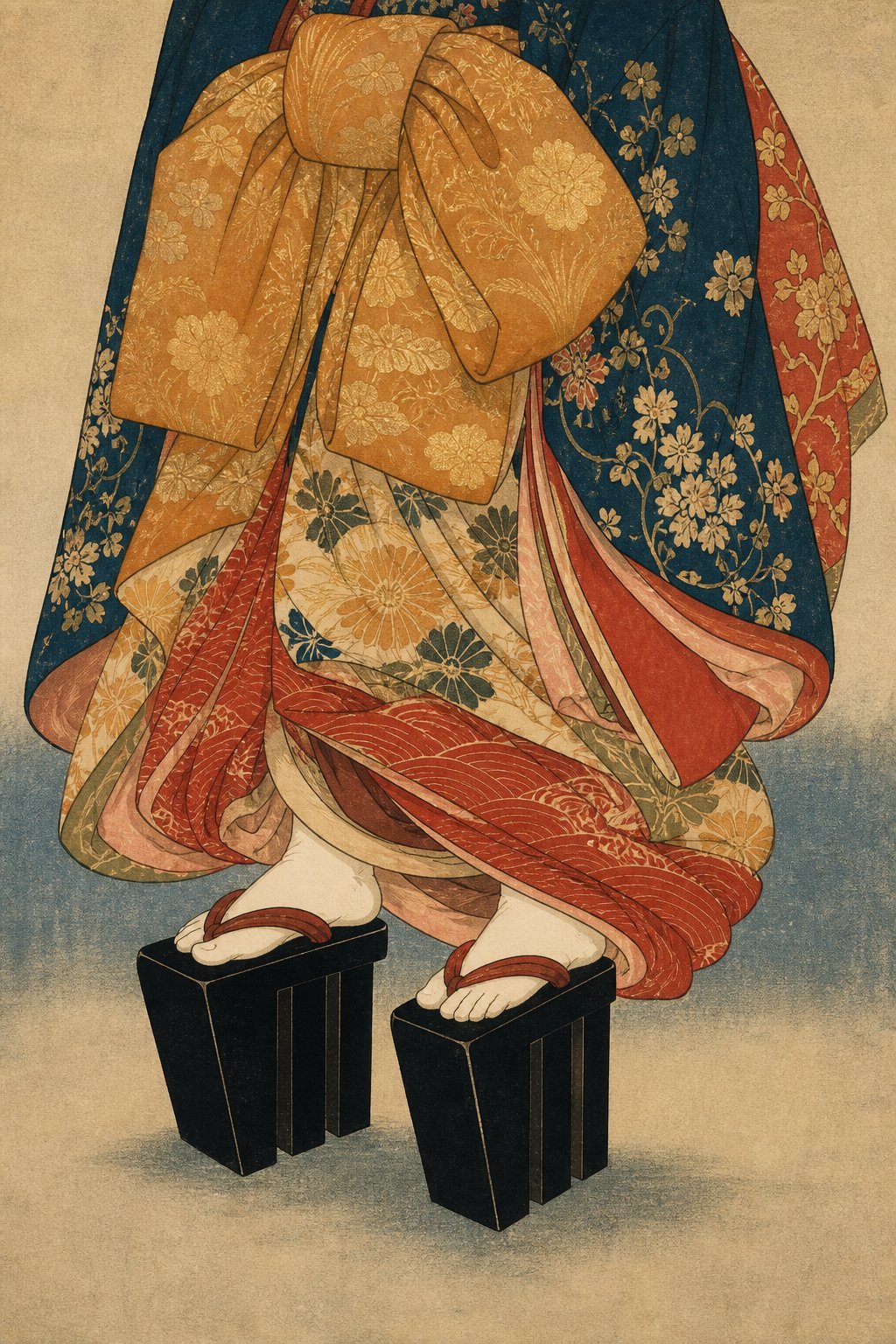
The irony is that the two professions were far easier to tell apart in period Japan than they are on a modern screen. The differences were designed to be read at a glance by anyone on the street. A photograph flattens exactly the details that used to do the work.
What Was the Actual Job?
A geisha is a performing artist. She trains for years in shamisen, song, and classical dance, and she is hired to bring a room to life — to perform, to lead games, to hold a conversation that makes strangers comfortable with each other. In Asakusa today, geisha work as independent professionals, engaged through the district’s registry office for each banquet.
The oiran was the highest-ranking courtesan of the Yoshiwara, the walled licensed quarter of Edo. Her role included intimate companionship, and it was a recognised, regulated occupation of its time. An oiran was also expected to be formidably accomplished — poetry, calligraphy, tea, music — because her clientele was wealthy and she had the standing to refuse them.
The two worked side by side in the Yoshiwara without their roles overlapping. Geisha and their male counterparts, the hōkan (幇間, also called taikomochi), were hired to entertain at banquets. The oiran was the companion for the evening. The distinction was clear enough at the time that the city had rules for keeping it visible.
Here is the historical order, which surprises many visitors: courtesans are the older profession, and geisha established themselves later as a separate occupation. But by the time both worked in the same quarter, the roles were already understood as distinct — one sold companionship, the other sold art. Sharing a neighbourhood is not the same as sharing a lineage.
“Historically, the licensed courtesans of the Yoshiwara provided companionship, including intimate services, as a recognised occupation, while geisha sold their art. Geisha were there to entertain guests with music, dance, and refined conversation. The two were treated as different professions, not as a hierarchy.”
— the Okami of Miyakodori
A conversation recorded at Miyakodori on how the two were kept apart: the kenban office listed geisha and courtesans on separate boards, and the obi — tied at the back for one, at the front for the other — let you tell them apart at a glance. English subtitles available.
How Did Japan Keep Them Separate?
This is the part that settles the argument, and it is a matter of administrative record rather than opinion.
The kenban (見番) — the registry office that anchors flower districts across Japan, Asakusa included — handles the administrative side of the profession: registering performers, taking bookings, keeping the arts in order. Exactly when it took its present form is not something we can date precisely, and it may well have existed in some form before the Edo shogunate formally recognised geisha as a profession inside the Yoshiwara. What is clear is what its records did — and still do.
But the way it kept its records had a public side effect. Inside a kenban, the names of working performers were posted on wooden boards, and the names of geisha and the names of licensed courtesans were written on physically separate rows of those boards. The filing system was not designed to settle the question of who was who — but anyone standing in front of it could read the answer at a glance.
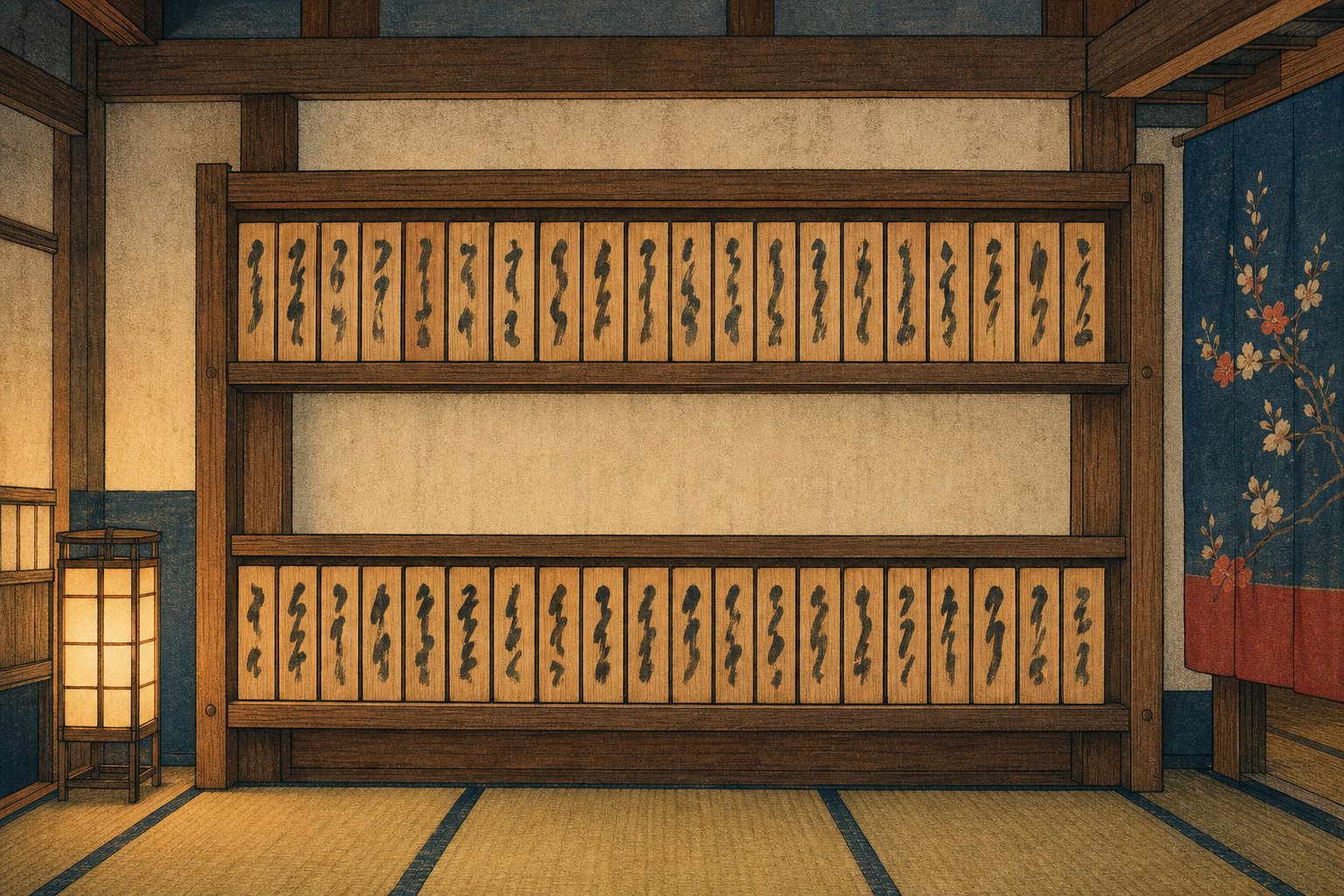
The visual rules followed from the same intent: the obi at the back for geisha, at the front for courtesans, along with distinctions in hairstyle, sleeve length, and where each woman was permitted to work. These were not fashion choices. They were a public filing system, worn.
How Do You Tell Them Apart in a Photograph?
| Look for | Geisha | Oiran |
|---|---|---|
| Obi | Neat knot at the back | Large, elaborate knot at the front |
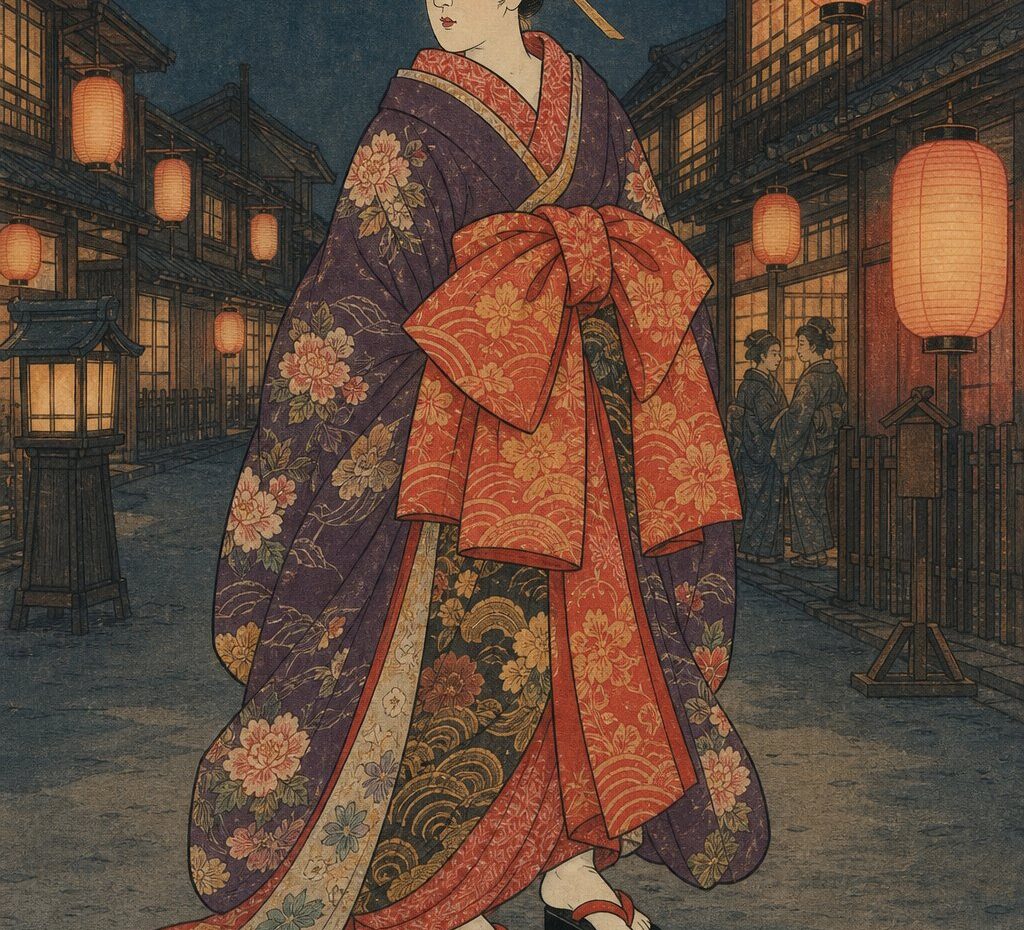
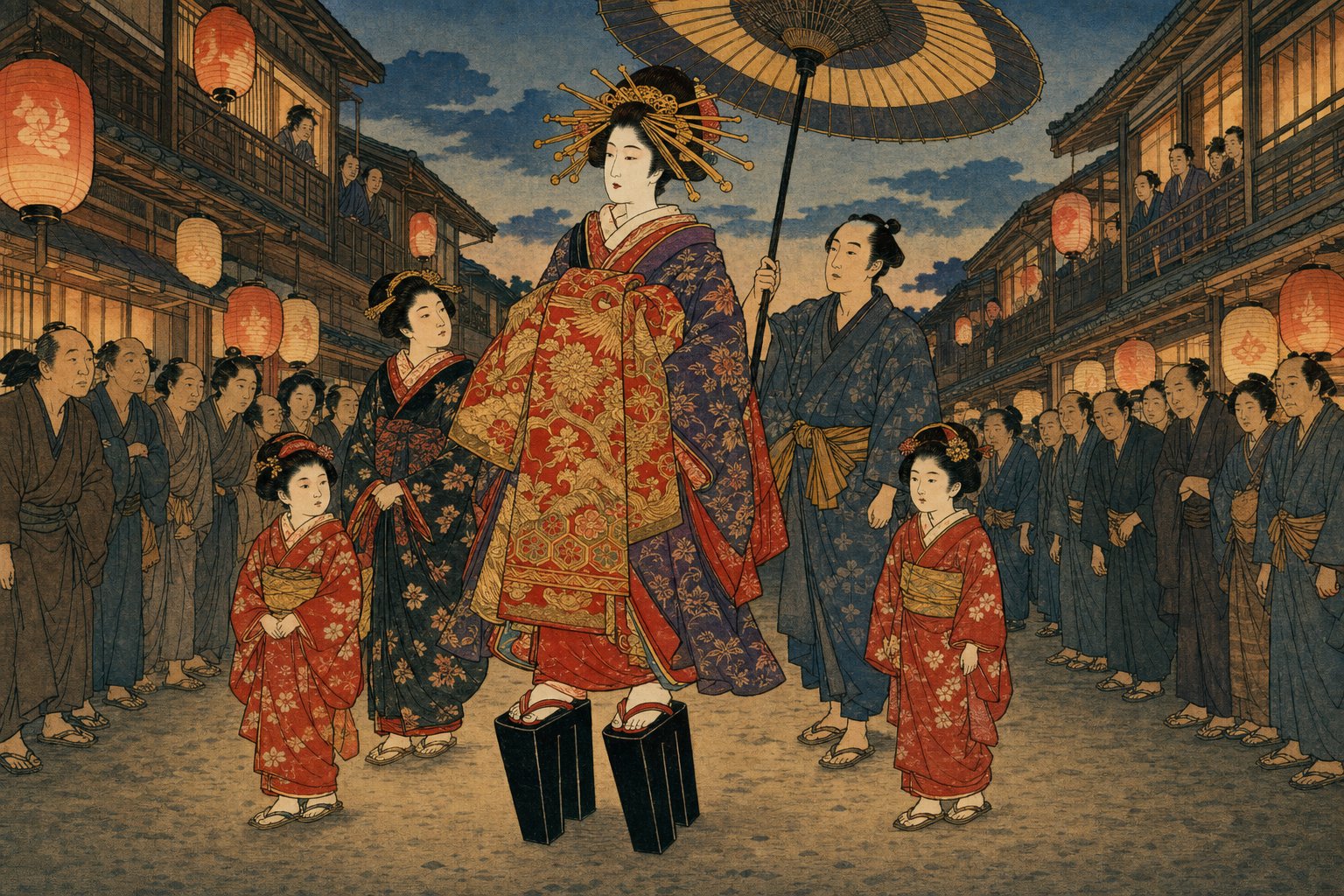
| Hairpins | Restrained; a few seasonal pieces | Many, radiating outward like a crown |
| Footwear | Flat zōri or modest geta | Three-toothed geta, tall and heavy |
| Layers | One kimono, clean lines | Multiple layered robes, heavy outer garment |
| Overall impression | Understated elegance | Deliberate spectacle |
The single fastest check is the obi. If the sash is tied in front, you are not looking at a geisha.
Where Did Each One Work?
The oiran belonged to one place: the Yoshiwara, a licensed quarter enclosed by a wall and a moat, entered through a single gate. It was a district defined by its boundary.
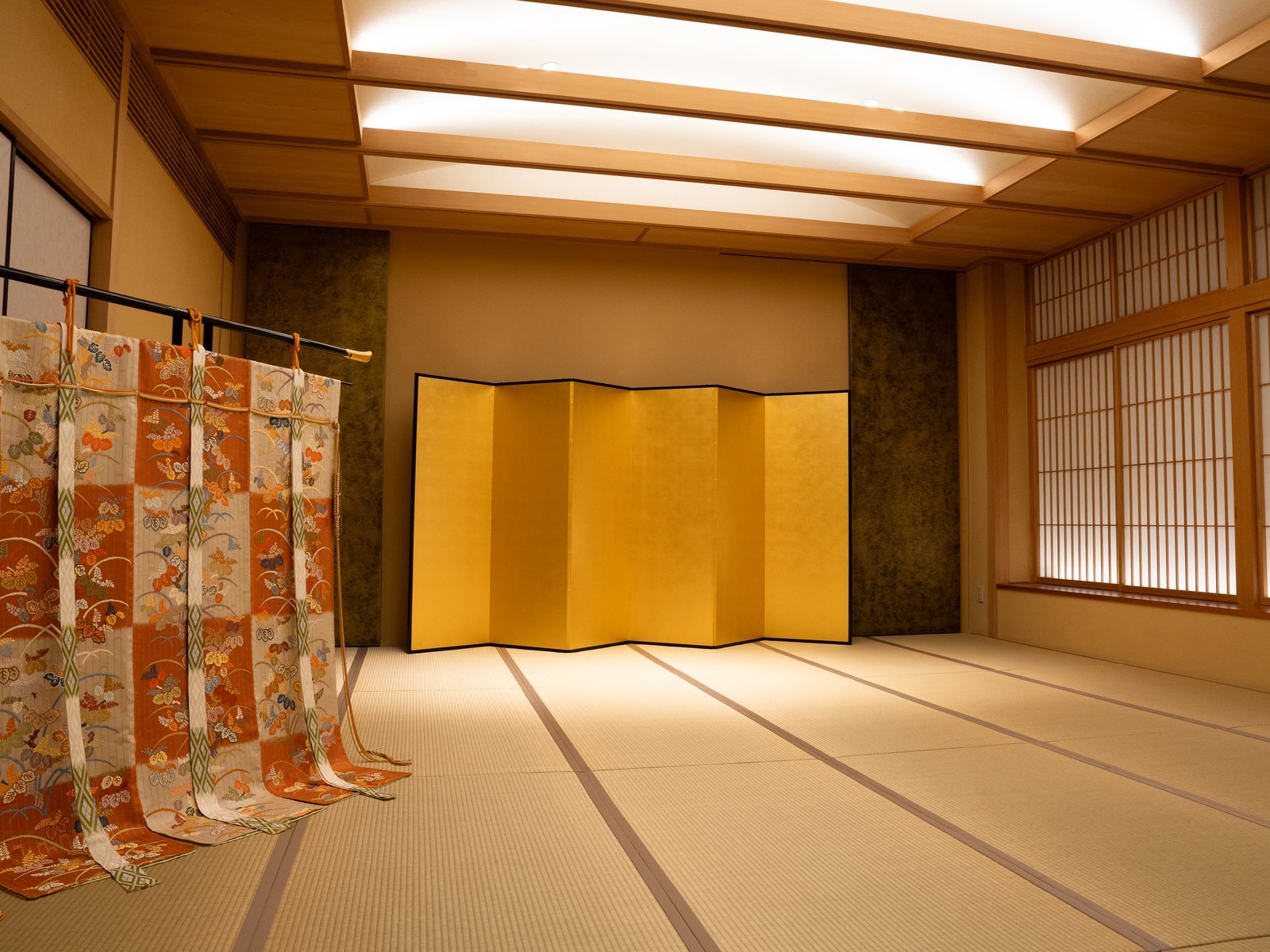
Geisha worked — and still work — in hanamachi, flower districts made of tea houses and banquet rooms scattered through ordinary neighbourhoods. There is no wall. In Asakusa, an ozashiki (お座敷, a geisha banquet) happens in a tatami room on a normal street, behind a door you could walk past without noticing.
That difference in geography says something true about the two professions. One was contained by design. The other was woven into the life of the city, which is a large part of why it survived.
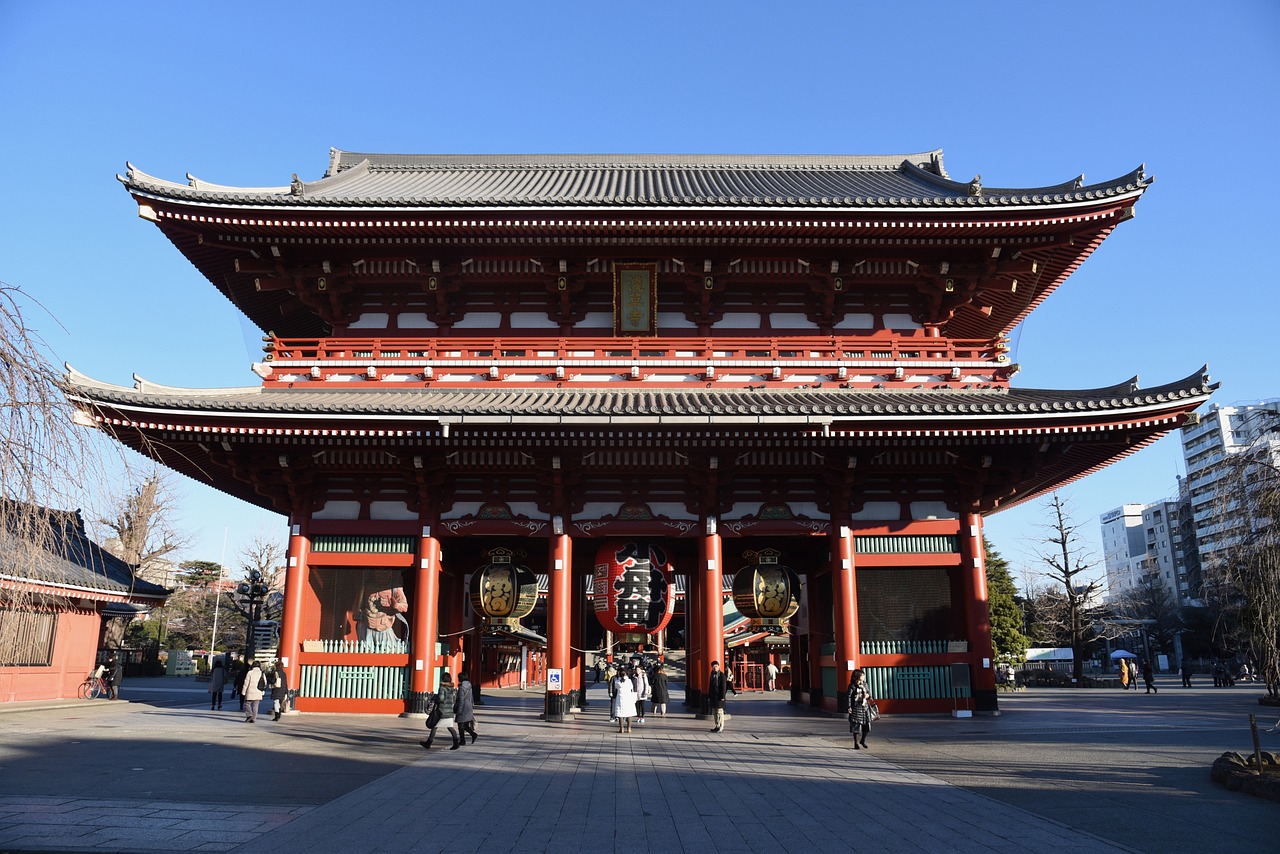
The two are closer together than most visitors realise. The Yoshiwara stood in the northern part of Asakusa, and Miyakodori — our tea house — is in the same district, a short walk from the temple, in the quarter where both stories unfolded. The pleasure quarter tends to be read as a sealed-off past, which makes the geography easy to miss: the geisha performing on a given evening works a few streets from where it stood. The proximity is not a coincidence. It is what happens when one profession ends by law and the other simply keeps going.
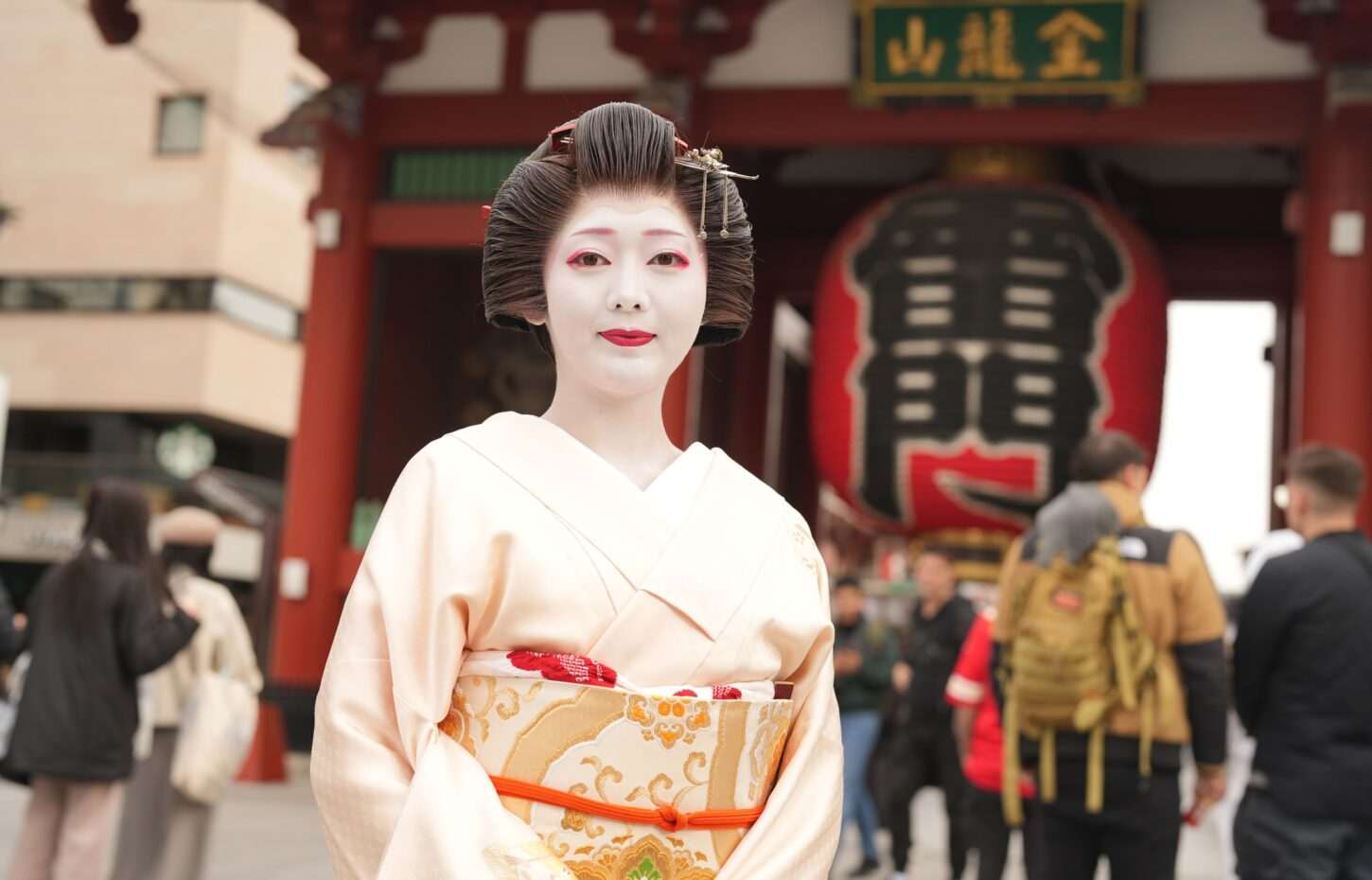
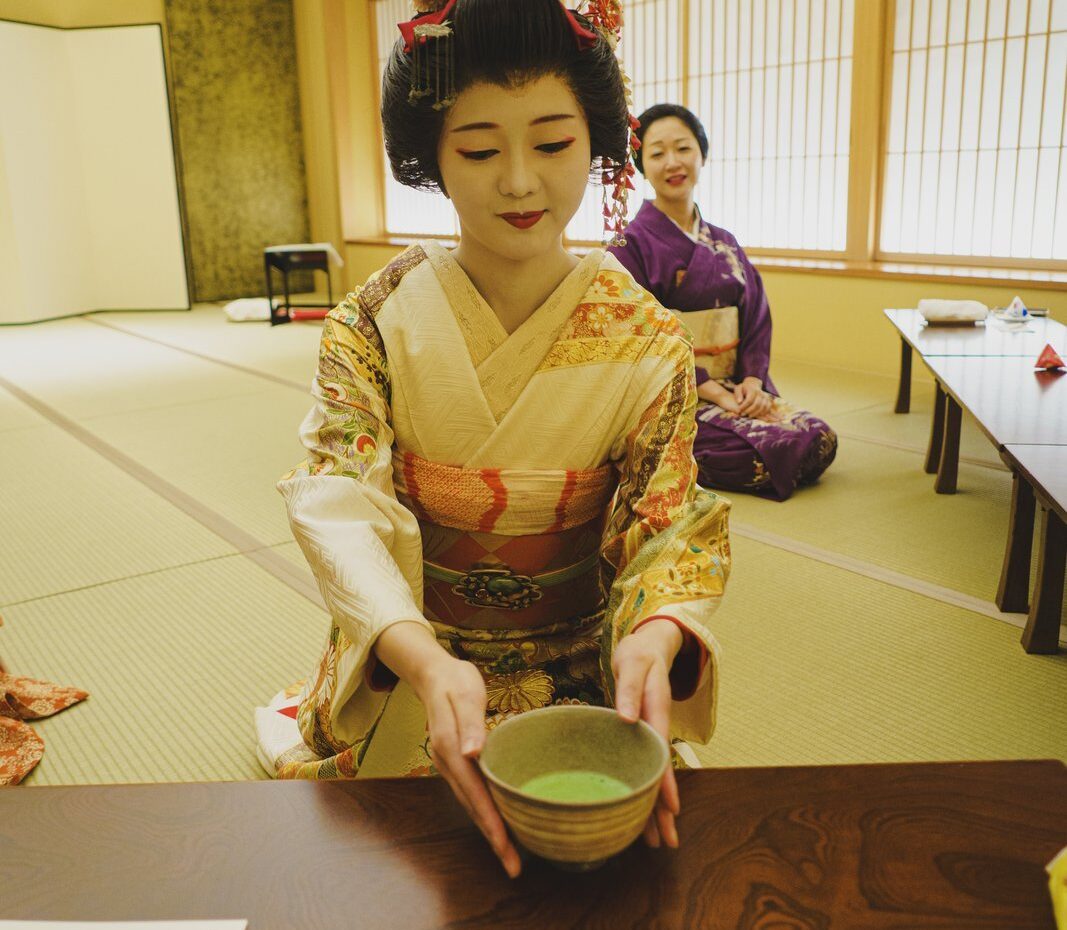
A hanamachi has no wall. This is an Asakusa geisha on an ordinary street: the same neighbourhood described above, where an ozashiki happens behind a door you could walk past without noticing.
Which One Still Exists Today?
Oiran do not exist as a living profession. Japan’s Anti-Prostitution Law closed the Yoshiwara in 1958, and no one has worked as an oiran since. What you can see today is reenactment: the oiran dōchū procession staged at festivals such as the Ichiyo Sakura Matsuri, held in spring in the backstreets behind Sensō-ji, and costume studios that recreate the look for photographs. Whether the procession itself runs in a given year is announced by the organisers, so check before travelling for it. These are performances of a memory, and they are honest about it. Asakusa’s geisha take no part in these reenactments — the procession belongs to the courtesans’ story, not the geisha’s.
Geisha are a living profession. In Asakusa there are around twenty geisha working today, along with the district’s hōkan — male entertainers of an art you will not find performed anywhere else in Japan. They rehearse, they take engagements through the kenban, and they perform in the evening in rooms a few minutes’ walk from Sensō-ji. The path into the profession still runs in three stages: six months to a year as a minarai, learning manners and movement before performing; then hangyoku, already a geisha, appearing at banquets while continuing to study; then, after three or four years, ippon — a full-fledged geisha.
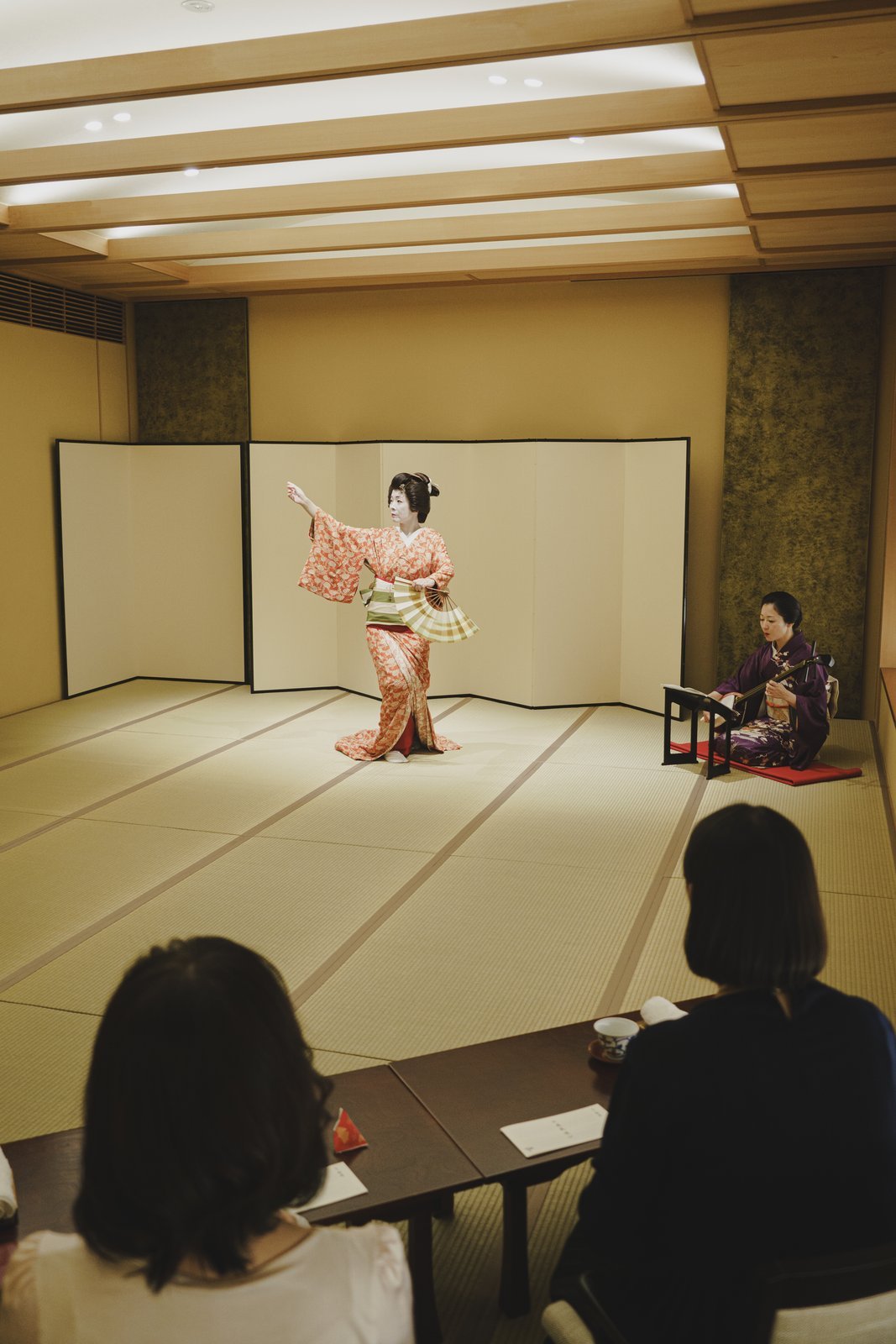
So the honest answer to “can I see one?” splits in two. You can see an oiran portrayed. You can meet a geisha at work.
You Can Meet the Second One Tonight
One of these two professions still works in Asakusa. Miyakodori hosts ozashiki (a private gathering with geisha) evenings with the district’s geisha and hōkan.
So — Were Geisha Prostitutes?
No. This is the misconception the whole comparison exists to correct, so let us state it plainly: geisha are artists, and the profession has never been prostitution.
The confusion has a traceable history. Some of it is Western wartime and postwar writing that applied the word “geisha” loosely to almost any Japanese woman in a kimono. Some of it is the fact that both professions existed in the same period, occasionally in the same quarter. And some of it is simply that oiran imagery is more dramatic, so it travels further.
But Edo-period Japan drew this line with wooden boards and separate rows of names, and Asakusa’s geisha still observe the distinction with care today. When you sit in an ozashiki, what is being sold to you is unmistakable: the person playing three feet from where you are sitting spent years in training before she was allowed to.
If you would like to meet the living half of this comparison, Miyakodori hosts ozashiki evenings with Asakusa’s geisha and hōkan — the living half, in the neighbourhood where it never stopped.
Asked whether she is glad she became a geisha, she answers for herself. The profession described on this page is one that people choose, train for years to enter, and stay in. Subtitled on screen.
Frequently Asked Questions
Were geisha prostitutes?
No. Geisha are performing artists trained in shamisen, song, and classical dance. The confusion comes from oiran — licensed courtesans of the Yoshiwara — being a separate profession that existed in the same era. Edo-period Japan kept the two formally distinct through the kenban registry system.
What is the difference between oiran and geisha?
The difference between oiran and geisha is what they sold. An oiran was the highest rank of courtesan in the licensed Yoshiwara quarter and provided companionship. A geisha is a performing artist who sells art — and the two are not the same profession. Courtesans are the older profession and geisha established themselves later, but by the time both worked in the same quarter their roles were already distinct.
Do oiran still exist in Japan?
No. The profession ended when Japan’s Anti-Prostitution Law closed the Yoshiwara in 1958. What exists today is reenactment: oiran dōchū processions staged at festivals such as Asakusa’s Ichiyo Sakura Matsuri, and costume photo studios.
How can I tell an oiran from a geisha in a photo?
Check the obi. Geisha tie the sash at the back; courtesans tied it at the front. Oiran also wear many more hairpins, tall three-toothed geta, and multiple layered robes, while a geisha’s appearance is deliberately restrained.
Which came first, geisha or oiran?
The courtesan quarters came first. Geisha emerged as a recognised profession later, partly from within the Yoshiwara itself, when performance-focused apprentices became the quarter’s first geisha and the shogunate formally separated the two occupations.
Can you still meet a geisha in Tokyo today?
Yes. Asakusa has around twenty working geisha, along with the district’s hōkan. They perform at ozashiki — banquets held in tatami rooms at tea houses — which visitors can attend by reservation.
Is a maiko the same as an oiran?
No. A maiko is an apprentice geisha in Kyoto, training in the same performing arts as a full geiko. In Tokyo the equivalent apprentice stage is called hangyoku. Neither is related to the oiran, who was a courtesan.
Meet the Living Half of This Comparison
Miyakodori hosts ozashiki (a private gathering with geisha) evenings with Asakusa’s own geisha and hōkan, a few streets from where the Yoshiwara once stood.


- The Miyakodori Bird in Ukiyo-e: Hiroshige's Namesake
- What Is the Tora Tora Game? Rules, History, and How to Play
Types of Geisha: Tachikata, Jikata, Hangyoku, Ippon, and Tokyo’s Male Geisha
Traditional Japanese Culture Experience: A 2026 Travel Guide
Enjoy Asakusa! Complete Year-Round Information on Seasonal Events, Festivals, and Sightseeing Activities
1,060 to 20: A Third-Generation Owner on What Changed in Asakusa’s Geisha World
Enjoy Autumn in Asakusa! Recommended Food Walk & Momiji Model Course with Kimono

No comments yet.