



Tori no Ichi in Asakusa 2026: Dates, Hours, Kumade, and a Geisha House’s View of the Rooster Fair
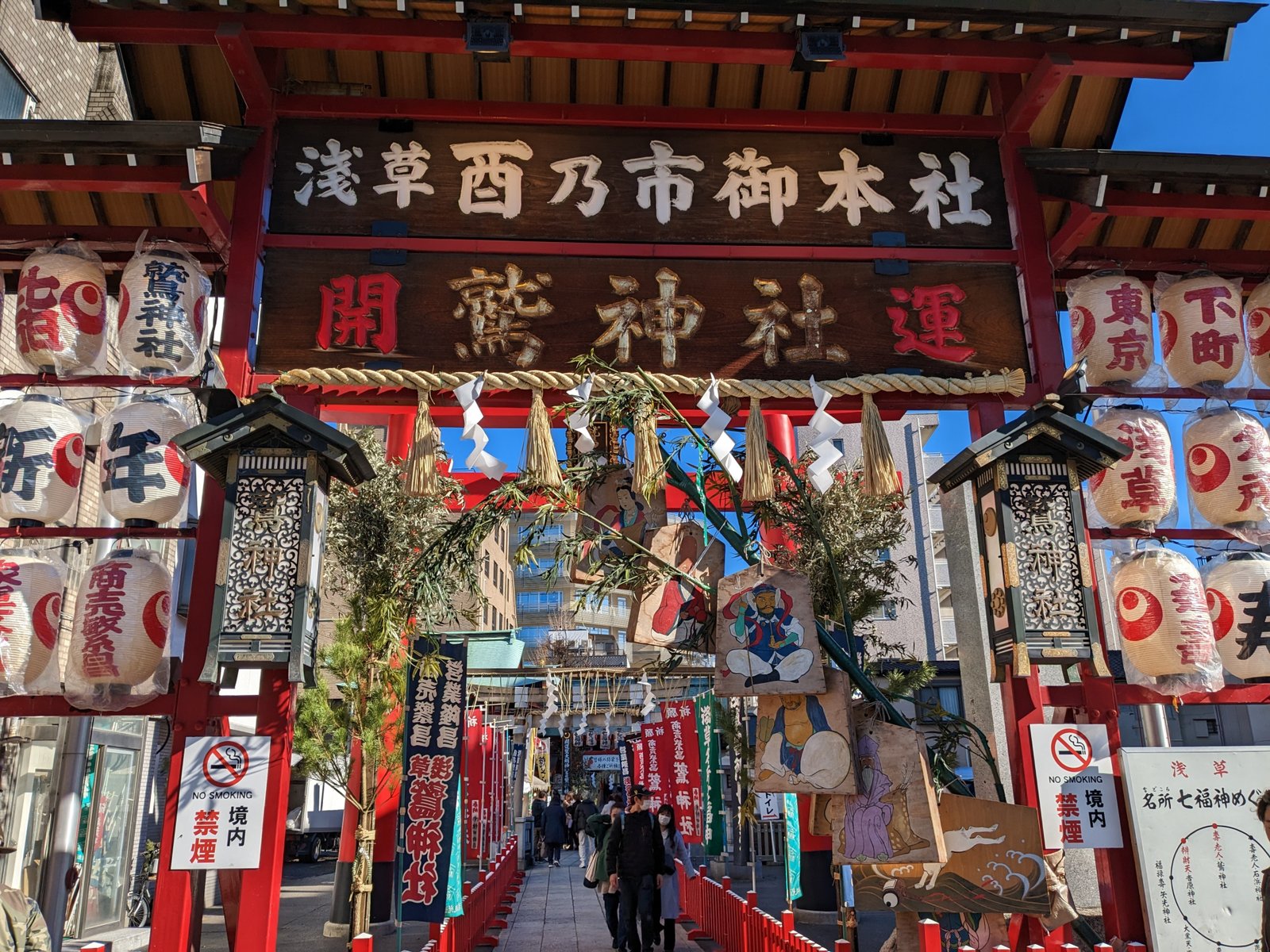
Tori no Ichi, the “rooster fair,” takes place in Asakusa in 2026 on Saturday 7 November (Ichi no Tori) and Thursday 19 November (Ni no Tori). There is no third fair this year. Each fair runs for 24 hours, from midnight to midnight, at two neighboring sites in Senzoku, Taito City: Otori Shrine and Chokokuji Temple, about 7 to 8 minutes’ walk from Iriya Station or from Asakusa Station on the Tsukuba Express. Visitors come to buy a kumade, an ornamental rake meant to rake in good fortune and business for the coming year. The shrine says the blessings are the same on either date, so choose the one that suits your trip.
We are Miyakodori, a machiai-chaya in Asakusa, and Otori Shrine, one of the fair’s two sites, is about 10 minutes on foot from our door. Our okami (proprietress) goes every November, and so does the third generation of the house. Each year we buy a kumade. This guide starts with the dates and hours as the shrine and the temple publish them, then covers how to buy, display, and return a kumade, how to get there, and how to fit the fair into a day in Asakusa. Dates and times can change, so check the official pages before you go.
Tori no Ichi 2026 at a Glance: Dates, Hours, and Venues
Asakusa’s fair is held at two neighboring sites: Otori Shrine, written Ootori or Ohtori in some places, also called Washi Shrine and known locally as Otorisama, and Chokokuji Temple, nicknamed the “rooster temple” (Tori no Tera). Both are in Senzoku, in Taito City. Do not confuse this shrine with the other Otori shrines elsewhere in Tokyo, such as the one in Meguro. Each site keeps its own website and its own schedule of ceremonies, and the table below draws on both.
| Detail | Ichi no Tori (first) | Ni no Tori (second) |
|---|---|---|
| Day | Saturday 7 November | Thursday 19 November |
| Evening before | Friday 6 November | Wednesday 18 November |
| Fair hours | Midnight to midnight, 24 hours | Midnight to midnight, 24 hours |
| Eve ceremony at the shrine | 11:15 pm on 6 November | 11:15 pm on 18 November |
| Special ceremony at the shrine | 1:00 pm on 7 November | 1:00 pm on 19 November |
Sources: Otori Shrine, Chokokuji Temple, and the Tokyo Convention & Visitors Bureau (GO TOKYO). Otori Shrine is at 3-18-7 Senzoku, and Chokokuji Temple is at 3-19-6 Senzoku. The shrine says you may attend either ceremony, but you need to reserve in advance and check in 15 minutes before it starts.
The fair itself begins with the first drum at midnight and runs for a full 24 hours. Chokokuji adds details on the stalls. Near the temple, some stalls open from about 7 pm on the evening before, and many stay open until about 2 am the morning after the rooster day. Chokokuji notes that these stall times shift with the weather and the day of the week. Some kumade shops start selling around 9 pm the night before and keep selling until about 1:30 am on the day after the rooster day. On the rooster day itself, some shops do not serve customers from about 3 am to 9 am. The temple’s charm office is open from midnight to midnight, except from 2 am to 9 am.
Rooster days come around every 12 days, and the fair is held on the ones that fall in November. If the first rooster day falls between the 1st and the 6th, there is room for three fairs; between the 7th and the 12th, two. In 2026 the first falls on the 7th, so there are two, and the next rooster day, 12 days after the 19th, is 1 December. The shrine calls a third fair San no Tori, and there is none this year.
Chokokuji says the fair goes ahead in rain or snow unless the weather or a disaster makes it unsafe, and that it appears never to have been postponed or cancelled because of weather.
What Is Tori no Ichi? (and Why Two Sites Share It)
The Rooster Days
Tori is the rooster, and ichi means a market or fair. The rooster is one of the twelve zodiac animals, and the same twelve animals are used to name days, so a rooster day comes back every 12 days. In November, those days are festival days at shrines and temples across the Kanto region. The shrine says the festival was first called Tori no Machi, the “festival of the rooster,” and that the word for market came later, because stalls began to set up at the festival.
Three Stories of Where It Began
Nobody can say for certain how it began. The National Diet Library lists three accounts side by side.
The first comes from Otori Shrine itself. By the shrine’s tradition, the legendary prince Yamato Takeru stopped at the shrine to pray before a campaign. On his way home, victorious, he hung his weapon, a kumade, on the pine tree in front of the shrine and gave thanks. That day was a rooster day in November, so the shrine fixed its annual festival on it. The shrine enshrines Yamato Takeru alongside its main deity for this reason.
The second is tied to Chokokuji. In this account, the fair grew out of the market that gathered at the temple gate on the days when the temple’s image of Washi Myoken Daibosatsu was shown to the public.
The third is older and further out. It begins in Hanamata, now Hanahata in Adachi City, where farmers held a harvest festival to thank their local god, Washi Daimyojin. Chokokuji’s history page says they offered chickens to the god, and that the birds were then carried to Senso-ji and, it is said, set free in front of the Kannon Hall.
Why Asakusa Became the Famous One
In the Edo period, three fairs were well known. Chokokuji’s history page calls them Hon no Tori (the original), at Hanamata; Naka no Tori (the middle), at Shosenji Temple in Senju; and Shin no Tori (the new), in Asakusa. The shrine’s own page uses different names for the same three, upper, middle, and lower. Chokokuji says Asakusa’s fair became widely known from around 1771, when the image of Washi Myoken Daibosatsu was moved to the temple. It adds that the Hanamata fair had street gambling, that gambling was banned in the An’ei era (1772 to 1781), and that the crowds then moved toward Asakusa.
Geography helped too. Shin-Yoshiwara, Edo’s licensed pleasure quarter, lay just east of the shrine, and the quarter is said to have opened its gates to the public on festival days. Geisha and courtesans were separate professions: a geisha’s work was dance, music, and conversation. Our guides to the Yoshiwara and to oiran versus geisha explain how the two were told apart.
Edo’s Last Event of the Year
The fair has long marked the turn of the year. Kikaku, a disciple of Basho, wrote a haiku that the shrine and the temple both quote: Haru o matsu / koto no hajime ya / Tori no ichi, which could be rendered as “Waiting for spring: its first sign is the rooster fair.” In the Edo period, townspeople bought kumade and yatsugashira, a kind of taro, at the fair to greet the new year. Woodblock prints by Toyokuni and Yoshitoshi, among others, show the crowds, and Higuchi Ichiyo’s story Takekurabe describes a year with three fairs and the shrine’s roaring crowds. The National Diet Library counts more than 40 shrines and temples in Tokyo that hold a Tori no Ichi today.
The shrine’s own record adds one more point: it says the festival has been held every year, including the year of the 1923 Great Kanto Earthquake, through the war years, and in the year the war ended.
Which Rooster Day Should You Go? (and What Time)
Either one. The shrine explains that at first the first rooster day seems to have been the main one, and that the second and third came to be held over time as Edo townspeople kept coming. So, it says, the blessings are the same whichever rooster day you visit, and you can go on the day that suits you. Chokokuji notes that the first seems to have been given the most weight.
The calendar gives you a Saturday and a Thursday this year. Neither site publishes crowd figures by day or by hour, so we will not guess which is quieter. For the wider picture of Asakusa’s busy and calmer seasons, see our guide to the best time to visit Senso-ji.
How a Rooster Day Runs
- Midnight. The first drum sounds and the fair begins. The shrine starts handing out its kumade charms from this moment (more on those below).
- Daytime. The shrine holds its special ceremony at 1:00 pm. Prayers for individuals and families are also held on request through the day; the shrine’s fee starts at 5,000 yen, and a family or group may send up to five people.
- Evening and night. Stalls stay open late, and shops keep selling kumade until the early hours of the next morning, as described above. The shrine’s Washi-mai dance is offered around 6 pm and 8 pm (details below).
Ichiban-fuku: The First Fortune
At the stroke of midnight, the shrine gives away a limited “first fortune” (Ichiban-fuku). Three tags called ichiban-fuda are handed to the first people to receive a kumade charm after the first drum, and each can be exchanged for a netsuke-style charm in the shape of a koban, an oval gold coin, made of pure 24-karat gold. Only three are given out, and the shrine keeps it secret which of its charm counters they will come from.
The Crowds
The shrine says 700,000 to 800,000 people come each year, a count it makes itself and does not date. For 2025, Chokokuji’s notice expected more visitors than the year before and changed how the line in front of its gate was arranged: instead of running straight along Kokusai-dori, it was to bend at the corner. The notice asked visitors to follow the staff.
How to Buy a Kumade: What the Rake Means, What It Costs, and the Haggling Custom
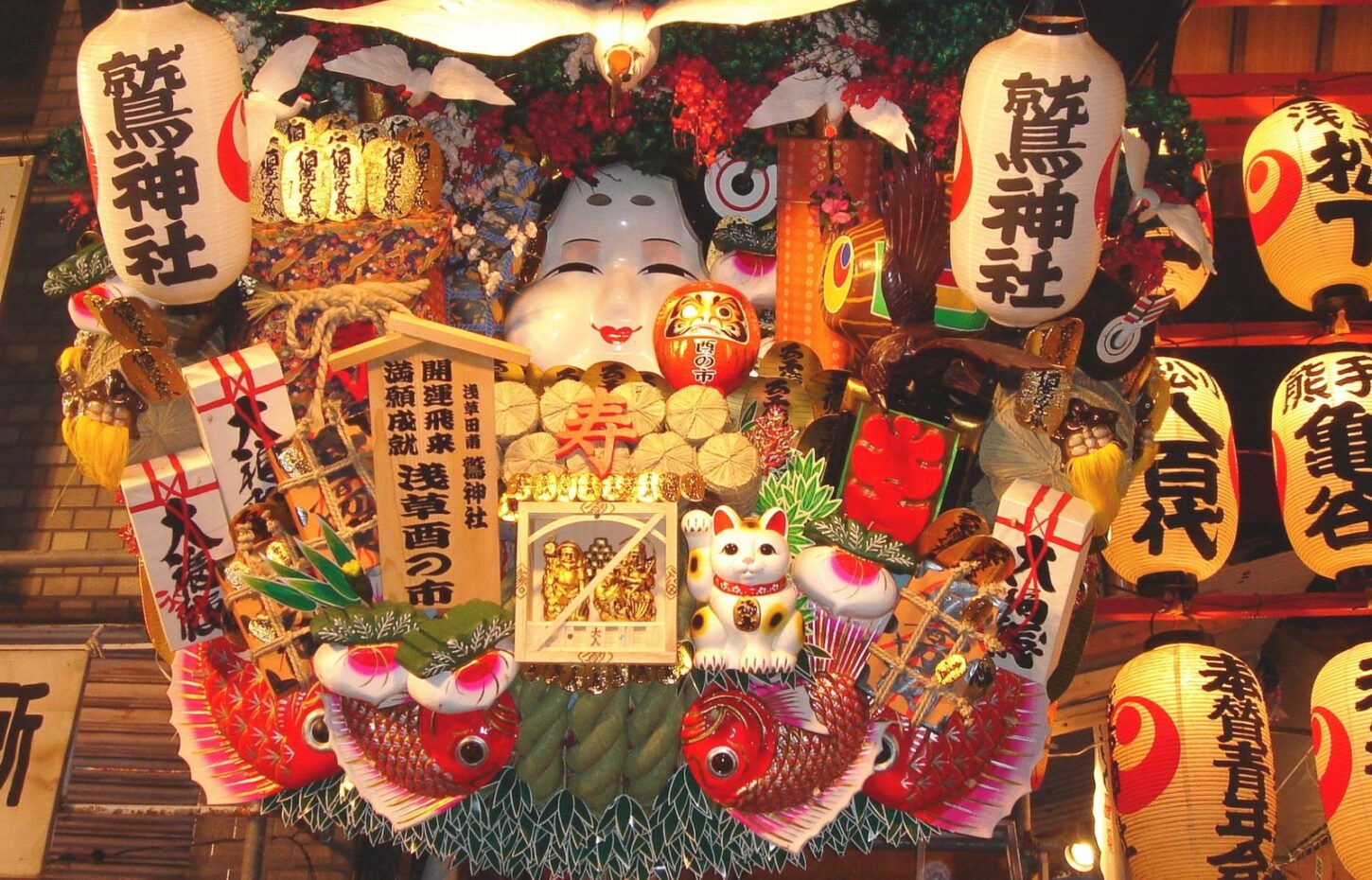
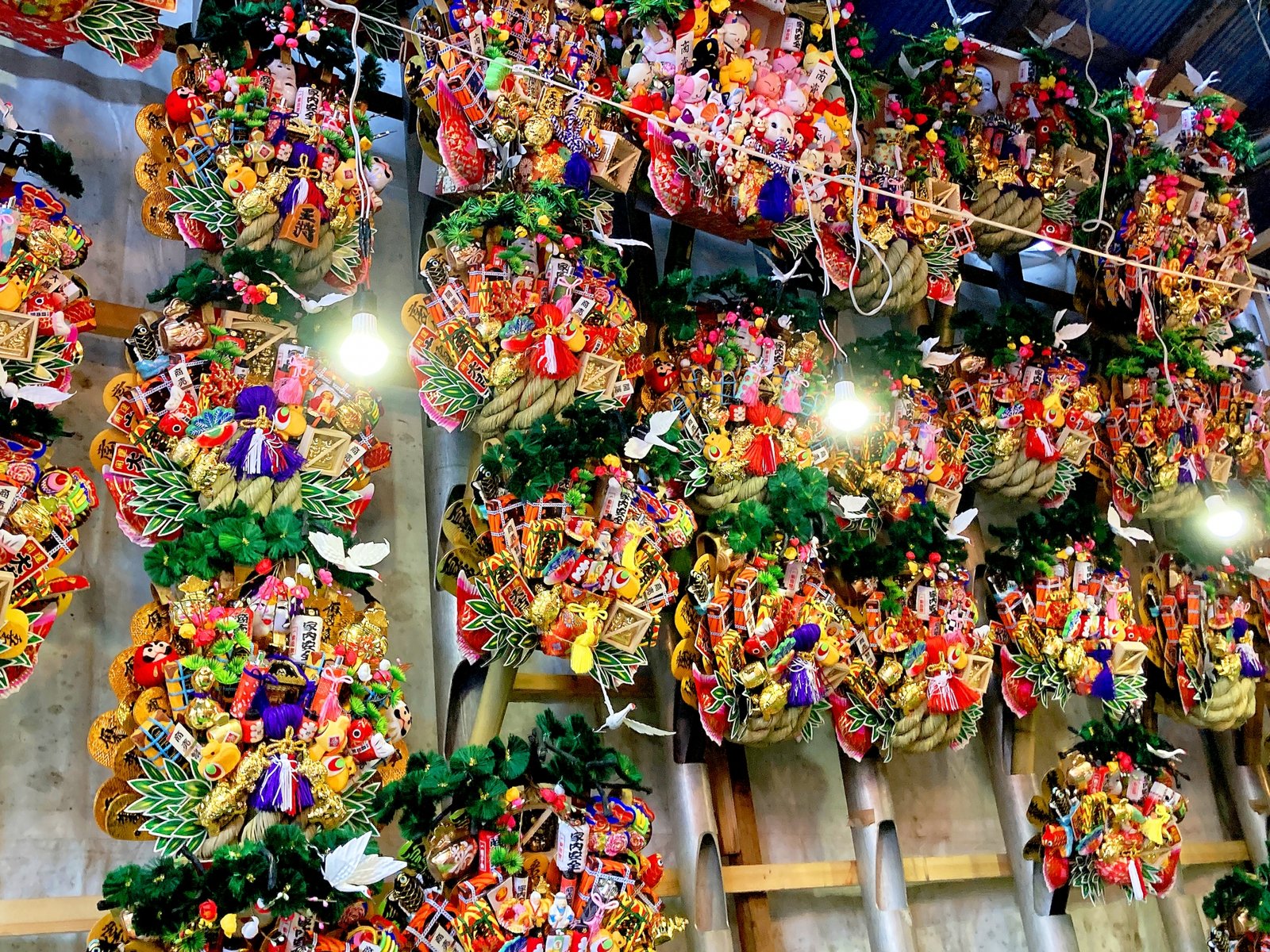
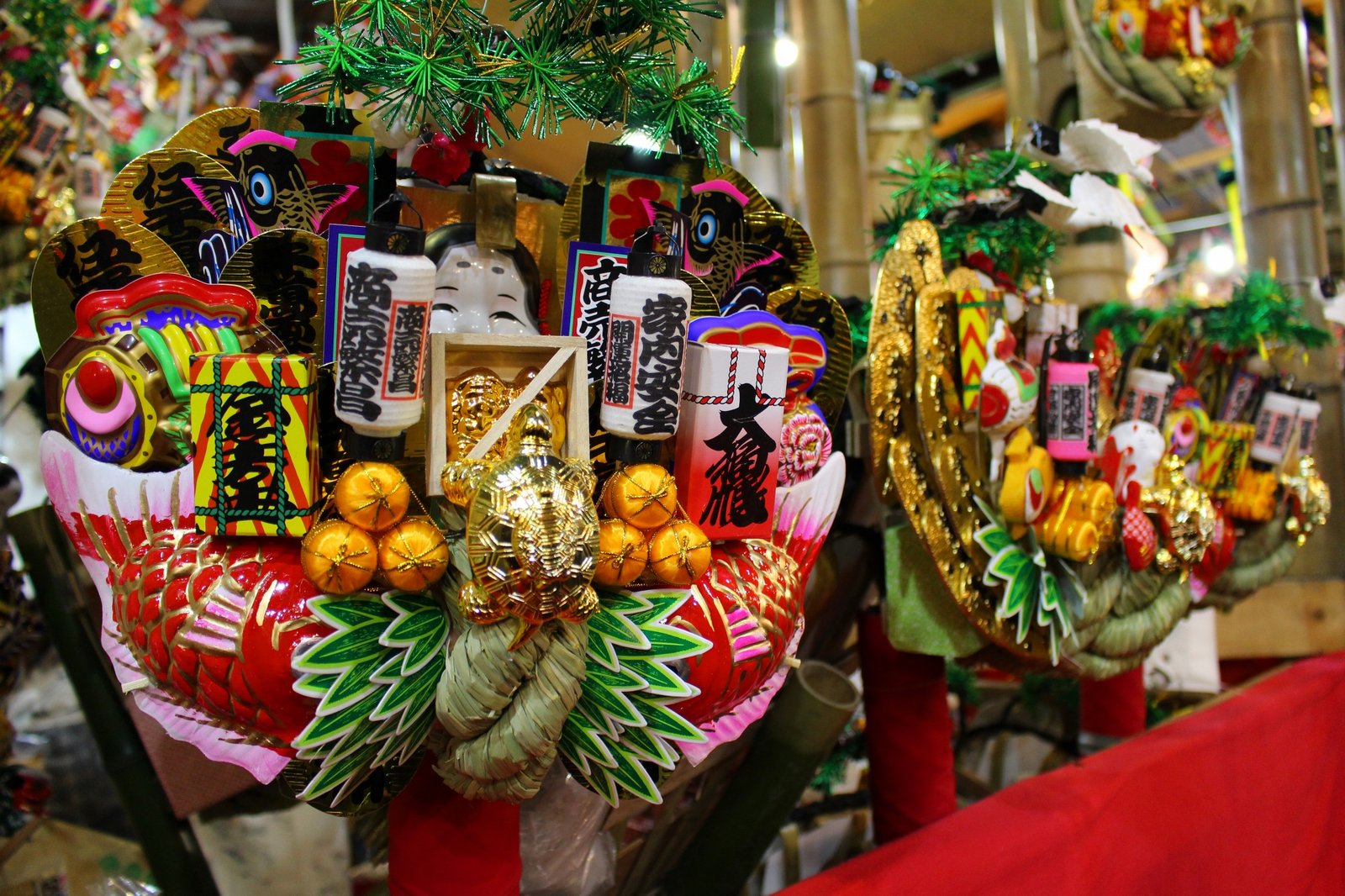
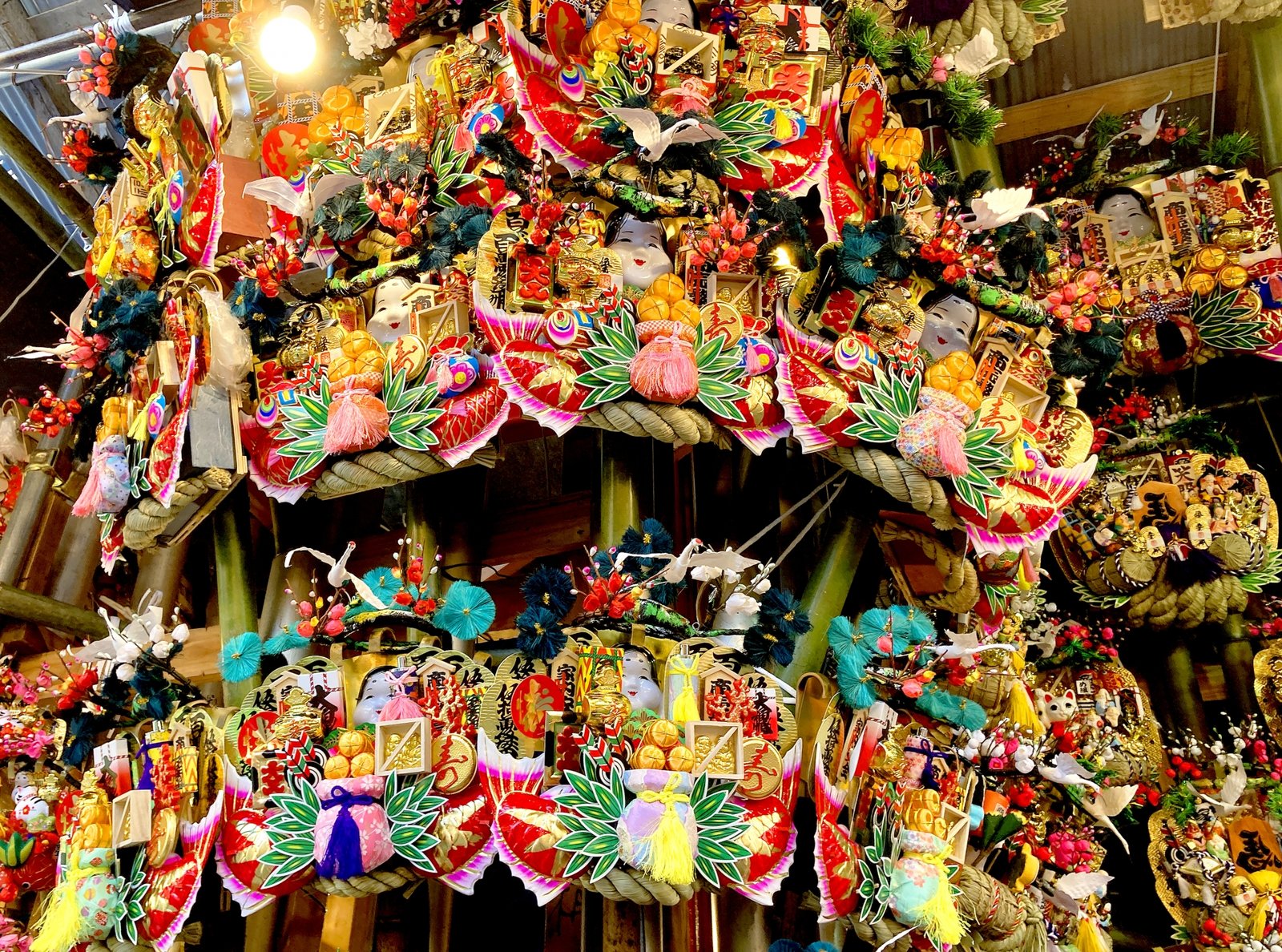
A kumade is a “bear’s paw,” a rake. The National Diet Library explains that it stands for raking in luck and gold, and that its shape suggests the claws of an eagle seizing fortune. Shops decorate them with lucky motifs, often in gold and silver. The shrine says the fair is no longer only for shopkeepers: today people look to a kumade for family safety and health, and young people for luck in love.
One decoration is worth knowing. The round-faced woman’s mask on many kumade is Okame, also called Otafuku, and the shrine’s account is that she is Ame-no-Uzume, the goddess who danced in the myth of the heavenly rock cave to bring light back to the world.
Two Kinds of Kumade
There are two things to buy. The first is the shrine’s own kumade charm (kakkome), given out only during the fair. The second is a lucky kumade sold by the kumade shops, which the shrine says number about 150, mostly around its grounds. The shrine says it is usual to receive the charm first and then buy a lucky kumade, and to display the two together at home. Chokokuji also gives out kumade charms, at a charm office open from midnight to midnight, except from 2 am to 9 am, with no application needed. One limited kumade charm, the Juban-fuda, is capped at ten and needs an application.
What It Costs
The shrine’s guidance is a rough one, and its own wording is hedged. Small kumade start at 1,000 yen, and large ones can cost several hundred thousand yen. The best sellers are said to be around 20,000 to 50,000 yen. Treat that as a guide, not a quote. The shrine advises you to decide on a design and a budget, then walk once around the grounds before you choose, because two kumade of the same size can differ in price depending on how many decorations they carry.
The Haggling and the Hand-Clap
The fun comes in the bargaining. The shrine says that in the old days the stylish way to buy a kumade was to haggle, and then leave the amount you had talked off the price with the shop as goshugi, a celebratory gift. In effect you paid the shop’s asking price, but you got to feel like a lord, and the seller got to feel the better for it. Chokokuji gives the same account and adds the meaning: thanks for the seller’s generosity, and a way of cheering the shop on to a good year. A hand-clap (tejime) follows to mark the sale and to wish your home or company prosperity. Japan’s national tourism office lists the hand-clapping among the sights of the fair.
Chokokuji stresses that the goshugi is a custom, not a rule. Today, some shops tell you a price when you ask, based on the size and the decorations, and regular customers often receive a price the shop has already decided. So the haggling goes case by case. Enjoy the sales patter whichever way it goes.
Bring Last Year’s Kumade
When you buy a new kumade, Chokokuji asks you to bring last year’s. There are collection points for old kumade at the entrances of both Chokokuji and the shrine, and the temple purifies what is left there on a regular schedule. If you cannot bring it to the fair, a very small one can be taken to a nearby shrine or temple that holds a burning ceremony at New Year, with a small offering. A large one should be taken apart and discarded according to your local rules, with thanks for the year it served. The shrine adds that old amulets and kumade are returned to the shrine or temple where they were bought, with a fee for the burning ceremony.
Where to Display It
Chokokuji’s advice is to hang it high at the entrance of your home, facing the door so that fortune comes in. Failing that, hang it high inside, facing south, east, or west. If you have a household shrine shelf (kamidana) or a Buddhist altar, a charm from a temple or shrine can go there. Avoid facing it north. The shrine says to put up new items on 28 December, though you may hang a replacement right away if you are swapping one for another.
| Step | What the two sites say |
|---|---|
| Kumade charm | The shrine gives out its own only during the fair; Chokokuji also gives out kumade charms during the fair |
| Lucky kumade | Sold by about 150 kumade shops, mostly around the shrine grounds (the shrine’s figure) |
| Price guide | From 1,000 yen; best sellers about 20,000 to 50,000 yen (the shrine’s rough guide) |
| Haggling | Optional; the amount haggled off is left with the shop as goshugi, a custom and not a rule |
| Old kumade | Bring last year’s to the collection point at the entrance of the shrine or Chokokuji |
| Display | High, facing the entrance or facing south, east, or west; avoid north; new items go up on 28 December |
What to Eat and See Beyond the Rakes
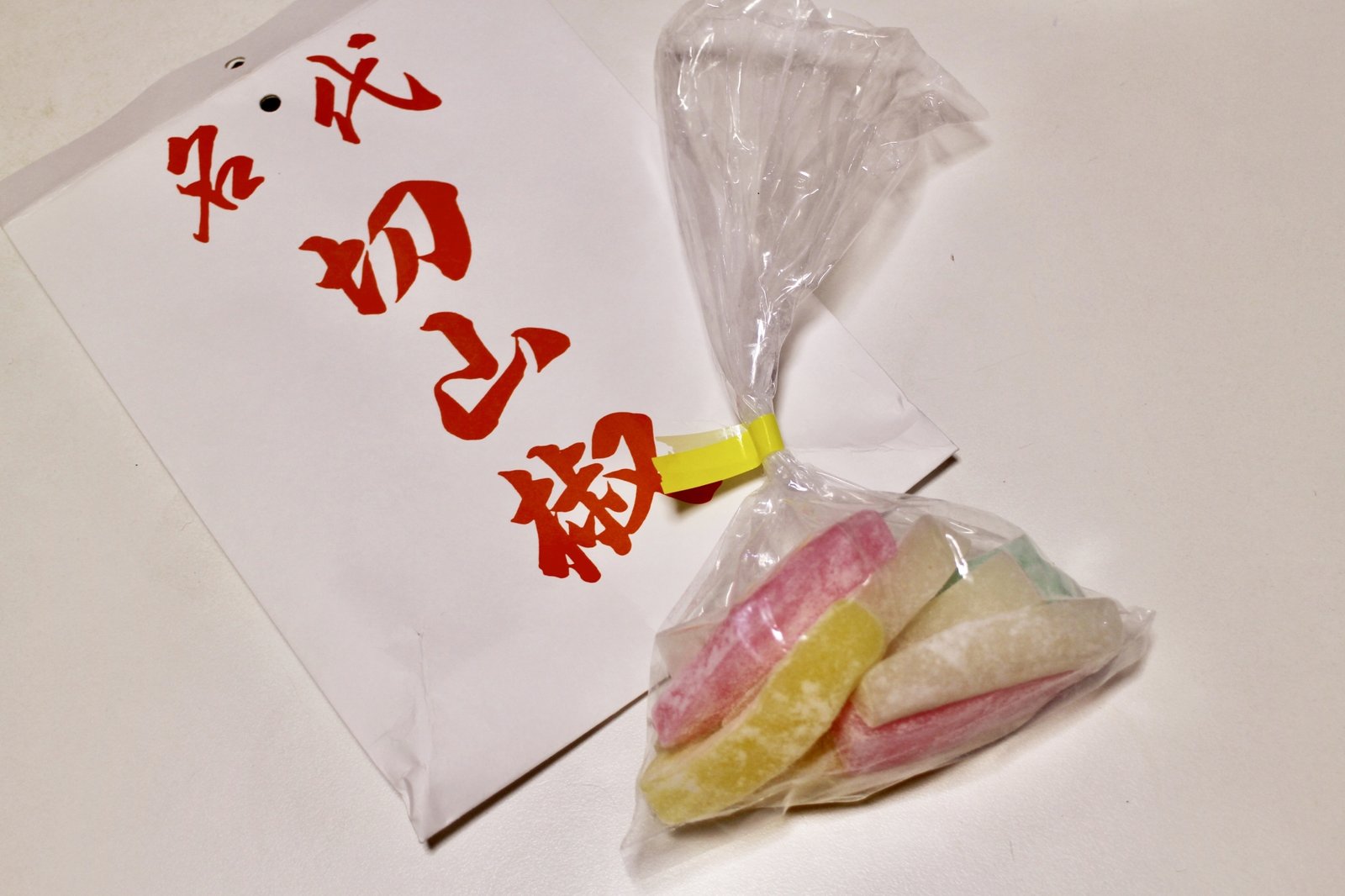
Alongside kumade, the fair has its own lucky foods. Yatsugashira is a large taro. Its old nickname, “head taro” (tō no imo), is said to promise a rise to the top, and since one taro sprouts many shoots, it also stands for many children. Kirizansho is a rice-flour cake made with sugar and sansho pepper, cut into strips, and sold as a sweet that announces the year’s end and the new year. The shrine notes that the old millet cake, kogane-mochi, no longer has a seller, and that only one stall inside its grounds sells yatsugashira and only one sells kirizansho, both just inside the torii on the right. Its page is undated, so look around on the day. A few stalls outside the grounds appear to sell kirizansho as well.
Inside the shrine, look for the Nadeokame, a round-faced Okame figure that visitors stroke for luck. During the fair, the shrine moves it in front of the shrine office entrance. Stroke the forehead for wisdom, the eyes for foresight, the nose for luck with money, the cheek on your right as you face her for romance, the other cheek for health, and the mouth to ward off misfortune. The shrine says the nose is stroked most of all, and that the romance cheek is darkening nearly as fast.
The shrine also offers Washi-mai, a sacred dance offering that lasts about 15 minutes. The shrine lists the same three performances on each rooster day: just after the first drum at midnight, around 6 pm, and around 8 pm, at Zuiwashi Watadono and other places. The times can change with the crowd, so check the shrine’s page for the day.
The shrine puts the scale of the fair at about 150 kumade shops and about 750 stalls, figures it reports itself. Japan’s national tourism office points to the food stalls in the streets behind the temple.
Getting There: Stations, Walking Times, and What the Two Official Sites Say
The two sites sit side by side, so every route below reaches both. The walking times are the ones each site publishes.
- Hibiya Line, Iriya Station (exit 3): about 7 minutes (both sites).
- Tsukuba Express, Asakusa Station: about 8 minutes (both sites). This station is separate from the Ginza Line, Tobu, and Toei Asakusa stations, and it is the closest of the stations called Asakusa.
- Hibiya Line, Minowa Station: about 9 minutes (Chokokuji).
- Toden Arakawa Line, Minowabashi Station: about 11 minutes (Chokokuji).
- Ginza Line, Tawaramachi Station: about 15 minutes (the shrine) or 17 minutes (Chokokuji).
- Ginza Line, Tobu line, and Toei Asakusa Line, Asakusa Station: here the two sites differ. The shrine says about 15 minutes from Asakusa Station on the Tobu and Ginza lines. Chokokuji says about 20 from the Ginza and Tobu stations and about 22 from the Toei station, and the Japan National Tourism Organization says about 20. If you are walking from these stations, plan on 20 or more.
- JR Uguisudani and Ginza Line Inaricho: about 19 to 20 minutes (Chokokuji says 19 for both, and the shrine says about 20 for Uguisudani).
- Bus: a Toei bus on the Nippori to Kinshicho route stops at Senzoku, near the shrine, and at Ryusen, near the temple, each about a 2-minute walk.
Neither Chokokuji nor the shrine has a parking lot for the fair. Chokokuji warns that on the day, lane closures and the crowds cause traffic jams, and asks visitors to come by train or bus. The shrine likewise asks visitors to use public transport; for those who must drive, its parking page asks them not to park on the street and points to a parking search site for nearby lots.
From Miyakodori, Otori Shrine is about 10 minutes on foot. Both our house and the fair lie on the north side of Senso-ji. If you are still planning the rest of your day, our Asakusa tourist guide and our guide to where Asakusa is will help you get your bearings.
Making It an Asakusa Day: Pairing the Fair with an Ozashiki
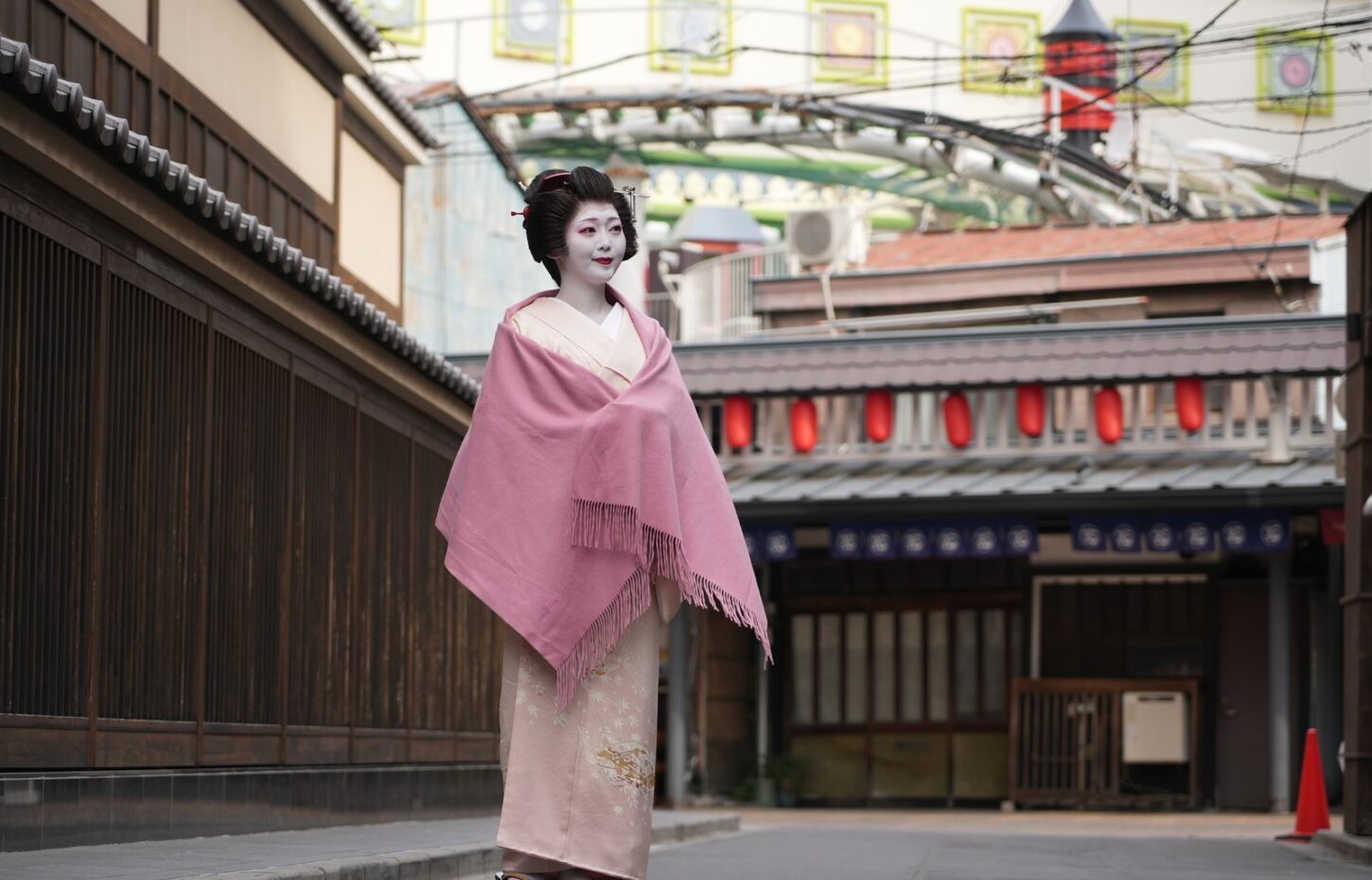
Miyakodori, founded in 1950, is the only machiai-chaya in Asakusa, a traditional teahouse where geisha are called to entertain guests at an ozashiki (geisha banquet). The fair is an easy fit with a visit to us. We receive guests from 2:00 pm, with the last reception at 8:00 pm, and the fair is open all day and into the night. So you can spend the afternoon at an ozashiki, with the geisha in dance, shamisen, and old parlor games, and then walk to Senzoku in the evening.
Here is what to know for the two dates.
- Thursday 19 November (Ni no Tori) is a regular business day for us. You can request a reservation on our reservation page.
- Saturday 7 November (Ichi no Tori) falls on one of our regular closed days. We can sometimes open on a closed day by request. Please write to us at [email protected] at least a week ahead, and we will reply with the details. An additional charge applies to opening on a closed day. Our online reservation form does not take closed days, so email is the way to ask.
There is one small thing the two rooms share. Goshugi is the word for the thanks left with a kumade shop, and it is also the word for the small gift that guests may hand to the geisha at an ozashiki. In both places, it is a thank-you given directly, as part of a good evening.
If you would like to see more of what an evening with Asakusa’s geisha looks like, our guides to geisha in Asakusa and to Asakusa at night are a good place to start.
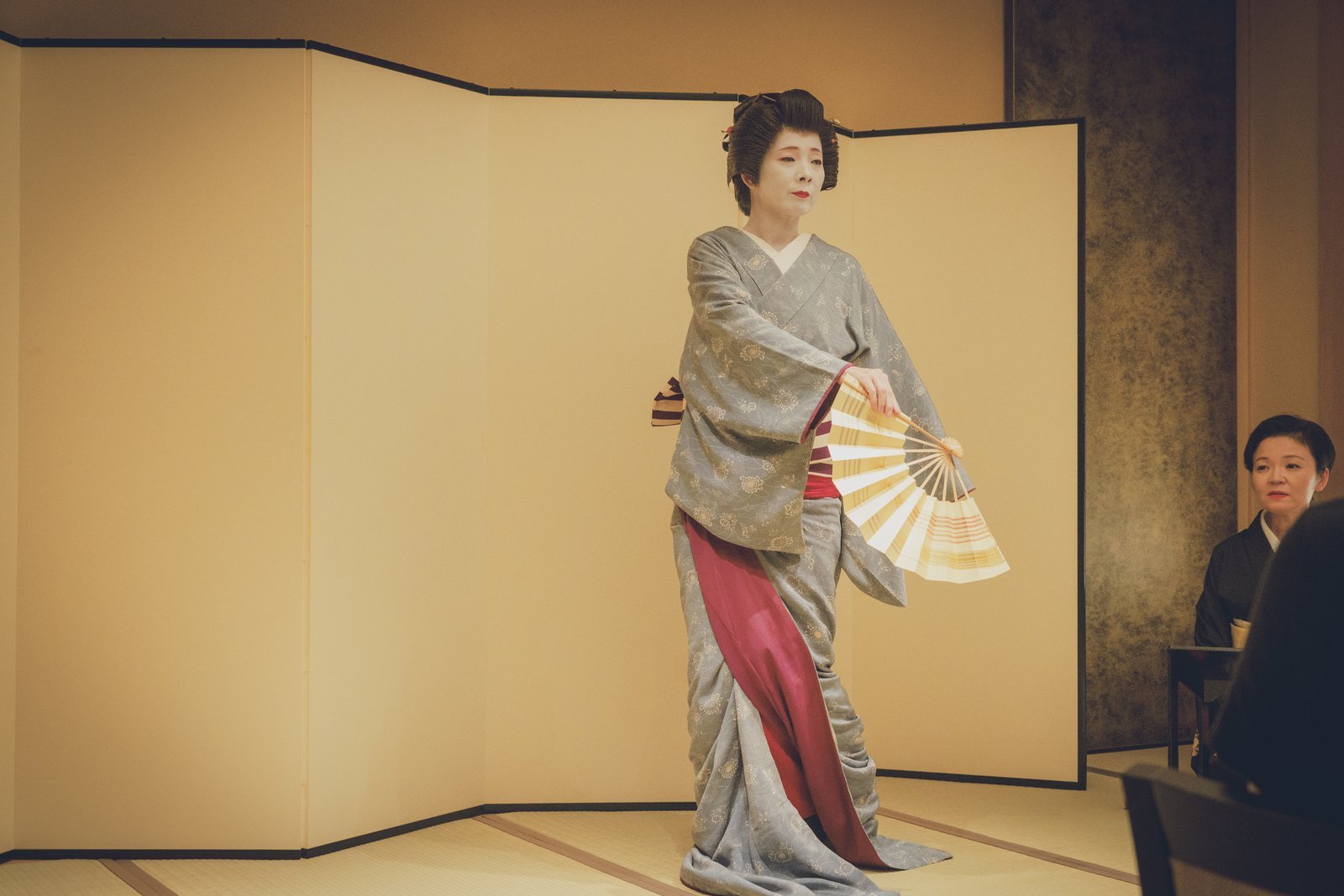
Spend the Afternoon at an Ozashiki, Then Walk to the Fair
At our teahouse in Asakusa, a private ozashiki (geisha banquet) brings dance, shamisen, conversation and the old parlor games into one room, for your group alone. Request a reservation for Thursday 19 November, or write to us about Saturday 7 November. First-time and overseas guests welcome.
Request a ReservationPractical Tips for the Night
- Bring last year’s kumade to the collection point at the shrine or Chokokuji, if you have one.
- Come by train or bus. Neither Chokokuji nor the shrine has a parking lot for the fair, and Chokokuji says the roads jam on the day.
- Dress warmly. In a notice for the last fair of 2024, Chokokuji urged visitors to dress properly for the cold.
- Expect a line at Chokokuji’s gate. In 2025 the line was reshaped for safety, and the temple asked visitors to follow the staff.
- Know the night’s rhythm. Stalls start the evening before. On the rooster day, some kumade shops do not serve from about 3 am to 9 am, and the temple’s charm office is closed from 2 am to 9 am.
- Rain is not a reason to cancel. The fair goes ahead in rain or snow unless it is unsafe.
- Check the official pages the week before. Dates, hours, and the location of the collection points can change.
Other Tori no Ichi in Tokyo
This guide covers only Asakusa. The National Diet Library counts more than 40 shrines and temples in Tokyo that hold a Tori no Ichi today, and Chokokuji notes that not every one of them keeps to the November rooster days. If you are heading to another fair, check the host’s own page for dates and hours before you go.
Frequently Asked Questions
What does Tori no Ichi mean?
Tori is the rooster, and ichi means a market or fair. The fair is held on the rooster days of November, which come around every 12 days. The shrine says it was first called Tori no Machi, the “festival of the rooster,” and that the word for market was added later.
When is Tori no Ichi 2026 in Asakusa?
Saturday 7 November (Ichi no Tori) and Thursday 19 November (Ni no Tori). Both are held at Otori Shrine and Chokokuji Temple in Senzoku, Taito City.
How long does Tori no Ichi last?
Each fair runs 24 hours, from midnight to midnight. Some stalls near Chokokuji open from about 7 pm the evening before, and many stay open until about 2 am the morning after.
Which Tori no Ichi should I visit?
Either. The shrine says the blessings are the same on any rooster day. In 2026 that means Saturday 7 November or Thursday 19 November.
Does Tori no Ichi start the night before?
The fair itself begins at midnight, with the first drum. The evening before, the shrine holds an eve ceremony at 11:15 pm (attendance needs a reservation), and some stalls near Chokokuji open from about 7 pm.
What is a kumade, and how much does it cost?
A kumade is an ornamental rake that stands for raking in luck and business. The shrine’s rough guide is from 1,000 yen for a small one, about 20,000 to 50,000 yen for the best sellers, and several hundred thousand yen for the largest. It is a guide, not a quote.
Where is Otori Shrine in Asakusa?
At 3-18-7 Senzoku, Taito City, next to Chokokuji Temple (3-19-6 Senzoku). It is about 7 minutes on foot from Iriya Station and about 8 minutes from Asakusa Station on the Tsukuba Express. Do not confuse it with the Otori shrines in other parts of Tokyo.
Is there a third rooster day in 2026?
No. The first rooster day in November 2026 is the 7th, so there are two fairs, on 7 and 19 November. The next rooster day, 12 days after the 19th, is 1 December.
A Year’s End That Keeps Coming Back
Tori no Ichi is a year’s-end habit: you buy the coming year’s luck, and you return last year’s kumade with thanks. The shrine says the festival has been held every year without a break, even through the Great Kanto Earthquake and the war. Chokokuji’s history page says the fair was long regarded as the first festival to welcome the new year. Before the fair, there are the autumn leaves, which our autumn guide covers. After it, Asakusa in winter and hatsumode at Senso-ji pick up where this guide leaves off. And if you like festivals, Sanja Matsuri, held each May, is the other big one on Asakusa’s calendar.
Plan a Day Around the Fair
Spend an afternoon with Asakusa’s geisha at a private ozashiki (geisha banquet) in our teahouse, then walk up to Senzoku for the fair. First-time and overseas guests welcome, without an introduction. Thursday 19 November is a regular day; for Saturday 7 November, write to us by email. Current rates are on our pricing page.
Request a Reservation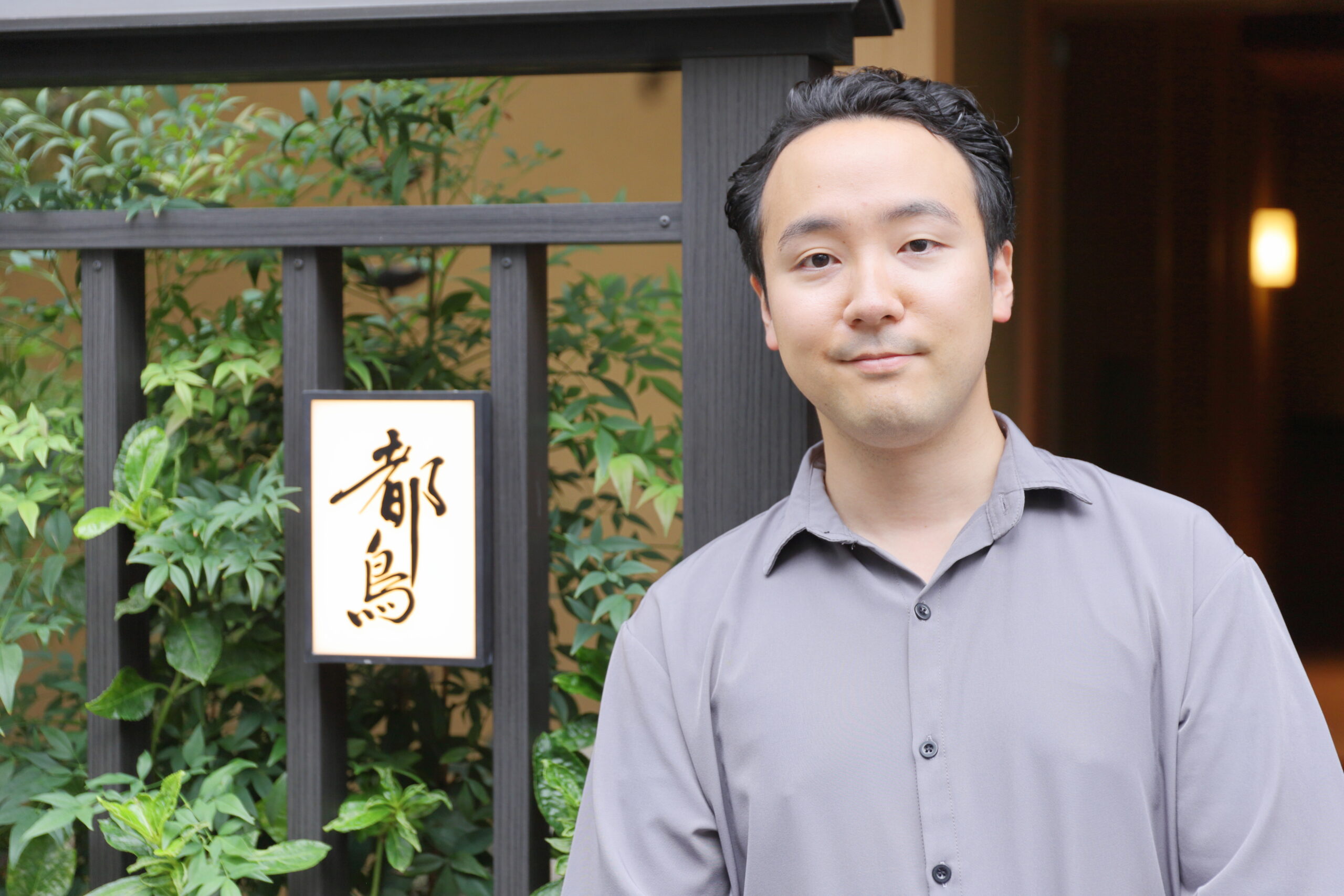


【2025 Edition】Recommended for Foodie Walks! Autumn Asakusa Gourmet & Sweets
What Is the Origin of Asakusa’s Place Name? 【Thorough Explanation】Three Prominent Theories and Unfamiliar History
Sanja Matsuri in Asakusa: A Geisha House Guide to Tokyo’s Wildest Festival
Hatsumode Etiquette Guide: How to Pray at Senso-ji (2027)
【Definitive Guide】Retro Coffee Shops Found in Asakusa | Relaxing Moments in Nostalgic Spaces
No comments yet.