



Sanja Matsuri in Asakusa: A Geisha House Guide to Tokyo’s Wildest Festival
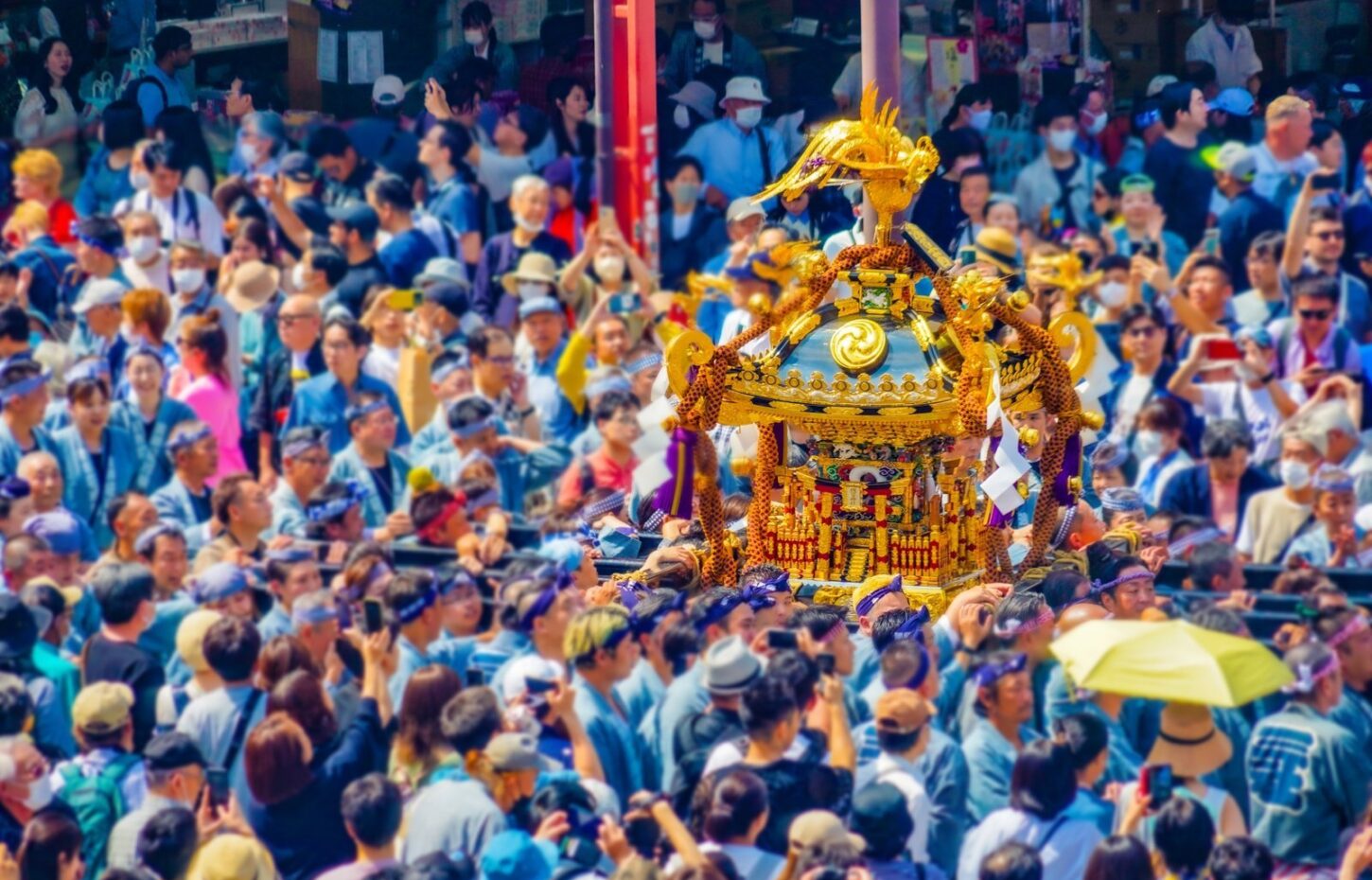
Sanja Matsuri is the annual festival of Asakusa Shrine, held every year over the third full weekend of May — in 2026, on May 15, 16, and 17 — and it is free to attend. Over three days, close to one hundred mikoshi (portable shrines) belonging to Asakusa’s 44 neighborhoods, and finally the three main shrines of the enshrined deities themselves, are carried through the streets around Senso-ji by teams of bearers, drawing close to 1.8 million people. One of the three great Shinto festivals of Tokyo, it has a reputation as the wildest festival in the city, and the geisha of Asakusa take part in the Daigyoretsu grand procession on the opening Friday (May 15 in 2026).
There is a weekend each May when the neighborhood we call home stops being quiet. The narrow lanes behind Senso-ji fill with the pounding of drums, the smell of grilled food drifting from the stalls, and the roar of thousands of voices chanting “Soiya! Soiya!” as they heave a portable shrine down the street. This is Sanja Matsuri, and for those of us who live and work in Asakusa, it is the heartbeat of the year.
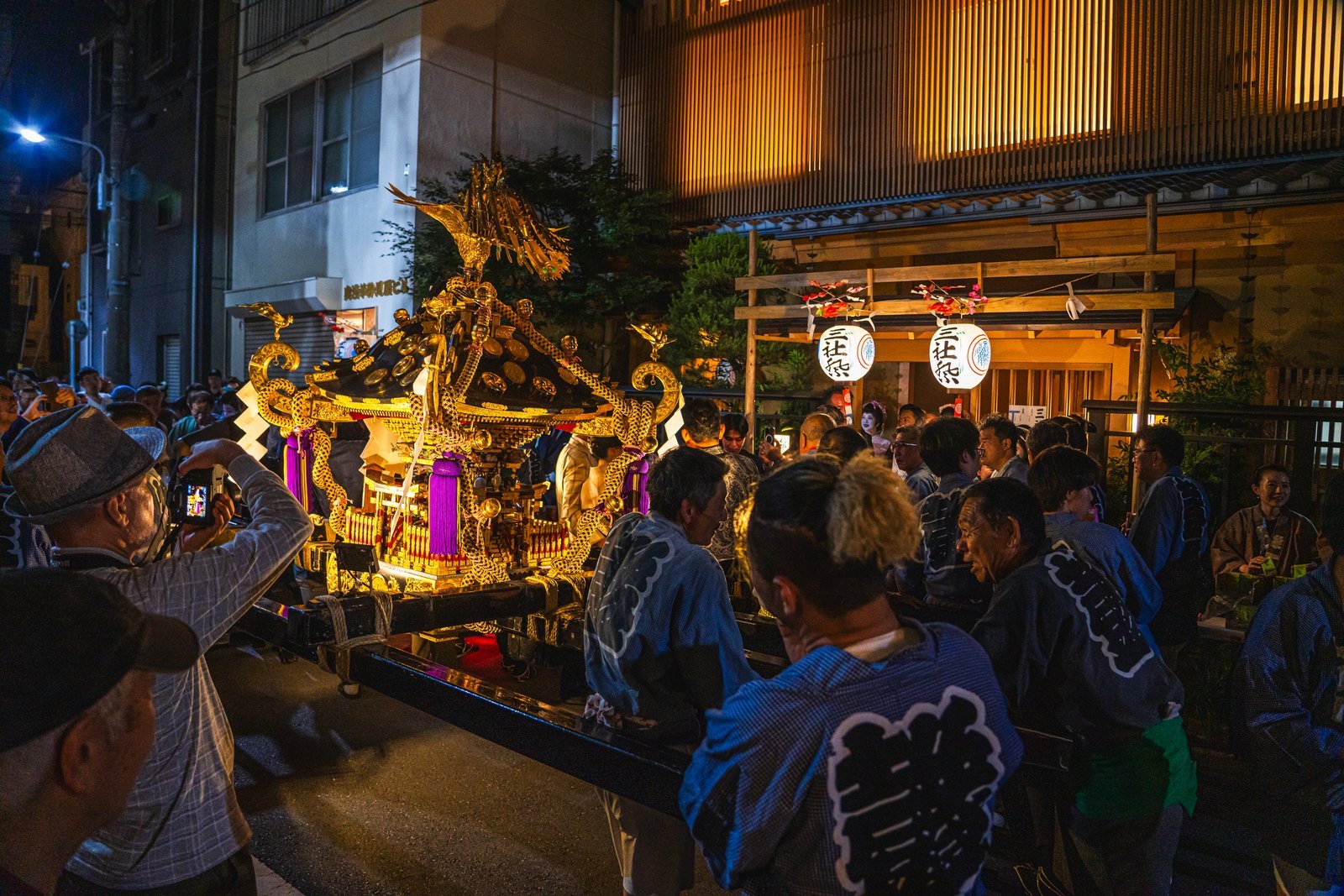
We are Miyakodori, a geisha teahouse (machiai-chaya) that has stood in the streets behind Asakusa Shrine since 1950. Our okami grew up in this hanamachi, and she has watched this festival from the same lanes her whole life. So when foreign visitors ask us what Sanja Matsuri is really like, we do not answer as a travel website would. We answer as neighbors. In this guide we will walk you through what the festival is, when it is held, what to look for, and how to enjoy it without getting lost in the crowd of nearly two million who come each year.
What Is Sanja Matsuri? The Festival at the Heart of Asakusa
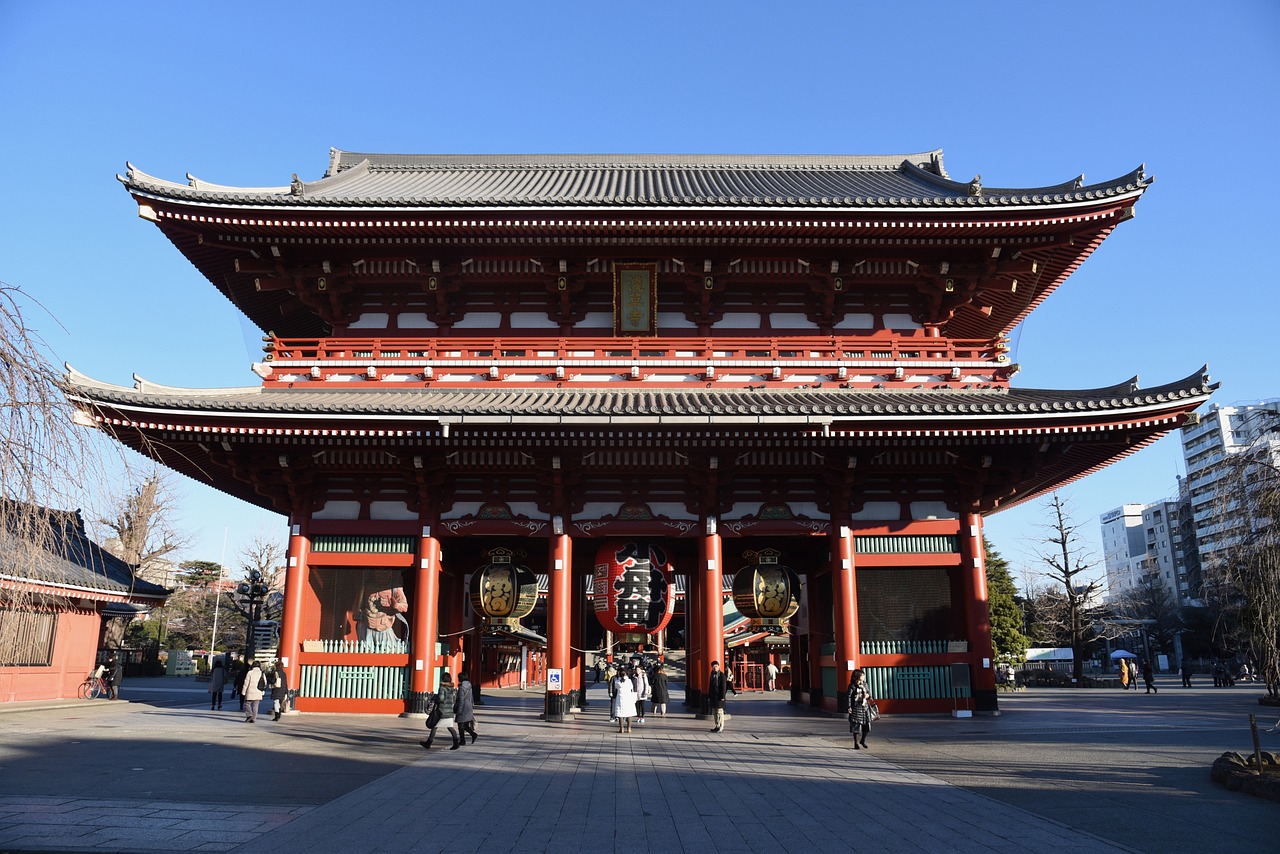
Sanja Matsuri, written 三社祭 and meaning “Three Shrine Festival,” is one of the three great Shinto festivals of Tokyo. It is held each May at Asakusa Shrine, which sits directly beside Senso-ji, the oldest temple in the city. The festival honors three men: the two fishermen brothers Hinokuma Hamanari and Hinokuma Takenari, who are said to have pulled a statue of Kannon from the Sumida River, and Hajino Nakatomo, the wealthy man who enshrined it and helped found the temple. Because three founders are worshipped here, the shrine is affectionately called Sanja, and the festival that celebrates them carries the same name.
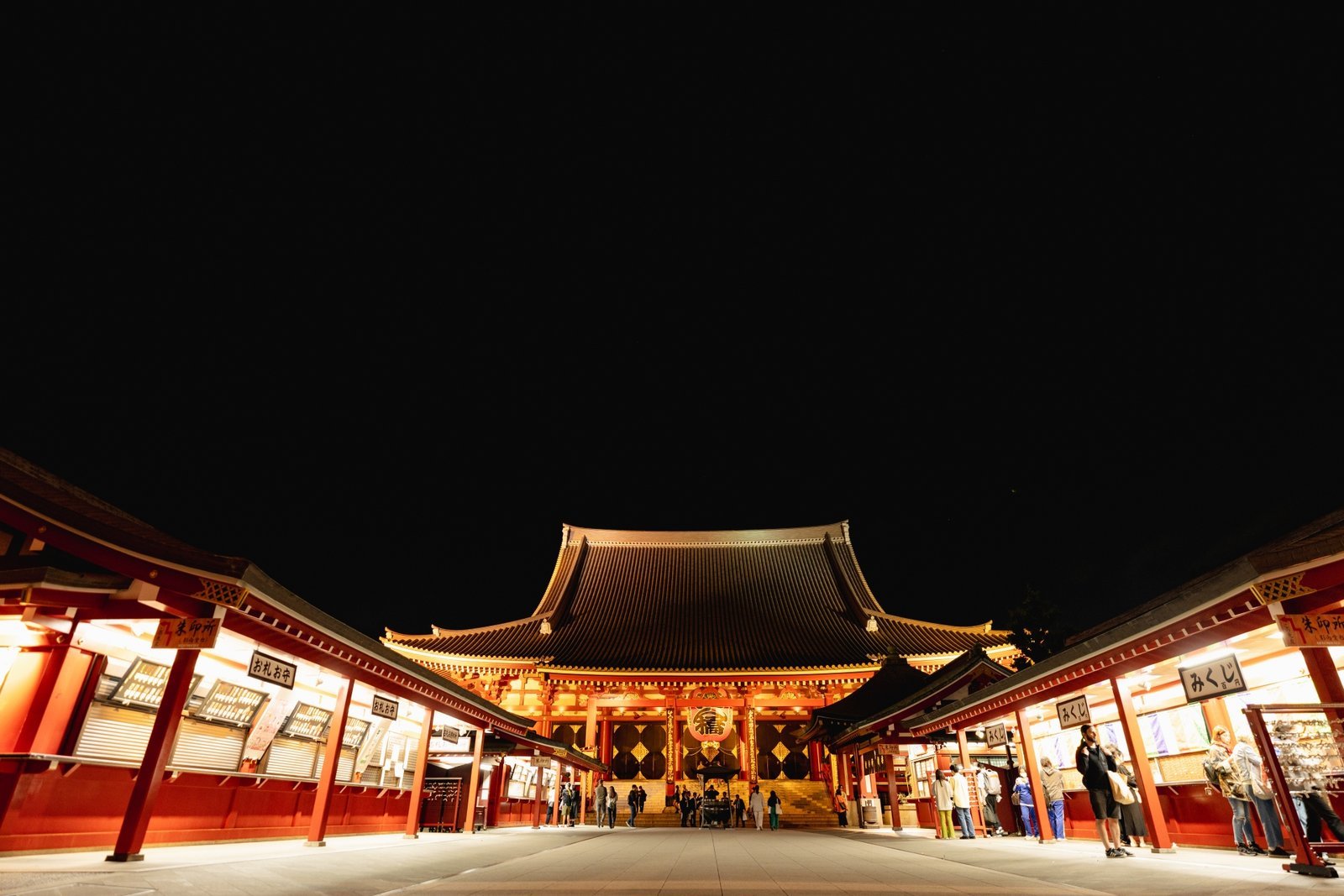
What makes this event different from a calm shrine ceremony is its energy. Sanja Matsuri has a reputation as the wildest festival in Tokyo, and that reputation is earned. Over three days the streets of Asakusa are given over to the portable shrines, the mikoshi, which the community carries on their shoulders. The belief goes that the more powerfully a mikoshi is shaken and heaved, the more the spirit inside is pleased and the more blessing it brings to the neighborhood. So the men and women who carry them do not walk gently. They surge.
For us, the festival is also a reminder of how open Asakusa has always been. Unlike some quieter hanamachi, our district grew up around the most visited temple in Tokyo, and its geisha culture was raised and protected by the whole town rather than kept behind closed doors. Sanja Matsuri is that same spirit made loud and public, a festival that belongs to everyone who steps into the neighborhood.
When Is Sanja Matsuri Held? The 2026 Schedule
Sanja Matsuri takes place every year over the third full weekend of May, running from Friday to Sunday. In 2026 it will be held on Friday May 15, Saturday May 16, and Sunday May 17. There is no admission fee. The festival is free to attend, and you are welcome simply to arrive and become part of the crowd.
Looking ahead, Sanja Matsuri is expected to return in 2027, most likely over the third weekend of May, around May 14 to 16. The dates are set by Asakusa Shrine each year, so please confirm the official schedule closer to the time.
Each day has its own character, so it helps to know what you are walking into.
Friday: The Grand Procession
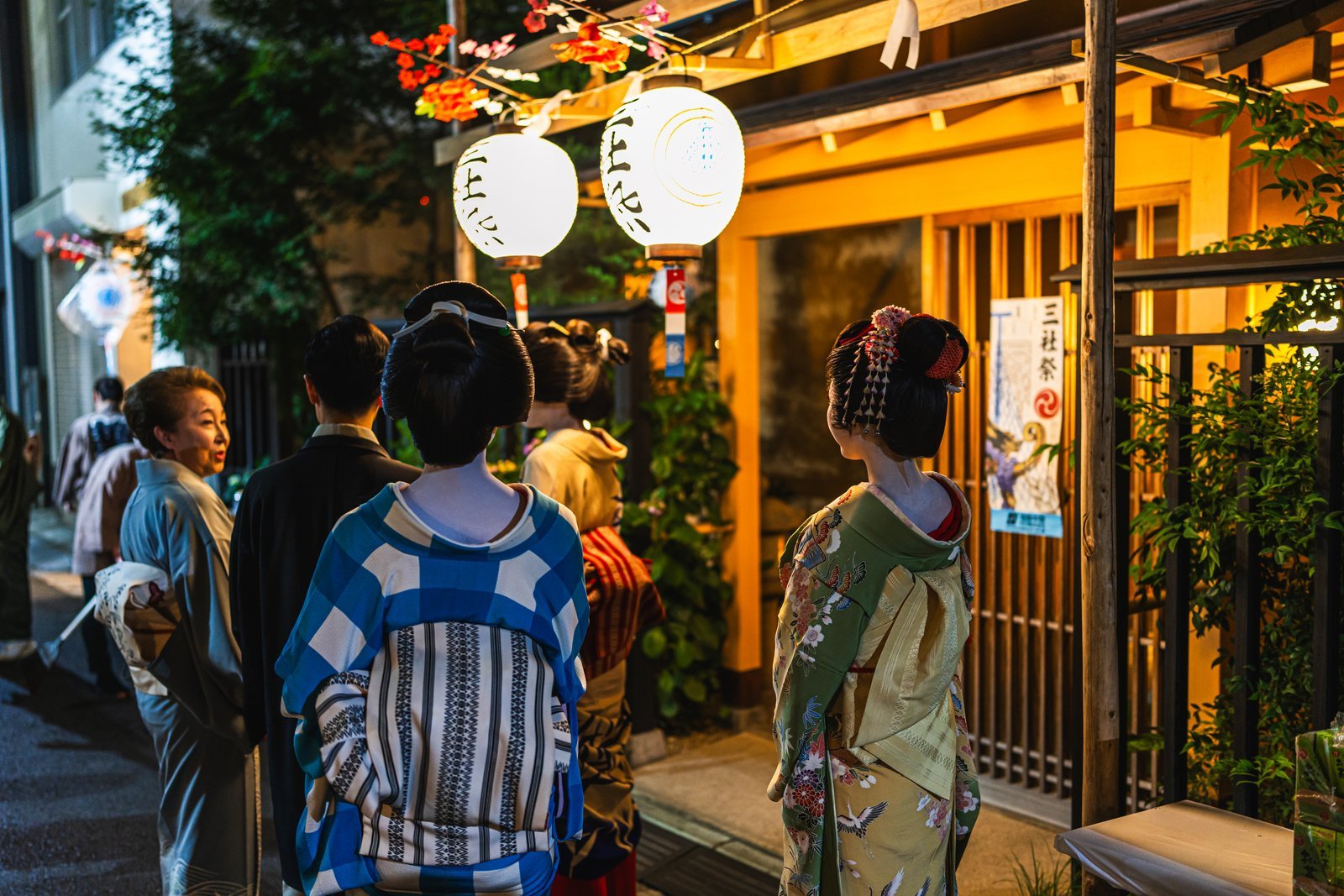
The festival opens on Friday afternoon with the Daigyoretsu, a grand parade of priests, city officials, musicians, dancers, and geisha in Edo period costume who proceed along the streets toward Senso-ji and Asakusa Shrine. A Shinto ceremony follows, along with a traditional dance offered in prayer for a good harvest and for the prosperity of the community. For those of us in the geisha world, this is a proud day, because the procession is one of the rare times the wider public sees Asakusa’s performers out in the open street rather than inside a parlor.
Saturday: The Neighborhood Mikoshi
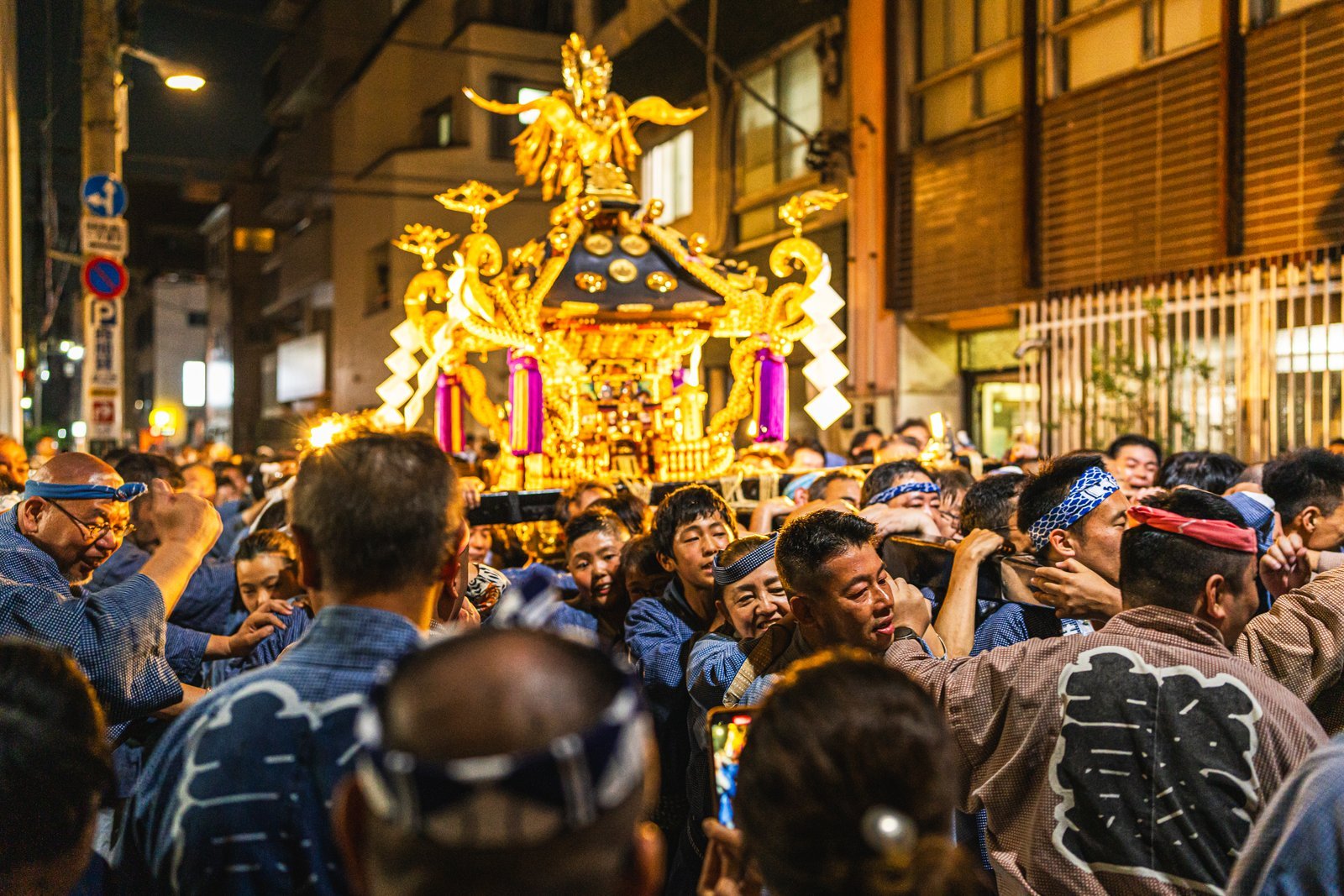
Saturday is when the town truly comes alive. Around midday, close to one hundred portable shrines belonging to Asakusa’s 44 neighborhoods are brought out and carried through the district to Senso-ji, each accompanied by its own team of bearers, drummers, and flute players. Every neighborhood carries its own mikoshi with its own pride, and the streets fill with color from morning until night.
Sunday: The Three Main Mikoshi
The climax comes on Sunday. Early in the morning the three largest and most sacred mikoshi, the ones that represent the three enshrined deities themselves, are brought out from Asakusa Shrine in a ceremony called Miyadashi. These three shrines are then paraded through the whole of Asakusa across the day before returning to the shrine grounds by evening. The sight of the main mikoshi swaying through the torii gate at sunset is, for many, the single most powerful moment of the festival.
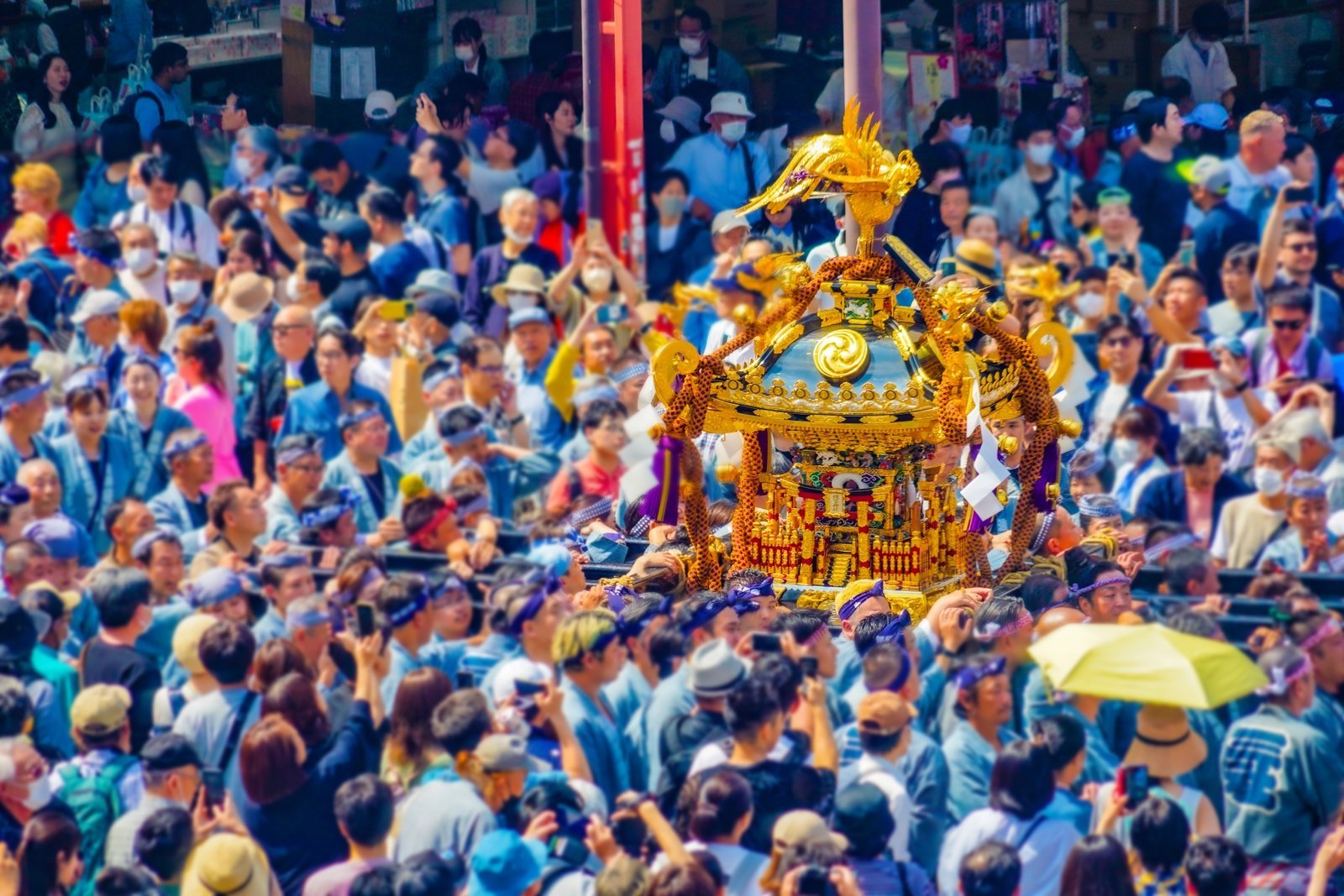
The festival from street level: the procession filling the road, the covered arcade packed shoulder to shoulder, and geisha walking through it in kimono.
The Highlights: Mikoshi, Music, and the Streets of Old Edo
If you have never seen a mikoshi carried in earnest, it is hard to prepare for it. Each shrine weighs a great deal — hundreds of kilograms, lifted by human strength alone — and it takes a whole team to lift one, shoulders packed together, moving as a single body while the crowd chants around them. You will often see the bearers heave and rock the shrine hard, and there is a reason for it: this deliberate shaking, called tamafuri, is believed to rouse the spirit within and strengthen its blessing. But do not mistake wild movement for skill. When a team is truly good and everyone’s rhythm locks together, the shrine settles and rides smoothly, without rattling or clattering. That quiet, steady carrying is its own mastery, and to a local eye it impresses as much as the shaking. No photograph or video ever manages to hold it.
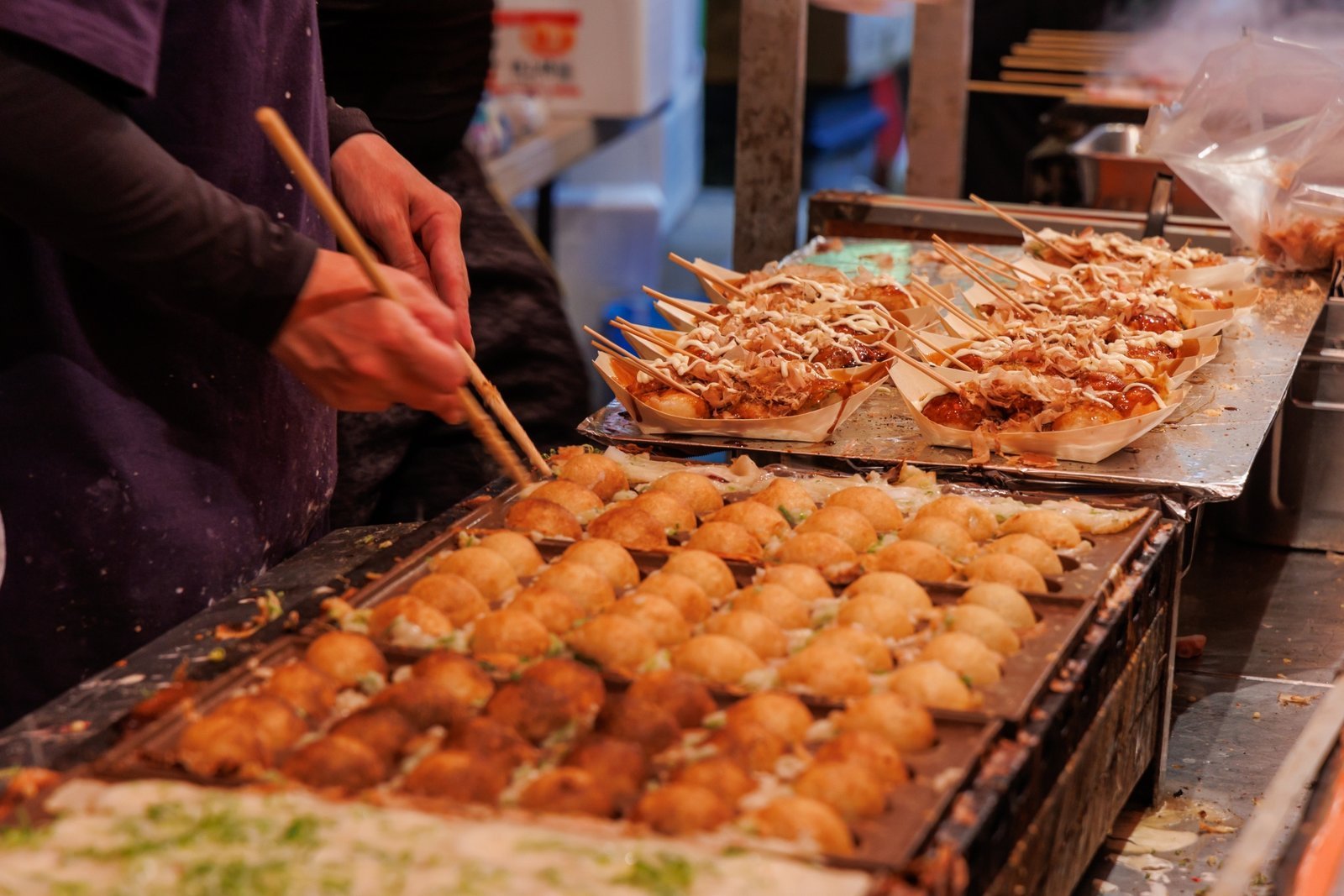
Around the mikoshi, the festival fills every sense. Musicians play Japanese drums and flutes that carry for blocks, food stalls line the approaches to the temple, and the smell of grilled skewers hangs in the warm May air. The Nakamise shopping street and the lanes near Kaminarimon become rivers of people in happi coats. If you want a quieter moment, step back toward the Sumida River, where the crowds thin.
There is also a texture to Sanja Matsuri that rewards anyone who knows a little of Asakusa’s history. This district carries the atmosphere of old Edo more than almost anywhere in Tokyo, and during the festival that past feels present. The Edo period costumes, the traditional dances, the shrine rituals rooted in a boat festival centuries old, all of it turns the modern streets into something older for three days.
Carrying the Mikoshi: What the Festival Feels Like from the Inside
Watching a mikoshi go by is one thing. Getting under it is another. I have carried in this festival, in the mid-May heat and under a pole shared with the rest of the team, and there are things you only learn with the weight on your shoulder.
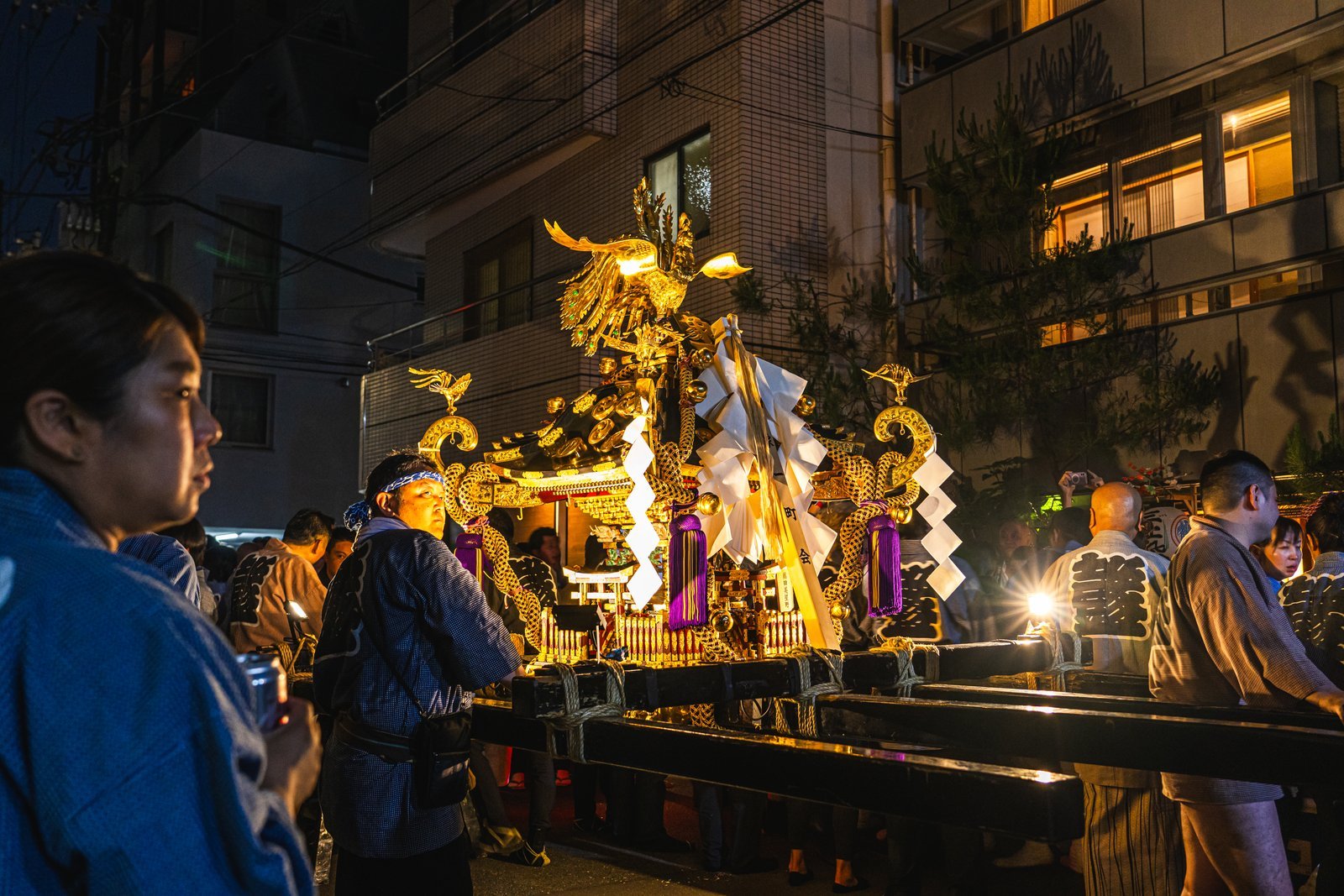
The first is the heat. Sanja Matsuri lands in mid-May, and packed inside a team of bearers, it is simply, brutally hot. The second is the pain. Each mikoshi moves to its own rhythm, and until you find it, the carrying pole slams into your shoulder again and again. Your shoulder aches for days afterward. Nobody tells you that part.
Then there is the morning of Miyadashi, when the main shrines are brought out. From the crowd it looks orderly, but up close it is close to a brawl: bearers scramble to grab a place on the pole, everyone wanting to lift the shrine first. That raw, half-chaotic energy is exactly why it moves people.
And there is one thing every local half-believes. Senso-ji began, the old story goes, when a statue of Kannon was pulled from the Sumida River. Perhaps that is why, year after year, rain seems to find its way to Sanja Matsuri. Ask anyone who carries here and they will tell you the same: the festival and the rain go together.
Stay One More Evening in the Asakusa Hanamachi
The same lanes that fill with mikoshi in May are home to a working geisha district all year. At Miyakodori, a machiai-chaya behind Asakusa Shrine since 1950, you can book a private ozashiki (a private gathering with geisha) — seasonal kaiseki, live shamisen, dance, and ozashiki games in a private tatami room. First-time guests from overseas are welcome.
Request a ReservationHow to Enjoy Sanja Matsuri: Tips from the Neighborhood
The festival draws close to 1.8 million people over its three days — May 15 to 17 in 2026 — so a little planning goes a long way. Here is what I would tell a friend visiting for the first time.
Go early in the day if you want room to move. The crowds build steadily, and by afternoon the main streets around the temple are shoulder to shoulder. Mornings are calmer and the light is good for photographs.
Come on Sunday for the peak, but arrive with patience. The three main mikoshi are the emotional heart of the festival, but Sunday is also the busiest day. If you only have one day, this is the one, provided you are ready for crowds.
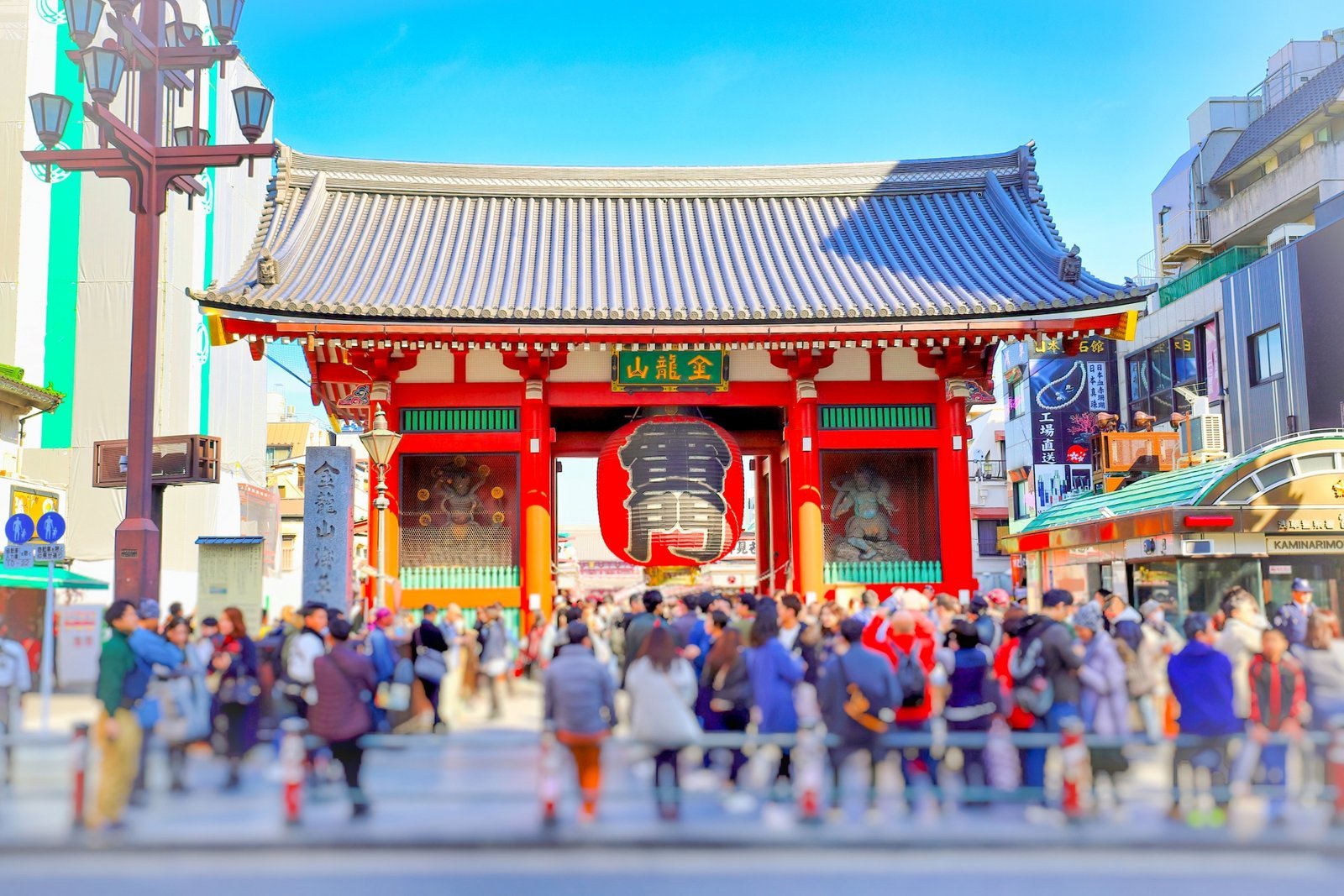
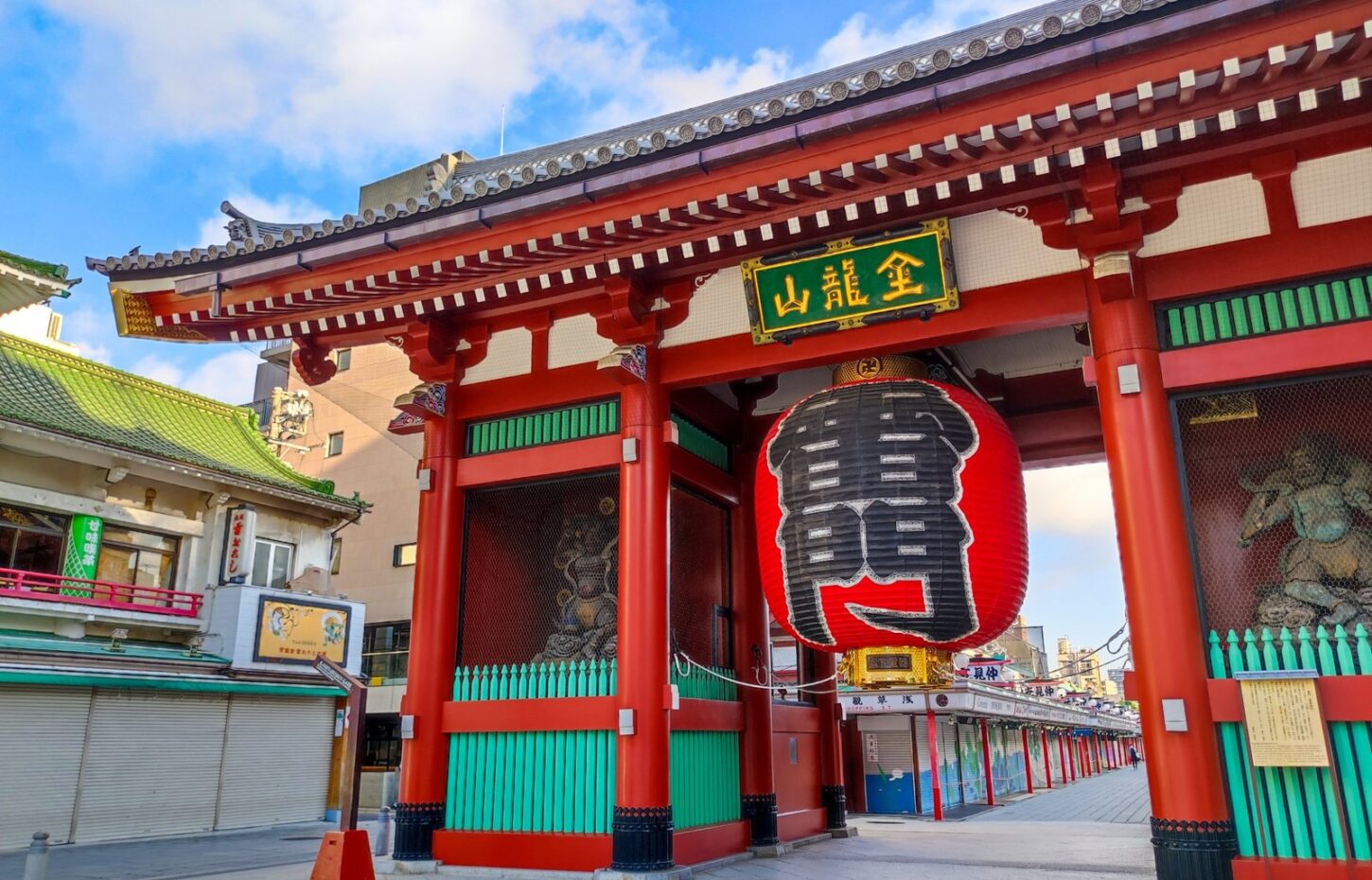
Watch from Kaminarimon-dori, not the temple itself. Here is the local secret. The lanes around Senso-ji are narrow, and when a shrine that large moves through them, the crowd becomes almost impassable. The area right by the temple is the most crowded of all. My honest advice is to stand along the wide Kaminarimon-dori avenue, or near the Kaminarimon gate. You get room to breathe, a clear view of the mikoshi passing, and far less of the crush.
Take the train, not a taxi. Asakusa Station is served by the Ginza Subway Line, the Toei Asakusa Subway Line, the Tobu Railway, and the Tsukuba Express, and it is only a short walk to the shrine. Roads around Asakusa are closed or gridlocked during the festival, so the subway is by far the easiest way in and out.
Respect the mikoshi teams. The bearers are locals carrying their neighborhood’s pride. Give them space, follow the direction of the marshals, and you will be welcomed as part of the day rather than in the way of it.
After the Festival: An Evening in the Asakusa Geisha World
Sanja Matsuri is a festival of the street, loud and open and shared by everyone. But Asakusa holds another kind of experience too, one that is quiet, intimate, and just as rooted in the culture the festival celebrates: a private ozashiki (a private gathering with geisha) in a machiai-chaya. Miyakodori has stood in these lanes since 1950, about a three-minute walk north of Senso-ji, on the far side of the temple grounds from the crowds at Kaminarimon.
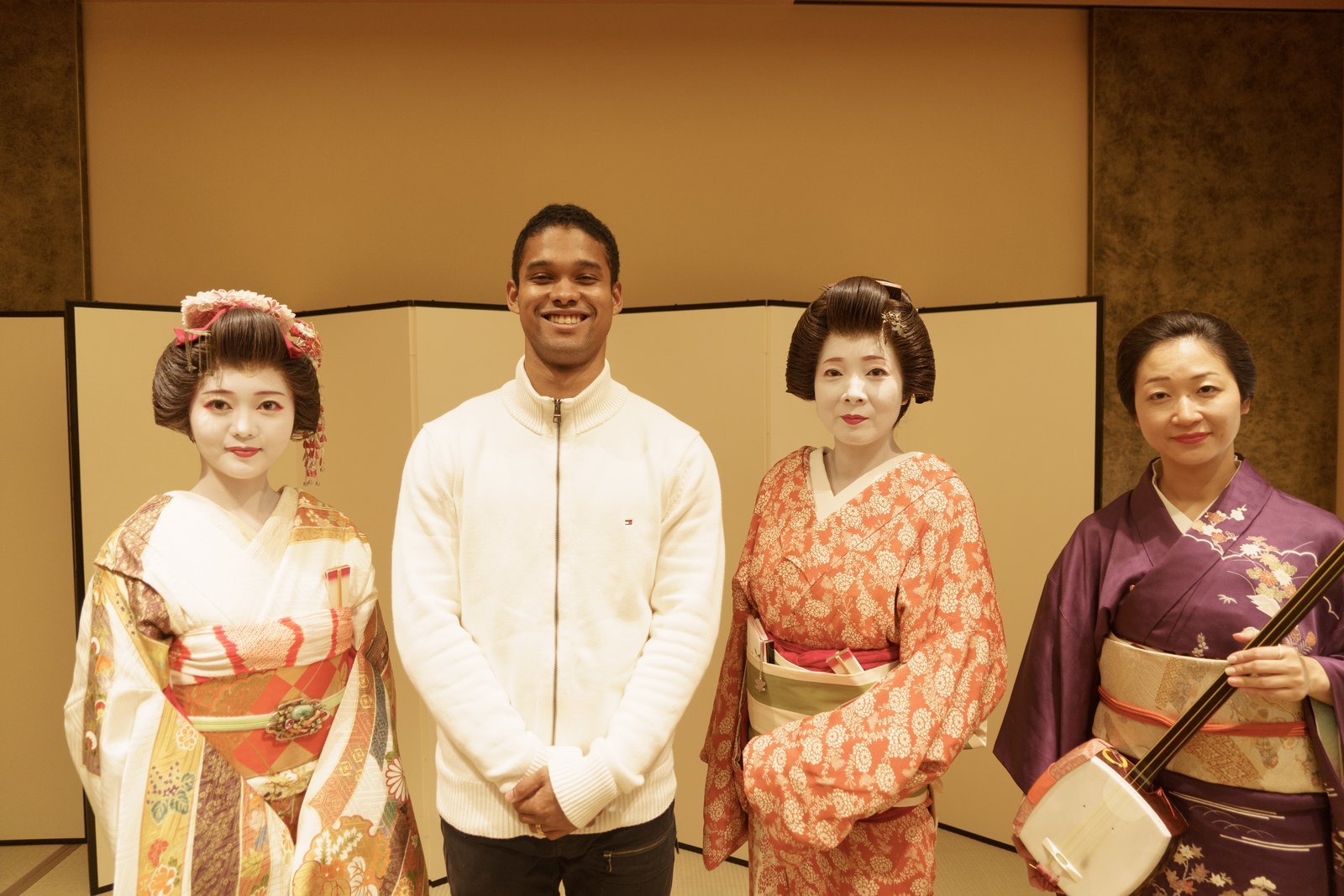
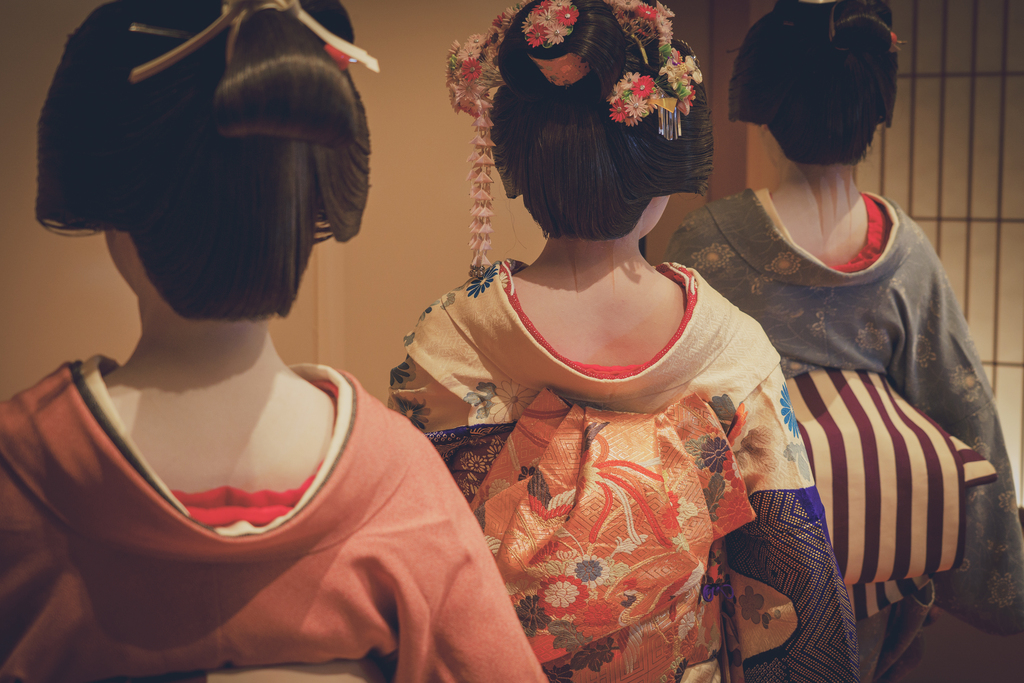
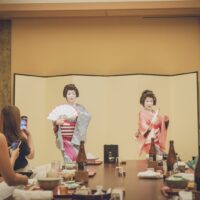
When the crowds have gone home and the drums have fallen silent, the geisha of Asakusa are still here, as they have been for generations. At Miyakodori, our okami and our geisha welcome guests into a private tatami room for an evening of seasonal kaiseki cuisine, live shamisen music, dance, and the ozashiki games that have entertained visitors to this district for centuries. The same performers you might glimpse in the Friday procession can, on another evening, sit across from you and share the living culture of the Asakusa hanamachi up close.
We welcome first-time guests, including visitors from overseas, and our okami is happy to guide you gently into a world that can feel unfamiliar at first. If your trip to Tokyo brings you to Asakusa for Sanja Matsuri, consider staying one more evening to see the other side of this neighborhood, the side that has quietly kept its art alive for more than four hundred years.
If the festival draws you to Asakusa, the geisha district behind the shrine is worth an evening of its own: read more about the Asakusa geisha district, or see our complete experience guide.
Frequently Asked Questions
When is Sanja Matsuri held in 2026?
The festival runs Friday to Sunday, May 15 to 17, 2026, at Asakusa Shrine and throughout the surrounding district.
How much does it cost to attend Sanja Matsuri?
Sanja Matsuri is free to attend — there is no admission fee. The festival is open to the public; you simply come to Asakusa and join the crowd.
What is the best day to go?
Sunday offers the grand procession of the three main mikoshi and is the emotional peak, but it is also the most crowded. Saturday, with nearly one hundred neighborhood mikoshi, is a wonderful and slightly less overwhelming choice.
How do I get to Sanja Matsuri?
Take the train to Asakusa Station (Ginza Subway Line, Toei Asakusa Line, Tobu Railway, or Tsukuba Express); the shrine is a short walk away. Avoid driving, as roads are closed and congested.
What is a mikoshi, and why do the bearers shake it?
A mikoshi is a portable shrine carried on the shoulders of a team of bearers, and the deliberate shaking is a ritual called tamafuri, believed to rouse the spirit inside and strengthen the blessing it brings to the neighborhood. The shrines weigh hundreds of kilograms and are lifted by human strength alone; when a team is truly good, the shrine rides smoothly rather than rattling.
Where is the best place to watch Sanja Matsuri?
Stand along the wide Kaminarimon-dori avenue, or near the Kaminarimon gate, rather than in the narrow lanes right beside Senso-ji, which are the most crowded part of the festival. You get room to breathe and a clear view of the mikoshi passing, with far less of the crush.
When is Sanja Matsuri in 2027?
Sanja Matsuri is expected to return over the third weekend of May 2027, most likely around May 14 to 16. Asakusa Shrine sets the dates each year, so please confirm the official schedule closer to the time.
Can I see geisha during the festival?
Yes — the geisha of Asakusa take part in the Daigyoretsu grand procession on the opening Friday (May 15 in 2026). For a closer experience, a geisha teahouse such as Miyakodori offers private evenings of performance and dining.
Conclusion
Sanja Matsuri is Asakusa at its most alive: three days each May when a whole neighborhood pours into the street to carry its shrines, honor its founders, and celebrate together. If you come, watch closely as teams of people lift shrines weighing hundreds of kilograms by human strength alone. In that sight you feel the sheer energy and bottomless power of Asakusa, and you understand just how sacred temples and shrines are to this town, and to Japan. Do not leave without eating, either. Stalls line the approaches to Senso-ji throughout the festival, and this is one of the best places anywhere to taste real Japanese festival food. For 2026, mark May 15 to 17 on your calendar, come early, take the train, and let yourself be swept up in it.
And when the festival ends, remember that the culture behind it does not. The geisha of Asakusa keep this district’s traditions alive every evening of the year, and here at Miyakodori we would be honored to share that quieter side of our home with you.
Book a Private Ozashiki at Miyakodori
A machiai-chaya behind Asakusa Shrine since 1950. Spend an evening in a private tatami room with the geisha of Asakusa — a private ozashiki (a private gathering with geisha) with seasonal kaiseki cuisine, live shamisen, dance, and ozashiki games. First-time and overseas guests welcome, with our okami to guide you.
Request a ReservationSources and References
- Japan Guide, “Sanja Matsuri 2026 (Sanja Festival) – Tokyo Travel”: japan-guide.com/e/e3063.html
- Wikipedia, “Sanja Matsuri”: en.wikipedia.org/wiki/Sanja_Matsuri
- The Asakusa Tourism Federation, “Sanja Matsuri (Asakusa Shrine Grand Festival) May 15th, 16th, and 17th, 2026”: e-asakusa.jp/en/culture-experience/11452
- Asakusa Shrine official Sanja Matsuri site: asakusajinja.jp/sanjamatsuri/
- Asakusa Shrine, English information: asakusajinja.jp/english/
- On tamafuri (the ritual meaning of shaking the mikoshi): goodcross.com/words/19075-2019


- Wagashi in Japan: A Guide to Traditional Japanese Sweets, Seen Through the Eyes of an Asakusa Geisha House
- Asakusa Temple Autumn: A Guide to Fall Foliage at Senso-ji and the Streets of Old Tokyo
From Anime Geisha to the Real Thing in Asakusa
What Is a Ryotei? Japan’s Traditional Restaurant Culture, Explained
Asakusa Geisha Culture: How-to & Etiquette Q&A【Miyakodori】
2026 Best Tokyo Geisha Dinner Guide: Top Recommendations for an Authentic Evening in Asakusa
Ozashiki Parlor Games: How to Play Konpira Funefune & Tora-Tora

No comments yet.