



From Anime Geisha to the Real Thing in Asakusa
Anime can show you a drawing of the geisha world; an ozashiki (a private geisha banquet) is the room itself — live shamisen, dance, a conversation you steer yourself, and traditional parlor games you play alongside the geisha. At Miyakodori, a machiai-chaya in Asakusa founded in 1950, first-time guests are welcome, an English interpreter is present throughout, and every private evening is booked by request.
If your first ever geisha appeared in anime, you’re not alone. A silk kimono, a painted fan, a glance across a screen — it’s a beautiful introduction. But anime can only ever show you a drawing of this world. Here at Miyakodori, in Asakusa, we get to show you the real one.
What Anime Gets Right — and What It Can’t Show You
Anime captures the visual poetry of geisha life with real care: the kimono, the quiet confidence, a world with its own rules. What it can’t capture is the experience itself — a shamisen a few feet away, a conversation you steer yourself, an evening that never unfolds the same way twice.
There’s a second thing a screen can’t do: it can’t be surprised by you. On screen, the geisha performs for the story. In an ozashiki (a private geisha banquet), she reads the room — who’s shy, who’s curious, who just landed from a fifteen-hour flight — and the evening bends around that. The same is true of films and series. Whether you arrived through Memoirs of a Geisha or through The Makanai on Netflix, the story ends and the room stays the same. Ours doesn’t.
Geisha Are Not Oiran — and Not Hostesses Either
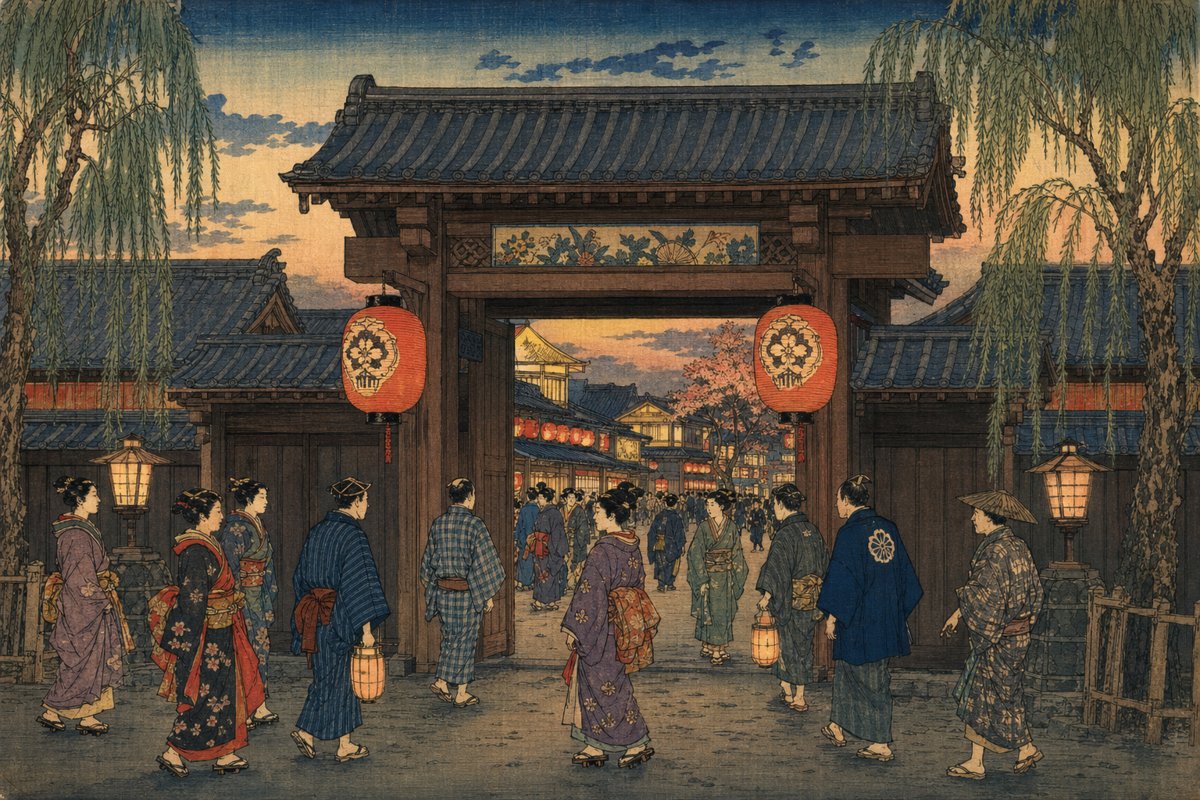
This is the one thing anime blurs most often. Geisha and oiran — the high-ranking courtesans of the Yoshiwara district — are drawn with similar splendor, so viewers merge them into a single character. Historically they were two clearly separated professions: oiran offered companionship, including intimate services, while geisha specialized in artistic entertainment. As our okami describes it, the old saying drew the line plainly: courtesans sold company, geisha sold art. The second half of that line has not changed — the art is still the whole job.
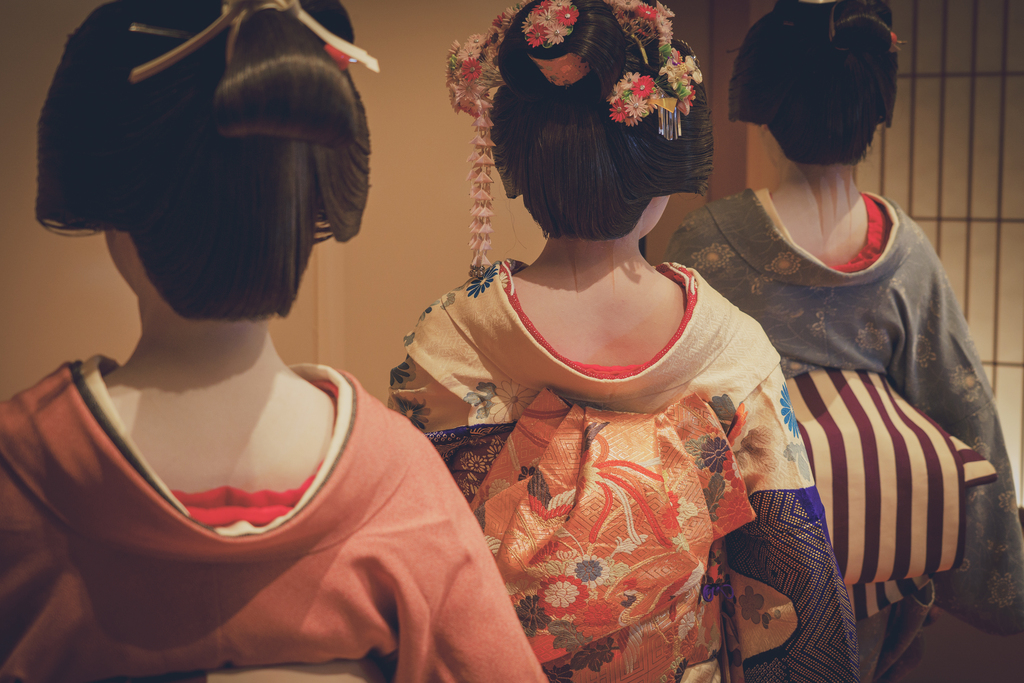
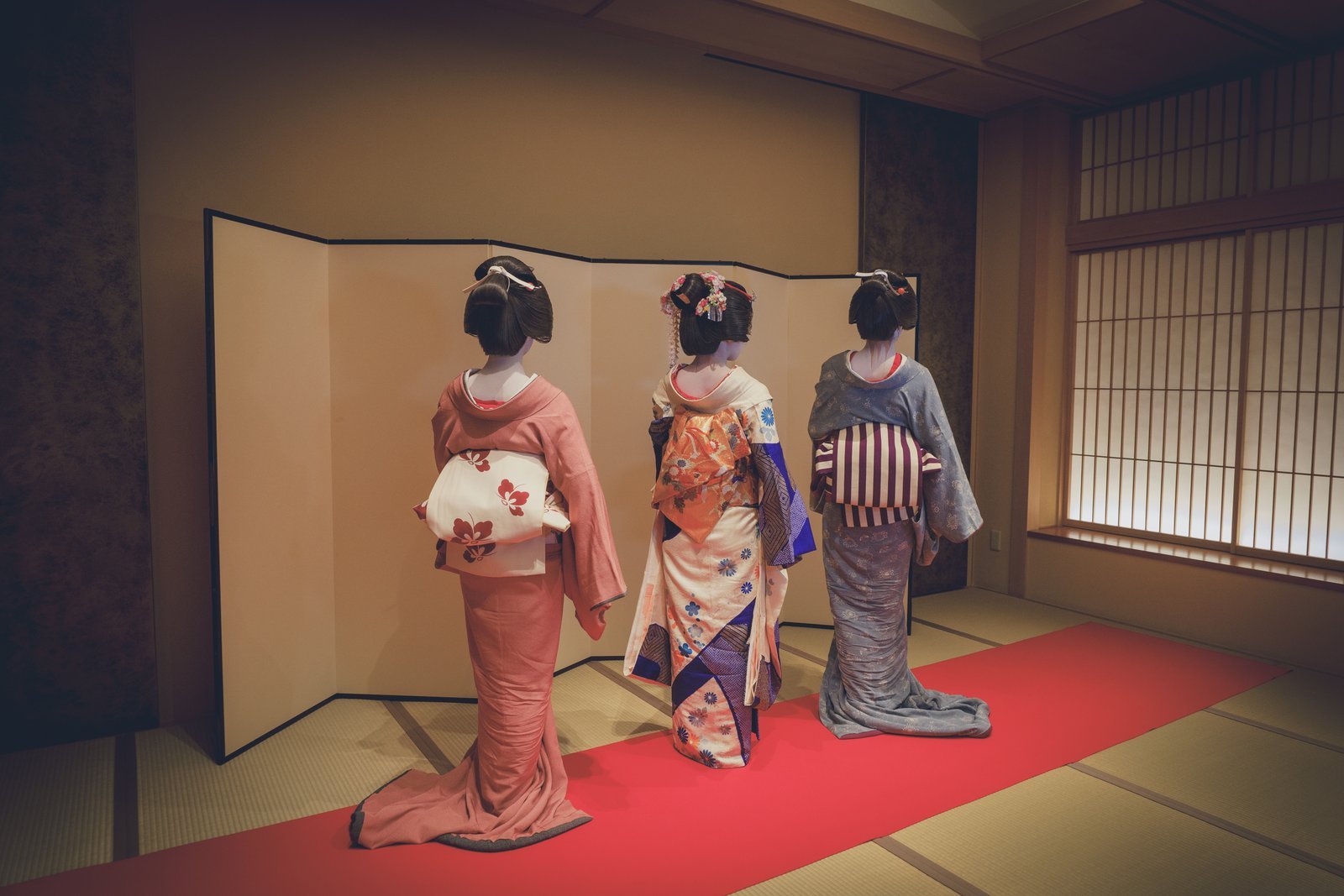
There is even a way to tell them apart at a glance. Around the time the shogunate gave official recognition to the Yoshiwara geisha, the kenban — the registry office that lists and dispatches geisha — came into being, and the dress rules of that period set where the obi is tied: a geisha’s sash is knotted at the back, a courtesan’s at the front. The registry was there to manage the profession rather than to police the boundary, but keeping those records made the line between the two visible in practice. So if you are looking at an illustration and the obi is tied in front, you are not looking at a geisha.
The second confusion is more modern: geisha are not part of Japan’s nightlife hostess trade. The difference comes down to one word — gei, art. A geisha performs. That is not optional, and it is why the lessons never stop.
The Story Behind Our Name
Miyakodori means “capital bird.” The name was chosen by the founder, who took it from a poem in the Tales of Ise: if you are worthy of your name, then I ask you, bird of the capital — is the one I love safe and well? It’s a question about holding someone in your heart. That’s the kind of machiai-chaya (a traditional teahouse where geisha banquets are held) we want to be: a place our guests keep thinking fondly of long after they’ve left.
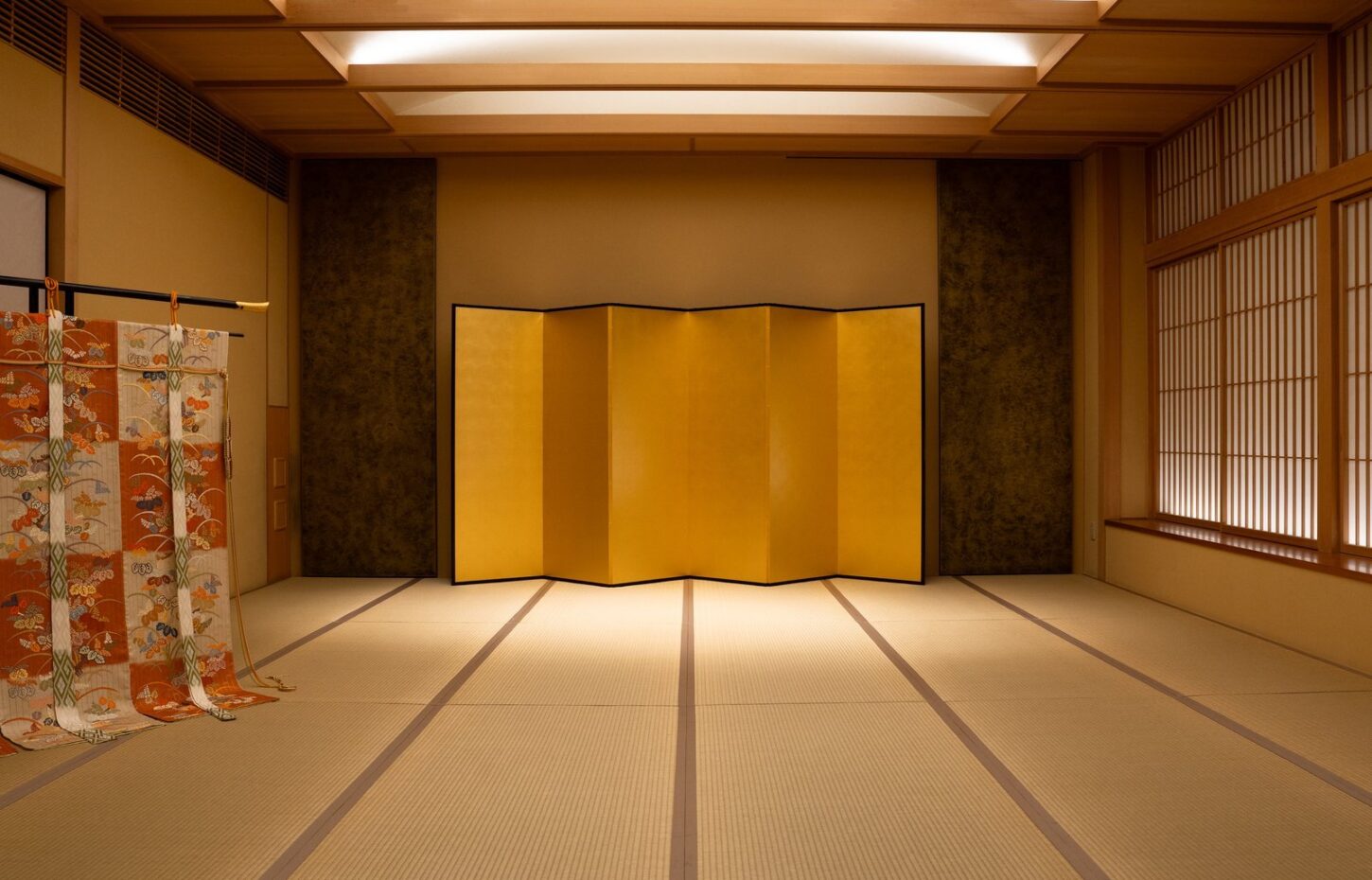
That word matters more than it looks. Miyakodori, founded in 1950, is the only machiai-chaya in Asakusa. A machiai-chaya doesn’t run its own kitchen — it provides the room, calls the geisha, and brings the food in from outside. What sounds like a limitation is the reason we can build an evening around vegan, vegetarian, gluten-free or allergy needs, or serve no meal at all if you’d rather keep the focus on the performance. Fully halal or kosher meals are possible too, served as a bento and ordered five days ahead. One thing the word “teahouse” does not mean: this is not a tea ceremony. A machiai-chaya is the room where geisha are received, not a place where tea is prepared as ritual. Matcha and a seasonal sweet can be ordered alongside your evening, but they arrive as refreshments, not as a ceremony.
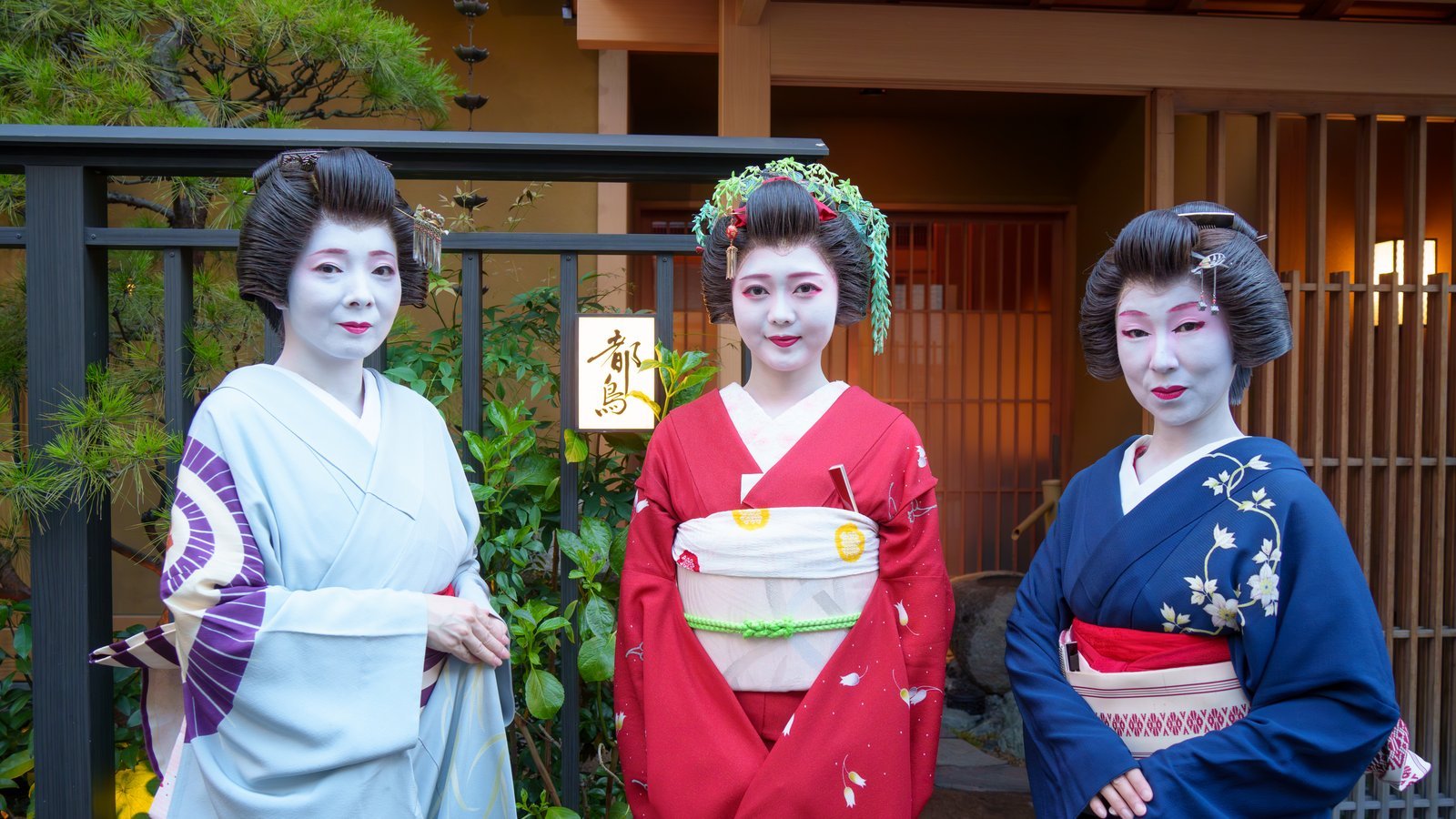
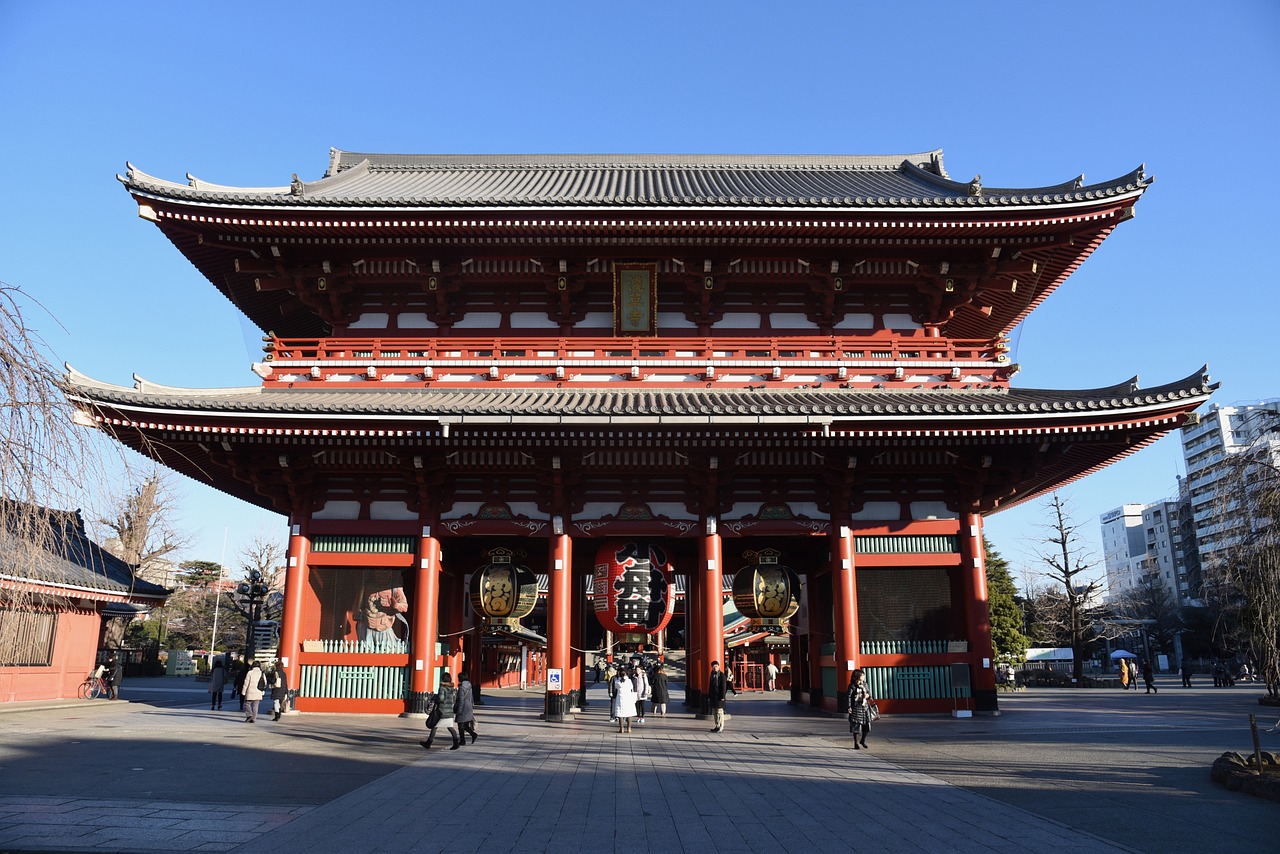
We aren’t located in Asakusa by accident, either. Our okami, Chikage, was born and raised in Asakusa — home to one of the six geisha districts of Tokyo — and her mother was a geisha before her. She made her own debut as an Asakusa geisha in 1969, at fifteen, worked twenty-seven years in the profession, and took over Miyakodori at forty-two. She is the only okami in Asakusa who was herself a geisha, and she holds a shihandai teaching licence in the Hanayagi school of Japanese dance. When she talks about what happens in the room, she is describing a room she has spent her life in. This neighborhood comes alive every year for the Sanja Matsuri and countless other festivals. We want geisha culture to be part of that same energy — a living, present-tense part of Asakusa, not restricted to screens or history books.
Chikage, the okami of Miyakodori, in her own words: a geisha from the age of fifteen, and the proprietress of this house since. Filmed in the room where the ozashiki actually happens.
Real Geisha
“Geisha” literally means “a person of art.” It’s not just about being skilled — it’s about loving your art enough to make it your life. That includes the art of hosting a guest and making sure they enjoy themselves. Taking that on as a profession takes real resolve.
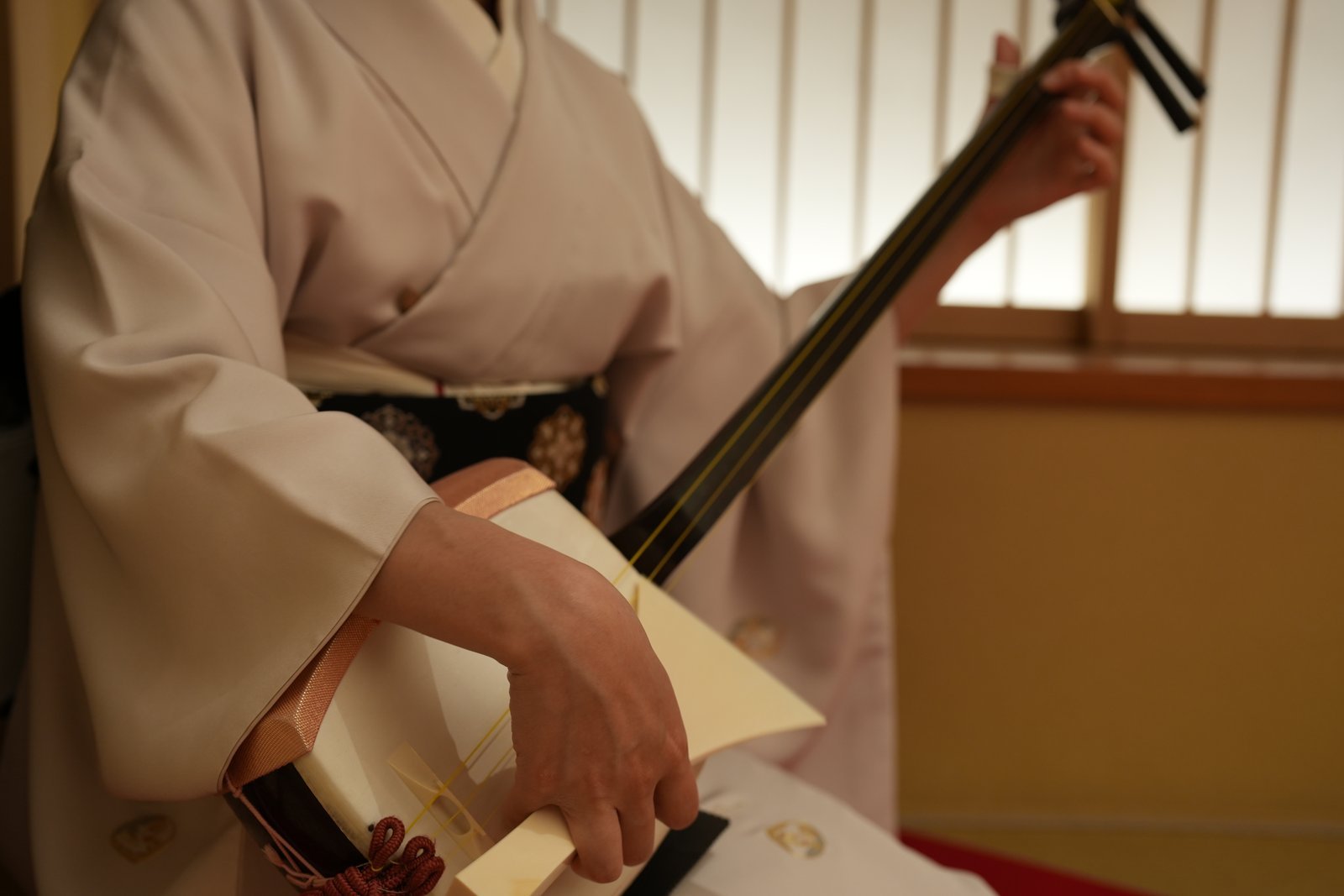
In practice that resolve looks like a calendar. Every week, for as long as she works, a geisha goes to lessons — shamisen, the percussion of the hayashi ensemble, dance, song, the way she carries herself in a room. There is no graduation. The women you meet at Miyakodori have been doing this for years or decades, and they will keep doing it after your evening ends.
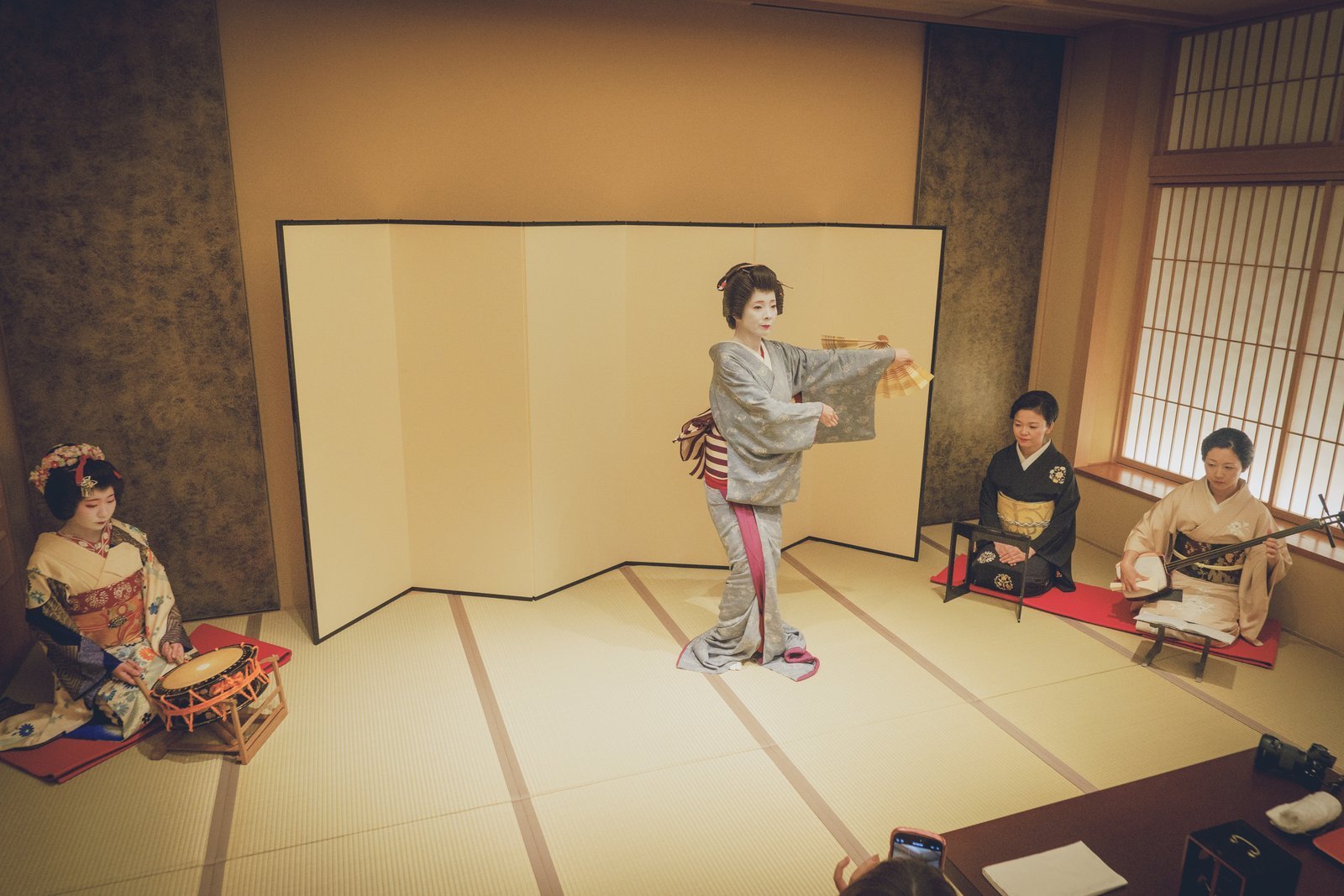
They are also not our employees. The geisha of Asakusa are independent artists registered with the local kenban, and a house like ours invites them for each ozashiki. It’s worth knowing, because it’s the difference between a costumed performer hired for a photo opportunity and a working professional with her own name and reputation in a living hanamachi.
What an Evening at Miyakodori Actually Looks Like
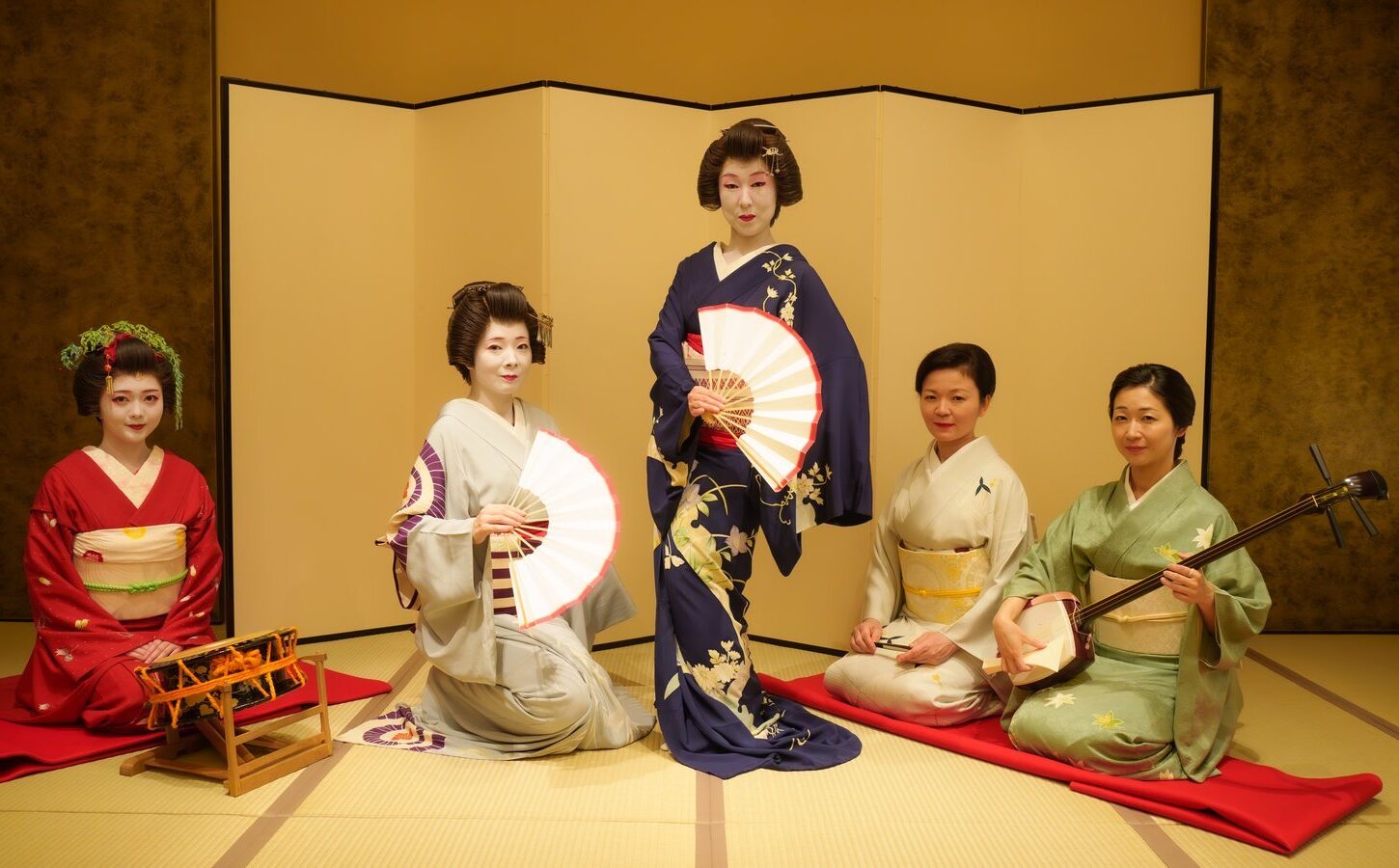
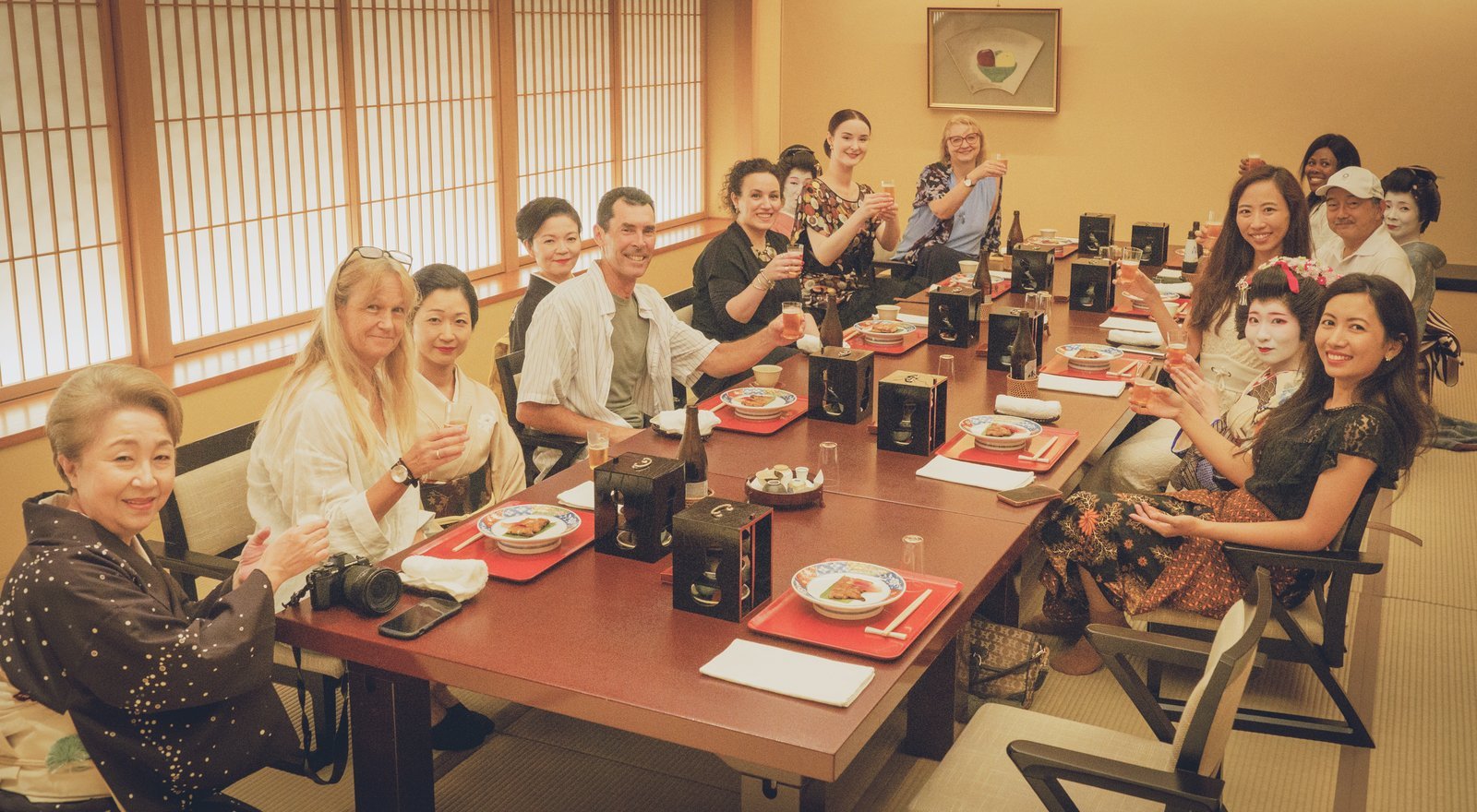
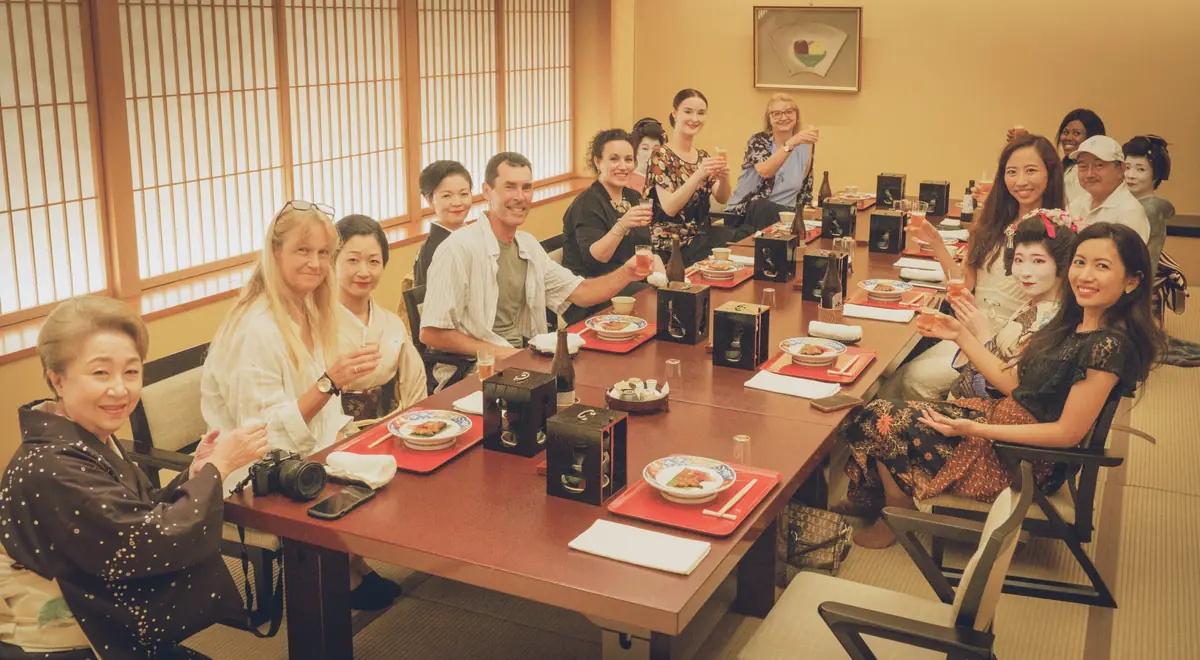
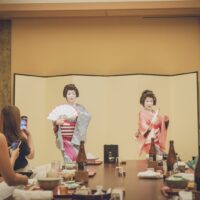
Once the geisha arrive, they stay with you for the length of your banquet. You’ll pour each other drinks and talk, watch the traditional arts the geisha perform, and then play ozashiki asobi together, the traditional parlor games that have entertained guests here for generations: Konpira Fune Fune, Tora Tora, and Tosenkyo. The distance between you closes faster than you’d expect, the conversation picks up, and somehow the time disappears.
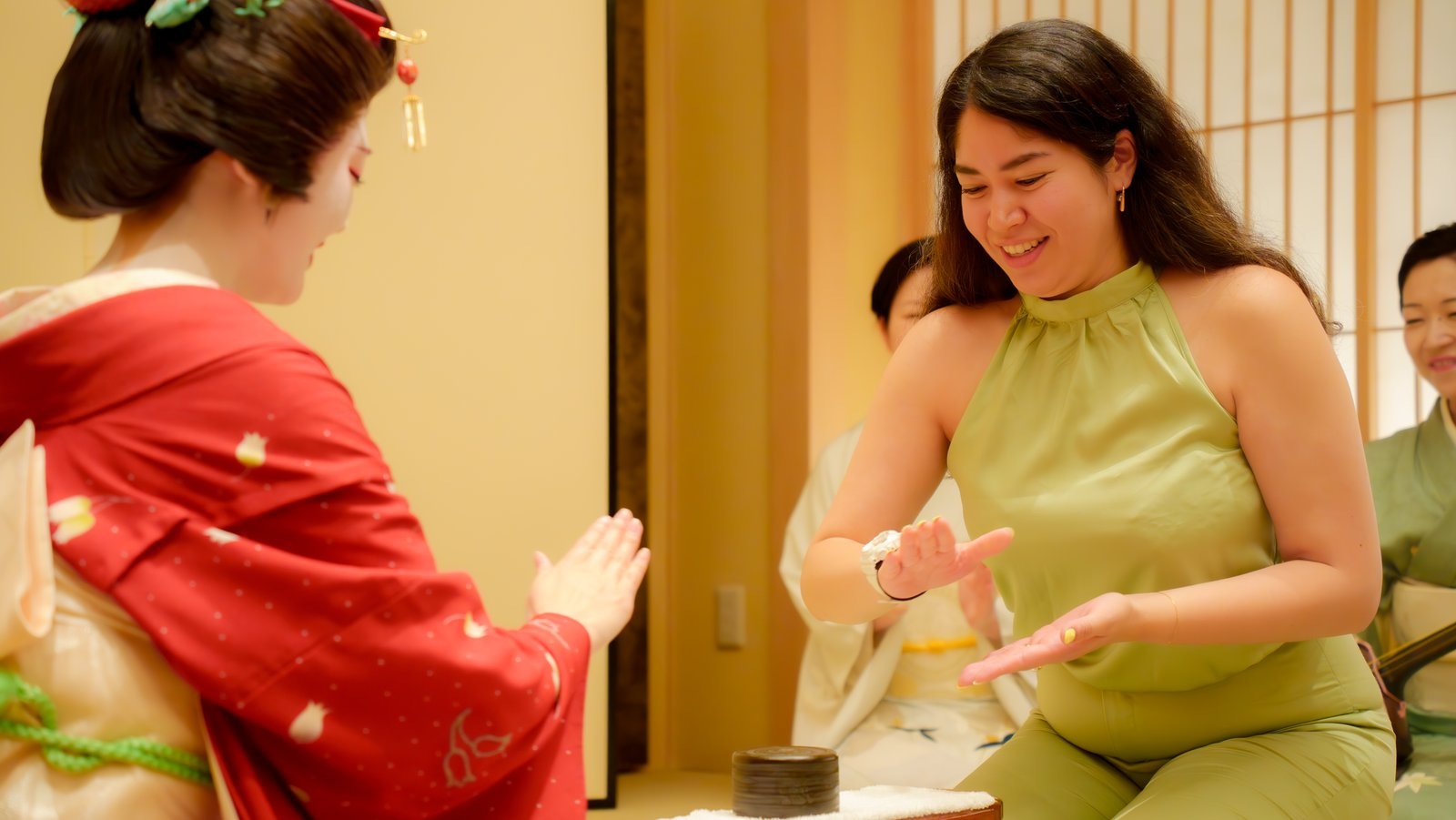
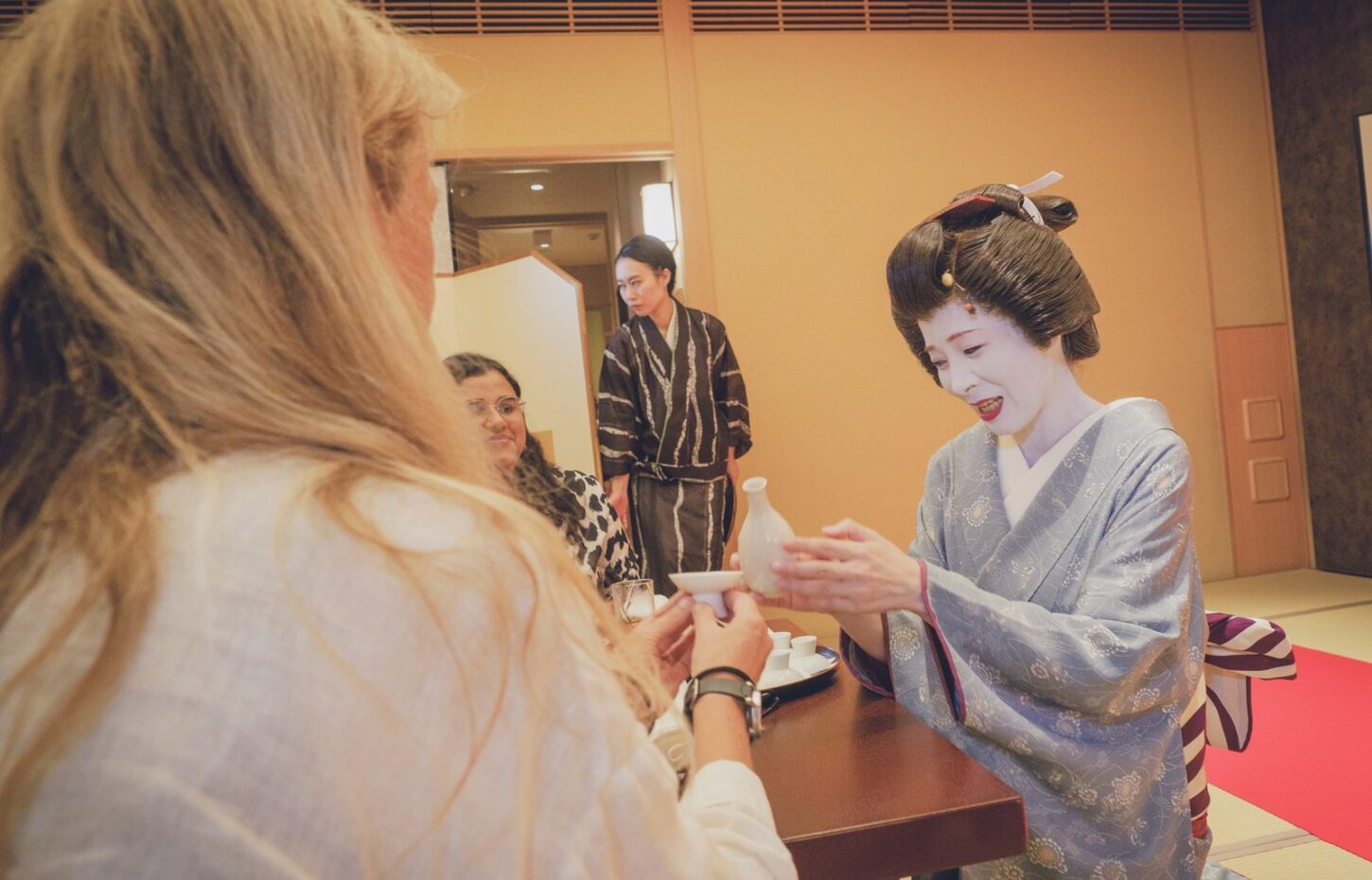
A few practical things anime will have taught you wrong. You won’t be kneeling: the standard at Miyakodori is low chairs at the tatami table, so nobody spends the evening negotiating with their knees. And pouring is not a one-way ritual performed at you — the geisha pours for you, you pour back for her, and that exchange is where the conversation usually starts. Guests who try it are doing it right.
The dances aren’t random, either. First-time guests almost always see the same pair. Asakusa Meibutsu was written for this neighborhood: it names local landmarks and sings its festivals, the Sanja Matsuri among them, and the fan becomes the carrying pole of a mikoshi. It is a bright, noisy, celebratory piece. Then comes Sawagi, a short, lively piece that came out of Yoshiwara and is known across all six of Tokyo’s hanamachi — a song about seeing a guest off, with lyrics and choreography that shift with the season and the occasion.
Meet a Real Geisha in Asakusa
Anime gives you the picture. A private ozashiki (a private gathering with geisha) at Miyakodori puts you in the room — live shamisen, dance, and parlor games you play yourself, with an English interpreter present throughout.
Request a ReservationFirst Time? You are Welcome
Geisha culture has a reputation for being “no first-timers allowed.” Traditionally only existing customers could introduce a new customer due to the billing process. However, nowadays first-time guests are welcome at Miyakodori.
The reason for that old rule is more interesting than the rule itself, and it wasn’t snobbery. This world ran on tsuke — credit. Bills were settled every two months, every three, sometimes twice a year; some guests deposited a sum in advance and topped it up when it ran low. In a cash economy with no credit cards, that only worked with people whose word was good. “Introduction only” was, in effect, a credit check. It also meant the hanamachi never developed the habit of advertising: there was no point courting strangers who couldn’t book anyway.
Asakusa was no exception, and many houses here still keep the old rule. Miyakodori was the first in Asakusa to open that door — not to break with tradition, but because a tradition nobody new can enter has nowhere to go. If you’re nervous, the geisha will work to put you at ease. We’ve also thought about comfort in practical ways — including an elevator — so more guests can enjoy an evening here without worrying about the details.
Anime Geisha vs. an Evening at Miyakodori
| In anime | At Miyakodori |
|---|---|
| A character, watched from a distance | A real geisha, sitting across from you |
| A story someone else wrote | A conversation only you had |
| Art performed in 2D | Art performed live, polished since the late 1600s |
We watch this land on people’s faces. Guests arrive from all over — Europe, the Americas, across Asia — and they leave saying the same thing, usually while still smiling about a game they lost. Our okami noticed something else: the three parts of the evening produce three completely different expressions. People watch the dance seriously, listen to the talk with curiosity, and play the games with total abandon. We’ve had families where a grandparent, a parent and a child were all laughing at the same round of Konpira Fune Fune, and guests from their twenties to their nineties. Whatever the anime promised you, the room does not sort people by age or nationality.
A Living Art You Can Only Feel in Person
Geisha culture took shape in the late 1600s, in the long peace of the early Edo period, when entertainment culture flourished and a performer could spend a lifetime pushing one art as far as it would go — with none of today’s distractions competing for that lifetime. The ozashiki itself is younger, and it is the part that has held still: the shape of an evening here has barely changed for something like two centuries. That’s the part worth sitting with. Something designed two hundred years ago, for guests with none of your entertainment options, is still funny, still tense, still worth playing tonight. Things that survive that test are usually the ones that were refined until there was nothing left to remove. A tradition with that much sanding behind it deserves to meet each new generation of guests, including the ones who found their way to us through a screen.
Frequently Asked Questions
Is an evening at Miyakodori like the geisha I’ve seen in anime?
The appearance of the geisha will be familiar. However most anime won’t show what a banquet with a geisha is like in its entirety — the live shamisen, the back-and-forth conversation, and the games you actually take part in.
Do I need experience, or to speak Japanese?
No. Most guests are visiting for the first time, and the geisha who join us, and our staff, are used to helping newcomers feel comfortable right away. An English interpreter is present throughout your ozashiki on every plan.
Can I take photos?
Yes — photos with the geisha are welcome on our private ozashiki plans. We only ask you not to live-stream.
What should I wear?
There’s no formal dress code; casual to smart-casual is fine. If you’d like to come in kimono, we love that — some guests rent one earlier in the day and come straight to us.
How much does an evening cost?
The one-hour daytime plan starts from ¥34,000 per person for parties of four or more; on that plan every guest also orders one drink, charged separately (¥800–¥5,500). Longer plans include free-flow drinks. Food depends on the plan rather than coming as standard: the three-hour evening plan includes a kaiseki dinner, shorter plans take a seasonal bento or à la carte dishes as options, and you are welcome to book with no meal at all.
What kind of occasion are geisha good for?
Anniversaries, business hospitality, family celebrations — anyone genuinely curious about geisha culture is who we hope to welcome.
You can get to know us a little more online before you visit — our guide to Asakusa’s geisha district is a good place to start. We’re three minutes north of Sensō-ji, about a thirteen to fifteen minute walk from the nearest stations. When you’re ready, take a look at our plans and pricing, then design your geisha experience and send us a request. Every private ozashiki is booked by request rather than instantly confirmed, and we normally reply within two business days.
From the Screen to the Room — Design Your Evening at Miyakodori
First-time guests are welcome. Tell us what you’d like your evening to be, and we’ll build a private ozashiki (a private gathering with geisha) around it in Asakusa. Booked by request, with a reply normally within two business days.
Request a Reservation


- Meet Real Geisha in Tokyo: An Evening on the Geisha Streets of Asakusa
- Asakusa Geisha Encyclopedia: Inside Tokyo's Hanamachi
How Much Do Geisha Make? How Geisha Are Paid in Tokyo, Then and Now
The Ultimate Guide to Geisha Dinner in Tokyo: Experience Authentic Japanese Culture, Cuisine, and Entertainment in 2026
What Is Ozashiki Asobi? A Guide to Geisha Games, Etiquette, and the Real Experience in Asakusa, Tokyo
Yoshiwara: History, Location & Legacy of Japan’s Famous District
What Is a Ryotei? Japan’s Traditional Restaurant Culture, Explained

No comments yet.