日本語のページはこちら
MIYAKODORIASAKUSA · TOKYO

Tokyo geisha and Kyoto geiko and maikoNames, dress and dance schools compared

Tokyo and Kyoto at a glance

Many people picture Kyoto's maiko when they hear the word geisha. Tokyo and Kyoto differ in names, dress and dance schools.

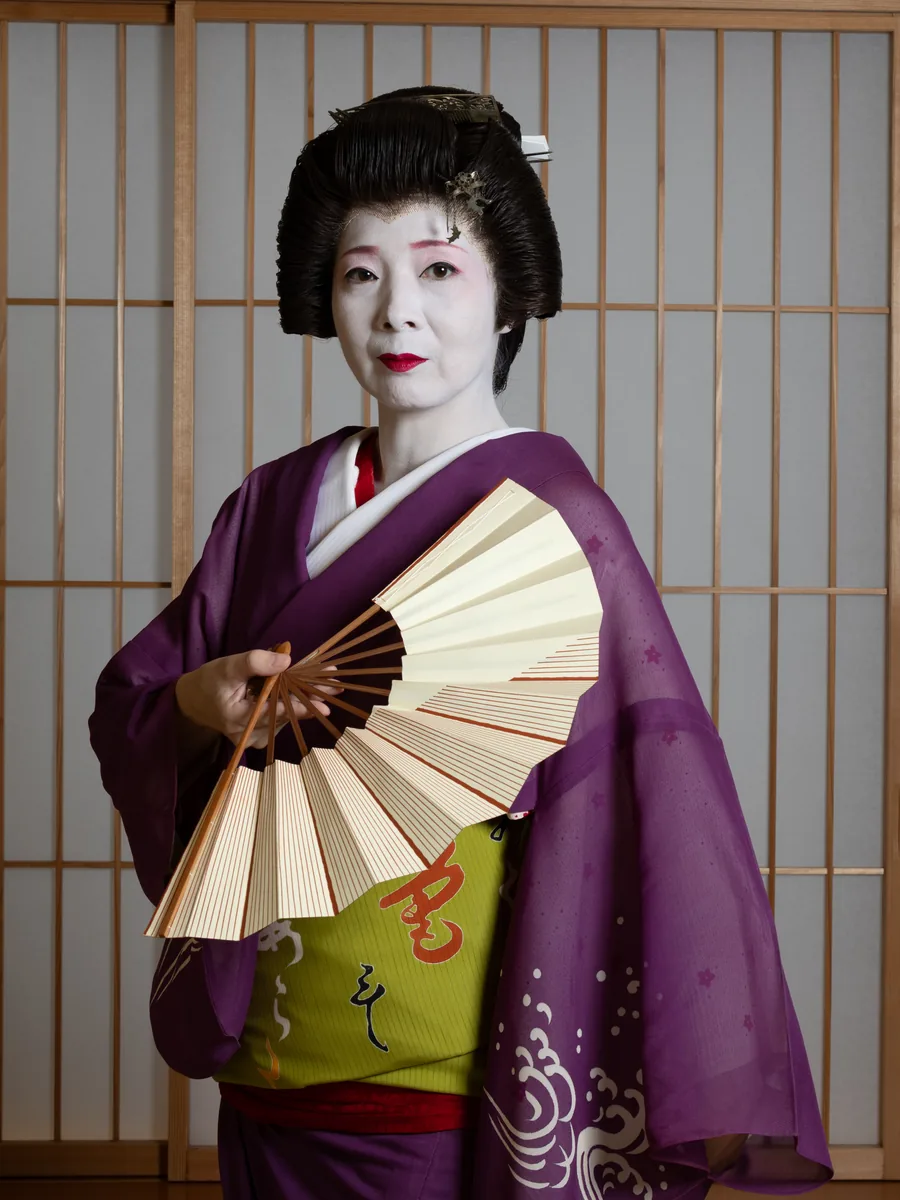
An Asakusa geisha who dances, standing before a shoji screen, in white makeup, a Japanese hairstyle and a purple kimono, holding an open fan.
TopicTokyoKyoto
Name for a full geishaGeishaGeiko. Some books write it with different characters (芸子 instead of 芸妓); both are read geiko
Name for an apprenticeHangyokuMaiko
House a geisha belongs toOkiyaYakata
Apprentice's kimonoFurisode (long-sleeved kimono)Furisode with a trailing hem and the long darari obi
Geisha's kimonoHikizuri (trailing kimono) in Edo komon, an all-over fine pattern. Irokawari is also worn in some seasonsEdo komon is rare. Tsukesage or irokawari, kimono patterned at the hem, worn trailing
School of Japanese danceAsakusa: Hanayagi and FujimaGion: Inoue
Impression of the dressIki (chic, understated style)Hin (grace, refinement)
Photo: An Asakusa geisha who dances (Asakusa Miyakodori, September 2026). Sources are given with each entry.

Many people know geisha only through Kyoto's maiko and geiko. Tokyo has geisha too, and the word itself was born here. The two traditions share a root but differ in names, dress and dance. This page sets out those differences, from the accounts of the okami (proprietress) of Miyakodori and its third-generation owner, and from books on the geisha world.

12 entries · 12 terms · Updated 2026-10-24

This archive is kept by Miyakodori, a ryotei in Asakusa since 1950 that keeps the form of a machiai (a house where guests call geisha for a private party). It rests on what we have heard directly in Asakusa (accounts), checked against books on the geisha world. Memories differ from person to person and from one era to another, so not everything here is certain. If you find something that differs, please tell us with “Ask the archive”; we will check and correct it.

01Names and roots

↑ The overview is at the top of this page

01Tokyo says "geisha" and Kyoto says "geiko" for the same profession

The apprentice is a hangyoku in Tokyo and a maiko in Kyoto.

Some words of the geisha world differ between Tokyo and Kyoto. A full geisha is called geisha in Tokyo and geiko in Kyoto. An apprentice is a hangyoku in Tokyo and a maiko in Kyoto. A book adds that the house a geisha belongs to is an okiya in Tokyo and a yakata in Kyoto.

Another book writes the Kyoto word with different characters. It says the character form 芸妓 is a written word only, and that in speech people say geisha in the east and geiko in the west. In Asakusa today, though, some geisha do use the word 芸妓 for themselves. According to Yuta Kawamura, about as many use 芸妓 as say geisha.
The book and present-day Asakusa disagree on whether 芸妓 is used in speech, so both are given.

BookAsahara Sumi, Ozashiki Asobi (お座敷遊び), Kobunsha Shinsho, 2003BookIwashita Hisafumi, Karyukai no Kioku: Geisha-ron (花柳界の記憶 芸者論), Bunshun Bunko, 2009AccountYuta Kawamura, third-generation owner of Miyakodori

02In Tokyo, a hangyoku is already a geisha, not a trainee

Tokyo's path runs from minarai (trainee) to hangyoku to ippon (full geisha).

Before her debut, a future geisha spends about six months to a year as a minarai, a trainee. In that time she learns manners and movement: how to pour, how to hand things across, how to walk on tatami.

She then debuts as a hangyoku and begins to appear at ozashiki (private parties with geisha). This is already a geisha, a young one still in training, whom the okami compares to Kyoto's maiko. After some years she moves on to become an ippon, a full geisha, marked by a ceremony called ippon hirome. The okami says a hangyoku learns by watching the older geisha, whose art and care for guests are ahead of hers.

Accounts give different lengths for the hangyoku years, so no single figure is given here.

Accountthe okami (proprietress) of MiyakodoriAccountYuta Kawamura, third-generation owner of Miyakodori

03The word "geisha" was born in Edo and passed down to Tokyo

A book says geisha in other regions took their name from Tokyo.

According to a book on the Tokyo geisha world, the name geisha became established in the mid-Edo period in Yoshiwara and was carried into Tokyo in the Meiji era. Edo is the old name of Tokyo. The book says geisha in regional districts such as Niigata and Hakata took the Tokyo name, while the Kansai region, which includes Kyoto, still says geiko.

BookIwashita Hisafumi, Karyukai no Kioku: Geisha-ron (花柳界の記憶 芸者論), Bunshun Bunko, 2009

04Kyoto's geiko and Tokyo's geisha share one root but grew in different ways

A book says both began near temples and shrines, by the water.

Gion's geiko trace their beginning to women of the tea stalls at the gate of Kanshin-in. Edo's geisha were born on the banks of the Sumida River. The book says both served close to the gods and Buddhas, and both were born beside water.

After that, the book says, they grew in very different ways. Its author writes that their styles are too far apart to judge on the same stage, and so writes only about the geisha of Edo and Tokyo.

BookIwashita Hisafumi, Karyukai no Kioku: Geisha-ron (花柳界の記憶 芸者論), Bunshun Bunko, 2009

02Dress

05Both wear furisode, but a Kyoto maiko trails her hem and wears the long darari obi

A Tokyo hangyoku and a Kyoto maiko look quite different.

A Tokyo hangyoku and a Kyoto maiko both wear furisode, a kimono with long sleeves. The okami of Miyakodori says the two are truly different all the same. A Kansai maiko lets her hem trail on the floor and ties the darari obi, a long hanging sash.

A hangyoku wears her furisode with tucks at the shoulders and sleeves (kata-age and sode-age) and flower hairpins in her hair, the okami says. A full Tokyo geisha wears a kimono with ordinary short sleeves, trailing at the hem, and tortoiseshell hairpins.

Accountthe okami (proprietress) of Miyakodori

06Tokyo geisha wear Edo komon; Kyoto geisha more often wear kimono patterned at the hem

This is what the okami has noticed when seeing Kyoto geisha.

The okami says full geisha look less different from each other than hangyoku and maiko do. The kimono still differ. A Tokyo geisha wears a hikizuri (a trailing kimono) in Edo komon, a fine all-over pattern. In the okami's eyes, Kansai geisha rarely wear Edo komon. They trail kimono such as tsukesage or irokawari, which carry their pattern at the hem.

Irokawari is not worn in Kyoto alone. Asakusa geisha also change from a black hikizuri to an irokawari hikizuri around mid-January.

Accountthe okami (proprietress) of MiyakodoriAccountYuta Kawamura, third-generation owner of Miyakodori

07Hairpins and white makeup are almost the same in Tokyo and Kyoto

Even where hangyoku and maiko differ, the hairpins do not.

The okami says that hangyoku and maiko differ in figure and dress, but their kanzashi (hairpins) are the same. Of the white makeup, she says there may be small differences between Kyoto (Kansai) and Tokyo, but she thinks it is almost the same.

Accountthe okami (proprietress) of Miyakodori

03Dance and how geisha are seen

08Gion in Kyoto dances in the Inoue school, a style of its own

The okami says its dance is entirely different from the schools well known in Tokyo.

Kyoto has several geisha districts, including Gion and Pontocho. Gion dances in the Inoue school, an old school of Japanese dance.

The okami says it is a distinctive school, unlike the Hanayagi, Fujima and Onoe schools that most people know, and that the dance itself is completely different. This comparison is her personal view.

The comparison between schools is recorded as the okami's personal view.

Accountthe okami (proprietress) of Miyakodori

09Asakusa geisha dance in the Hanayagi and Fujima schools

A 2003 book says the okiya decides which of the two a geisha learns.

The schools of Japanese dance that Asakusa geisha learn are Hanayagi and Fujima. A book from 2003 names the same two, and says which one a geisha learns depends on her okiya.

That the okiya decides the school is the book's statement. Whether this still holds has not been checked.

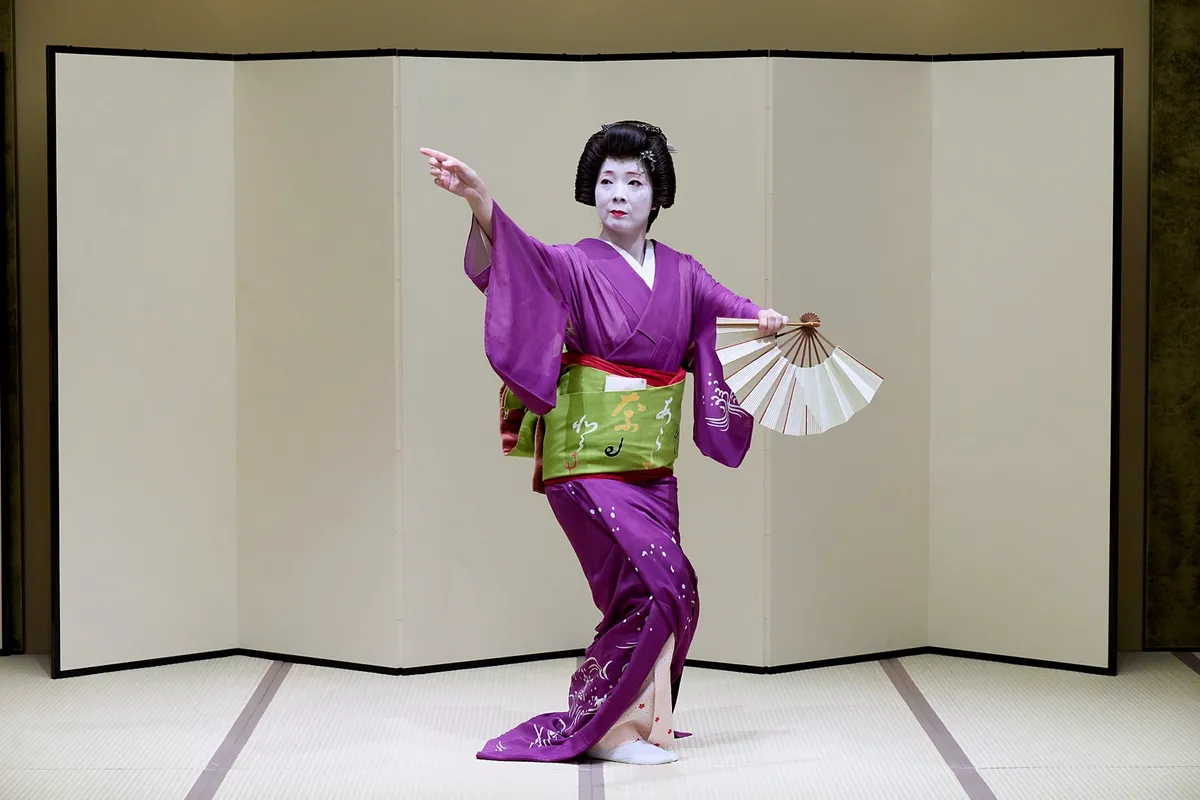
An Asakusa geisha dancing in front of a folding screen, one arm stretched out and an open fan in the other hand.
An Asakusa geisha performing Japanese dance (Miyakodori, Asakusa, September 2026).
AccountYuta Kawamura, third-generation owner of MiyakodoriBookAsahara Sumi, Ozashiki Asobi (お座敷遊び), Kobunsha Shinsho, 2003

10Many people, in Japan too, picture a Kyoto maiko when they hear "geisha"

Many guests who come to Miyakodori also think geisha belong to Kyoto.

A book says nearly all of the geisha world shown in magazines and on television is Kyoto's geiko and maiko. Not only visitors from abroad but many Japanese people today, it says, first picture a Kyoto maiko with her darari obi when they hear the word geisha. According to Yuta Kawamura, many guests at Miyakodori also think geisha are a Kyoto thing.

The author gives his reasons. Kyoto's districts cooperate with the press, spare no cost in raising maiko and keeping their streets, and the city treats them as a living cultural heritage. The long ties between Gion's Inoue school and the broadcaster NHK have also made events such as the Miyako Odori dances national news.

The reasons Kyoto became so well known are the book author's view.

BookIwashita Hisafumi, Karyukai no Kioku: Geisha-ron (花柳界の記憶 芸者論), Bunshun Bunko, 2009AccountYuta Kawamura, third-generation owner of Miyakodori

11Some guests arrive with a picture of geisha from the film SAYURI

Miyakodori explains that today's geisha have none of what those guests imagine.

According to Yuta Kawamura, films do not come up often, but some guests know the film SAYURI and ask about it. Now and then a guest from abroad believes geisha sold themselves, or were sold.

Miyakodori tells those guests that there is nothing of that kind in the work of geisha today.

AccountYuta Kawamura, third-generation owner of Miyakodori

12Edo means iki and Kyoto means hin, in the okami's own "personal image"

The okami herself says this is only how she feels.

After describing how Tokyo and Kyoto dress, the okami said that Tokyo is Edo, so perhaps it dresses with iki, a chic, understated style. Kyoto, she said, seems to aim less at iki and more at hin, grace and refinement.

She called this her "personal image". It is recorded as how the okami feels, not as a verdict.

Accountthe okami (proprietress) of Miyakodori

Terms on this page

Geiko (芸妓 / 芸子)
Kyoto's word for a full geisha.
Maiko (舞妓)
Kyoto's word for an apprentice geisha. Tokyo's equivalent is the hangyoku.
Hangyoku (半玉)
Tokyo's young geisha still in training. A hangyoku is already a geisha.
Ippon (一本)
A full geisha in Tokyo, after the hangyoku years.
Minarai (見習い)
The trainee period before debuting as a hangyoku.
Okiya (置屋)
The house a Tokyo geisha belongs to.
Yakata (屋形)
Kyoto's word for the house a geisha belongs to. Tokyo's equivalent is the okiya.
Darari obi (だらりの帯)
The long hanging sash worn by a Kyoto maiko.
Edo komon (江戸小紋)
Kimono with a fine all-over pattern. The hikizuri of Tokyo geisha.
Tsukesage (付け下げ) and irokawari (色変わり)
Kimono patterned at the hem. Common among Kyoto geisha; Asakusa geisha wear irokawari in some seasons.
Inoue school (井上流)
An old school of Japanese dance handed down in Gion, Kyoto.
Hanayagi and Fujima schools (花柳流・藤間流)
Schools of Japanese dance. Asakusa geisha learn these two.

Sources for this page

  • Account: the okami of Miyakodori, filmed interviews (November and December 2025) and a recording (September 2026)
  • Account: Yuta Kawamura, third-generation owner of Miyakodori (May, August and September 2026)
  • Book: Asahara Sumi, Ozashiki Asobi: Asakusa Kagai, Geisha no Iki o Do Tanoshimu ka (お座敷遊び 浅草花街 芸者の粋をどう愉しむか), Kobunsha Shinsho, 2003
  • Book: Iwashita Hisafumi, Karyukai no Kioku: Geisha-ron (花柳界の記憶 芸者論), Bunshun Bunko, 2009

Geisha carried on in Tokyo

Many people still picture Kyoto when they hear the word geisha. Yet the name was born in Edo and has been carried on by Tokyo's geisha districts. Names, dress and dance schools each differ between Tokyo and Kyoto. Asakusa geisha today still carry on the Hanayagi and Fujima dances, and still appear at ozashiki.

Update log 2026-10-24 published with 12 items

Archive home