日本語のページはこちら
MIYAKODORIASAKUSA · TOKYO

Kenban, okiya and ryoteiWho a geisha works for, and how she is called

What this page covers

How the geisha world is organized in Asakusa: the okiya a geisha belongs to, the kenban that registers her, and the ryotei that calls her.

  1. 1Who a geisha works forwho employs a geisha, how she is paid, what an okiya is, and how a geisha becomes independent.More
  2. 2How geisha come to an ozashikihow a guest reaches geisha, who chooses them, how the call travels, and where the word ryotei comes from.More
  3. 3The hakoya and the kenbanwhat the hakoya did, behind the scenes, so that geisha could get from one party to the next.More
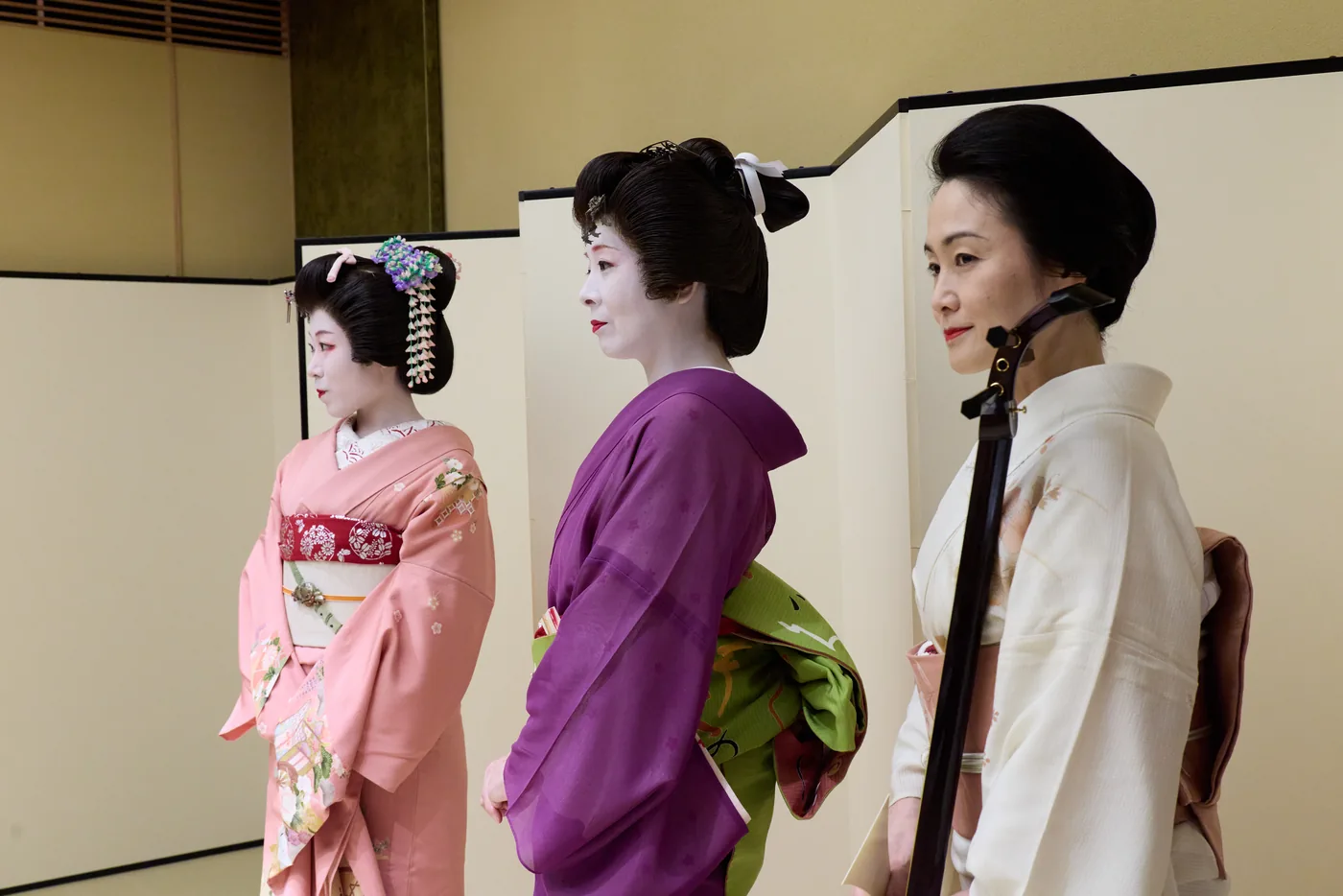
Three geisha seated in front of a gold folding screen: one with a flower hairpin, one in a purple kimono, and one holding a shamisen.
Geisha at an ozashiki. From left: a geisha with a flower hairpin, a geisha in a purple kimono, and a geisha holding a shamisen (Miyakodori, Asakusa, September 2026).

Who does a geisha work for, and how does she come to a party? In Tokyo the answer runs through three places: the kenban (the geisha registry office), the okiya (the house a geisha belongs to) and the ryotei (the restaurant where guests call geisha). This page sets out how they work together, from accounts heard in Asakusa and from books on the geisha world.

13 entries · 8 terms · Updated 2026-10-24

This archive is kept by Miyakodori, a ryotei in Asakusa since 1950 that keeps the form of a machiai (a house where guests call geisha for a private party). It rests on what we have heard directly in Asakusa (accounts), checked against books on the geisha world. Memories differ from person to person and from one era to another, so not everything here is certain. If you find something that differs, please tell us with “Ask the archive”; we will check and correct it.

01Who a geisha works for

↑ The overview is at the top of this page

01Asakusa geisha belong to an okiya, register with the kenban, and work for themselves

A ryotei does not employ geisha. It calls them through the kenban for each party.

Each Asakusa geisha belongs to an okiya (the house a geisha belongs to) and is registered with the kenban (the geisha registry office), which is run by the geisha's union. An okiya is not a company, so belonging to one does not make a geisha an employee. Each geisha is self-employed.

A ryotei (a restaurant where guests call geisha) does not keep geisha on its staff. For every ozashiki (a private party with geisha), it calls the geisha it needs through the kenban. Miyakodori, a ryotei that keeps the form of a machiai, works the same way.
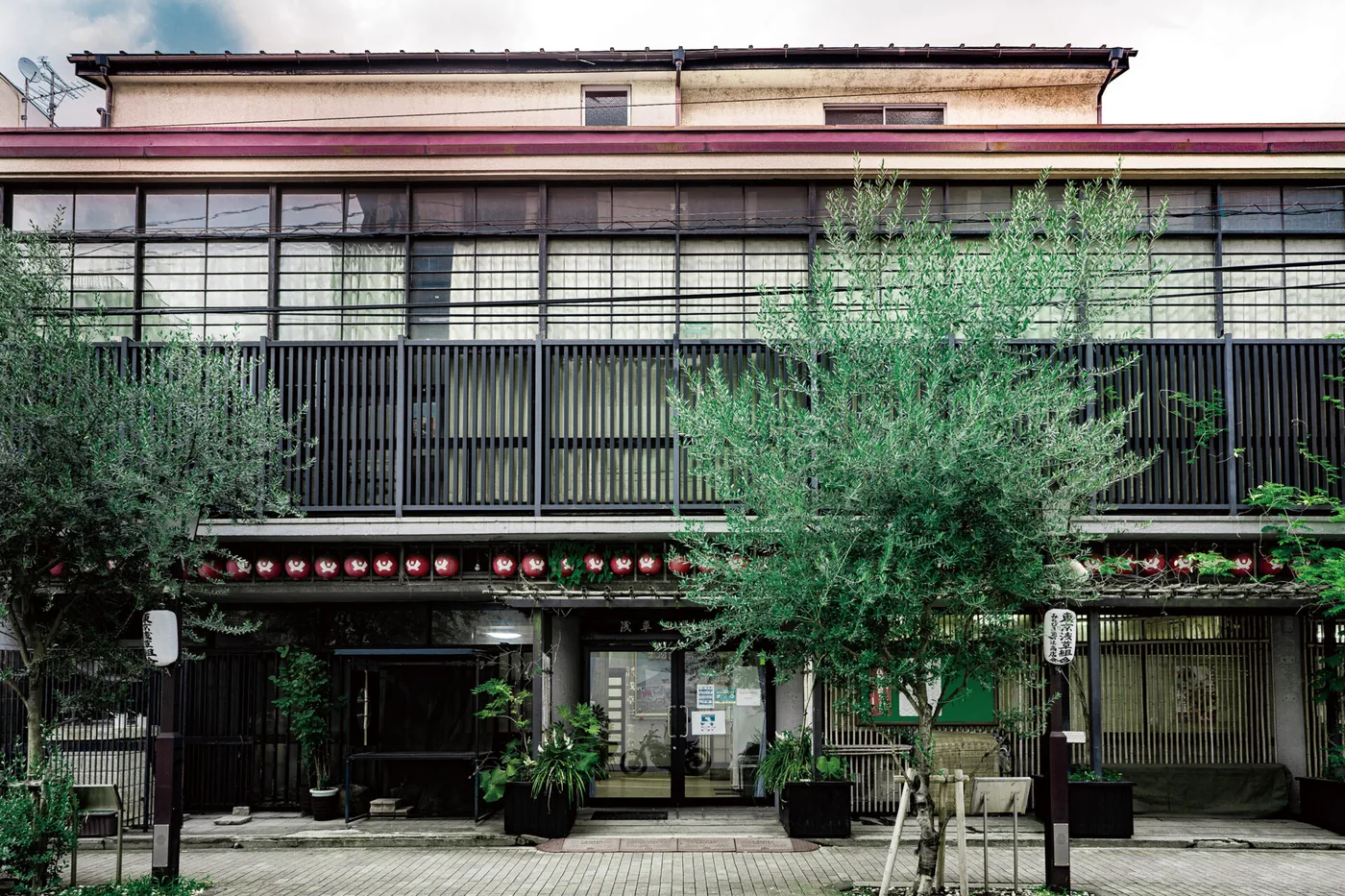
The front of the Asakusa kenban (Tokyo Asakusa Kumiai) building, with a row of paper lanterns.
The Asakusa kenban (Tokyo Asakusa Kumiai). Asakusa's geisha and hōkan (male entertainers) are registered here.
AccountYuta Kawamura, third-generation owner of Miyakodori
02A geisha is paid by the union, not by the ryotei: guest, ryotei, union, geisha

In Asakusa every step is a bank transfer.

The ryotei sets up the ozashiki, arranges the geisha and provides the room. It bills the guest and receives the payment. A geisha's fee is charged by the hour.

Once the guest has paid, the ryotei sends the Tokyo Asakusa Kumiai (the union that runs the kenban) a slip for the geisha who worked and pays the union. The union then pays each geisha. In Asakusa the money moves from guest to ryotei, from ryotei to union, and from union to geisha, all by bank transfer.

AccountYuta Kawamura, third-generation owner of MiyakodoriAccountthe okami (proprietress) of Miyakodori

03Every geisha belongs to an okiya, and its head is like a mother to her

The geisha call the head of the okiya okāsan, "mother", unless she is still a working geisha herself.

A 2003 book on Asakusa says every geisha belongs to some okiya and goes to the ozashiki carrying its name, much as a sumo wrestler belongs to his stable. Geisha are usually known by their professional names alone, but the okiya's house name works like a hidden family name. The book says that belonging to an okiya has been required by regulation since the Meiji era (1868–1912).

The head of the okiya is called okāsan, "mother", by the geisha in her care. If the head is still a working geisha, they call her onēsan, "elder sister", instead. Few geisha live in the okiya now, but the book says it is still the okiya mother who teaches a new geisha her manners from the beginning and listens to her troubles, and that the bond lasts for life, like that of a mother and daughter.

Choosing an okiya, the book says, shapes a geisha's whole career. Unless there is a serious reason, such as the head's illness, a geisha cannot move to another okiya. If it truly does not work out, she can only buy her independence, give up being a geisha, or go to another district.

The okiya mother is a different role from the okami of a ryotei.

BookAsahara Sumi, Ozashiki Asobi (お座敷遊び), Kobunsha Shinsho, 2003

04After a set number of years with her okiya, a geisha can become independent as a jimae

The union grants her a kōrō kanban, a "merit license". This is still how it works in Asakusa today.

While a geisha is in an okiya's care, she pays the okiya a kanban fee, a fee for working under its name. After a set number of years, the union grants her a permit called a kōrō kanban, and she can go independent as a jimae (a geisha who runs on her own). The 2003 book describes this as the Asakusa system of its time. Yuta Kawamura says it is the same today, and the words jimae and kanban-gari (working under an okiya's name) are still in use.

The book adds that taking on young geisha is a heavy burden, so many okiya are made up of a single geisha who is the owner of the house.

We have not checked whether the kanban fee is the same today, so no amount is given.

BookAsahara Sumi, Ozashiki Asobi (お座敷遊び), Kobunsha Shinsho, 2003AccountYuta Kawamura, third-generation owner of Miyakodori
05To become an Asakusa geisha, contact the kenban; some people contact an okiya directly through social media

Either way is fine. You can also write to Miyakodori.

The usual first step to becoming a geisha is still the kenban, but some people see an okiya on social media and contact it directly, and either way is fine. The 2003 book says that about twenty years before it was written, the way in had shifted from the okiya to the kenban. A 2009 book adds that its author heard many young women phone a kenban with no introduction and simply ask to become geisha.

You may also contact Miyakodori directly. Please send an email to info.ozashiki@miyakodori.art with your résumé and a photo that shows who you are.

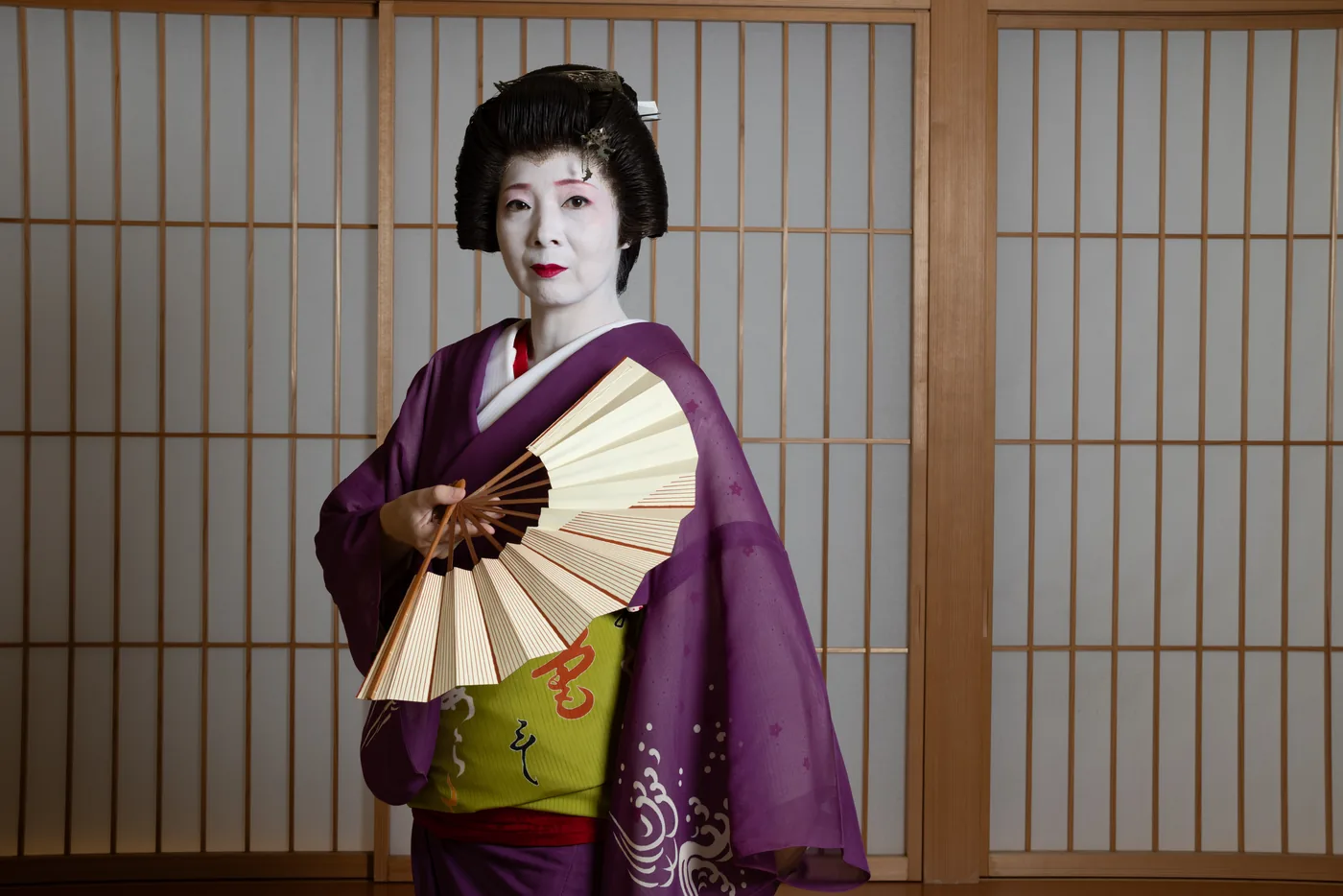
An Asakusa geisha who dances (a tachikata) standing in front of shoji screens, in white makeup, traditional Japanese hair and a purple kimono.
An Asakusa geisha, a tachikata who dances (Miyakodori, Asakusa, September 2026).
AccountYuta Kawamura, third-generation owner of MiyakodoriBookAsahara Sumi, Ozashiki Asobi (お座敷遊び), Kobunsha Shinsho, 2003BookIwashita Hisafumi, Karyukai no Kioku: Geisha-ron (花柳界の記憶 芸者論), Bunshun Bunko, 2009

02How geisha come to an ozashiki

06Guests reach geisha through the ryotei, not directly

The ryotei is the geisha world's one door to its guests.

The 2003 book says the geisha world rests on trust among three parties: the geisha and her okiya, the ryotei, and the guest. A guest is first of all the ryotei's guest. The only door the geisha world opens to guests is the ryotei, and guests and geisha do not contact each other directly outside the ozashiki, unless they knew each other before. The book also says the kenban is an office inside the union and has no dealings with guests.

The book also describes geisha being called outside the usual ryotei. In a geisha district, geisha are called to ryotei that hold the license to do so. Calling them to a place without that license, such as a hotel banquet hall, or to a ryotei in another district, is called tōde, "going far". The fee is higher, and the bill goes through the ryotei that holds the ozashiki. Yuta Kawamura says this rule is the same today.

The amounts are not given.

BookAsahara Sumi, Ozashiki Asobi (お座敷遊び), Kobunsha Shinsho, 2003AccountYuta Kawamura, third-generation owner of Miyakodori
07Unless a guest asks for particular geisha, the okami of the ryotei chooses who comes

She looks at each geisha's strengths and how they work together.

At Miyakodori, if the guest has not asked for particular geisha, the okami (the proprietress) decides which geisha come to the ozashiki. The 2003 book describes the okami of a ryotei as the one who puts an ozashiki together, matching each geisha's strengths and how well they work with one another.

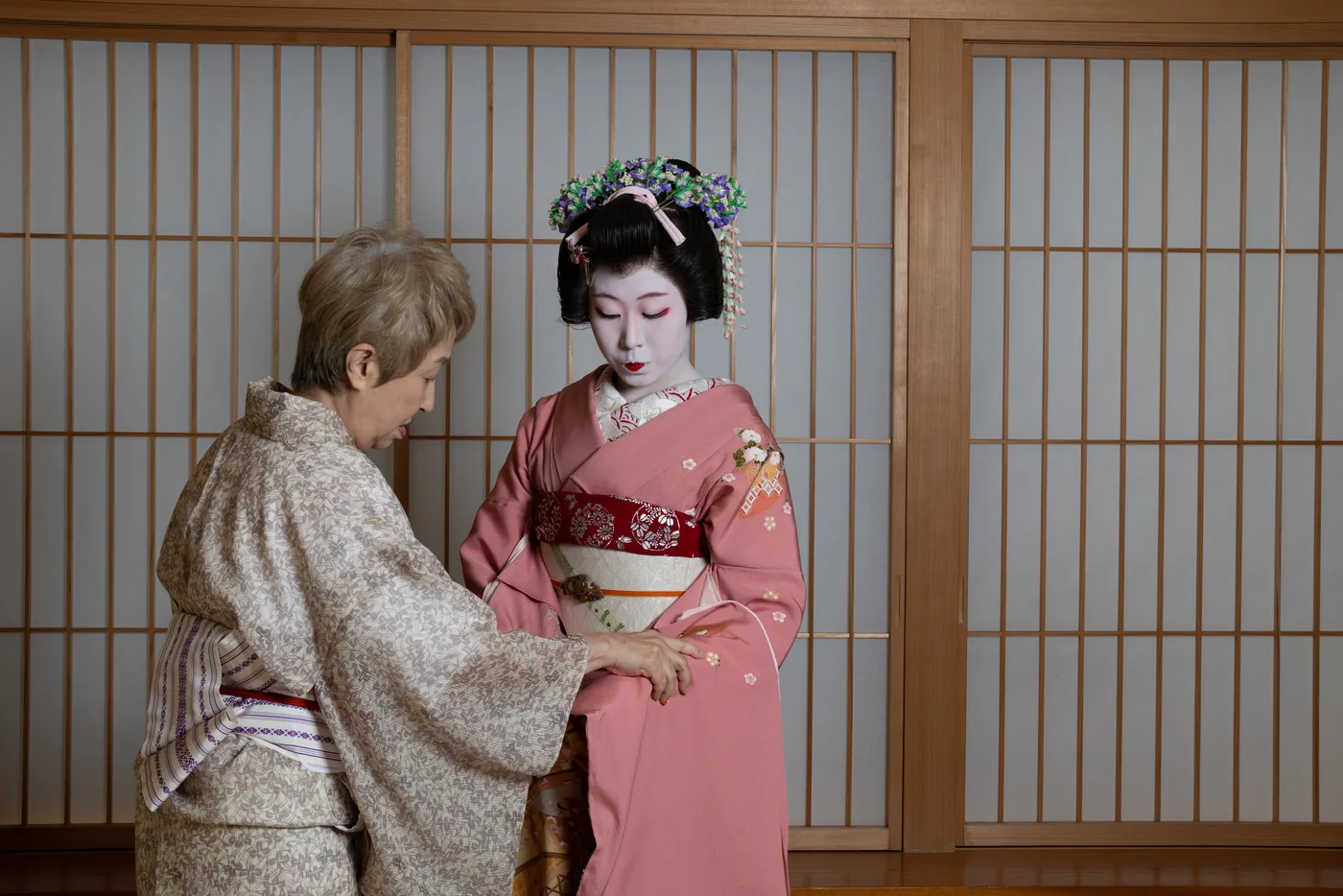
The okami straightening a geisha's sleeve in front of shoji screens.
The okami straightens a geisha's sleeve, behind the scenes at a Miyakodori event (Asakusa, September 2026).
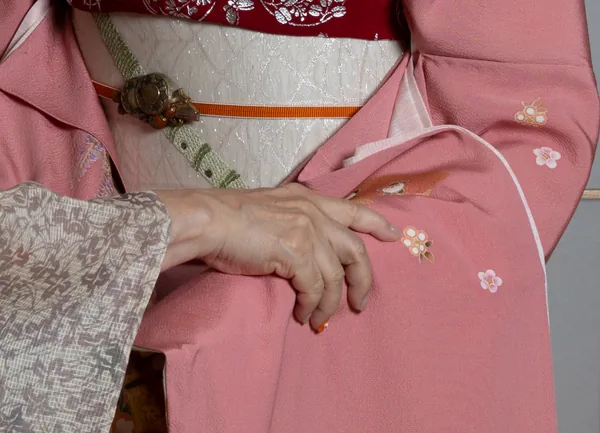
Close-up of the okami's hand on a geisha's sleeve.
Close-up from the photo above: the okami's hand on the sleeve
AccountYuta Kawamura, third-generation owner of MiyakodoriBookAsahara Sumi, Ozashiki Asobi (お座敷遊び), Kobunsha Shinsho, 2003

08A ryotei phones the kenban, and the call used to reach the geisha by a hakoya on foot or bicycle

Miyakodori still calls geisha by phoning the kenban.

The 2003 book describes Asakusa from about 1965 to 1974. A ryotei phoned the kenban to say how many geisha, which ones, on what day and at what time. A hakoya (an attendant who carried a geisha's shamisen and ran her errands) went to the okiya to ask whether she was free, then took her answer back to the ryotei, and the ozashiki was set. A booking made in advance was an oyakusoku, "a promise", and an ozashiki called after the first promise was an atokuchi, "a later call". Hakoya and geisha never used the front entrance of a ryotei, only the back door.

After 6 p.m., the book says, the calls came one after another. At the kenban's front desk, the ryotei's name and the geisha's name were written on a paper slip, and a waiting hakoya rode a bicycle to the okiya with it. Kei, a former hakoya, remembers geisha moving from party to party and phoning the kenban from a landline to learn where to go next and when. A hakoya brought them the slip for the next party. Kei calls this slip aijō, and we write it as he says it (愛情). The book writes the same word with other characters (逢状).

From about 1975, the book says, there were fewer hakoya, and the telephone came into use for these messages. Today, when Miyakodori calls geisha, it does so by phoning the kenban.

AccountYuta Kawamura, third-generation owner of MiyakodoriAccountKei, former hakoya (geisha's dresser and attendant) and former office head of the Tokyo Asakusa KumiaiBookAsahara Sumi, Ozashiki Asobi (お座敷遊び), Kobunsha Shinsho, 2003

09The word ryotei became official only after the war, in 1948

Before that, a geisha's main places of work were the ryōriya and the machiai.

The 2003 book says the geisha world was made up of three trades: the machiai (a house where guests met and called geisha) and the ryōriya (a restaurant), which held the ozashiki, and the okiya, where geisha belonged. A guest came to his usual machiai, and its okami ordered food from a ryōriya and called geisha from an okiya.

A 1948 regulation put ryōriya and machiai into one category, and they came to be called ryotei. The 2009 book says people who had lived in the geisha world since before the war rarely said ryotei in daily talk, and that older geisha in Shinbashi called the places they worked ochaya-san, "teahouses". The 2003 book also says that even after the word ryotei appeared, the names were not strictly kept apart in practice.

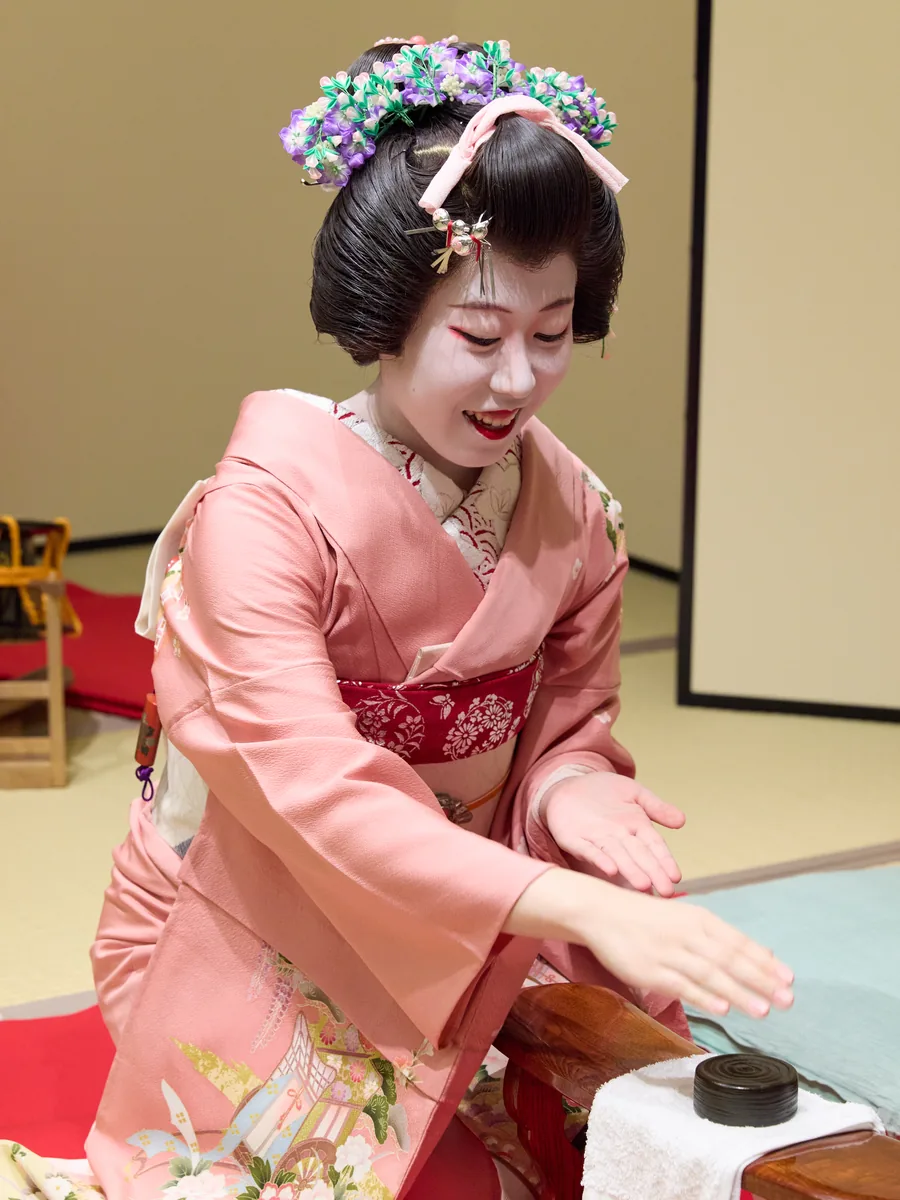
A geisha reaching toward the small cover on top of an armrest during a game of konpira fune fune.
An ozashiki today: a geisha playing konpira fune fune (Miyakodori, Asakusa, September 2026).
BookIwashita Hisafumi, Karyukai no Kioku: Geisha-ron (花柳界の記憶 芸者論), Bunshun Bunko, 2009BookAsahara Sumi, Ozashiki Asobi (お座敷遊び), Kobunsha Shinsho, 2003

03The hakoya and the kenban

10The "box" in hakoya is the long box that holds a shamisen

A hakoya carried it and walked with the geisha to the ozashiki.

Hako means box. A hakoya walked with a geisha when she moved from one ozashiki to another, or went from home to an ozashiki, carrying the long box with her shamisen (a three-stringed instrument) in it. Looking after a geisha's personal needs was the job of the okiya's maid. The hakoya's main work was running errands and carrying the shamisen.

From the filmed interview (received May 2026), 01:10–01:34.

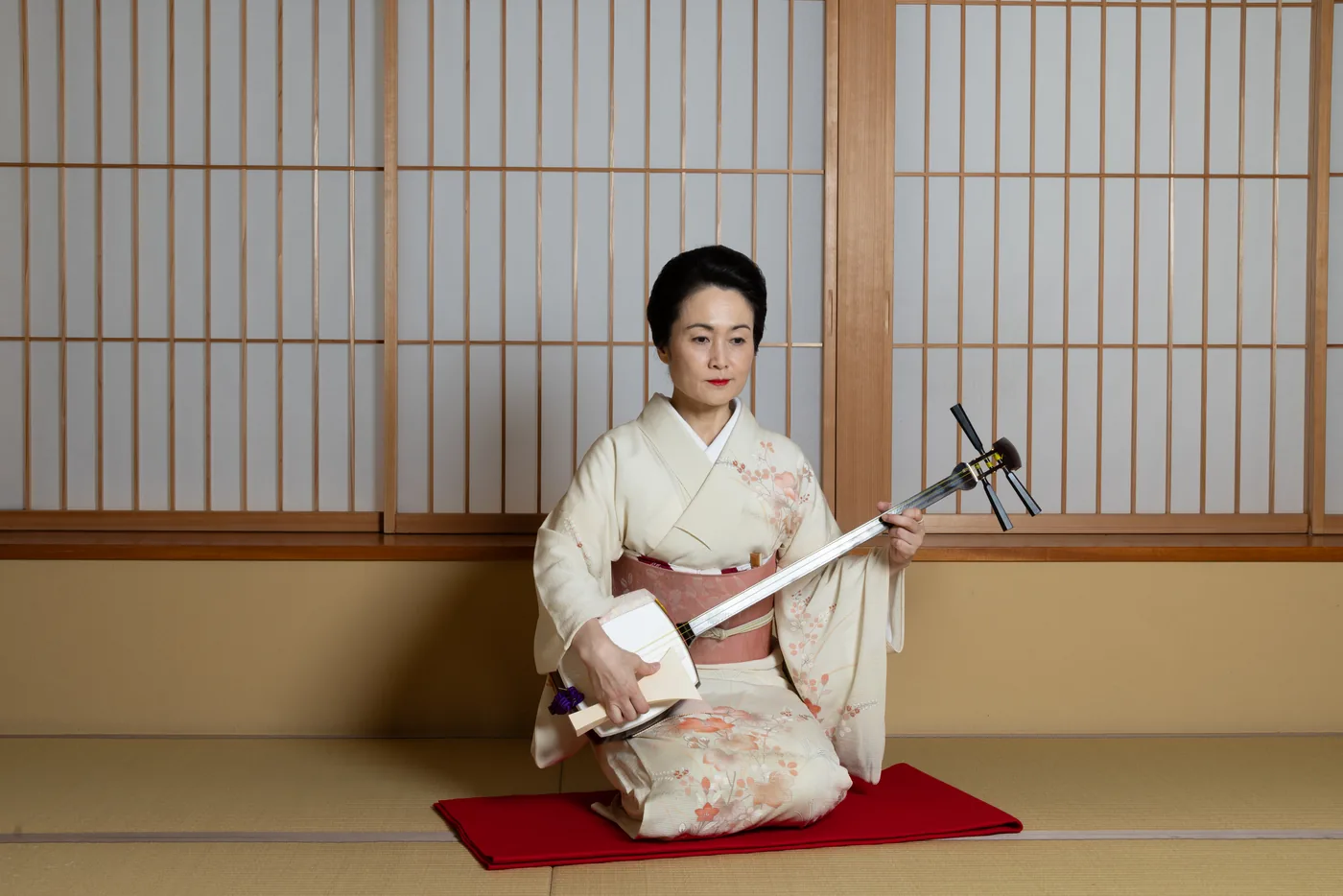
A geisha playing the shamisen, seated on a red felt mat in front of shoji screens.
What the hakoya carried in the long box was the shamisen. Here a geisha plays one at Miyakodori (Asakusa, September 2026).
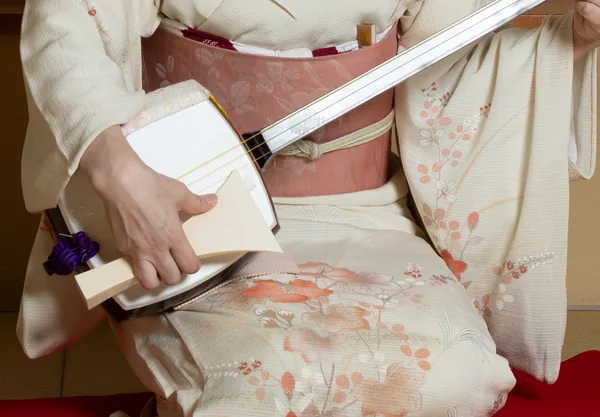
Close-up of the shamisen body and the hand holding the plectrum.
Close-up from the photo above: the body and the plectrum
AccountKei, former hakoya (geisha's dresser and attendant) and former office head of the Tokyo Asakusa Kumiai

11When a geisha could not go to an ozashiki, the hakoya carried her answer to the ryotei

He stood between geisha and ryotei so that no one was offended.

Geisha have their own circumstances, including their schedules and how well they get along with a guest. Kei says that when a geisha was called to an ozashiki she could not attend, it was the hakoya's job to go to the ryotei and turn it down gracefully.

The 2003 book tells the same story. The trick was not to refuse outright but to answer vaguely. What might cause friction if a geisha said it to a ryotei herself went smoothly when a hakoya stepped in. The book says hakoya took on these awkward tasks so that geisha could give themselves to their lessons and their ozashiki without extra worry.

AccountKei, former hakoya (geisha's dresser and attendant) and former office head of the Tokyo Asakusa KumiaiBookAsahara Sumi, Ozashiki Asobi (お座敷遊び), Kobunsha Shinsho, 2003

12Hakoya once lived in at the kenban and came at any hour of the night

A quilted firefighter's coat and a helmet hung there too.

Kei says two hakoya at a time lived in at the kenban. Even at night, if someone called to say a rat or a cockroach had got in, they went. Sometimes they were woken by knocking at the door.

A sashiko coat (a heavy quilted cotton coat worn for firefighting) and a helmet hung at the kenban, ready to wear if something happened, so the hakoya also served as a kind of volunteer fire brigade. Kei says he never went out to fight a fire, and there was only about one fire. At the end of each year, he put on the coat and walked the streets for hi no yōjin, the year-end fire watch.

The 2003 book calls the kenban, where hakoya were always on hand, a kind of refuge for geisha. When something happened, people phoned the kenban before the police, and when a fire broke out, they phoned the kenban before calling 119, the fire emergency number.

AccountKei, former hakoya (geisha's dresser and attendant) and former office head of the Tokyo Asakusa KumiaiBookAsahara Sumi, Ozashiki Asobi (お座敷遊び), Kobunsha Shinsho, 2003

13Today kenban staff carry the shamisen, and geisha often bring their own

In the past, a geisha never carried her shamisen herself.

The hakoya's name comes from carrying the shamisen box, but in Asakusa today the kenban staff carry the shamisen, and geisha often bring their own. The 2003 book says that a geisha never carried her shamisen herself, whatever the occasion; a hakoya took it to the ryotei of her next ozashiki.

Dressing geisha in the hikigi (a formal kimono with a long trailing hem) is still mainly the hakoya's job today. The book says this dressing has always been done by a hakoya or by an uchibako, a dresser who lived in the okiya. Tying the obi in the yanagi ("willow") style took real strength. In the book, Kei says each geisha is dressed differently, and that he learned each senior geisha's collar line, cords and obi position one by one, with his body.

AccountYuta Kawamura, third-generation owner of MiyakodoriBookAsahara Sumi, Ozashiki Asobi (お座敷遊び), Kobunsha Shinsho, 2003

Where the books and today's Asakusa differ

TopicIn the booksAsakusa today
The hakoya walking with a geishaLit her way with a lantern at night and held a parasol over her by day (Shinbashi, late Meiji to early Taisho, about 1900s–1910s)
Tanaka Yuko, Geisha to Asobi, pp. 76–77
Not done in Asakusa
Yuta Kawamura (September 2026)
The phrase for calling geishaKuchi o kakeru (as said in Shinbashi)
Iwashita Hisafumi, Karyukai no Kioku: Geisha-ron
Geisha o kakeru; kuchi o kakeru is not used
Yuta Kawamura (September 2026)

Terms on this page

Kenban (見番)
The registry office of a geisha district, run by the geisha's union. In Asakusa, the Tokyo Asakusa Kumiai.
Okiya (置屋)
The house a Tokyo geisha belongs to. Its head is called okāsan, "mother".
Jimae (自前)
A geisha who has become independent of her okiya.
Ryotei (料亭)
A restaurant where guests call geisha. The name became official in 1948.
Machiai (待合)
A house where guests met and called geisha, with food ordered from a restaurant. Merged with restaurants under the name ryotei in 1948.
Hakoya (箱屋)
A geisha's dresser and attendant, who carried her shamisen box and ran her errands. The hakoya does not appear at the party.
Tōde (遠出)
Calling geisha to a place without a license to call them, such as a hotel banquet hall, or to another district.
Geisha o kakeru (芸者をかける)
To call geisha to an ozashiki. The Asakusa phrase.

Sources for this page

  • Account: Yuta Kawamura, third-generation owner of Miyakodori (May and August to October 2026)
  • Account: the okami of Miyakodori, filmed interview (May 2026)
  • Account: Kei, former hakoya and former office head of the Tokyo Asakusa Kumiai, filmed interview (received May 2026)
  • Book: Asahara Sumi, Ozashiki Asobi: Asakusa Kagai, Geisha no Iki o Do Tanoshimu ka (お座敷遊び 浅草花街 芸者の粋をどう愉しむか), Kobunsha Shinsho, 2003
  • Book: Tanaka Yuko, Geisha to Asobi: Nihonteki Salon Bunka no Seisui (芸者と遊び 日本的サロン文化の盛衰), Kadokawa Sophia Bunko, 2016
  • Book: Iwashita Hisafumi, Karyukai no Kioku: Geisha-ron (花柳界の記憶 芸者論), Bunshun Bunko, 2009

A system with people to carry it on

Asakusa has far fewer ryotei and geisha than it once did. Still, the kenban is there, young geisha are growing up in their okiya, and ozashiki go on today. In this archive we will keep adding what can still be heard in Asakusa now.

Update log 2026-10-24 published with 13 items

Archive home