日本語のページはこちら
MIYAKODORIASAKUSA · TOKYO

Ozashiki: how a geisha party runs, its manners and its gamesHow a party with geisha runs, and its games

What this page covers

How an ozashiki runs, the manners geisha keep, and the games played with guests.

  1. 1How an ozashiki runshow an ozashiki begins and ends, where everyone sits, and which manners geisha keep in the room.More
  2. 2Ozashiki gameshow konpira fune fune, tora tora, tosenkyo and the other party games are played, and what happens to the loser.More
  3. 3Stories from the ozashikiwhat the okami and the books say about guests and geisha at the ozashiki, and how the seasons change a party.More
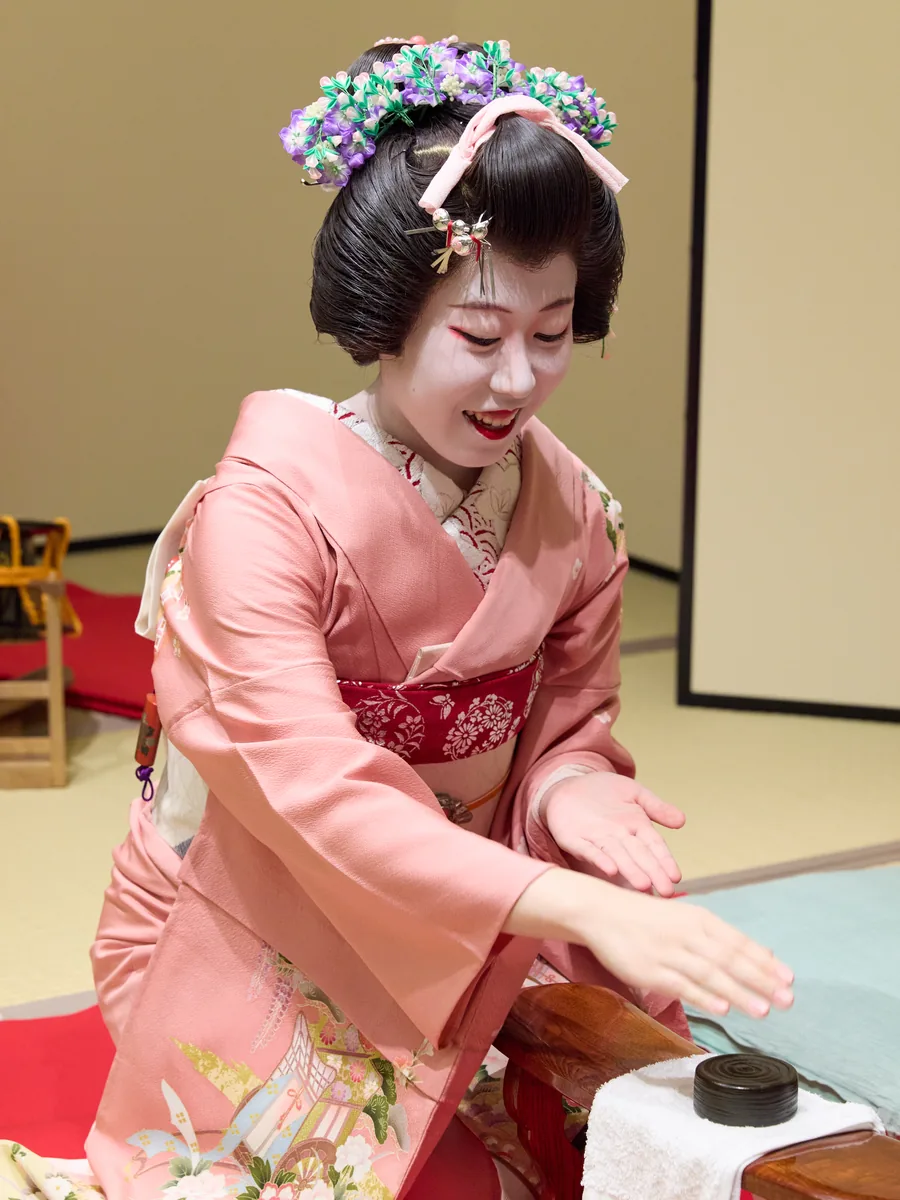
A geisha reaching toward the small cover on top of an armrest during a game of konpira fune fune.
A geisha playing konpira fune fune (Miyakodori, Asakusa, September 2026).

An ozashiki is a private party where guests call geisha to a tatami room for food, drink, dance and conversation. This page records how one runs from start to finish, the manners geisha keep in the room, and how the party games such as konpira fune fune and tora tora are played. It draws on accounts from the third-generation owner and the okami (proprietress) of Miyakodori, and on books about the geisha world.

12 entries · 14 terms · Updated 2026-10-24

This archive is kept by Miyakodori, a ryotei in Asakusa since 1950 that keeps the form of a machiai (a house where guests call geisha for a private party). It rests on what we have heard directly in Asakusa (accounts), checked against books on the geisha world. Memories differ from person to person and from one era to another, so not everything here is certain. If you find something that differs, please tell us with “Ask the archive”; we will check and correct it.

01How an ozashiki runs

↑ The overview is at the top of this page

01Geisha enter with a bow, and the dance comes partway through the meal

In the geisha world, performing a dance at the party is called "ozashiki o tsukeru."

Geisha come into the room soon after the guests sit down. They always bow as they enter, sit, bow once more and say "irasshaimase" (welcome). The third-generation owner says they make no grander greeting than that. The guests are the center of the party, and not breaking the mood matters a great deal to geisha.

The party moves along with the meal. Performing a dance is called "ozashiki o tsukeru." According to the third-generation owner, it usually comes around the soup, sashimi and grilled courses, about 20 minutes after the geisha arrive. The geisha step out of the room to get ready, and the dance starts within five minutes. One dance lasts about three minutes.

A minarai (a trainee who has not yet debuted as a geisha) bows with the geisha but does not say "irasshaimase," and enters last. This is how the okami of Miyakodori teaches trainees.
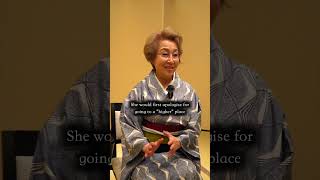
AccountYuta Kawamura, third-generation owner of MiyakodoriAccountthe okami (proprietress) of Miyakodori

02The seat nearest the alcove is the highest, and things are handed over while seated

Among geisha too, the senior sits nearest the tokonoma and the most junior nearest the door.

The okami explains that in a Japanese room, the seat nearest the tokonoma (the decorative alcove) is kamiza (the top seat), and the seat nearest the door is shimoza (the bottom seat). Senior people sit as close to the top as possible and the most junior near the door, and the same order holds among geisha. When an older geisha tells a younger one to move toward the alcove, she says "Onēsan, takaagari shitsurei shimasu" (excuse me for sitting above you, sister) before she moves.

Geisha are also taught never to turn their back to guests and never to hand anything over while standing. Whether bringing sake or beer or clearing it away, they sit down first. The okami thinks this is because handing things down from a standing position looks down on the guest. When making a whisky and water in the room, a geisha sits slightly at an angle and turns her back toward the lower end of the room as much as she can.

Accountthe okami (proprietress) of Miyakodori

03Guests do not need to know any of these manners

Making sure guests never feel ill at ease is part of a geisha's work.

The third-generation owner says guests are very welcome to pour for the geisha. A geisha pours for a guest, the guest pours back, and conversation starts naturally from there. A geisha may also ask, "May I have some too?"

As a rule, geisha drink when a guest offers and do not eat the food. A 2003 book describes the same custom. The okami teaches trainees that when a guest offers a drink, they should accept it with thanks rather than refuse.

Guests do not have to remember any of this. The third-generation owner says it is the geisha's job to keep guests from feeling they must be careful. An author who spent many years in the Shimbashi geisha district wrote the same: geisha who know their work never let a guest feel embarrassed.

AccountYuta Kawamura, third-generation owner of MiyakodoriAccountthe okami (proprietress) of MiyakodoriBookSumi Asahara, Ozashiki Asobi (お座敷遊び), Kobunsha Shinsho, 2003BookHisafumi Iwashita, Karyūkai no Kioku: Geisha-ron (花柳界の記憶 芸者論), Bunshun Bunko, 2009

04The end of an ozashiki is called "ohiraki," and there is no fixed way to close it

Some parties end with a rhythmic hand clap, and some simply come to a close.

The end of the party is called ohiraki. Nakajime is a pause partway through a banquet, not the name for the end. The third-generation owner says there is no set way to close: sometimes the room does tejime (a hand-clapping close), sometimes the party just ends, depending on the guests. The food usually signals the end. Once the final rice course and fruit arrive, the party moves naturally toward its close.

When the guests leave, the geisha kneel at the entrance, bow and see them off. After the guests have gone, the okami and the geisha thank each other.

A 2003 book gives one example of a party that ended with a three-part hand clap led by the senior geisha.

AccountYuta Kawamura, third-generation owner of MiyakodoriBookSumi Asahara, Ozashiki Asobi (お座敷遊び), Kobunsha Shinsho, 2003

02Ozashiki games

05In konpira fune fune, two players take turns over a small cover set on an armrest

The games often begin with konpira fune fune, and it is the most popular one.

According to the third-generation owner, the games often start with konpira fune fune, and it is also the most popular. A kyōsoku (an armrest used when sitting on tatami) is placed between two players, and a hakama is set on top of it. Here the hakama is a cover that goes under a beer bottle to catch the drips, not the pleated garment of the same name. When the okami was young in Asakusa, konpira fune fune was also played on a kyōsoku.

To shamisen music and song, the two players take turns reaching to the armrest. While the hakama is on the armrest, you touch it with an open palm. When the other player has taken it, you tap the empty armrest with a closed fist. Whoever uses the wrong hand loses. A player can take the hakama up to three times in a row.

The song gets faster and faster, until the shamisen is playing as fast as it can. Now and then a guest beats a geisha, but the third-generation owner says that if a geisha plays in earnest, a guest will almost never win. A 2003 book tells of the author beating a geisha and trying to stay in the game, only for other guests to call out that she was too strong and should step aside.

AccountYuta Kawamura, third-generation owner of MiyakodoriBookSumi Asahara, Ozashiki Asobi (お座敷遊び), Kobunsha Shinsho, 2003

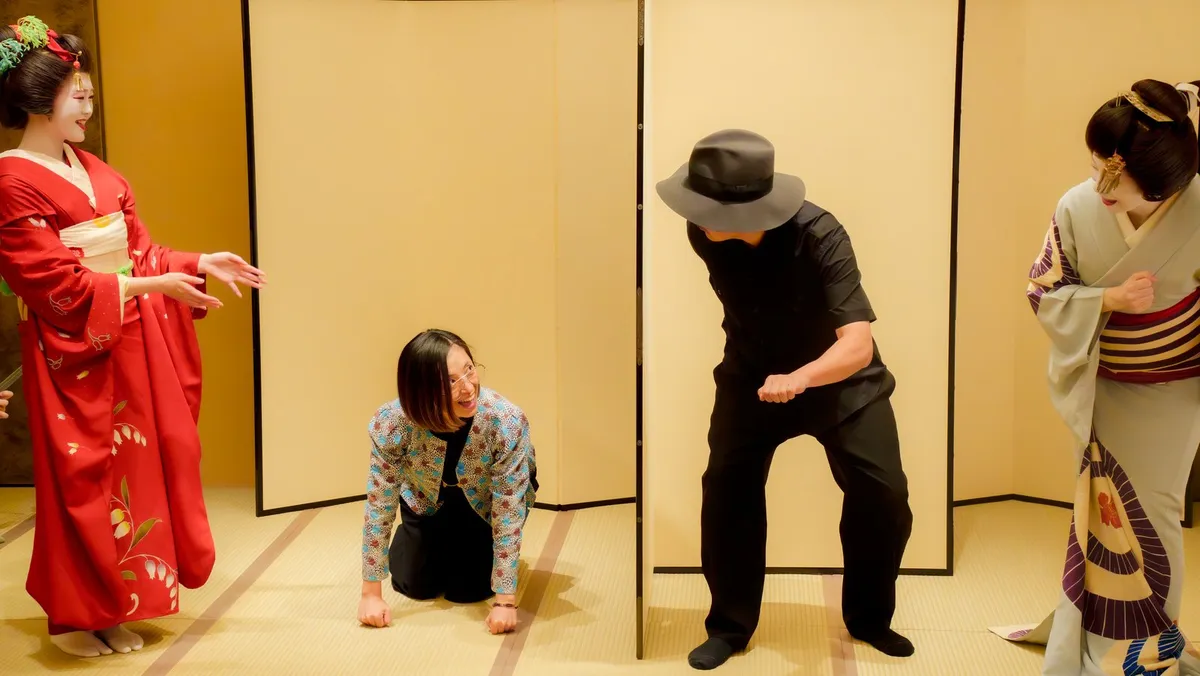
06Tora tora is a three-way game of tiger, old woman and the hero Watōnai

Two players dance on either side of a folding screen and jump out as one of three figures when the song ends.

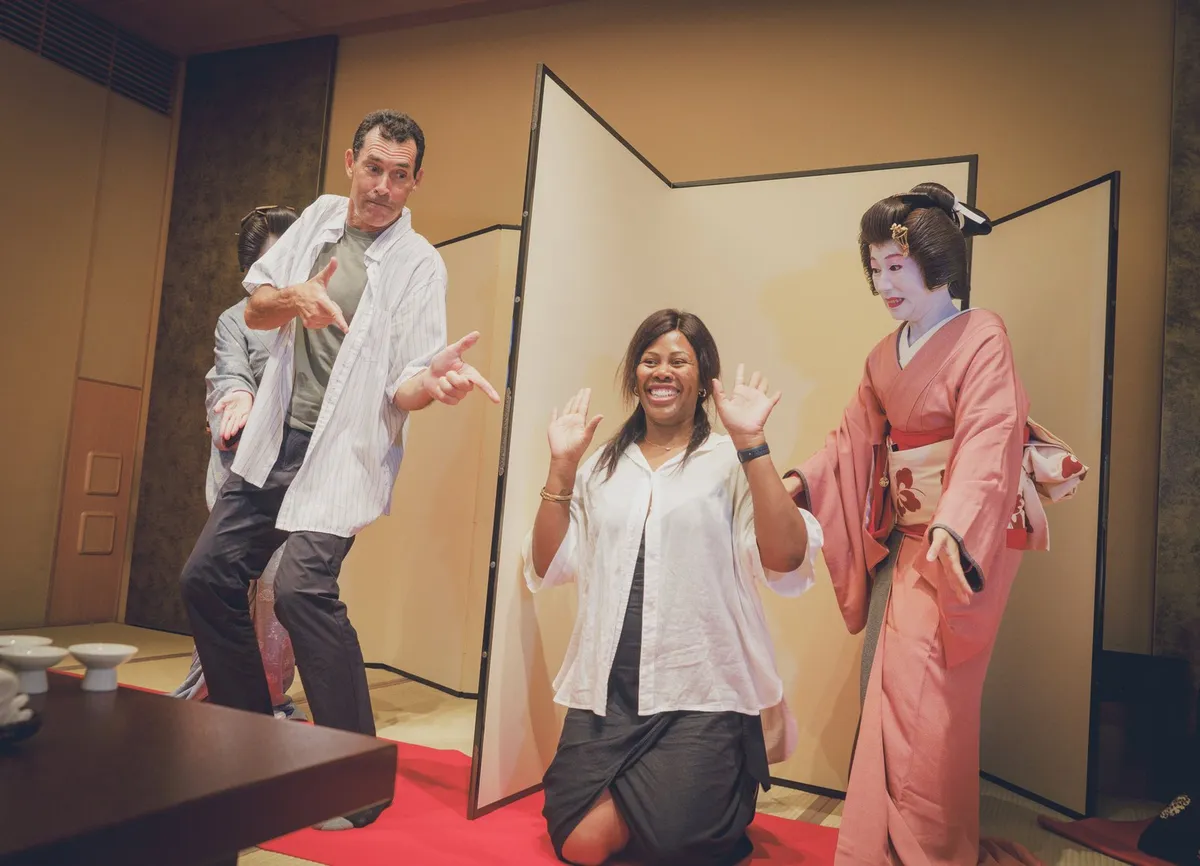
In tora tora, two players stand on either side of a byōbu (folding screen) and dance to a song. When the song ends, each jumps out from behind the screen as a tiger, an old woman or Watōnai. The tiger beats the old woman, the old woman beats Watōnai, and Watōnai beats the tiger, much like rock, paper, scissors.

According to a 2003 book, Watōnai is the hero of Kokusen'ya Kassen (The Battles of Coxinga), a puppet play by Chikamatsu Monzaemon. He is strong enough to defeat a tiger, yet helpless before his own mother.

The third-generation owner says tora tora is usually played guest against guest, with geisha dancing beside each player to show them how. The biggest laughs come at the moment of the result and when it is a tie two or three times running. Because it is played with the whole body, children in family groups often take part.

Two guests striking tora tora poses in front of a folding screen, with geisha watching on either side.
Guests playing tora tora, with geisha on either side (Miyakodori, Asakusa).
AccountYuta Kawamura, third-generation owner of MiyakodoriBookSumi Asahara, Ozashiki Asobi (お座敷遊び), Kobunsha Shinsho, 2003

07In tosenkyo, players throw an open fan to knock down a target and score by how it falls

The first throws rarely hit; a hit usually comes on the third or fourth.

In tosenkyo, a butterfly-shaped target sits on a wooden pillow, and players throw a fan at it from a set distance. The score depends on how the target and fan land, and each landing pattern is named after a chapter of The Tale of Genji. According to a book, the game was popular in Edo-period amusement halls and drinking parties, and a preservation society still keeps it going.

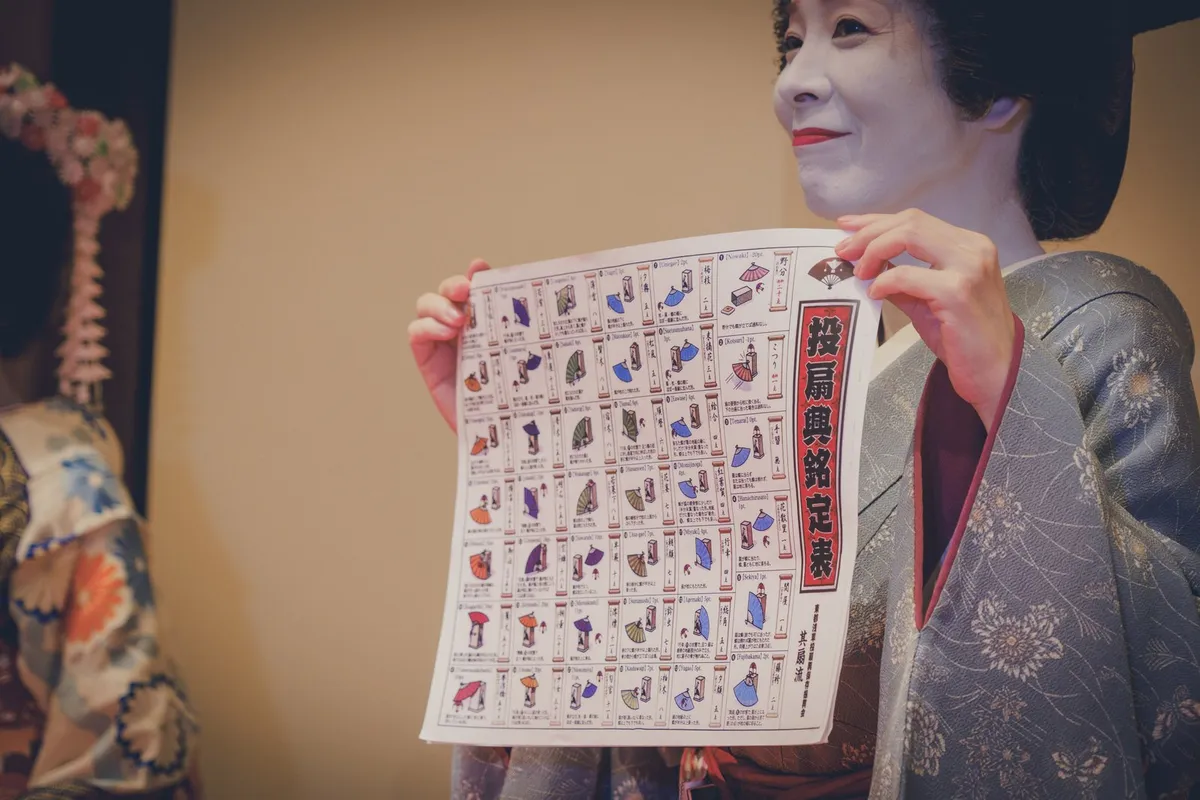
The third-generation owner says each player throws four or five times, and the hit usually comes on the third or fourth. A geisha sits beside the guest holding a fan too, shows how to hold it, and guides the guest's hand. With three or more geisha, two teach and one sits by the target with the score chart to keep score. Guests get a copy of the chart, and the geisha acting as judge calls out the pattern and the points, for example "Hanachirusato, so many points."

The top score is 50, which the third-generation owner has never seen. When someone scored 30, many people took photos, and the room was thrilled.

A geisha holding up the tosenkyo score sheet, which lists a name and points for each way the fan and target can fall.
A geisha showing the tosenkyo score sheet (Miyakodori, Asakusa, September 2024).
AccountYuta Kawamura, third-generation owner of MiyakodoriBookSumi Asahara, Ozashiki Asobi (お座敷遊び), Kobunsha Shinsho, 2003

08The loser drinks one small cup, and the geisha cheer them on

It does not have to be sake, and some guests look forward to losing.

In konpira fune fune and tora tora, the loser drinks one small cup. This is called bappai (the forfeit cup). It is traditionally sake, but tea or a soft drink is fine too.

During the bappai, the geisha lead the chant "sore sore sore sore." Once the cup is empty, they call out "Onīsan wa otsuyoi, ii otoko" (what a strong drinker, what a fine man) to a man, or "Onēsan wa otsuyoi, ii onna" (what a strong drinker, what a fine woman) to a woman. The third-generation owner says some guests tell him they want to lose, or that losing is the fun part.

There are other ozashiki games too: gunshiken, a team version of rock, paper, scissors; omawarisan, played around a drum; berobero no kamisama; and kiku no hana. The third-generation owner says every one of them is made so that the people in the room enjoy themselves together. According to a 2003 book, a hand game called tōhachiken was once popular, but it is not played at Miyakodori's ozashiki today.

AccountYuta Kawamura, third-generation owner of MiyakodoriBookSumi Asahara, Ozashiki Asobi (お座敷遊び), Kobunsha Shinsho, 2003

21Guests from abroad enjoy the games just as Japanese guests do

The third-generation owner sees no difference in how guests from Japan and from abroad react.

The third-generation owner says reactions to the games are the same everywhere in the world. The one difference he mentions is that Japanese guests are more used to holding a fan.

The games usually take about 30 minutes, or about an hour if guests are keen to play more. The time for food, conversation and performance is balanced to suit the guests. Some regular guests do not play at all and simply enjoy a relaxed conversation.

Two guests from abroad laughing as they strike tora tora poses beside a folding screen, with a geisha guiding them.
Guests from abroad playing tora tora with a geisha (Miyakodori, Asakusa, September 2024).
AccountYuta Kawamura, third-generation owner of Miyakodori

03Stories from the ozashiki

09The guest the okami calls "cool" is one who can play cleanly

It is not about spending a lot of money, the okami says.

The okami says the guest who looks good at an ozashiki is one who knows "kirei na asobi" (clean, graceful play). That guest is smart in how they enjoy themselves, not forward in a suggestive way, familiar with ozashiki manners, and yet not showing off. Spending a lot of money is not the point. Geisha are fond of guests like that. The okami recalls that there used to be many of them.

A 2003 book describes how Asakusa regulars once enjoyed themselves. Local shop owners and company presidents paid out of their own pocket money and neither stayed long nor drank too much. One would have a geisha who had slipped away from another party sing a single kouta (a short song), tell her she had improved, send her back to her party, leave a word with the okami and go home.

Accountthe okami (proprietress) of MiyakodoriBookSumi Asahara, Ozashiki Asobi (お座敷遊び), Kobunsha Shinsho, 2003

10The night hot fin sake spilled over the okami's white kimono

The okami went home to change and came back to the party, and she did not ask the guest to pay for the kimono.

The okami says drinks get spilled at an ozashiki fairly often. Sometimes it lands on a guest and misses her entirely.

Once, in the middle of winter, a guest ordered hirezake (hot sake with a toasted pufferfish fin in it). She was told, "Careful, it's hot," and then the hirezake tipped over toward her. That day, of all days, she was wearing a white kimono, and it soaked through to the nagajuban (the under-kimono). She went home, changed everything down to the nagajuban, and returned to the party. She says she did not accept a single thing for the kimono.

Accountthe okami (proprietress) of Miyakodori

11At Setsubun in February, geisha dress up in costume for "obake"

The flow of an ozashiki does not change with the seasons, but at Setsubun geisha wear costumes.

According to the third-generation owner, the basic flow of an ozashiki stays the same all year. What changes is the dances, the pictures on display and the geisha's kimono. In January, geisha wear black hikigi (a formal trailing kimono), and a hōkan (a professional entertainer who performs alongside geisha) may perform lucky pieces such as the lion dance. At Setsubun, the bean-throwing festival in February, geisha dress up in costume for what is called obake, and geisha also take part in the bean-throwing at Sensō-ji Temple.

A book describes Setsubun in Asakusa around the late 1970s and early 1980s. Geisha dressed up however they liked, and guests looked forward to it every year. Any costume was fine on one condition: it must not be vulgar. When a senior geisha went for a bold costume, the younger ones followed. Each year the kumiai (the geisha association) put on the "Otome-gumi" (maidens' troupe), in which the eldest geisha dressed as hangyoku (Tokyo's young geisha) in white makeup and long-sleeved furisode, and it drew a roar of cheers.

AccountYuta Kawamura, third-generation owner of MiyakodoriBookSumi Asahara, Ozashiki Asobi (お座敷遊び), Kobunsha Shinsho, 2003

Terms on this page

Ozashiki (お座敷)
A private party where guests call geisha to a tatami room.
Ozashiki o tsukeru (お座敷をつける)
The geisha's term for performing a dance at the party.
Kamiza (上座)
The top seat, nearest the decorative alcove.
Shimoza (下座)
The bottom seat, nearest the door, taken by the most junior person.
Takaagari (高上がり)
Sitting above an older geisha. A younger geisha asks pardon before she does.
Ohiraki (お開き)
The end of an ozashiki. There is no fixed way to close it.
Nakajime (中締め)
A pause to close a banquet partway through. Not the name for the end of an ozashiki.
Kyōsoku (脇息)
An armrest used when sitting on tatami. In konpira fune fune it is placed between the two players.
Hakama (袴)
Here, a cover placed under a beer bottle to catch drips. The piece players take in konpira fune fune.
Watōnai (和藤内)
The hero of the puppet play Kokusen'ya Kassen and one of the three figures in tora tora.
Tosenkyo (投扇興)
A game of throwing a fan to knock down a target, scored by how they land.
Bappai (罰杯)
The one small cup a loser drinks in a party game. It need not be sake.
Obake (お化け)
The Setsubun custom of geisha performing in costume.
Hirezake (ヒレ酒)
Hot sake with a toasted pufferfish fin in it.

Sources for this page

  • Account: Yuta Kawamura, third-generation owner of Miyakodori (May to September 2026)
  • Account: the okami (proprietress) of Miyakodori, filmed interview (March 2026) and a recording of her teaching manners to trainees (received October 2026)
  • Book: Sumi Asahara, Ozashiki Asobi: Asakusa Kagai, Geisha no Iki o Dō Tanoshimu ka (お座敷遊び 浅草花街 芸者の粋をどう愉しむか), Kobunsha Shinsho, 2003
  • Book: Hisafumi Iwashita, Karyūkai no Kioku: Geisha-ron (花柳界の記憶 芸者論), Bunshun Bunko, 2009

Passing the manners and the games on

The seating order and the way things are handed over are passed from older geisha to younger ones and on to trainees. Konpira fune fune, tora tora and tosenkyo are still played at ozashiki today. Asakusa geisha continue to hand these manners and games on to the next generation.

Update log 2026-10-24 published with 12 items

Archive home