日本語のページはこちら
MIYAKODORIASAKUSA · TOKYO

HōkanThe entertainer who brings the party together

What this page covers

What the word hōkan means, where the role came from, and what a hōkan does at an ozashiki today.

  1. 1The name and its originswhat the word hōkan means, how hōkan relate to the first geisha, and where books trace the role from.More
  2. 2What hōkan did in Edowhat the hōkan of Edo took charge of at a banquet, and what the books say was asked of them.More
  3. 3Hōkan at an ozashiki in Asakusa todaywho the hōkan are today, how a hōkan enters the room and what he does there, the seasonal acts, and how guests respond.More
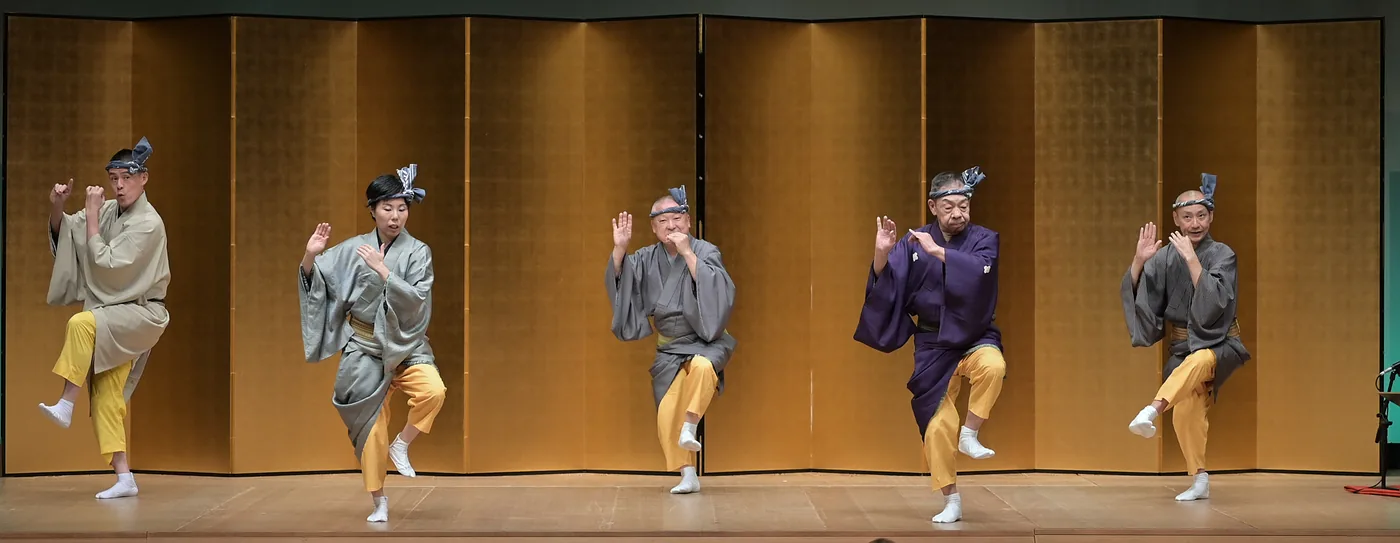
Five hōkan dancing in a row in front of a gold folding screen, each lifting one leg.
Hōkan of Asakusa (on stage).

The hōkan is a professional entertainer who works at an ozashiki (a private party with geisha) alongside the geisha. This page covers where the role came from, what hōkan did in the banquet rooms of Edo (old Tokyo), and what they do at an ozashiki in Asakusa today. It draws on accounts from the third-generation owner and the okami (proprietress) of Miyakodori, and on books about the geisha world.

12 entries · 9 terms · Updated 2026-10-24

This archive is kept by Miyakodori, a ryotei in Asakusa since 1950 that keeps the form of a machiai (a house where guests call geisha for a private party). It rests on what we have heard directly in Asakusa (accounts), checked against books on the geisha world. Memories differ from person to person and from one era to another, so not everything here is certain. If you find something that differs, please tell us with “Ask the archive”; we will check and correct it.

01The name and its origins

↑ The overview is at the top of this page

01Hōkan means a person who brings a gathering together

In Asakusa the word is read hōkan. Taikomochi is another name for the same role.

The word hōkan is written with two characters. According to a book on Asakusa's geisha world, the first, hō, means to help and to bring people together, so a hōkan is someone who keeps a drinking party running smoothly. In Asakusa people say hōkan. Taikomochi is another name for the same role, but it is not how hōkan are addressed there.

When Miyakodori arranges an ozashiki, the phrase used for booking a hōkan is the same one used for booking a geisha: hōkan wo kakeru, "to call a hōkan."

A hōkan is sometimes confused with a hakoya. The same book says they are entirely different jobs. A hōkan is an entertainer who looks after the guests at the party. A hakoya (a geisha's dresser and attendant) works behind the scenes, carrying her shamisen case and helping her dress, and does not appear at the party.

AccountYuta Kawamura, third-generation owner of MiyakodoriBookAsahara Sumi, Ozashiki Asobi (お座敷遊び), Kobunsha Shinsho, 2003

02The first people called geisha were men, and they came to be called hōkan

When women geisha became the majority, the men were called otoko geisha, "male geisha," and later hōkan.

In Yoshiwara, the licensed quarter of Edo, the word geisha first meant male entertainers. According to the books, from the middle of the Edo period geisha came to mean women, and the men had to call themselves otoko geisha, "male geisha." In time they were called hōkan or taikomochi. One book says that from the Ansei era (1854 to 1860) on, Yoshiwara had more than three hundred women geisha, while the men stayed at about forty until the end of the Edo period.

The books tell the change in slightly different ways. One says the male geisha were first specialists in instruments and song, later added imitations of kabuki actors and lighter acts, and were then called hōkan. Another gives two views: that the male geisha simply changed their name to hōkan, or that the hōkan of Yoshiwara were a different kind of entertainer, known for imitations, voice mimicry and talk.

BookAsahara Sumi, Ozashiki Asobi (お座敷遊び), Kobunsha Shinsho, 2003BookIwashita Hisafumi, Karyukai no Kioku: Geisha-ron (花柳界の記憶 芸者論), Bunshun Bunko, 2009BookTanaka Yuko, Geisha to Asobi (芸者と遊び), Kadokawa Sophia Bunko, 2016

03In Fukagawa in 1770, "let's call a geisha" could mean calling a man

A book of the time shows a guest asking for a geisha and being asked which kind he means.

Tatsumi no Sono, a sharebon (a kind of popular book of the time) from 1770, has a scene in a banquet room in Fukagawa, a district of Edo. A guest asks to liven things up by calling a geisha. The serving woman asks back whether he wants a haori, meaning a geisha in a haori (a short kimono jacket), or an otoko geisha. The author of a book on geisha reads the guest's "geisha" as a male geisha, in other words a hōkan.

A picture of Fukagawa painted around 1775 by Katsukawa Shunsho shows a hōkan entertaining the guests, with a geisha in a black haori playing the shamisen beside him.

BookTanaka Yuko, Geisha to Asobi (芸者と遊び), Kadokawa Sophia Bunko, 2016

04One view traces hōkan to cultured men who kept gatherings going

Poets, physicians and painters who settled in Yoshiwara became hōkan, according to one book.

The author of a book on Tokyo's geisha world, centered on Shinbashi, sees the roots of the hōkan in renga and haikai poets, physicians and painters. These were people who used their knowledge of poetry and the Chinese classics, and their training in linked verse and the tea ceremony, to suit the moment and keep a gathering together. Some of them settled in Yoshiwara and became hōkan.

The same author writes that the male entertainers of early Yoshiwara taught the courtesans refined manners and the basics of poetry, the tea ceremony and flower arranging.

Another book on Yoshiwara in the Edo period also says that many hōkan had a grounding in the tea ceremony or haikai.

BookIwashita Hisafumi, Karyukai no Kioku: Geisha-ron (花柳界の記憶 芸者論), Bunshun Bunko, 2009BookAndo Yuichiro (supervising editor), Edo no Iromachi: Yujo to Yoshiwara no Rekishi (江戸の色町 遊女と吉原の歴史)
02What hōkan did in Edo

05Hōkan once also managed the whole banquet

Ryotei (restaurants where guests call geisha) and geisha called them tayu-shu.

According to a 2003 book, the hōkan of the past were entertainers and also organizers who could put on a highly satisfying banquet on a limited budget. They were close to the ryotei, the okami and the geisha, and knew everything about the geisha district. That organizing role has gone, the book says. What remains is the entertainer, who lifts the party together with the geisha.

The books explain the name tayu-shu differently. The 2003 book says the ryotei and the geisha used it to flatter the hōkan, who brought them work. A 2009 book says the hōkan specialized in music and most held a professional name in a school of music, which is why they were called tayu-shu.

BookAsahara Sumi, Ozashiki Asobi (お座敷遊び), Kobunsha Shinsho, 2003BookIwashita Hisafumi, Karyukai no Kioku: Geisha-ron (花柳界の記憶 芸者論), Bunshun Bunko, 2009

06Hōkan passed old shamisen music such as Katobushi and Itchubushi on to the geisha of the Meiji era

One book says these old pieces survive because hōkan kept performing them in Yoshiwara's banquet rooms.

According to a 2009 book, the music used in kabuki theater was treated as the real thing in Edo, and schools of music that the theater dropped were at risk of dying out. The hōkan, the tayu-shu, took that music on, performed it in Yoshiwara's banquet rooms, and handed it to the geisha of the Meiji era (from 1868). That is how old styles of shamisen narrative song, such as Katobushi, Itchubushi, Miyazonobushi and Ogiebushi, were carried from Edo into Meiji.

Yuta Kawamura, third-generation owner of Miyakodori, says these old pieces are hardly ever performed at a Miyakodori ozashiki today. He has heard they were in the past.

AccountYuta Kawamura, third-generation owner of MiyakodoriBookIwashita Hisafumi, Karyukai no Kioku: Geisha-ron (花柳界の記憶 芸者論), Bunshun Bunko, 2009

07Books on Edo say the first thing asked of a hōkan was ki-bataraki, attentiveness

He read the guests' mood and the courtesans' feelings, and looked after the teahouses and boathouses too.

According to a book on Edo's Yoshiwara, hōkan told funny short stories and sang and danced to excite the room. More than that, they were expected to have ki-bataraki, the habit of sensing what others need before they ask. A hōkan read the guests' mood and the courtesans' feelings, and kept the teahouses and boathouses in mind as well.

The author of another book watched film of a 1959 stage performance in which a Yoshiwara hōkan accepts a sake cup from a guest. His movements were quick and careful at once. From that, the author writes, one can see that what matters for a hōkan is to make himself unobtrusive.

BookIwashita Hisafumi, Karyukai no Kioku: Geisha-ron (花柳界の記憶 芸者論), Bunshun Bunko, 2009BookAndo Yuichiro (supervising editor), Edo no Iromachi: Yujo to Yoshiwara no Rekishi (江戸の色町 遊女と吉原の歴史)

03Hōkan at an ozashiki in Asakusa today

08Registered hōkan work only in Asakusa, and today one of the six is a woman

Six hōkan are registered with the Asakusa kenban (the geisha registry office).

Today the only hōkan registered with a geisha district are those registered with the Asakusa kenban. The registration is with the kenban, not with any cultural heritage program. A 2003 book counted four hōkan in all of Japan who belonged to a geisha association, all of them in Asakusa. Today six are registered with the Asakusa kenban.

For a long time the hōkan was called Japan's only male geisha. Now one of the six is a woman, a new wind in a role long held by men.

AccountYuta Kawamura, third-generation owner of MiyakodoriBookAsahara Sumi, Ozashiki Asobi (お座敷遊び), Kobunsha Shinsho, 2003

09A hōkan enters with the geisha and does not start performing right away

He begins by getting to know the guests, Yuta Kawamura says.

According to Yuta Kawamura, a hōkan comes into the room at the same time as the geisha. Like them, he greets the guests and enters quietly, without breaking the mood. He always comes in after the geisha, last of all. When a trainee is there, the trainee comes in last.

He does not perform the moment he arrives. Whether to introduce himself is something he decides by reading the room. He starts by getting to know the guests.

The okami of Miyakodori says hōkan do not wear the white makeup that geisha wear.

AccountYuta Kawamura, third-generation owner of MiyakodoriAccountthe okami (proprietress) of Miyakodori

10A hōkan's real work is lifting the whole party, more than any single act

Supporting the guests, livening up the room and backing up the geisha: those three things are what a hōkan adds.

Hōkan have acts that only hōkan perform, such as an act using a folding screen. Even so, Yuta Kawamura says there is no one act that always gets the biggest laugh. A hōkan's work is to lift the ozashiki itself, more than to entertain with an act.

He names three differences between an ozashiki with a hōkan and one without: support for the guests, a livelier room, and backup for the geisha. A hōkan pays attention at every moment. When a laugh starts, he adds a line and makes it bigger. When a guest is quiet, he speaks to them. He and the geisha support each other, and they seem to bring out the best in one another.

AccountYuta Kawamura, third-generation owner of Miyakodori

11In January hōkan perform the lion dance, and a group of hōkan takes part in the Sanja Festival

The seasons bring acts and occasions that belong to the hōkan.

According to Yuta Kawamura, at January ozashiki the hōkan perform festive acts such as the shishimai (lion dance). It is the time of year when geisha wear the black hikizuri (a trailing kimono).

At the Sanja Festival in Asakusa, geisha form groups and go around the ryotei and other places performing group dances. Today there is a group of hōkan as well.

AccountYuta Kawamura, third-generation owner of Miyakodori

12Guests who have called a hōkan once almost always call one again

Guests from abroad are first surprised by a "male geisha," then want to call one.

According to Yuta Kawamura, the guests who call a hōkan are often people used to this kind of party, or people who want to know the culture. Once they have called a hōkan, they almost always call one again. Guests from abroad are first surprised: a male geisha? When they learn that registered hōkan are found only in Asakusa, and that the very first geisha were men, they want to call one.

Neither hōkan nor geisha say after an ozashiki that the room was hard to work. When a party did not go well, they take it as a sign that their own skill fell short.

AccountYuta Kawamura, third-generation owner of Miyakodori

Terms on this page

Hōkan (幇間)
A professional entertainer who looks after the guests and lifts the party at an ozashiki, alongside the geisha. Registered hōkan work only with the Asakusa kenban.
Taikomochi (太鼓持ち)
Another name for a hōkan. In Asakusa people say hōkan.
Otoko geisha (男芸者)
"Male geisha." The name for male entertainers once women geisha became the majority. They were later called hōkan.
Hōkan wo kakeru (幇間をかける)
To call a hōkan for an ozashiki. The same phrase is used for calling a geisha.
Tayu-shu (太夫衆)
What ryotei and geisha once called hōkan. Books explain the origin of the name differently.
Ki-bataraki (気働き)
Sensing what others feel and need, and acting before being asked. Books on Edo say it was the first thing asked of a hōkan.
Hakoya (箱屋)
A geisha's dresser and attendant, who works behind the scenes and does not appear at the party. A different job from the hōkan.
Katobushi, Itchubushi (河東節・一中節)
Old styles of Edo shamisen narrative song. A book says hōkan kept them alive in Yoshiwara's banquet rooms.
Kenban (見番)
The registry office of a geisha district. Hōkan in Asakusa are registered there, as geisha are.

Sources for this page

  • Account: Yuta Kawamura, third-generation owner of Miyakodori (August to October 2026)
  • Account: the okami (proprietress) of Miyakodori, filmed interview (December 2025)
  • Book: Asahara Sumi, Ozashiki Asobi: Asakusa Kagai, Geisha no Iki wo Do Tanoshimu ka (お座敷遊び 浅草花街 芸者の粋をどう愉しむか), Kobunsha Shinsho, 2003
  • Book: Iwashita Hisafumi, Karyukai no Kioku: Geisha-ron (花柳界の記憶 芸者論), Bunshun Bunko, 2009
  • Book: Tanaka Yuko, Geisha to Asobi: Nihonteki Salon Bunka no Seisui (芸者と遊び 日本的サロン文化の盛衰), Kadokawa Sophia Bunko, 2016
  • Book: Ando Yuichiro (supervising editor), Edo no Iromachi: Yujo to Yoshiwara no Rekishi (江戸の色町 遊女と吉原の歴史)

From the banquet rooms of Edo to the ozashiki of Asakusa today

The hōkan began as the male entertainers who were the first to be called geisha in Edo's Yoshiwara. They kept gatherings together and handed old music on to the next generation. A 2003 book counted four hōkan in Asakusa. Today six are registered with the Asakusa kenban, and one of them is a woman. At an ozashiki in Asakusa today, the hōkan still lifts the party together with the geisha.

Update log 2026-10-24 published with 12 items

Archive home