日本語のページはこちら
MIYAKODORIASAKUSA · TOKYO

The okami of Miyakodori: Asakusa seen by a former geishaAsakusa seen by a former geisha

What this page covers

The okami of Miyakodori grew up in Asakusa, debuted as a hangyoku and worked as a geisha before running the house.

  1. 1Growing up in Asakusawhat family the okami was born into, and how she became a geisha.More
  2. 2Life as a hangyoku and a geishahow the okami spent her years as a hangyoku and a geisha, and what Asakusa was like then.More
  3. 3Life as okamiwhy the okami left geisha life to run Miyakodori, and what she values today.More
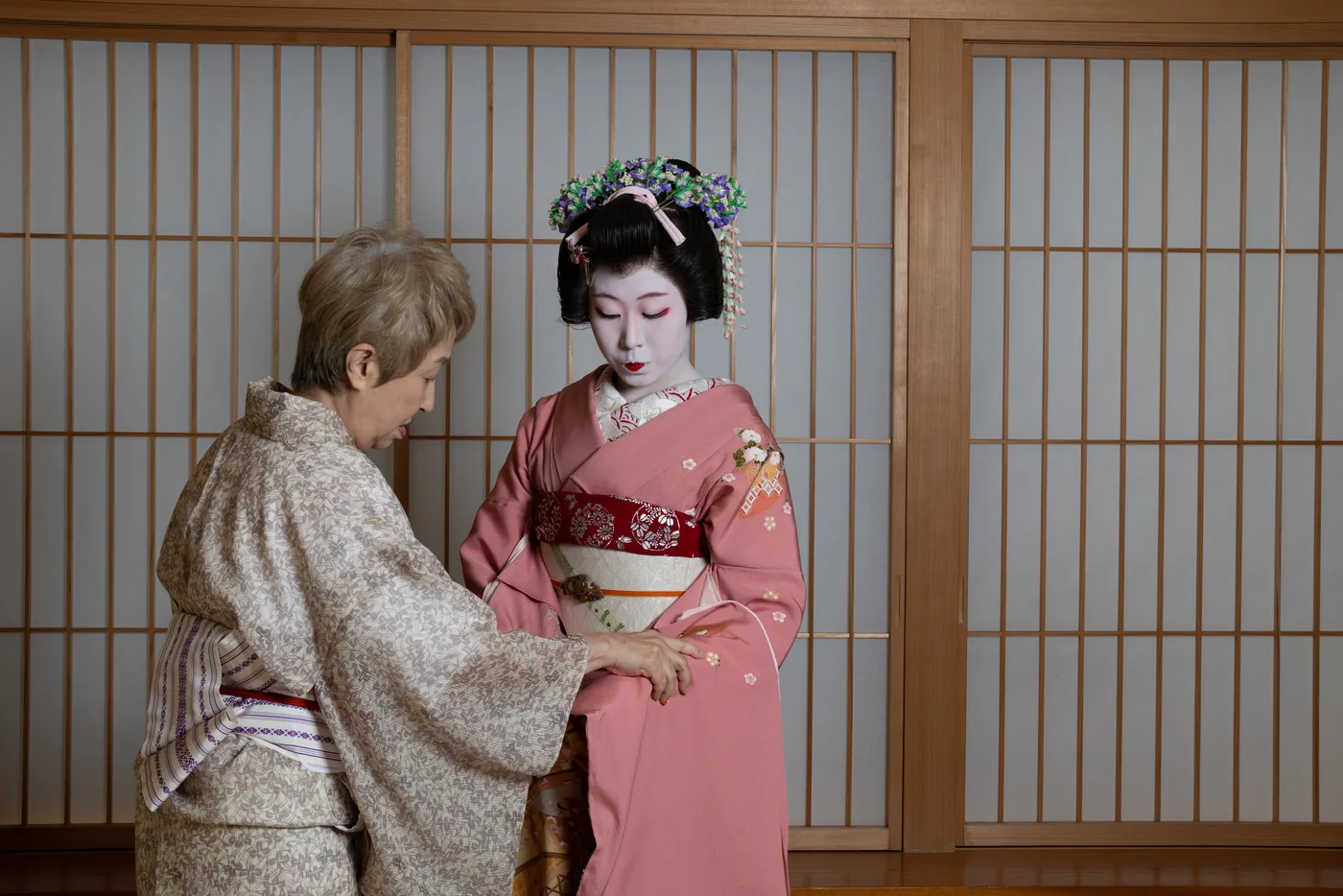
In front of shoji screens, the okami of Miyakodori straightens the sleeve of a geisha's kimono.
The okami straightens a geisha's sleeve (Miyakodori, Asakusa, September 2026).

The okami (proprietress) of Miyakodori was born and raised in Asakusa. In 1969, at 15, she became a hangyoku, Tokyo's apprentice geisha, and she spent 27 years as a geisha. Today she runs Miyakodori and calls geisha for each ozashiki (a private party with geisha). This page records her childhood lessons, a hangyoku's day, the busiest years of the geisha world and her life as okami, from her own words and the accounts of Yuta Kawamura, Miyakodori's third-generation owner, and of Kei, a former hakoya.

11 entries · 15 terms · Updated 2026-10-24

This archive is kept by Miyakodori, a ryotei in Asakusa since 1950 that keeps the form of a machiai (a house where guests call geisha for a private party). It rests on what we have heard directly in Asakusa (accounts), checked against books on the geisha world. Memories differ from person to person and from one era to another, so not everything here is certain. If you find something that differs, please tell us with “Ask the archive”; we will check and correct it.

01Growing up in Asakusa

↑ The overview is at the top of this page

01The okami was born and raised in Asakusa, and her mother was a geisha

From childhood, a world with geisha in it was simply normal to her.

The okami of Miyakodori was born in Asakusa and grew up there. Her mother was a geisha. She never lived outside Asakusa, and she says the geisha world was the ordinary world of her childhood.

According to Yuta, her grandfather was an actor of shinpa, a form of Japanese theater that began in the 1880s as a new kind of drama set against kabuki. Her grandmother was not a geisha, but she loved the traditional arts.

Kei worked at the Asakusa kenban (the geisha registry office) as a hakoya, a geisha's dresser and attendant. He has known the okami since she was in elementary school. "There was this sweet little schoolgirl," he recalls, "and she went and became a geisha."

Accountthe okami (proprietress) of MiyakodoriAccountYuta Kawamura, third-generation owner of MiyakodoriAccountKei, former hakoya (geisha's dresser and attendant) and former office head of the Tokyo Asakusa Kumiai
02She began lessons in dance and song as a small child, following an old custom

An old saying held that lessons begun on the sixth day of the sixth month would never bore a child and would make her skilled.

Following that saying, her grandmother took her by the hand to lessons in Japanese dance and in kiyomoto, a style of narrative singing to the shamisen (a three-stringed instrument). Lessons in the tsuzumi hand drum and the taiko drum began when she was in elementary school.

Once she was a hangyoku, three lessons were essential: Japanese dance, narimono (percussion such as hand drums and drums) and the tea ceremony. She also studied shamisen for nagauta, kiyomoto and kouta. With five or six arts to study, she had lessons almost every day.

Accountthe okami (proprietress) of Miyakodori

03Right after junior high school she began training, and at 15 she debuted as a hangyoku

The okami says the hardest time of her whole career was the training before her debut.

The okami entered the geisha world as soon as she finished junior high school. After three or four months as a minarai (a trainee who is not yet a geisha), she debuted in 1969 as a hangyoku. In her own words, a hangyoku is what Kyoto calls a maiko. A hangyoku is already a geisha. The length of training differs from person to person; today half a year to a year is common.

She says nothing in her long life as a geisha was as hard as those training months. She had just left school and knew nothing of the world. Even for a girl born in Asakusa, it was her first time at parties where drinks were served, and she was on edge the whole time.

Accountthe okami (proprietress) of Miyakodori

02Life as a hangyoku and a geisha

04A hangyoku's day ran from morning lessons to parties in the evening

Lessons started around 10 a.m., and by early evening she was out working with her hair done in the traditional style.

As a hangyoku, the okami ate breakfast, got ready, put on her kimono and went out. Lessons began around 10 a.m., and she went to about three a day: dance, ohayashi (the drum and flute ensemble), nagauta and others.

Back home, she ate an early supper and had her hair dressed in the traditional Japanese style. By 5 or 6 p.m. she was already out at work.

Yuta says that, though there were hard times, the okami remembers her hangyoku years as great fun. After the parties, the hangyoku went to the public bath together and then out to eat.

Accountthe okami (proprietress) of MiyakodoriAccountYuta Kawamura, third-generation owner of Miyakodori

05She became an ippon geisha and worked as a geisha for 27 years from age 15

She danced on the stages of the Kabukiza, the National Theatre and the Meijiza, mostly in Japanese dance.

After her years as a hangyoku, the okami held her ippon hirome, the celebration at which a hangyoku becomes an ippon, a full-fledged geisha. Both hangyoku and ippon are geisha. Counting from her debut at 15, she worked as a geisha for 27 years.

According to Yuta, during her geisha years she appeared several times, mostly in Japanese dance at dance recitals, on the stages of the Kabukiza (both before and after it was rebuilt), the large and small halls of the National Theatre, and the Meijiza. Dance in Asakusa is mainly of the Hanayagi school, and the okami holds a shihandai license from the Hanayagi school.

Accountthe okami (proprietress) of MiyakodoriAccountYuta Kawamura, third-generation owner of Miyakodori

06When she debuted, the geisha world was at its busiest since the war

Some nights she could stay only 10 or 30 minutes at each party.

The okami calls the Asakusa of around 1969 "the postwar golden age of the geisha world." "People always say the bubble years were something," she says, "but they were nothing like that."

According to Yuta, she could stay only 30 or even 10 minutes at a party, showing her face and moving on to the next. "I was lucky enough to know the very best era as a geisha," the okami says.

Accountthe okami (proprietress) of MiyakodoriAccountYuta Kawamura, third-generation owner of Miyakodori

07"My guests raised me"

When she was young, guests spent time with the hangyoku and taught them many things.

The okami remembers guests who looked after the young ones. When a party ended at 9 or 10 p.m., one guest would call three or four hangyoku on their own and say, "Go on, eat something," and let them order whatever they liked. He came about once a week, and those were relaxed, noisy parties, a break for the girls. She also learned mahjong and hanafuda (a Japanese card game) from guests at parties.

In those days many guests were senior people from large and well-known companies. She says it was a great privilege to meet people she would never otherwise have met. Over the past 10 or 20 years, she says, more parties have been business entertaining, where everyone is a little tense.

Yuta says the words of hers that stay with him most are "My guests raised me." She means that she could give herself to her art because her guests supported her and valued what she did.

Accountthe okami (proprietress) of MiyakodoriAccountYuta Kawamura, third-generation owner of Miyakodori

08She kept up hard lessons because she wanted to catch up with the senior geisha she admired

Kei says she stood apart even in her geisha days.

The okami says that no lesson is easy, dance least of all. But she was performing in front of guests, so she wanted to become truly good, if not a professional artist, then as if she were one. There were fine senior geisha in Asakusa and in other districts, and her wish to catch up with them is what carried her through.

Kei says that to a hakoya, every geisha is someone above him, and that even among them the okami stood apart from a young age. It was so in her geisha days, he says, not only after she became okami.

Accountthe okami (proprietress) of MiyakodoriAccountKei, former hakoya (geisha's dresser and attendant) and former office head of the Tokyo Asakusa Kumiai
03Life as okami

09In Asakusa a geisha cannot also be an okami, so she stopped working as a geisha

She went from being called to parties to calling geisha herself, and at first it was hard to get used to.

The okami explains that in Asakusa you cannot be a geisha and an okami at the same time, so she left geisha work to become okami of Miyakodori. The okami runs the house: she arranges each ozashiki and calls the geisha for it. She is the second generation of Miyakodori; the name Miyakodori was given by her predecessor.

As a geisha she had been the one called. As okami she became the one who calls. Many of the geisha were still older than her, and she says it took a lot of tact and restraint. All she could think was that she had to get used to it.

Today she is the only okami in Asakusa who has worked as a geisha.

Accountthe okami (proprietress) of MiyakodoriAccountYuta Kawamura, third-generation owner of Miyakodori

10The okami values two things: that guests leave happy, and the art itself

"Take the art away from a geisha and she is nothing special," she says.

According to Yuta, the okami holds to two things. One is that every guest goes home having enjoyed themselves. The other is that for a geisha, the art is everything. "The art is what makes a geisha," she says. "Because of the art, a geisha can stay a geisha."

Asked whether she lives up to this herself, she says she still has far to go. "English, and this work too, I think it is a lifetime of practice, a lifetime of learning."

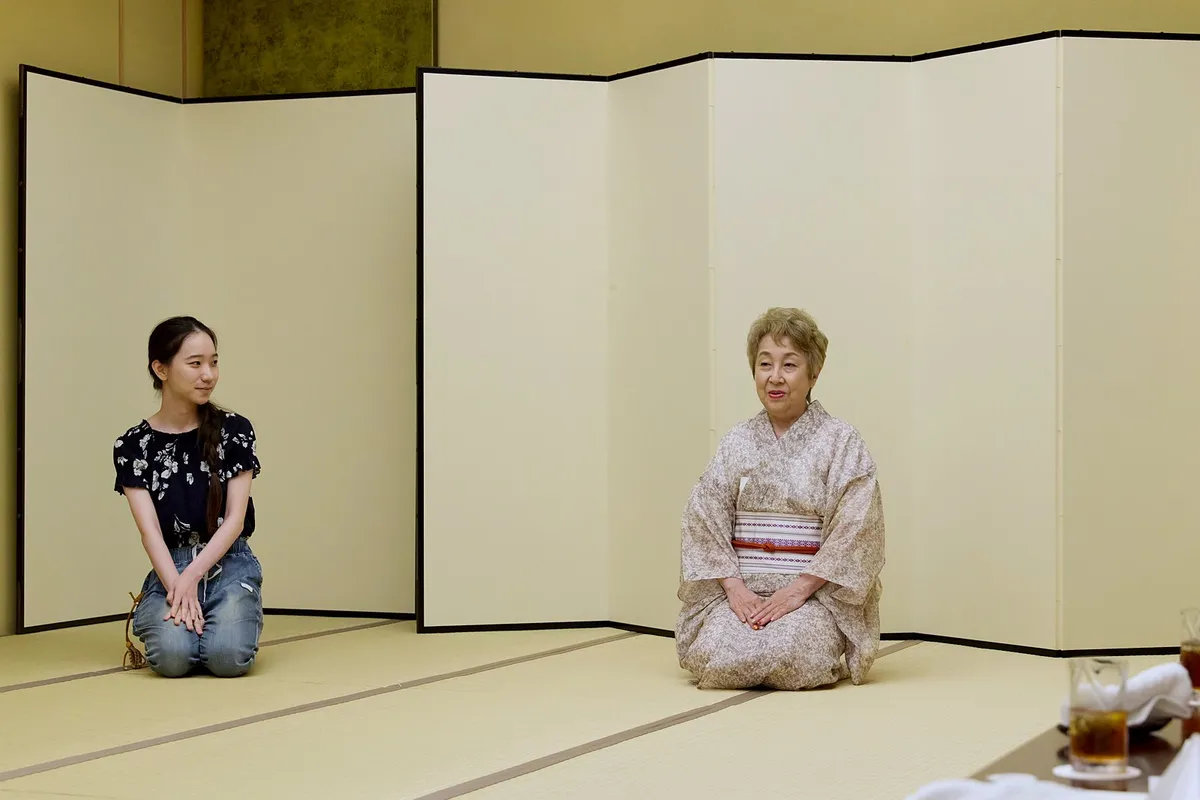
The okami seated on the tatami in front of a folding screen, talking, with a guest seated a little apart.
The okami speaking at an ozashiki (Miyakodori, Asakusa, September 2026).
AccountYuta Kawamura, third-generation owner of MiyakodoriAccountthe okami (proprietress) of Miyakodori

11Miyakodori stopped turning away first-time guests, which the okami calls "shaving down the threshold"

Anyone can now enjoy an ozashiki with geisha at Miyakodori, without an introduction.

Many old houses follow ichigen-san okotowari: they turn away first-time guests who come without an introduction from a regular. According to Yuta, Miyakodori ended this so that anyone can come. The okami describes it as "shaving down the threshold." She is glad the house has opened its doors, and she also feels the weight of it: "Because we opened, we have to walk steadily and make a path."

Yuta says the okami often talks about the geisha world of the past, and that sometimes she looked lonely when she did. The geisha world is still shrinking, most visibly in Tokyo. Yuta joined Miyakodori because he believed there were things that could be done now, while the okami is still here. The ozashiki the okami knew as a geisha in Asakusa carries on at Miyakodori today.

AccountYuta Kawamura, third-generation owner of Miyakodori

Terms on this page

Okami (女将)
The proprietress of a ryotei or teahouse. She runs the house and calls the geisha for each ozashiki.
Minarai (見習い)
The trainee period before a woman debuts as a geisha. For the okami it lasted three or four months.
Hangyoku (半玉)
Tokyo's young geisha in training, close to what Kyoto calls a maiko. A hangyoku is already a geisha.
Ippon (一本)
A full-fledged geisha.
Ippon hirome (一本披露目)
The celebration at which a hangyoku becomes an ippon.
Hakoya (箱屋)
A geisha's dresser and attendant.
Kenban (見番)
The geisha registry office of a geisha district.
Narimono (鳴り物)
Percussion instruments such as the tsuzumi hand drum and the taiko drum.
Nagauta (長唄)
A style of shamisen music from the Edo period.
Kiyomoto (清元)
A school of narrative singing to the shamisen, born in the late Edo period.
Kouta (小唄)
Short songs sung to the shamisen at ozashiki.
Hanayagi school (花柳流)
A school of Japanese dance; the main school of dance in the Asakusa geisha district.
Shihandai (師範代)
A license from a dance school recognizing someone as qualified to teach.
Shinpa (新派)
A Japanese theater born in the Meiji era, named as a new kind of drama in contrast to kabuki.
Ichigen-san okotowari (一見さんお断り)
Turning away first-time guests who have no introduction. Miyakodori stopped doing this.

Sources for this page

  • Account: the okami of Miyakodori, filmed interviews (November and December 2025, May 2026)
  • Account: Kei, former hakoya and former office head of the Tokyo Asakusa Kumiai, filmed interview (received May 2026)
  • Account: Yuta Kawamura, third-generation owner of Miyakodori (April to August 2026)

The ozashiki the okami has known, carried on today

The okami of Miyakodori was born in Asakusa, debuted as a hangyoku at 15 and spent 27 years as a geisha. She knew the geisha world at its busiest, and today she is the one who calls the geisha. Asakusa has fewer geisha than it once did, but the art and the ozashiki the okami has cared for all her life carry on at Miyakodori.

Update log 2026-10-24 published with 11 items

Archive home