日本語のページはこちら
MIYAKODORIASAKUSA · TOKYO

How geisha dress: hair, kimono and makeupHair, kimono and obi, white makeup

What this page covers

The three topknot shapes, hair ornaments, kimono and obi, and the white makeup of Asakusa geisha.

  1. 1Hair and hair ornamentswhat hairstyles geisha wear, whether the hair is their own, and what they put in it.More
  2. 2Kimono and obiwhat a geisha's formal dress is, how she wears the trailing hem, how she ties her obi, and how a hangyoku dresses.More
  3. 3White makeupwhat colors a geisha's makeup uses, how it is put on, and why the face is painted white.More
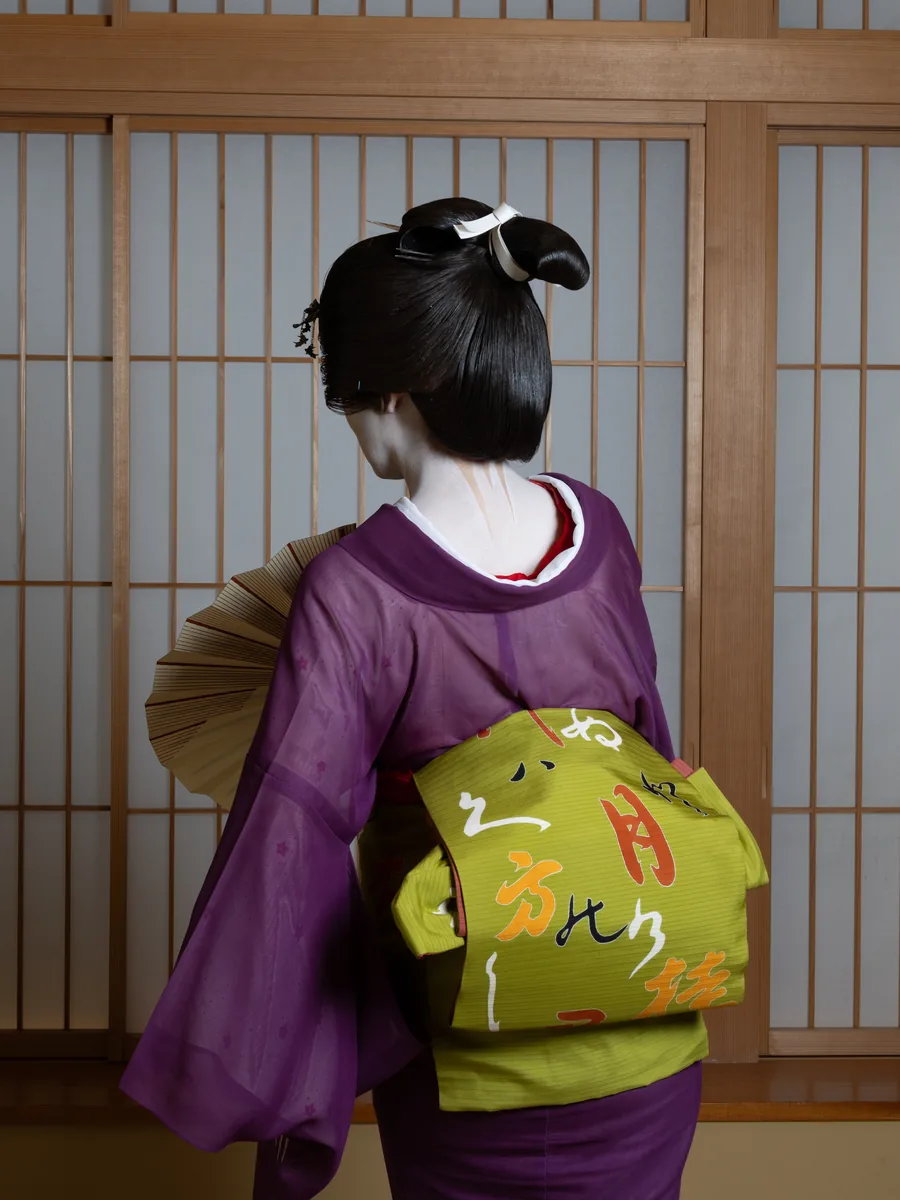
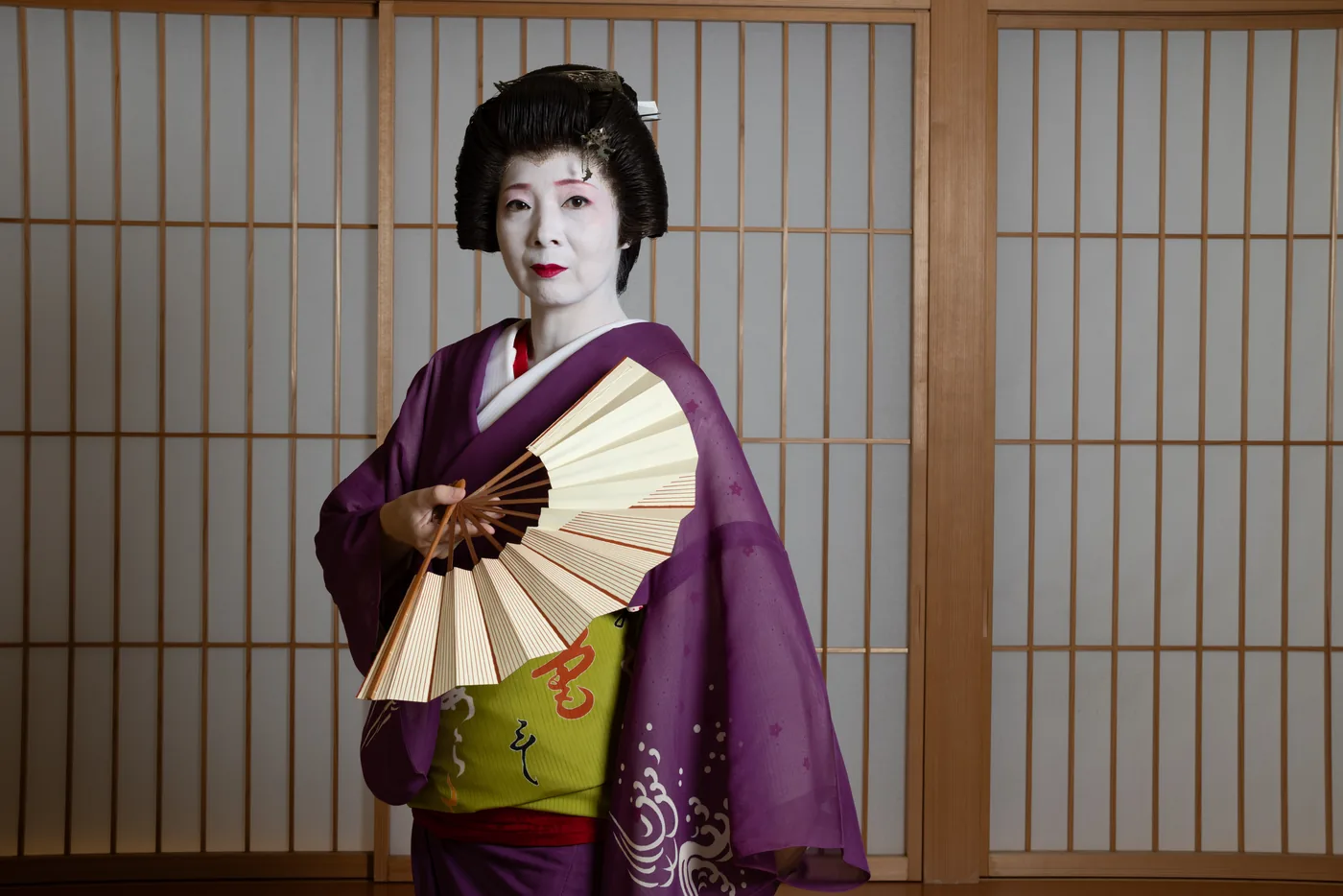
A geisha who dances (a tachikata) standing in front of shoji screens, in white makeup, traditional Japanese hair and a purple kimono.
A tachikata, a geisha who dances (Miyakodori, Asakusa, September 2026).

Each part of a geisha's appearance has a name and a rule: the shape of the hair, the ornaments in it, the black formal kimono, the knot of the obi (the wide kimono sash) and the white makeup. This page records them as they are in Asakusa today, from the accounts of the okami (proprietress) and the owner of Miyakodori, and from books on the Tokyo geisha world.

11 entries · 16 terms · Updated 2026-10-24

This archive is kept by Miyakodori, a ryotei in Asakusa since 1950 that keeps the form of a machiai (a house where guests call geisha for a private party). It rests on what we have heard directly in Asakusa (accounts), checked against books on the geisha world. Memories differ from person to person and from one era to another, so not everything here is certain. If you find something that differs, please tell us with “Ask the archive”; we will check and correct it.

01Hair and hair ornaments

↑ The overview is at the top of this page

01A geisha's topknot takes one of three shapes: momoware, takashimada or tsubushi

A hangyoku wears momoware, and she changes to takashimada when she becomes an ippon.

Geisha wear nihongami (traditional Japanese hairstyles built around a mage, a gathered topknot at the back). The okami of Miyakodori says there are three shapes of topknot. A hangyoku (Tokyo's word for an apprentice geisha, who is already a geisha) wears momoware. When she becomes an ippon (a fully fledged geisha), she changes to takashimada. Later still, some change to a shape called tsubushi. From the front, the front hair looks the same. The difference is the shape of the topknot at the back.

The okami says a takashimada becomes heavy to wear, so some geisha switch to the lighter tsubushi as they grow older. Hair and kimono also have to suit each other: with a finely patterned Edo komon kimono, she says, a shimada does not look right.

Yuta Kawamura, the owner of Miyakodori, says that at ozashiki (private parties with geisha) today the takashimada is the norm, and some geisha wear tsubushi. Despite the name (taka means "high"), a takashimada today is usually of middle height. No one now wears a shimada between takashimada and tsubushi in height. The bunkin takashimada worn by brides is a different hairstyle.

Accountthe okami (proprietress) of MiyakodoriAccountYuta Kawamura, third-generation owner of Miyakodori

02In Asakusa, geisha wear their nihongami as a wig, and whether they wear it at all depends on the guests

For guests on their first visit, the dancing geisha almost always wear nihongami and white makeup.

According to Yuta Kawamura, in Asakusa today both hangyoku and ippon basically wear their nihongami as a wig. Whether a geisha wears a wig and whether she appears in nihongami or in yohatsu (the geisha world's word for a hairstyle that is not nihongami, gathered up to suit a kimono) are separate questions.

There is no fixed rule for the tachikata (the geisha who dances). At an ozashiki for guests coming for the first time, she almost always wears nihongami and white makeup. She would rarely appear in yohatsu for them. For regular guests, she often wears yohatsu without white makeup, because many regulars like her that way.

The okami says that if a guest asks for nihongami, the geisha will come properly dressed for it. The jikata (the geisha who plays the shamisen and sings) appears in yohatsu, without white makeup.

AccountYuta Kawamura, third-generation owner of MiyakodoriAccountthe okami (proprietress) of MiyakodoriAccountan Asakusa geisha who plays shamisen and sings (a jikata)

03With the black hikigi, the hair carries a tortoiseshell comb, kōgai and kanzashi, tied with a red and white cord

In the geisha world the cord, a motoyui, is pronounced "mottoi".

Yuta Kawamura says that when a geisha wears the black hikigi (the black formal kimono with a trailing hem, below), her takashimada carries three ornaments of bekkō (tortoiseshell): a kushi (comb), a kōgai (a bar that runs through the topknot from side to side) and a kanzashi (an ornamental hairpin). The comb sits on top, toward the front of the topknot. The kōgai passes through the topknot and shows on both sides. The kanzashi goes in on the side of the front hair.

A red and white motoyui (a cord that ties the base of the topknot) is tied at the base of the topknot. The knot is small and tight, and the ends that reach out to the left and right are long. Most people pronounce the word "motoyui"; in the geisha world it is "mottoi".

At New Year, every geisha, hangyoku and ippon alike, wears a kanzashi of rice ears, and she basically keeps wearing it for as long as she wears the black kimono. A hangyoku's hair carries bright flower ornaments, while an ippon keeps her kanzashi and comb plain. Tama-kanzashi (hairpins topped with a bead) of coral or jade are still worn today.

AccountYuta Kawamura, third-generation owner of Miyakodori

02Kimono and obi

04A geisha's most formal dress is a black kimono with five crests

In January geisha wear the black hikigi, and from around the middle of the month they change to the "irogawari".

The okami of Miyakodori says that the black crested kimono a geisha wears once she becomes an ippon is the most formal thing a geisha wears. It carries five crests: on the left and right of the chest, on both sleeves and on the back. The okami explains that five crests mark a kimono as formal for anyone, not only in the geisha world. Each geisha puts the crest of her okiya (the house she belongs to as a geisha) on it.

In January, geisha wear the black hikigi. Black is worn until around the middle of January, and then, still within January, they change to the irogawari (literally "change of color"). The irogawari is a hikigi that is not black, with three crests, on both sleeves and on the back.

A book on the Tokyo geisha world says this outfit, a black kimono with five crests, a white collar and a woven obi tied in the yanagi style, was settled as the formal dress of Tokyo geisha in Shinbashi during the Meiji period (1868–1912). When the Meiji government made black the color of formal dress, the geisha world followed. After the Second World War, the book says, this dress spread to geisha districts all over Tokyo.

The time of the change from the black hikigi to the irogawari is approximate.

Accountthe okami (proprietress) of MiyakodoriAccountYuta Kawamura, third-generation owner of MiyakodoriBookIwashita Hisafumi, Karyūkai no kioku: Geisha-ron (花柳界の記憶 芸者論), Bunshun Bunko, 2009

05The hikigi is a kimono whose hem trails along the floor as the geisha walks

A beautiful hem narrows toward the floor. A hem that spreads out is called "andon" (a paper lantern) and is disliked.

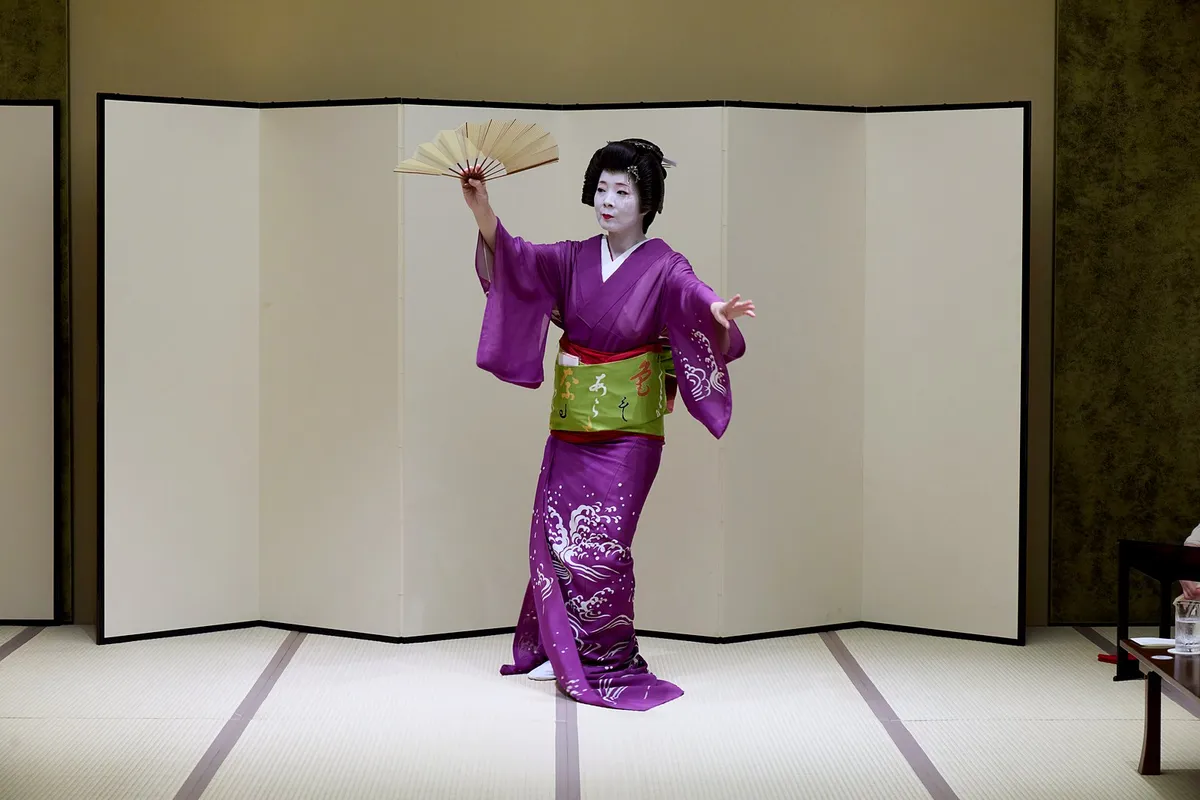
A hikigi has a long hem that trails over the tatami mats when the geisha walks. Yuta Kawamura says the black hikigi is an ohikizuri (literally "trailing") kimono, far longer than the usual length. The hem should narrow toward the floor. When a hem spreads out, people in the geisha world say it has "become an andon" (a paper lantern), and they consider it wrong.

A hikigi is heavy and hard to walk in, so it is worn by geisha with experience. Basically every geisha has one made. Those who were hangyoku for a long time sometimes have one made when they become ippon. A geisha who started straight away as an ippon finds it hard to have one made. Some geisha own a hikigi and some do not. A 2003 book on Asakusa geisha also says a hikigi was something a geisha had made after gaining experience, and that a newcomer who trailed her hem straight away would look presumptuous.

Books record a time when the trailing hem left the everyday ozashiki. After the Marco Polo Bridge Incident of 1937, Tokyo geisha put their shimada up into yohatsu and stopped trailing their hems, as restraint in keeping with the times. After the war, one book says, the trailing hem became dress only for New Year and for dances. In a 2009 book, the novelist Hiraiwa Yumie wrote that unless the occasion is special, wearing yohatsu and a hem that does not trail had become normal. Yuta Kawamura says that in Asakusa today many geisha trail their hems at everyday ozashiki too, especially the tachikata.

Each book describes the Tokyo geisha world at the time it was written.

A tachikata dancing with a raised fan, the hem of her purple kimono trailing on the tatami.
A tachikata trailing her hem at an everyday ozashiki (Miyakodori, Asakusa, September 2026). This is a purple kimono, not the black hikigi.
AccountYuta Kawamura, third-generation owner of MiyakodoriBookAsahara Sumi, Ozashiki asobi (お座敷遊び), Kobunsha Shinsho, 2003BookIwashita Hisafumi, Karyūkai no kioku: Geisha-ron (花柳界の記憶 芸者論), Bunshun Bunko, 2009

06Tokyo geisha tie the obi of the black hikigi in the yanagi knot

With the black hikigi, the obijime cord is basically not worn.

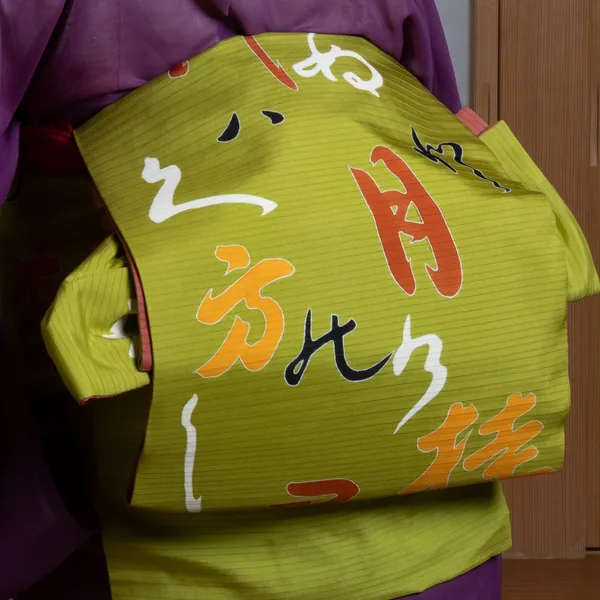
Yuta Kawamura says the obi worn with the black hikigi is tied in the yanagi-musubi ("willow knot"). The knot looks like a cross, and that, he says, is what makes it stylish. With this black hikigi, the obijime (the thin cord tied over the obi) is basically not worn.

A 2003 book also describes a geisha's formal dress as a black crested hikigi with the obi in the yanagi knot, and says that in the Kansai region (around Kyoto and Osaka) the obi is tied in the otaiko style instead.

With an everyday ozashiki kimono, the obijime is still a braided cord (kumihimo). When going to an ozashiki, the rule is to take off rings and watches.

Close-up of a geisha from behind, a green obi with large written characters tied in an otaiko knot on the back of a purple kimono.
An obi tied in the otaiko knot at the back of an everyday purple kimono (Miyakodori, Asakusa, September 2026). With the black hikigi, the obi is tied in the yanagi knot instead.
AccountYuta Kawamura, third-generation owner of MiyakodoriBookAsahara Sumi, Ozashiki asobi (お座敷遊び), Kobunsha Shinsho, 2003

07A hangyoku wears a long-sleeved furisode with the shoulders tucked, does not trail her hem, and wears pokkuri clogs

Pokkuri have a bell inside and jingle as she walks.

The okami of Miyakodori says a hangyoku wears a furisode (a kimono with long hanging sleeves) with kataage, a tuck sewn at the shoulders. It is the same tuck put on children's kimono for Shichi-Go-San (the festival for children aged three, five and seven). A Tokyo hangyoku wears her kimono in the hashori style, with the length taken up at the waist so the hem does not trail, and she ties her obi differently from an ippon.

Outdoors, a hangyoku wears pokkuri (tall wooden clogs). The okami says the sole has a hollow with a bell inside, so the clogs jingle as she walks. Yuta Kawamura says the pokkuri are a whitish color; geisha do not wear black ones.

A hangyoku's collar may be red, or sometimes white. Outdoors, an ippon basically wears zōri sandals, and sometimes geta clogs. Inside the ozashiki room, hangyoku and ippon alike wear pure white tabi socks.

Accountthe okami (proprietress) of MiyakodoriAccountYuta Kawamura, third-generation owner of Miyakodori

03White makeup

08Makeup with nihongami uses only three colors: white, red and black

The okami says the most important thing is "not to look modern".

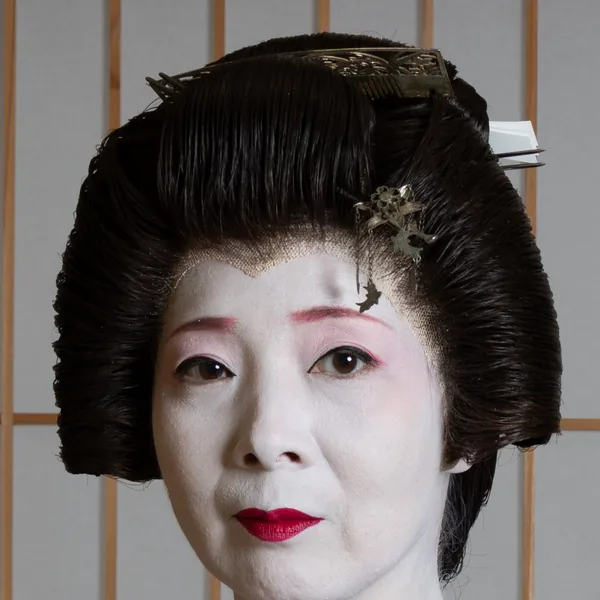
The okami of Miyakodori says the makeup worn with nihongami uses three colors: white, red and black. Today's makeup adds color upon color, but the old makeup, she says, worked by subtraction, showing each woman's character in how much she thinned the red. "You may take away, but you hardly ever add," the okami says.

The red is red only, never pink or beige. There is no eye shadow and no false eyelashes. Seen from the side, eyelashes curling up under nihongami look wrong; they may suit yohatsu, but not nihongami.

The eyebrows are drawn lightly in black or brown, with red laid over and blurred with a brush. They are drawn low and crescent-shaped, never sharply. A touch of red at the corners of the eyes gives allure, the okami says. A hangyoku puts on her red the same way as an ippon.

Close-up of a geisha's face in white makeup, red at the eyes and lips, with a comb and a hairpin in her nihongami.
White, red and black: a tachikata's makeup (Miyakodori, Asakusa, September 2026).
Accountthe okami (proprietress) of MiyakodoriAccountYuta Kawamura, third-generation owner of Miyakodori

09White makeup goes on over a base of binzuke oil, and powder is patted on to finish

A quick geisha can finish her face in about 10 to 15 minutes.

The okami of Miyakodori describes the steps. First, binzuke oil (the hair oil used for nihongami, the same oil sumo wrestlers use in their hair) is spread well with the hands and put on the face and neck. Over it goes eri-oshiroi (white powder for the face and neck), mixed with water or toner, and it is patted on. Some geisha use a pure white pancake made for the stage instead, with a white foundation under it. Which one a geisha uses depends on what suits her skin.

The white was once spread with a thick, soft brush. Today a sponge is used.

When she was a working geisha, the okami finished her face in about 10 to 15 minutes and was told she was quick. She thinks geisha today take under 30 minutes, though a slip of the brush can stretch it to one or two hours. Yuta Kawamura says getting ready, including dressing, takes 30 minutes to an hour in all, and around an hour and a half for a trainee. Hōkan (male entertainers who work at ozashiki alongside geisha) do not wear white makeup.

Accountthe okami (proprietress) of MiyakodoriAccountYuta Kawamura, third-generation owner of Miyakodori

10The nape is left unpainted on purpose, in a drawn shape called mitsueri

A geisha cannot draw it on herself, so the hakoya draws it for her.

The okami of Miyakodori says that when the neck is painted white, the shape of the nape is deliberately left unpainted. This is called mitsueri. It is done so that when a guest sees her from behind, or when she turns her back in a dance, her neck looks long and slender.

Real napes differ from person to person, so when it is drawn by hand, one side is made shorter and the other a little longer, to look natural.

A geisha can hardly draw mitsueri on herself, so the hakoya (the person who dresses geisha and attends them) draws it. When there is no one to help, some geisha paint the whole neck white without it. The okami says it really should be drawn.

A geisha seen from behind, facing shoji screens, with lines of bare skin left unpainted in the white makeup on her nape.
The nape, left partly unpainted in the white makeup (Miyakodori, Asakusa, September 2026).
Accountthe okami (proprietress) of Miyakodori

11The okami thinks the face was painted white so it would stand out by candlelight

It is her guess, and she also thinks the white was not as bright in the past as it is now.

The okami of Miyakodori says that before electricity, an ozashiki was lit by large candles called hyakume rōsoku, so geisha may have painted their faces white to make them stand out in the dark. She says this is what she has heard, not something she has looked into. She also thinks that, with fewer things available then, the white was not as bright as it is today.

A 2003 book tells of a guest who brought hyakume candles and held a party with geisha lit only by their light reflected off the shoji screens. He found that white makeup looks its best in flickering candlelight. Because the light was dim, faces came naturally close when sake was poured, and people could talk in whispers.

The reason for white makeup is recorded as the okami's guess.

Accountthe okami (proprietress) of MiyakodoriBookAsahara Sumi, Ozashiki asobi (お座敷遊び), Kobunsha Shinsho, 2003

Terms on this page

Nihongami (日本髪)
Traditional Japanese hairstyle built around a topknot. In Asakusa today, geisha basically wear it as a wig.
Yohatsu (洋髪)
A hairstyle that is not nihongami, gathered up to suit a kimono. The geisha world's word.
Momoware (桃割れ)
The topknot of a hangyoku.
Takashimada (高島田)
The topknot of an ippon. Not the same as the bride's bunkin takashimada.
Tsubushi (つぶし)
A lower, lighter topknot than the takashimada, worn by some older geisha.
Kōgai (笄)
A hair ornament that runs through the topknot from side to side.
Mottoi (元結)
The cord that ties the base of the topknot, red and white with the black hikigi. Usually read "motoyui".
Hikigi (引き着)
A kimono with a long hem that trails along the floor. Also called ohikizuri.
Irogawari (色変わり)
A hikigi that is not black, with three crests, worn after the black hikigi in January.
Yanagi-musubi (柳結び)
The way Tokyo geisha tie the obi with the black hikigi.
Kataage (肩上げ)
A tuck sewn at the shoulders, as on children's kimono. A hangyoku's furisode has it.
Hashori (はしょり)
Wearing a kimono with the length taken up at the waist, so the hem does not trail.
Pokkuri (ぽっくり)
Tall wooden clogs a hangyoku wears outdoors, with a bell inside.
Binzuke abura (鬢付け油)
Hair oil used for nihongami, also the base for white makeup.
Mitsueri (三つ襟)
The shape of the nape left unpainted in white makeup.
Hakoya (箱屋)
The person who carries a geisha's shamisen, dresses her and attends her. He also draws the mitsueri.

Sources for this page

  • Account: the okami (proprietress) of Miyakodori, filmed interviews (November–December 2025) and recordings (September 2026)
  • Account: Yuta Kawamura, third-generation owner of Miyakodori (August–October 2026)
  • Account: an Asakusa geisha who plays shamisen and sings (a jikata), filmed interview (received April 2026)
  • Book: Asahara Sumi, Ozashiki asobi: Asakusa kagai, geisha no iki o dō tanoshimu ka (お座敷遊び 浅草花街 芸者の粋をどう愉しむか), Kōbunsha Shinsho, 2003
  • Book: Iwashita Hisafumi, Karyūkai no kioku: Geisha-ron (花柳界の記憶 芸者論), Bunshun Bunko, 2009 (including the commentary by Hiraiwa Yumie)

Dress that carries on at today's ozashiki

Every part of a geisha's dress has a name and a rule, from the shape of the topknot and the placing of the hairpins to the obi knot and the mitsueri. In the books there was a time when the trailing hem left the everyday ozashiki, but in Asakusa today many geisha trail their hems at everyday ozashiki. Each January, geisha in the black hikigi with tortoiseshell ornaments in their hair still come to the ozashiki.

Update log 2026-10-24 published with 11 items

Archive home