



Real Geisha Stories: Tokyo — Komaaki, Chino & Chizuru of Asakusa
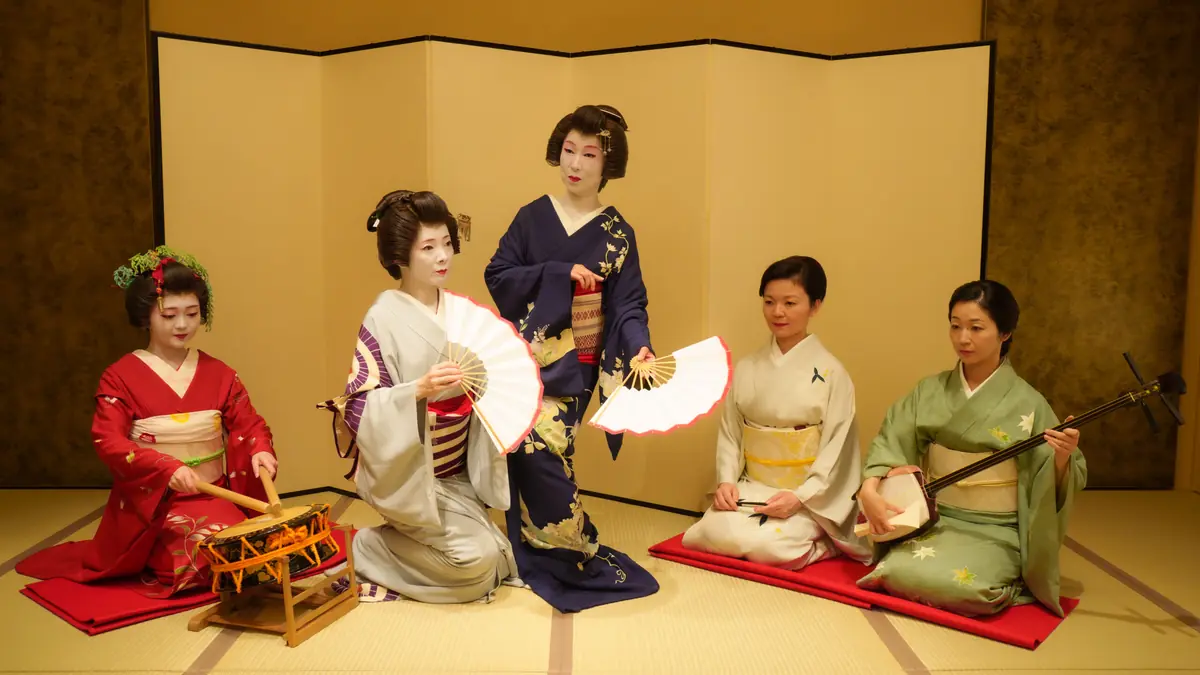
At Asakusa Miyakodori, a working geisha tea house in Tokyo founded in 1950, three regular geisha — Komaaki, Chino, and Chizuru — appear at the tea house alongside other Asakusa geisha, depending on each evening’s schedule. Their paths into the geisha world are completely different. Komaaki entered as an adult, after spotting Asakusa geisha walking through a Tokyo street in formal black kimono and realizing the tradition still existed in her own city. Chino traced her decision back to a kindergarten dance recital and a moment at age 18 “as if a seed sleeping inside her had opened up.” Chizuru trained only at Miyakodori and remembers the night before her professional debut as the most frightening of her life. Their stories — drawn directly from Miyakodori’s video interview series — are the closest a foreign reader can get to understanding what it actually means to become a Tokyo geisha today.
Why Three Stories?
Most English-language coverage of geisha treats the profession as if it were a single identity — a uniform path that all geisha walk down in the same direction. The reality, in Asakusa as in Kyoto, is the opposite. Every geisha enters the life through her own door, for her own reasons, and the older geisha will tell you that no two paths are the same.
These three interviews were recorded at Miyakodori in April 2026, as part of a long-form primary-source project. Each woman was asked the same opening question — “Why did you become a geisha?” — and each answer was completely different.
What follows is, as faithfully as English will allow, what they said.
Komaaki: “I Didn’t Know Tokyo Had Geisha”
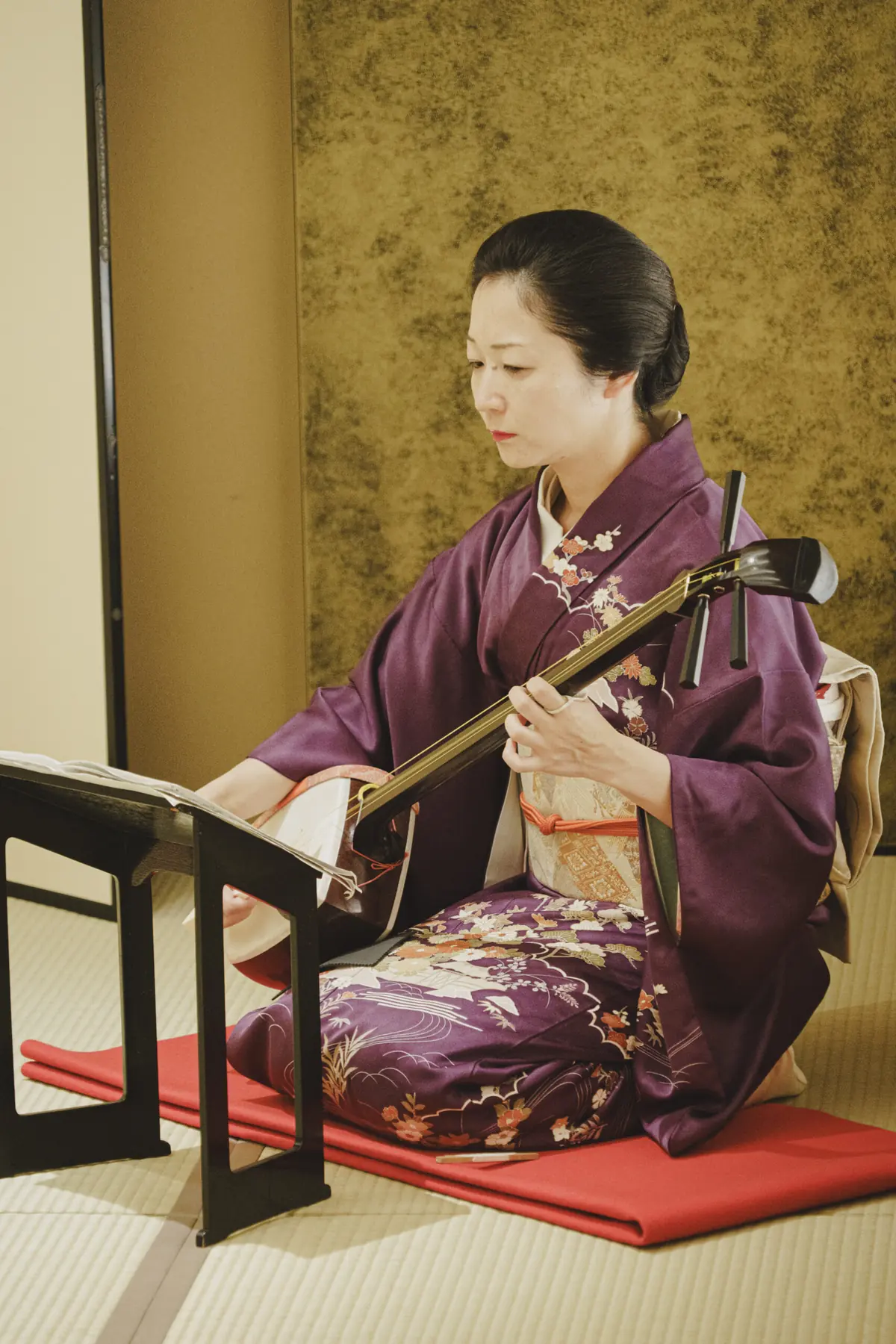
Komaaki is a jikata geisha at Miyakodori — the role responsible for the shamisen and the singing. She also performed as a tachikata (dancer) for two to three years earlier in her career. She entered the geisha world as an adult, not as a teenager.
Her own account:
“When I was small, I admired the maiko of Kyoto. But I didn’t know Tokyo had this world at all. It wasn’t until I was already an adult — I happened to see geisha walking through a Tokyo street, in formal black de-no-ishō kimono, and I thought, so Tokyo has this too. That’s when I started to admire the world.
Maybe I shouldn’t say this, but I thought — given my age — if I don’t do it now, I never will. So I jumped in.”
— Komaaki, Miyakodori interview, April 2026
What This Tells a Foreign Reader
Komaaki’s story is the most universally relatable for visitors from outside Japan. The single most common misconception about Japanese geisha — held by perhaps 90% of international travelers — is that geisha exist only in Kyoto. They do not. Tokyo has six historical hanamachi (Shimbashi, Akasaka, Kagurazaka, Mukōjima, Yoshichō, and Asakusa). All of them, including Asakusa, traditionally operated as ichigen-san okotowari — by introduction only — and most other Asakusa tea houses still do. Miyakodori is the Asakusa tea house that opened that door, which is why a foreign visitor can book Asakusa directly without a referral.
What Komaaki did not know — until she saw the black formal kimono on a Tokyo street — is what most foreign readers also do not know. Her story is, in a sense, the story you might be living right now: discovering that this world exists in Tokyo, and that it is possible to step into it.
The “de-no-ishō” (出の衣装) she mentions is the formal black-and-gold kimono Asakusa geisha wear when traveling between the kenban (geisha office) and a tea house. It is the visual signature of the Asakusa hanamachi in particular and is rarely seen anywhere else in the city.
Komaaki telling it herself, at the end of her section. As a child she admired the maiko of Kyoto and had no idea that Tokyo had geisha at all. She found out as an adult, passing a group of them in black kimono on an Asakusa street. Subtitled on screen.
Chino: “A Seed Sleeping Inside Me Opened Up”
Chino is the youngest of the three geisha profiled here. She entered the geisha world at 18, but she traces the moment of decision back much further than that.
Her own account:
“What first made me want to become a geisha was — I wanted to learn Japanese dance. And then I thought, rather than just learning it as a hobby, what if I could do it as my work? A geisha can keep doing Japanese dance as her profession.
The reason I wanted to do Japanese dance in the first place — at my kindergarten there was an otōgi-kai, a kind of dance recital. The kids who were learning ballet performed ballet, the kids who were learning Japanese dance performed Japanese dance. And I just remember watching them and thinking, that’s beautiful. That memory stayed with me.
It stayed there. And then when I was 18, it was like a seed sleeping inside me had opened up — fwaa — and I thought, alright, I’m going to do this.”
— Chino, Miyakodori interview, April 2026
Chino’s “Apprenticeship Wasn’t Hard”
Where many English-language sources frame geisha training as an ordeal — years of harsh discipline and cultural isolation — Chino’s testimony cuts directly against that framing:
“Was the apprenticeship hard? For me, no — I never thought it was hard at all. I only had about a month of formal apprenticeship, and there was a huge amount to learn in that time, but it was fun. I learned without any sense of struggle.
I just kept thinking, I want to do this, I really want to do this. It was something I had wanted, so when I finally got to do it, it was yatta! — yes, finally.”
— Chino, Miyakodori interview, April 2026
What This Tells a Foreign Reader
Two things, both important.
First, the kindergarten origin story. The Western framing of geisha as a “lost tradition” or “museum culture” implies that no young girl in Japan today aspires to this life. Chino’s story is the direct contradiction: her aspiration was rooted in childhood, carried unbroken into adulthood, and acted on at 18. Asakusa is smaller in numbers than at its postwar peak, but the tradition is not lost. It is renewing, one young woman at a time.
Second, the testimony that apprenticeship was fun, not hard. This is rarer in English than it is in real life. Asakusa geisha will tell you frequently — and Chino is not the only one — that the months before debut are remembered with fondness, not with pain. The “harsh training” trope is often a Western projection.
Chino on the decision itself. She wanted to learn Japanese dance, and then thought it would be better to make a living from it than to only study it. She traces the pull back to a kindergarten recital: she performed ballet, another child performed Japanese dance, and she kept thinking about the other side of the stage.
Chizuru: “I Was So Afraid the Night Before I Came Out”
Chizuru trained only at Miyakodori. Most Asakusa geisha rotate through multiple tea houses during their apprenticeship to gain experience with different patrons and different older sisters; Chizuru did not. She was apprenticed at Miyakodori, debuted from Miyakodori, and continues to perform there.
Her own account, on the period just before her debut:
“During my apprenticeship I didn’t really feel any hardship — it’s a world you don’t understand yet, and you just do what you’re told. But as the apprenticeship was ending, the idea of going out — of debuting — became frightening. The anxiety was overwhelming.
I had only trained at Miyakodori. So when I had to start going to other places — oyoso, the other tea houses — and seeing other older sisters and other patrons I’d already met through the mama of those houses, all of that ahead of me, the fear was bigger than I could handle. I was scared.
I was nervous. The pressure of that moment. But the safety of being at Miyakodori — that I felt.”
— Chizuru, Miyakodori interview, April 2026
What This Tells a Foreign Reader
Chizuru’s story is the most personal of the three, and in some ways the most surprising for a foreign reader. The geisha world is often imagined as a polished, confident performance — the visible side. Chizuru’s testimony shows what is underneath that polish: a young woman who was, in her own words, terrified the week before her debut.
The phrase “the safety of being at Miyakodori” is also, for the tea house’s identity, the most important sentence in any of these interviews. Asakusa hanamachi has long been considered the warmest and most family-like of Tokyo’s six geisha districts, and Miyakodori is, within Asakusa, the only remaining machiai-chaya — a tea house specifically built for hosting geisha and their patrons. For Chizuru, that unusual position translated directly into a sense of belonging.
Meet Asakusa’s Working Geisha at Miyakodori
Komaaki, Chino, Chizuru — and other Asakusa geisha — perform at Miyakodori through the year. Reserve a Tea House plan or a private 1-, 2-, or 3-hour ozashiki (geisha banquet) with live shamisen, traditional dance, and English support. No introduction required.
Common Threads (and Why They Differ)
Three completely different paths. And yet, when their stories are placed side by side, certain threads run through all three:
| Theme | Komaaki | Chino | Chizuru |
|---|---|---|---|
| Age at entry | Adult | 18 | Late teens |
| First spark | Black kimono on a Tokyo street | Kindergarten otōgi-kai | (untold here) |
| Hardship of training | “Manners specific to this house” | None | None until debut, then “terrifying” |
| Source of strength | Realizing Tokyo had geisha at all | “I just really wanted this” | “The safety of being at Miyakodori” |
What unifies the three is not a single starting point. It is a deliberate choice to commit to the form. None of these women was born into a geisha family. None of them inherited the role. Each of them, at a different age and for different reasons, looked at this profession from the outside and chose to walk into it.
This is, in itself, the answer to the most common foreign question about Tokyo geisha: “Are these women forced into the life?” The answer is no, and has been no for over a century. They are here because they decided, separately, to be here.
They decided to be here — and it was still frightening. Chizuru on the part that scared her: the trainee years never felt hard, she says, because she simply did as she was told. What frightened her was the debut itself, performing at other teahouses and meeting guests she had never met, after training only at Miyakodori.
The Senior Voice: Goro-san of Asakusa Hanamachi
The three stories above all come from geisha who entered the profession in recent decades. To understand the depth of the tradition they stepped into, it helps to hear from someone who has been at the center of it for far longer.
Goro-san is currently the most senior geisha actively performing in Asakusa — a jikata whose stage presence and quiet feminine elegance have remained unmistakable across her career. She is not affiliated with Miyakodori — she is an independent member of the Asakusa hanamachi — but the okami of Miyakodori, Chikage, refers to her as her closest geisha friend. Goro-san appears here not as part of the Miyakodori roster, but as the voice that contextualizes everything Komaaki, Chino, and Chizuru are continuing.
From Dance to Song: A Path That Deepens
Goro-san began her career as a tachikata — the role that dances — and later transitioned to jikata, the role that sings and plays the shamisen. She is still very much working the ozashiki today. The shift from tachikata to jikata is a long-standing path within the geisha world; rather than a step back, it is a deepening of musical training and an expansion of the range an established geisha can bring to a room.
In Chikage’s own words, introducing her:
“Goro-san is currently the most senior actively performing geisha in Asakusa. She used to be a dancer; now she is a jikata — a singer — and still very much working the ozashiki. She is my closest friend among the geisha.”
— Okami Chikage, Miyakodori interview, May 2026
A Long-Standing Friendship from the Okami’s Apprentice Days
Goro-san and Chikage first met when Chikage arrived in Asakusa as a hangyoku (apprentice geisha). Goro-san, already an established dancer, remembers the first encounter:
“It was when the okami first came to Asakusa, when she was still a hangyoku. I thought, I didn’t know there could be such a beautiful hangyoku. I was — quietly, as one woman to another — a little smitten. She was, to me, the finest geisha in the world.”
— Goro-san, Miyakodori interview, May 2026
That phrase — the finest geisha in the world — is not language an Asakusa geisha uses lightly, and the okami returns the regard in kind. The mutual respect between an Asakusa senior of Goro-san’s standing and the okami of one of the district’s surviving working tea houses is one of the threads that has held the Asakusa hanamachi together across decades. It is also part of why Goro-san’s stage presence — the elegance, the timing, the unmistakable feminine carriage — still reads as quintessentially geisha to anyone who sees her work an ozashiki.
The Annual Traditions She Carries Forward
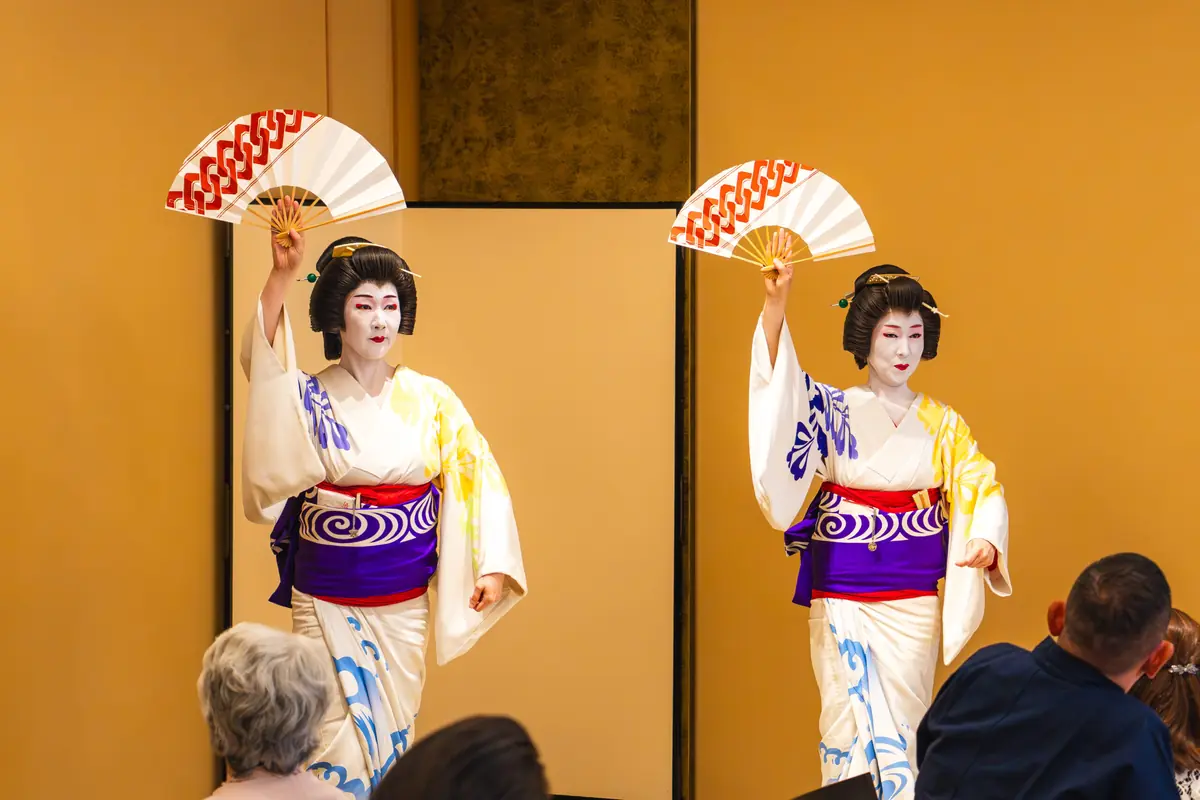
Goro-san is also one of the keepers of two Asakusa traditions that visitors rarely see, both rooted in the seasonal rhythm of the hanamachi:
- The Setsubun “o-bake” (お化け) — On Setsubun (February 3rd, the eve of spring in the lunar calendar), Asakusa geisha form small groups of two or three and travel between ozashiki, performing in elaborate costumes. The word o-bake in this professional context is not “ghost” — it is the geisha-world term for this once-a-year costumed performance tradition. Recent years have included pop-cultural references (Mario, Matsuken Samba) layered onto classical dance, with geisha changing costumes mid-performance behind a folding screen. Setsubun itself is a ritual of seasonal exorcism — yakubarai — and the o-bake tradition carries that meaning forward in playful form.
- The Sanja Matsuri kumi-odori (組踊り) — In May, Asakusa hosts the Sanja Matsuri, the largest festival in the shitamachi district. The geisha contribution is a kumi-odori — a coordinated group dance involving seven or eight geisha, mixing tachikata and jikata. The schedule used to be intense enough that the group traveled by truck from one engagement to the next. The kumi-odori in this Asakusa-specific sense is an in-house industry term for the festival’s geisha performance.
Neither of these traditions is something a visitor can casually witness. Both are deeply embedded in the working calendar of the hanamachi. But knowing they exist — and that a geisha of Goro-san’s generation has been at the center of them for decades — is what makes the present-day ozashiki feel less like a tourist attraction and more like a single window onto a world that is much larger than any one evening can show.
What Goro-san Adds to the Three Stories
Komaaki, Chino, and Chizuru are continuing a tradition. Goro-san is one of the geisha who has carried that tradition forward — and is still carrying it, on stage, every time she steps into an ozashiki. The fact that the most senior geisha currently active in Asakusa is also still very much a working performer — with the elegance and presence of a geisha at the height of her craft — is, for any guest weighing whether Asakusa hanamachi is “still real,” the most useful single data point in this article.
Goro-san, the oldest working geisha in Asakusa, in conversation with our okami — how they first met, and what has changed since. English subtitles available.
What Patrons Mean to a Geisha (Chizuru on Gratitude)
A second piece of testimony from Chizuru, in her own words, is worth quoting at length. She was asked which guests had stayed with her most strongly in memory:
“The guests who really stay with me are the ones who took me on as their o-hiki — their regular patron — when I was just starting out. When I’m practicing — when I’m working on a new dance, on the shamisen, on anything — at every stage I think, I want my patron to look at this and feel they were right to back me. They’ve watched me grow. I want them to feel I have actually become better.”
— Chizuru, Miyakodori interview, April 2026
And on what makes her happiest about the work:
“The most fun part of the job, for me, is meeting people I would never otherwise meet. People you couldn’t possibly cross paths with in ordinary life. Being able to talk with them. Showing them every day a little more growth — including the daily practice — and having them praise that growth. That’s the moment when I most feel, I’m glad I became a geisha.”
— Chizuru, Miyakodori interview, April 2026
“O-hiki” — The Backing Patron
The word o-hiki (お引き) does not have a clean English equivalent. It is closer to “supporter” than to “patron” in the modern sense — a regular guest who returns to see a particular geisha grow, takes a personal interest in her development, and over time becomes a kind of cultural godparent. In a Western framework, the closest analogy might be a longtime concert subscriber who follows a violinist’s career for decades.
For an Asakusa geisha, an o-hiki relationship is one of the deepest professional bonds available. Chizuru’s testimony makes clear that the relationship runs both ways: she is grateful to her patrons, and she practices with them in mind.
The Future of the Asakusa Hanamachi
The Asakusa hanamachi today is not museum culture. It is a working district, with new apprentices arriving, older geisha mentoring them, and tea houses like Miyakodori taking nightly bookings. Komaaki, Chino, and Chizuru are part of that present — three women out of a current Asakusa roster that has been carefully maintained over the past two decades.
What you see if you book an evening at Miyakodori is not three actors performing the role of geisha. It is three working professionals, each with her own path, each with her own way of holding the room. The dance is real. The shamisen is real. The conversation, when interpreted into English, is real.
The future of the Asakusa hanamachi depends, in the end, on visitors choosing to be there. That is the okami’s quiet observation — the more people who walk through the door, the more the tradition continues to renew itself.
Frequently Asked Questions
Q: Will I actually meet Komaaki, Chino, or Chizuru if I book?
Likely yes. Miyakodori works with a small roster of Asakusa geisha, and the three profiled here are core members of that roster. If you’d like to be matched with a specific geisha, please write her name in the request field when you book — we’ll do our best to arrange it within that day’s schedule. If you don’t name anyone, our okami chooses the geisha for your evening.
Q: Are these three the only geisha at Miyakodori?
No. Miyakodori works with multiple geisha registered with the Asakusa Geisha Association — Komaaki, Chino, and Chizuru are three of them, alongside other geisha who appear at the tea house on different evenings depending on each one’s schedule. The three profiled in this article were chosen for the primary-source interview series because each represents a different path into the geisha world.
Q: Can I ask the geisha about their stories during a session?
Yes. Private plans (1-hour and longer) are private rooms by design, which means real conversation time built in — questions about training, family backgrounds, the path into this life, are welcomed and the geisha enjoy them, especially when interpreted carefully into English. The 75-minute Tea House plan has a shorter, shared Q&A segment.
Q: Can I follow individual geisha online?
Individual Asakusa geisha generally do not maintain personal social-media accounts. For the closest equivalent, follow Miyakodori’s own channels — Miyakodori posts short clips of the geisha at work, the Konpira Fune Fune games, and the seasonal dances throughout the year. The Asakusa Geisha Association (asakusakenban.com) and Miyakodori itself are the primary points of contact. Personal contact information is, by tradition, not exchanged.
Q: Is the geisha profession respected in modern Japan?
Yes. Asakusa geisha are registered members of the local kenban (geisha office) and are recognized as cultural workers in the same sense as professional theater artists. And yes — there are fewer geisha in Asakusa today than there were at the postwar peak: in 1969, the Asakusa hanamachi counted around 250 geisha, 75 ryōtei and machiai-chaya, and 18 hakoya support houses. Those numbers are smaller now. That is exactly why Miyakodori works the way it does — opening the door to international visitors, training the next generation, sustaining the tradition by keeping it alive in actual practice rather than as museum culture. Treating the profession as merely “exotic” or as a “lost tradition” misses what working geisha and the houses around them are actually doing every evening.
Q: How can I learn more about geisha training and life?
For deeper context, see our pillar guide on Tokyo geisha experiences, our Konpira Fune Fune game guide (the most-played ozashiki game), and our tatami-room etiquette guide. For first-hand exposure on a tighter budget, the Miyakodori Tea House plan (75 minutes, ¥17,600 per person) is the entry-budget format; for the fuller experience the okami recommends, the private 1-, 2-, and 3-hour plans are the better fit.
Booking & Final Note
Komaaki on first realizing Tokyo had geisha. Chino on the kindergarten otōgi-kai. Chizuru on the night before her debut. These are not stylized stories. They are the actual answers three working Asakusa geisha gave when asked, in 2026, why they had chosen this life.
If you would like to spend an evening with them — or with their colleagues from the Asakusa hanamachi — Miyakodori offers four formats. The Tea House plan (¥17,600, 75 minutes, currently offered at a special campaign price) is the entry-budget format with shared seating. For the fuller experience the okami recommends, the private 1-, 2-, and 3-hour plans give you your own room, longer conversation time, multiple parlor games, and (in the 3-hour plan) a kaiseki dinner.
The room you walk into is, in the end, the same one Komaaki, Chino, and Chizuru walk into — three different stories, one tea house in Asakusa, founded in 1950, still very much open.
Request Your Evening with the Geisha of Asakusa
Miyakodori — Asakusa’s only remaining machiai-chaya, founded in 1950 — hosts working geisha including Komaaki, Chino, and Chizuru. Book a Tea House plan or a private 1-, 2-, or 3-hour ozashiki (geisha banquet). English support throughout. Direct booking — no introduction required.
Sources & References
- Komaaki interview, Miyakodori, April 2026 — origin story (Tokyo street encounter), apprenticeship reflection
- Chino interview, Miyakodori, April 2026 — kindergarten otōgi-kai origin, “seed sleeping inside opened up,” apprenticeship was “fun, not hard”
- Chizuru interview, Miyakodori, April 2026 — pre-debut anxiety, “the safety of being at Miyakodori,” o-hiki patron gratitude
- Goro-san & Okami Chikage interview, Miyakodori, May 2026 — Goro-san is an independent member of the Asakusa hanamachi, the most senior geisha actively performing; tachikata → jikata career arc; long-standing friendship beginning in the okami’s hangyoku years; Setsubun o-bake and Sanja Matsuri kumi-odori traditions
- Asakusa Geisha Association: https://asakusakenban.com/
- Asakusa Miyakodori Official Website: https://en.miyakodori-geisha.com/


- Geisha Etiquette in a Tatami Room: What to Know Before You Go
- Authentic Geisha Experience vs. Geisha Makeover: What's the Difference?
Karyukai: The Flower and Willow World of Geisha — Japan’s Geisha Culture Explained
Authentic Geisha Outfit Guide: Traditional Japan Costume Arts
UNLOCKING THE SECRETS OF OZASHIKI GAMES: TRADITIONAL GEISHA PLAY
Tokyo Experience Gifts: Unforgettable Cultural Gift Ideas in Japan
Konpira Fune Fune Lyrics and How to Play the Geisha Drinking Game (2026)
What Is a Taikomochi? Japan’s Hokan Tradition Guide
Comment ( 0 )
Trackbacks are closed.
No comments yet.