

Geisha Hairstyles: Nihongami, Wigs, and What Asakusa Geisha Wear Today
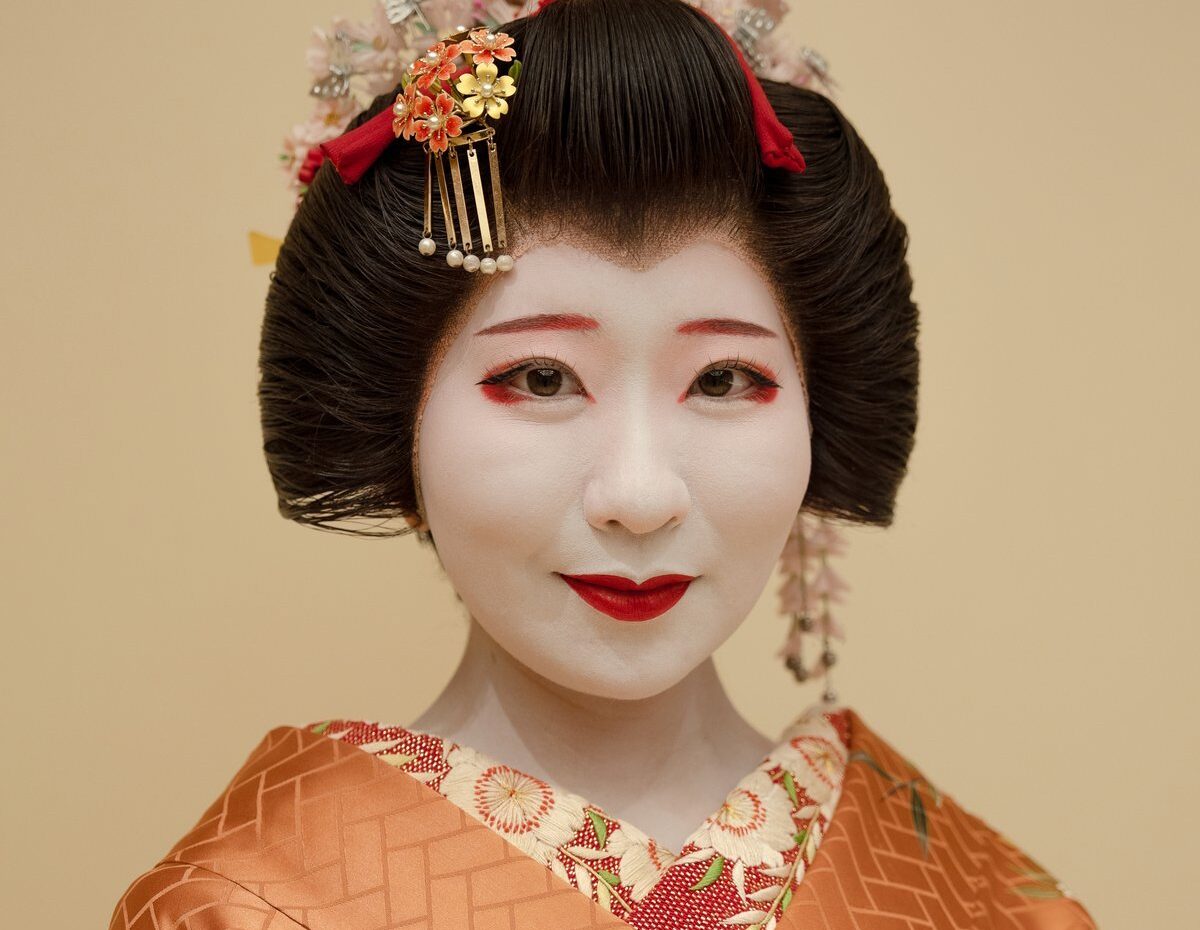
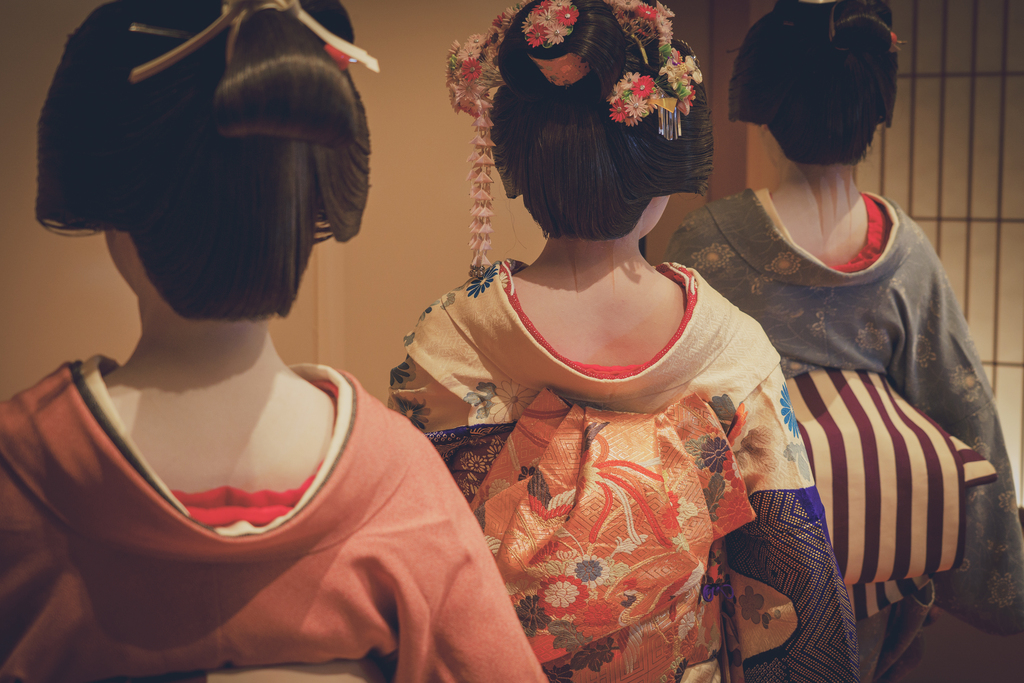
Geisha wear nihongami, the traditional Japanese hairstyles built around a topknot, and almost all of them belong to the shimada family. In Asakusa, Tokyo, there are three: momoware for the apprentice (hangyoku), taka-shimada for a full geisha, and the lower, lighter tsubushi as she grows older. Today most of these styles are worn as a wig (katsura) rather than set in the geisha’s own hair, and whether a geisha appears in nihongami at all depends on the evening and the guest, not on a fixed rule.
What Hairstyle Do Geisha Wear?
The short answer is nihongami (日本髪) — literally “Japanese hair.” The word covers the whole family of traditional women’s hairstyles in which the hair is swept up, shaped at the sides and back, and gathered into a sculpted knot, or mage, on top of the head. For geisha, that family narrows to one line in particular: the shimada.
In Asakusa, the geisha district where our house has hosted ozashiki since 1950, the okami (proprietress) explains it as three styles, each tied to a stage of a geisha’s career:
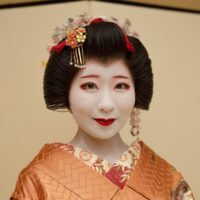
- Momoware (桃割れ) — “split peach,” worn by the hangyoku, Tokyo’s apprentice geisha. From the front it looks much like the others; the difference is the knot, which is shaped like a peach split in two. It signals youth.
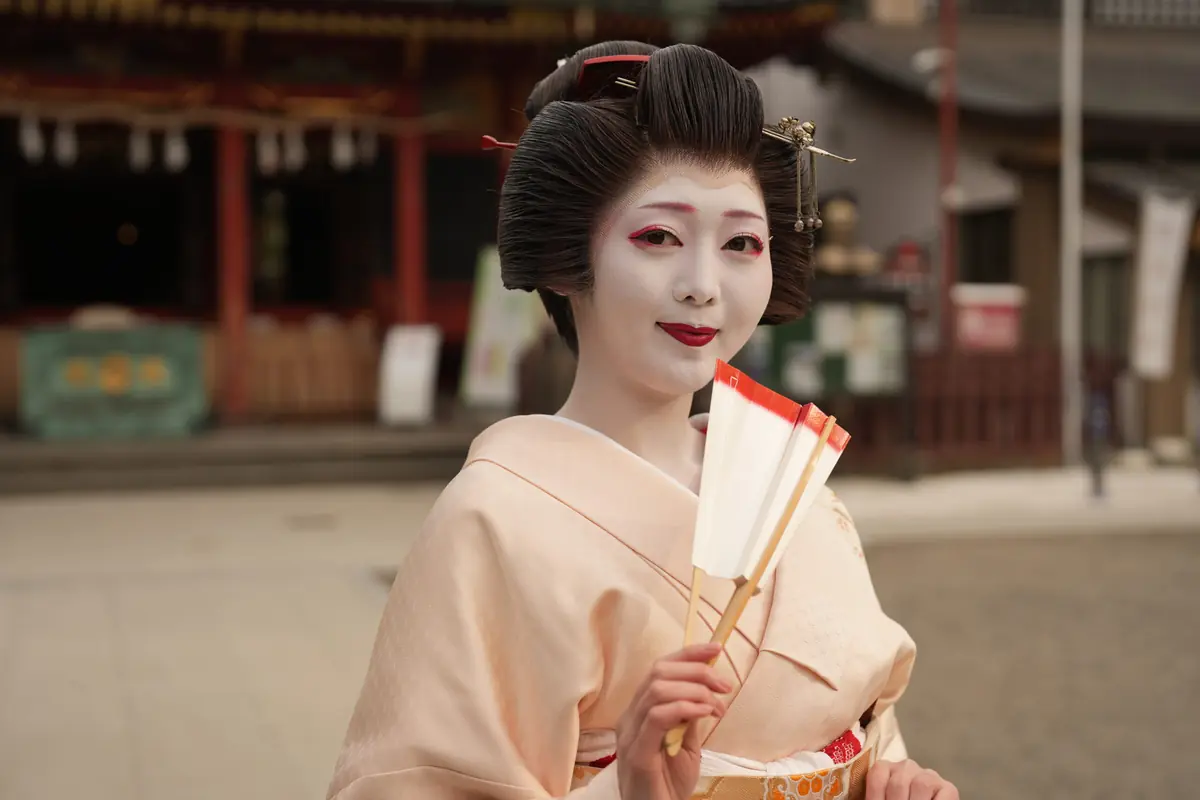
- Taka-shimada (高島田) — the “high shimada,” worn once she becomes ippon, a full geisha. This is the style most visitors picture when they think of a geisha’s hair.
- Tsubushi (つぶし) — a flatter, lighter knot. A high shimada is heavy to wear night after night, and older geisha change to tsubushi as the years go on.
The taka-shimada should not be confused with the bunkin taka-shimada that brides wear at traditional Japanese weddings. The bridal style is built on the same idea, but with the base of the knot raised even higher.
Three Styles, Three Stages
One historian of the Tokyo geisha world describes the shimada as coming in graded heights — high for the young, a middle height, and a low tsubushi for older geisha — with the knot lowered as a woman aged. In Asakusa today the middle step is no longer used as a separate style. There are two names in practice, taka-shimada and tsubushi. What happens in reality is softer than the names suggest: a “high” shimada is often set at something closer to a middle height.
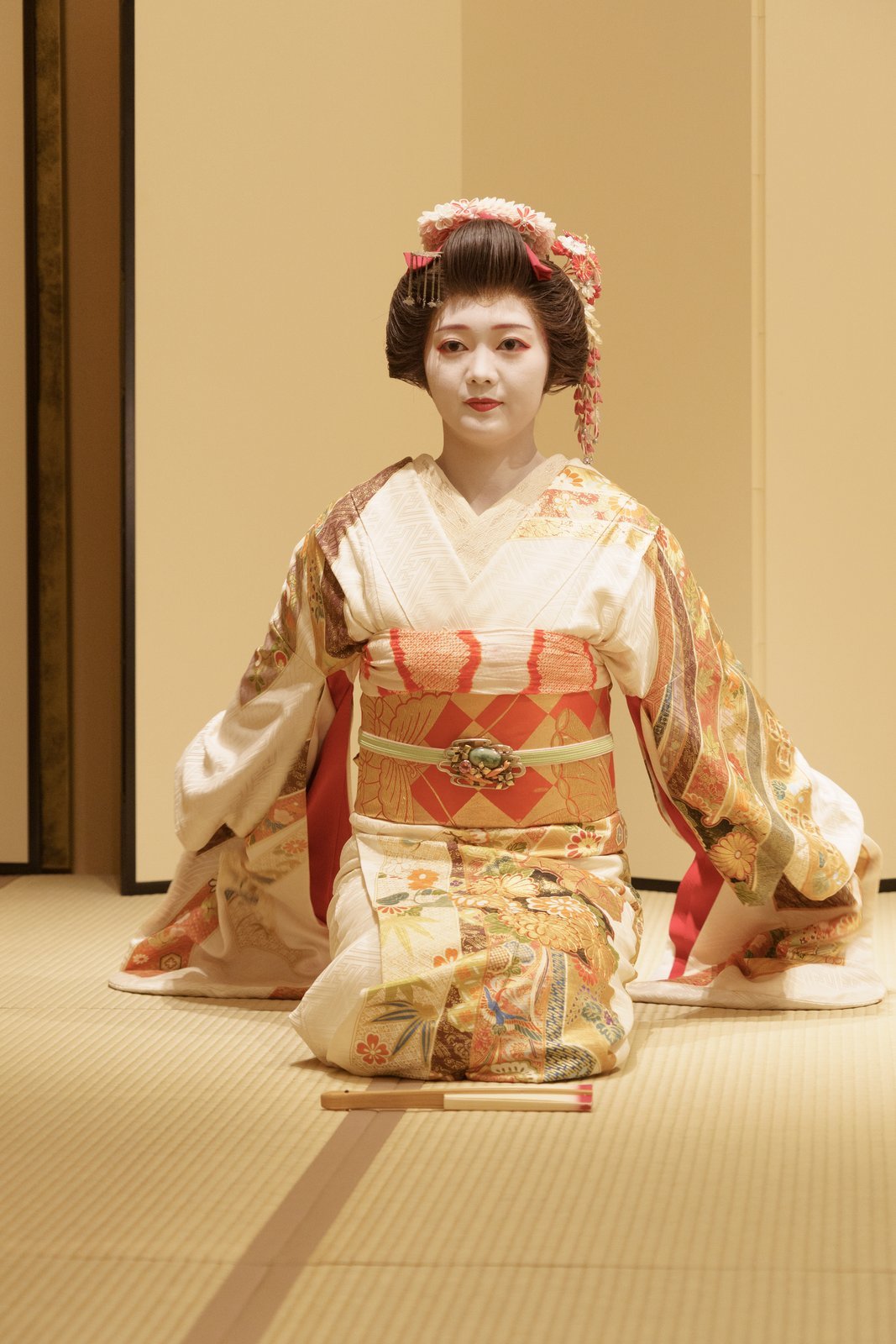
The apprentice’s momoware is its own category. A hangyoku is dressed to look young — a long-sleeved furisode kimono, bright flower ornaments in the hair — and the momoware belongs to that picture. When she becomes a full geisha, the whole look changes direction. The full geisha’s style is one of subtraction: fewer and simpler hair ornaments, quieter kimono, and a hairstyle that relies on its line rather than its decoration.
Geisha Hair or a Geisha Wig?
In Asakusa, both hangyoku and full geisha generally wear nihongami as a wig, or katsura (かつら). This is worth separating clearly, because English writing often treats the two words as the same thing. Katsura is the object; nihongami is the shape. A geisha in a taka-shimada is wearing a katsura set in the taka-shimada style.
Whether a geisha wears a wig is not decided by rank. It is not that apprentices use their own hair and full geisha use wigs, or the reverse — in Asakusa both use a katsura as the normal practice.
It was not always so. A history of the Asakusa district records that before the Second World War, apprentices had their own hair dressed by a professional hairdresser every third day, and a geisha’s handbook of the time advised getting a place in the hairdresser’s queue early. By the mid-twentieth century, apprentices were wearing wigs, and the wigs had a seasonal rhythm of their own: on New Year’s Eve they went out to the wig-maker to be dressed for the New Year, and for that one night an apprentice might go to her engagements with her own hair in plaits instead.
Who Wears Nihongami — and When?
Not every geisha at a banquet wears nihongami, and this is one of the things visitors most often misread in photographs.
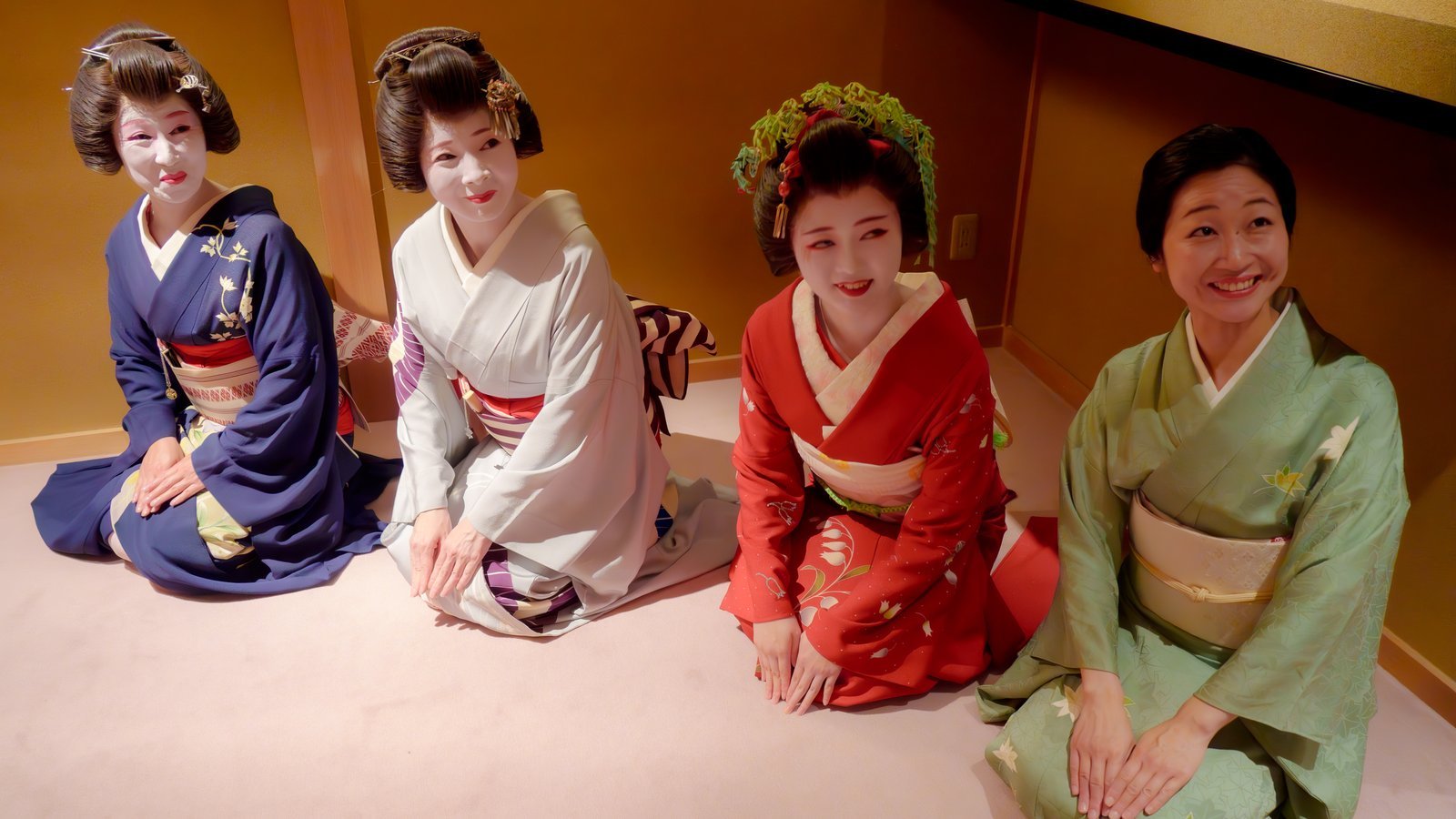
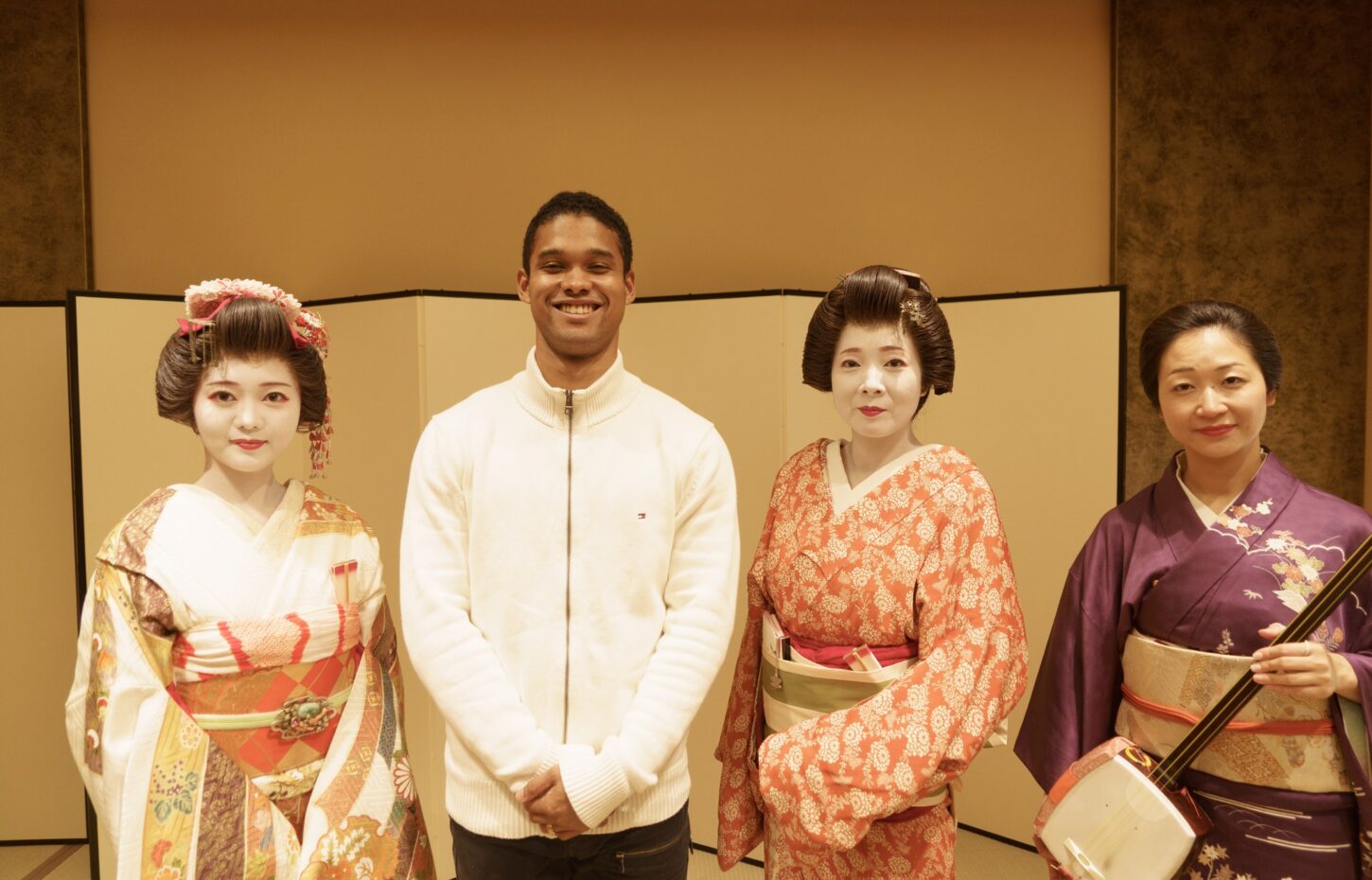
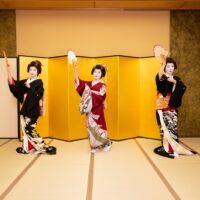
Dancers and musicians look different. A geisha’s career usually develops in one of two directions. The tachikata (立方) are the dancers: they wear white makeup and nihongami. The jikata (地方) are the musicians who play the shamisen and sing: they wear their natural face and a modern upswept style that geisha call yōhatsu (洋髪), “Western hair.” Before the war, jikata also went out in nihongami; today the upswept style is the norm for them.
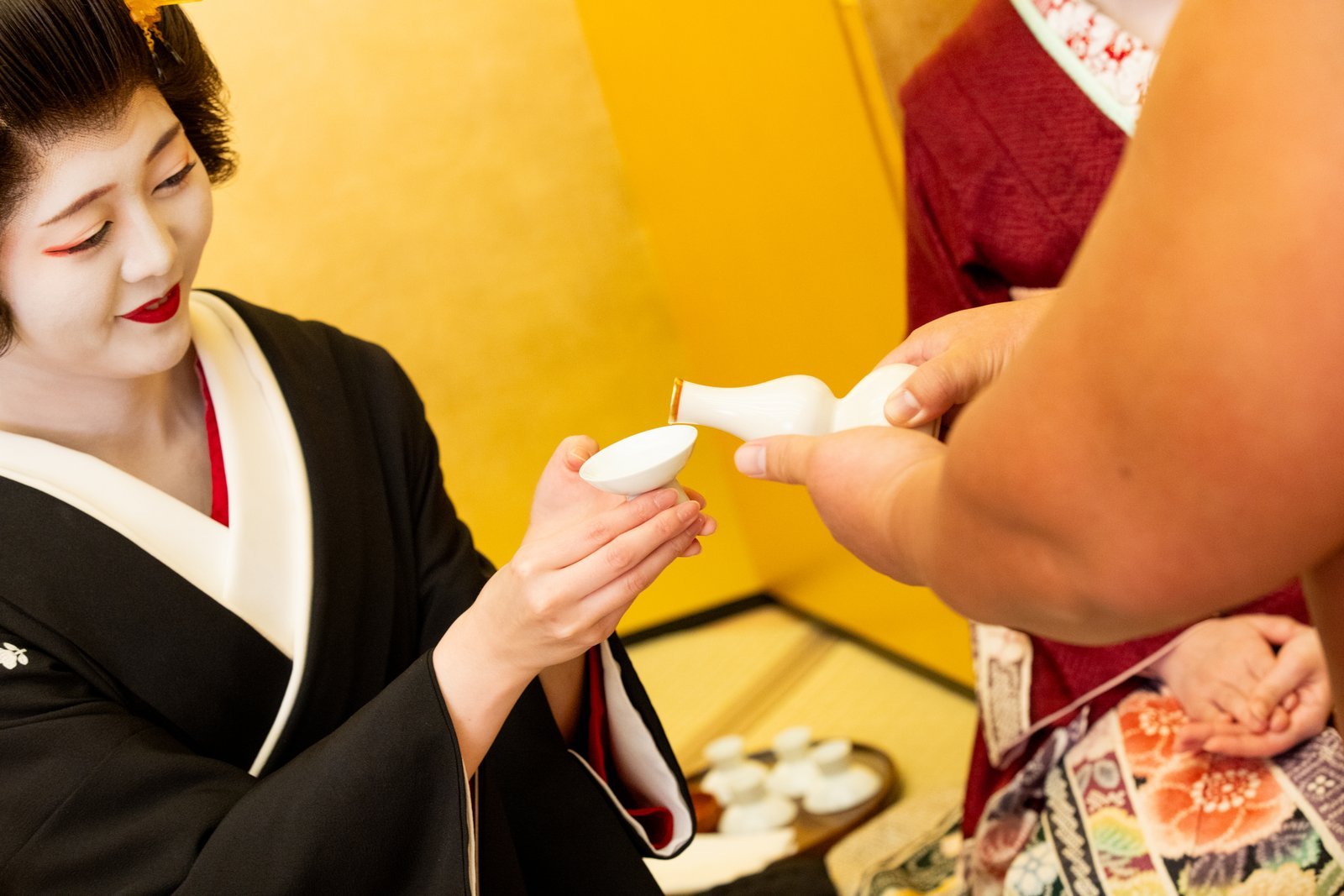
The guest shapes the look. For a tachikata, there is no fixed rule that says a given evening means nihongami. For a guest’s first ozashiki, the dancers almost always appear in nihongami and white makeup. For regular guests who have seen it many times, the same geisha may come in yōhatsu without the white face. If you would like to see the full look — wig, white makeup, and all — say so when you book; requests from international guests for nihongami are met.
Nihongami comes with its own makeup rules. White makeup worn with nihongami uses only three colors: red, black, and white. In Asakusa, false eyelashes and colored eyeshadow are not worn with it, because they do not sit right with the hairstyle — seen from the side, a curled lash sticks out against the line of the wig. With a Western hairstyle, the same rules do not apply. For more on the makeup itself, see our guide to geisha makeup.
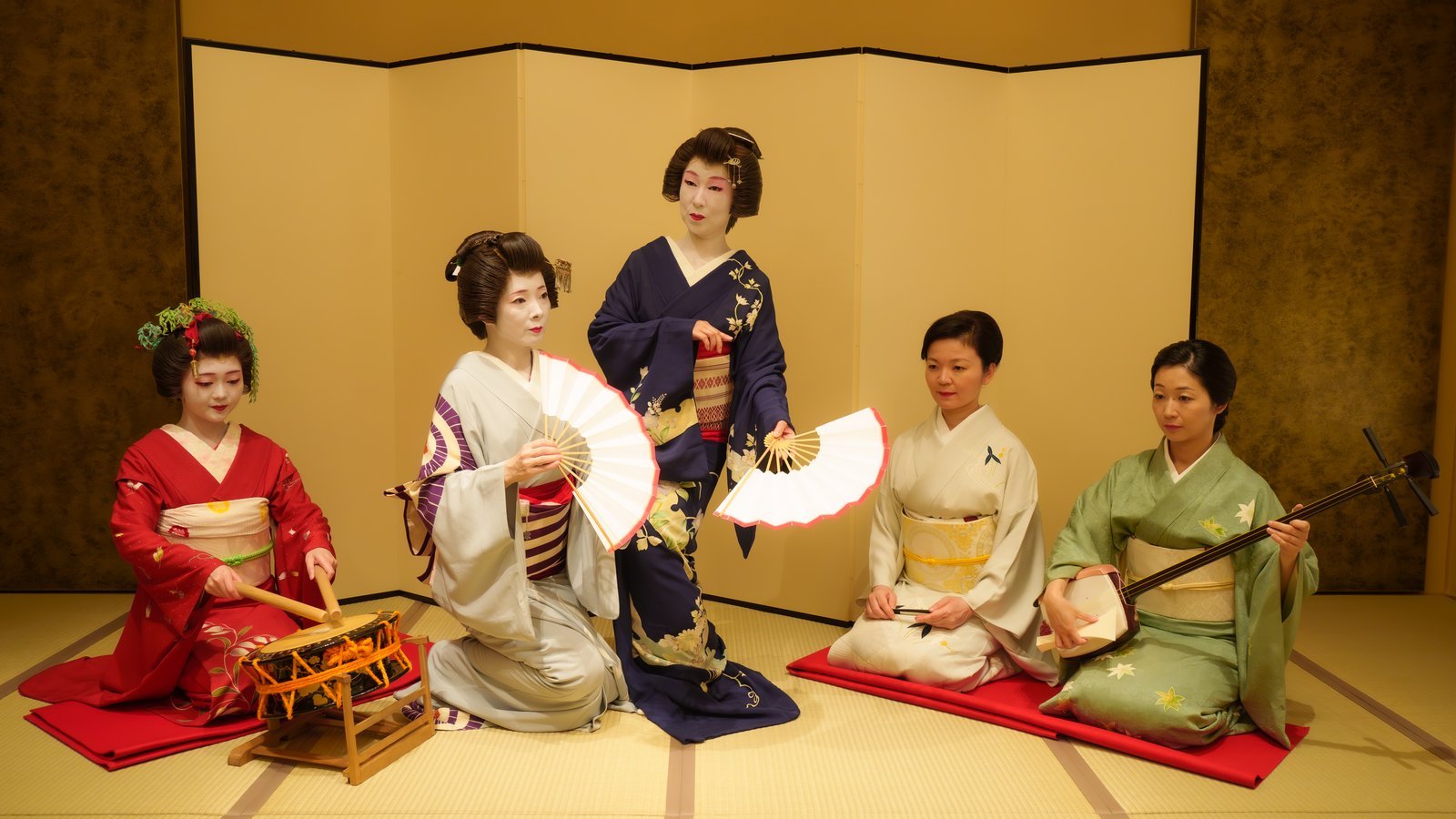
See the Full Nihongami and White Makeup
At a private ozashiki (geisha banquet) in Asakusa, request the full look — nihongami, white makeup, and all — when you book. First-time and overseas guests are welcome.
Request a ReservationHair Ornaments: Comb, Kogai, and Kanzashi
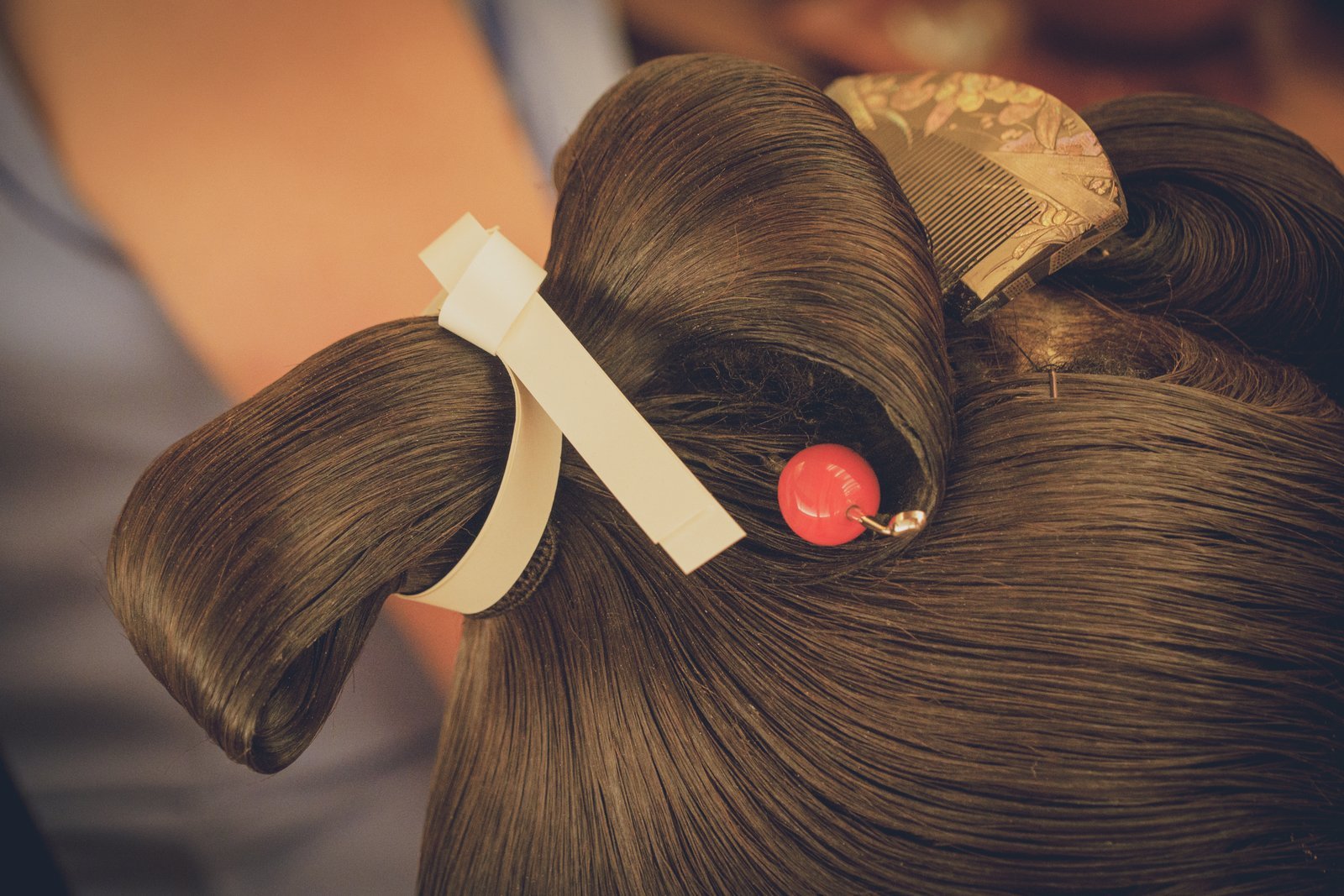
A geisha’s hair ornaments are not a single item. On the formal black kimono worn in January, a taka-shimada carries three distinct pieces in tortoiseshell:
- Kushi (櫛) — the comb, set toward the front of the knot.
- Kōgai (笄) — a long bar that passes sideways through the knot and shows at both ends.
- Kanzashi (簪) — the ornamental hairpin.
Just behind the comb, at the base of the knot, sits a red-and-white paper cord, the motoyui — pronounced “mottoi” in the geisha world. In January, hangyoku and full geisha alike add a kanzashi of rice ears for the New Year. Ball hairpins of coral or jade are also still in use.
For the full history of these ornaments and the materials they are made from, see our article on kanzashi.
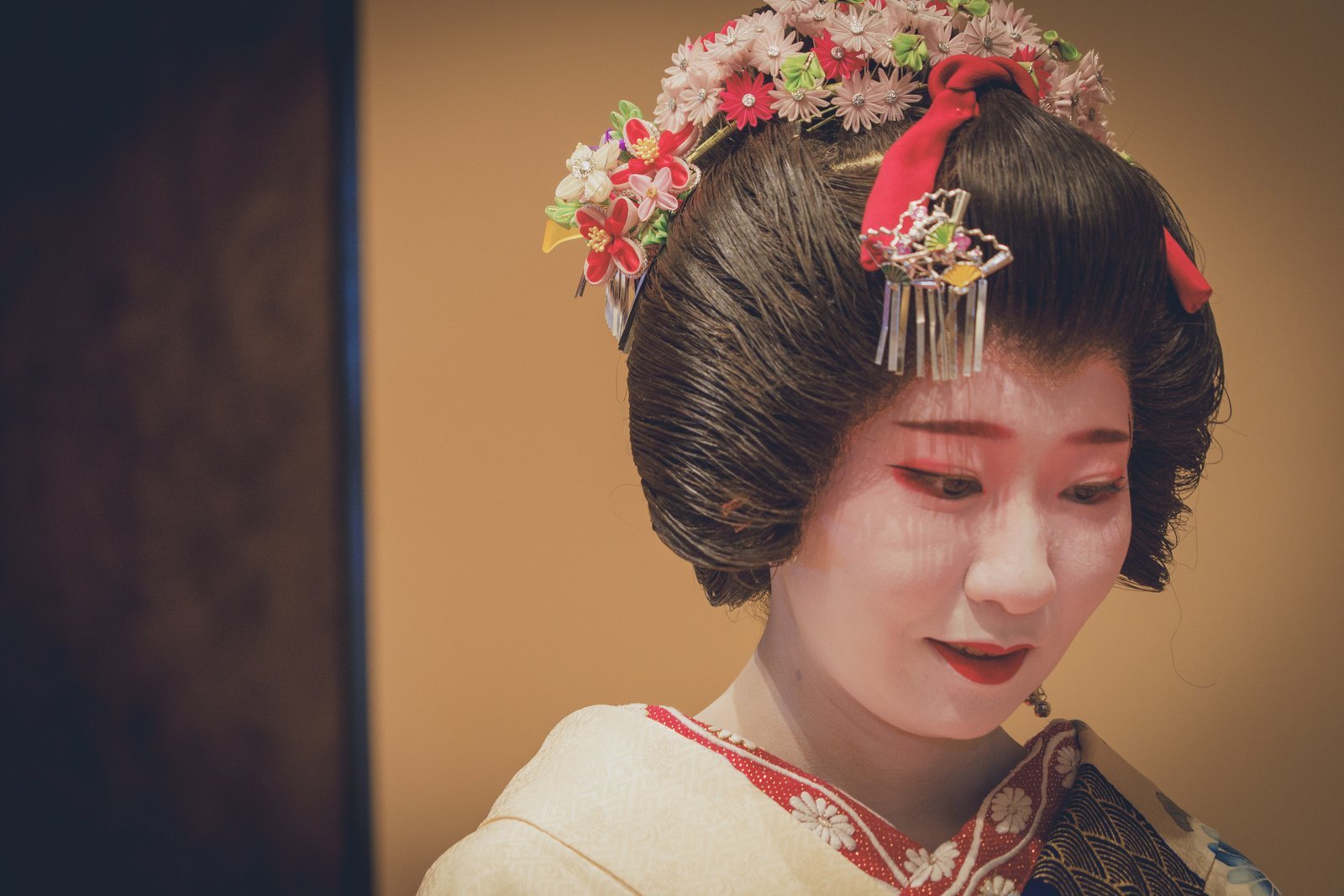
Tokyo Hangyoku vs Kyoto Maiko: How the Hair Differs
Most English-language pages on geisha hair describe Kyoto, where apprentices are called maiko. The Kyoto system is different from Tokyo’s, and the two should not be merged.
In Kyoto, a maiko’s hair changes with her age and seniority: she begins in wareshinobu, moves to ofuku, and shortly before she becomes a full geiko wears sakkō. In Tokyo, the hangyoku wears momoware. Visitors sometimes hear momoware used for a Kyoto maiko’s hair, but that is borrowing the Tokyo name; it is not what Kyoto calls its own styles.
Other differences show up below the hair. A Kyoto maiko trails her kimono and ties the long, hanging darari obi. A Tokyo hangyoku tucks up her kimono so the hem does not trail, and a full Tokyo geisha ties her obi in the yanagi (“willow”) knot, which reads from behind as a crossed shape. The hair ornaments, on the other hand, are broadly similar in both cities. For more on the two systems, see maiko vs geisha.
Geisha vs Oiran: Two Very Different Heads of Hair
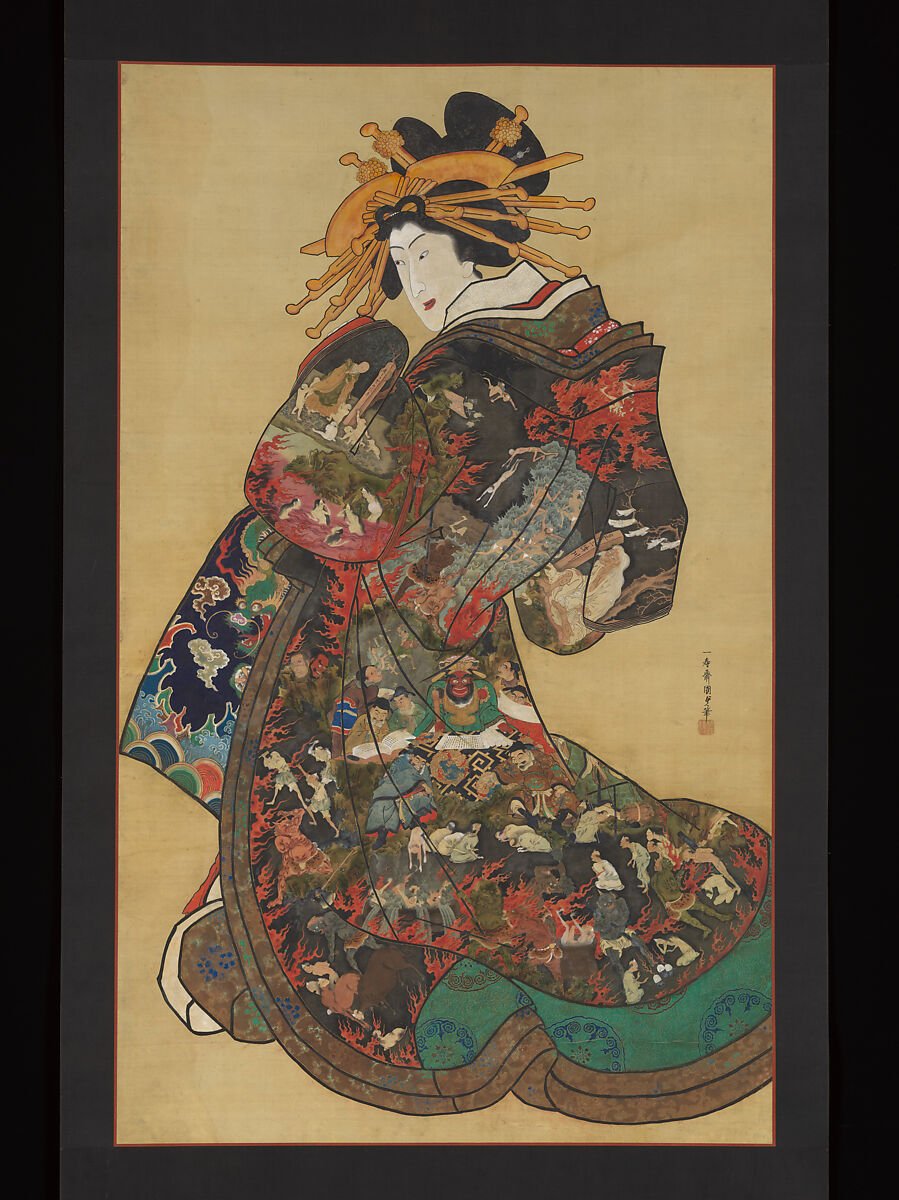
The difference between a geisha and an oiran — the high-ranking courtesans of Edo’s Yoshiwara district — was written on their heads.
An oiran on parade wore an elaborate style such as the date-hyōgo, with a crown of tortoiseshell hairpins fanning out around it. Her hair was dressed each day by a woman hairdresser who came to the house, because the style was too complex to do alone.
Geisha working in the same district were held to the opposite standard. So that they would not compete with the courtesans, their dress was deliberately plain, and the hair followed: one history of the Yoshiwara records limits of one comb and only two or three kōgai and kanzashi in total, against the oiran’s crown of pins. The contrast in hair was one of the clearest ways to tell the two apart at a glance — and it is why a geisha’s shimada, even today, looks restrained next to a courtesan’s portrait. Read more in oiran vs geisha.
A Short History of the Geisha’s Shimada
By the mid-eighteenth century, the shimada had been fixed as the style Yoshiwara geisha were expected to wear. Town geisha elsewhere in Edo still wore a variety of styles, but by the Meiji era (1868–1912) the geisha’s head across Tokyo had settled on the shimada. In Shinbashi, the district that set the formal standard of the time, it was worn with a tortoiseshell comb and kōgai. The style was close to what well-to-do young women wore for occasions, and one historian of the Tokyo geisha world notes that in paintings of the period it can be hard to tell the two apart.
The twentieth century changed the everyday picture. Western hairstyles spread after the Great Kantō Earthquake of 1923, and in 1937, as wartime restraint set in, geisha put their shimada away in favor of Western-style hair and stopped trailing their kimono. The same historian describes the full shimada with a trailing hem as having become, after the war, mainly a look for New Year and for dance.
That is the change. What continued matters as much. In Asakusa the shimada is still worn: the dancers still wear it for a first-time guest’s ozashiki, many tachikata still trail their kimono at an ordinary banquet, and every January the black kimono, the tortoiseshell ornaments, and the rice-ear kanzashi come out again. A hairstyle that once marked who a woman was on the street now marks an evening — and it is worn by women who chose to learn the dances and the songs that go with it.
Frequently Asked Questions
What are geisha hairstyles called?
The general term is nihongami, traditional Japanese hair. In Tokyo, apprentices (hangyoku) wear momoware, full geisha wear taka-shimada, and older geisha wear tsubushi. The last two belong to the shimada family.
Do geisha wear wigs?
Yes. A geisha wig is called a katsura, and in Asakusa both apprentices and full geisha generally wear their nihongami as one. Before the Second World War, apprentices had their own hair dressed by a hairdresser every few days.
Why do some geisha have modern hairstyles?
The musicians, called jikata, usually wear a modern upswept style (yōhatsu) and no white makeup. Dancers (tachikata) may also appear in yōhatsu at a regular guest’s banquet. Nihongami with white makeup is almost always worn for a guest’s first ozashiki.
What is the difference between momoware and shimada?
Momoware is the apprentice’s style in Tokyo, with a knot shaped like a split peach. Taka-shimada is worn once she becomes a full geisha.
Is a Kyoto maiko’s hairstyle the same as a Tokyo hangyoku’s?
No. Kyoto maiko wear wareshinobu, then ofuku, then sakkō; Tokyo hangyoku wear momoware.
Can I ask to see a geisha in nihongami?
Yes. Mention it when you book an ozashiki. For a first visit, the dancers almost always appear in nihongami and white makeup.
Book a Private Evening with Asakusa Geisha
See nihongami, kanzashi, and the geisha’s art up close at a private ozashiki (geisha banquet) in Asakusa. First-time and overseas guests are welcome without an introduction. Full pricing is on our pricing page.
Request a Reservation


- What Is a Ryotei? Japan's Traditional Restaurant Culture, Explained
- Geisha Dance: The Nihon Buyo You Will See at an Asakusa Ozashiki
How to See a Geisha in Tokyo: 5 Ways Compared (2026)
Indulge in Hot Springs in Asakusa this Winter! 5 Selected Day-trip and Accommodation Facilities for Complete Relaxation
Tokyo Experience Gifts: Unforgettable Cultural Gift Ideas in Japan
How Much Is a Geisha Dinner in Tokyo? (Complete Pricing Guide)
Asakusa Sightseeing with a Stroller: Family-Friendly Attractions & Gourmet Guide Part 2
No comments yet.