



Konpira Fune Fune: The Geisha Game Explained (Rules & History)
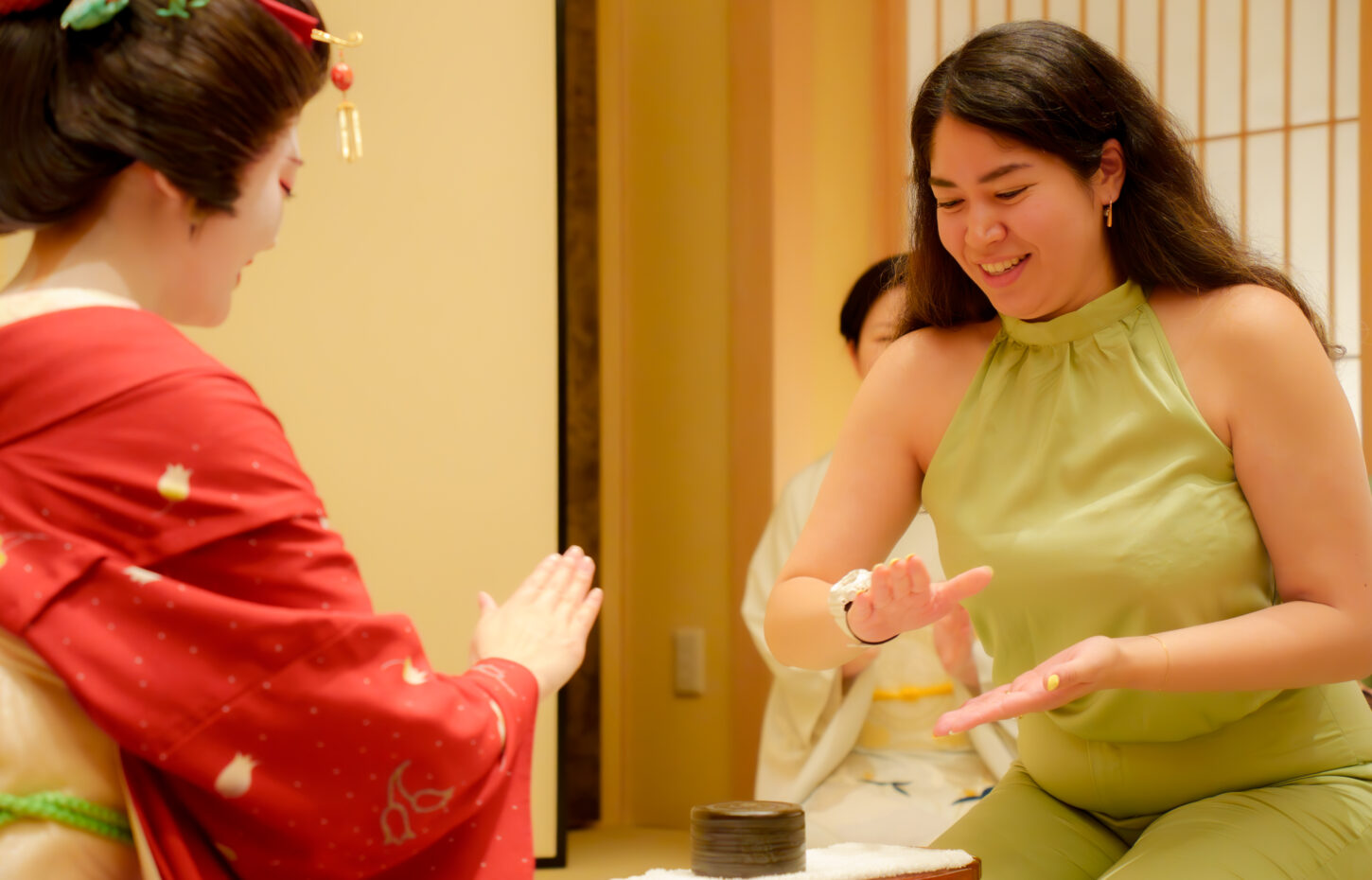
Konpira Fune Fune (金毘羅船々) is a traditional Japanese rhythm-and-reflex game played at geisha tea houses (machiai-chaya) in Tokyo and Kyoto. Two players sit across a kyōsoku (an armrest) with a small wooden piece called the hakama placed on top. While a geisha sings the Konpira Fune Fune folk song, players take turns reaching for the hakama — open palm if the hakama is on their side, closed fist if their opponent has taken it. The song accelerates, mismatches happen, and the loser drinks one small sakazuki (sake cup) as a forfeit. Note: the cup is not part of the game itself — it appears only at the moment of the forfeit. The game traces back to the Edo period (1603–1868), when pilgrims to Kotohira-gu (Konpira Shrine) in Kagawa Prefecture brought the song into Tokyo’s hanamachi — flower districts. At Asakusa Miyakodori, a working geisha tea house founded in 1950, guests play it almost every evening.
Seen it on TikTok or YouTube first? The viral clips tagged “geisha cup game,” “slap game,” or “cup and egg game” show this exact game — Konpira Fune Fune is its real name. And the object players grab is not a cup: it is the small wooden hakama.
What Is Konpira Fune Fune? (Origins & Etymology)
Konpira Fune Fune is one of the oldest ozashiki asobi — “tatami-room games” — still played in Tokyo today. The name comes from the opening line of an Edo-period folk song about ships sailing to Kotohira-gu, a shrine perched on Mount Zōzu in Kagawa Prefecture, dedicated to Konpira Daigongen, the deity of seafarers. The word Konpira itself is much older than Japan: it is a phonetic borrowing of the Sanskrit Kumbhīra, originally a crocodile spirit of the Ganges River, later absorbed into Buddhism as a guardian of water and, by extension, of ships.
By the Edo period, Konpira pilgrimage had become one of the great popular journeys of common people, second only to the Ise pilgrimage. Pilgrims who could not make the trip themselves would send a dog with a wooden tag and donations tied around its neck — the famous Konpira-inu. The folk song traveled the same routes the pilgrims did, and once it reached the entertainment districts of Edo (the old name for Tokyo), it was picked up by the geisha and worked into a game.
The game itself is simple in description but unforgiving in practice: rhythm, mirroring, and a small wooden hakama that may or may not be in front of you on the kyōsoku base. Played at a slow tempo it looks almost meditative. Played at full speed — which is how a skilled geisha closes the round — it is a small comedy of mistimed hands, missed beats, and laughter ringing around the room.
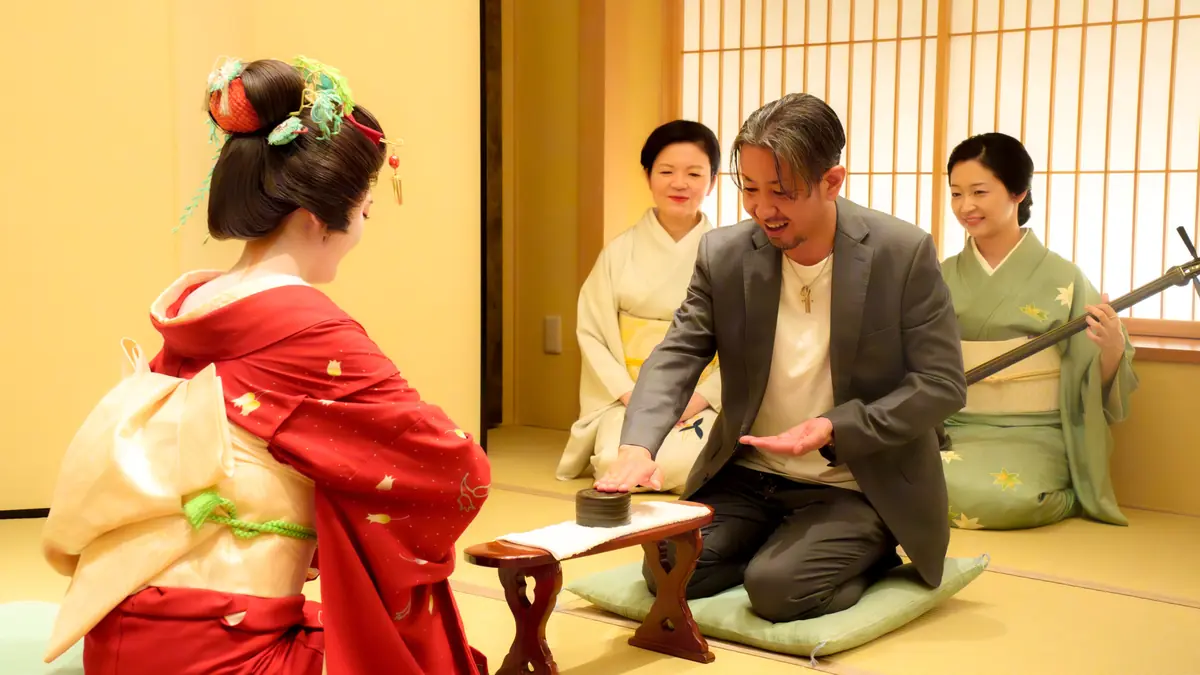
The game itself, before the rules. Two players face each other across a low stand, hands moving on the beat of the song. Watching it once makes the step-by-step below much easier to follow.
Rules: How to Play Konpira Fune Fune Step-by-Step
The game is played by two people seated facing each other across a kyōsoku — typically a guest and a geisha, but two guests can play each other while the geisha sings.
What You Need (and What’s Often Misunderstood)
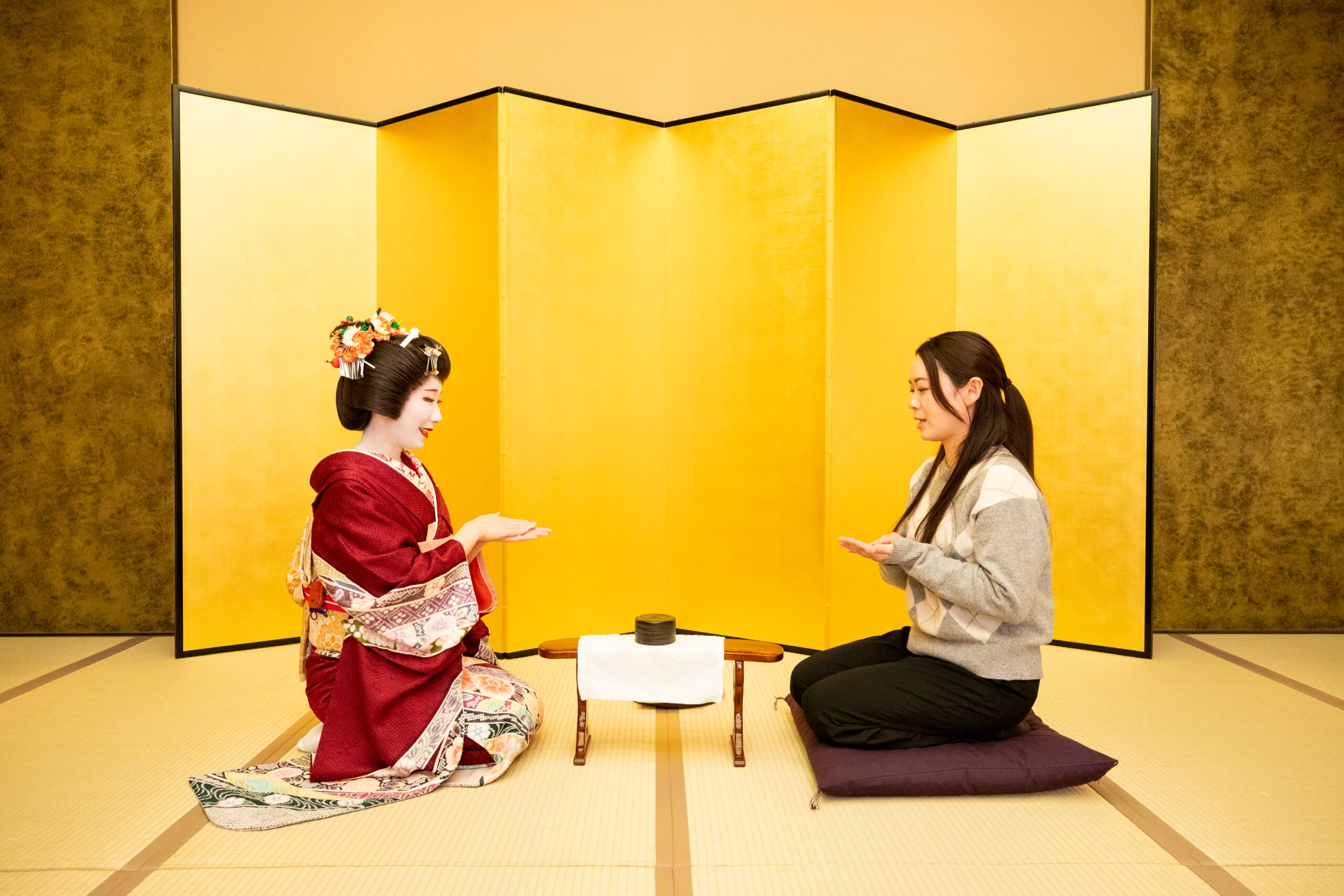
This is the part most English-language sources get wrong. The game itself uses only two pieces — a base and a small wooden piece that sits on top of it:
- The kyōsoku (脇息) — an armrest placed between the two players. Think of it as the playing surface. It is not a table. It is the same family of furniture as the cushioned armrest you might see beside a person sitting in a tatami room.
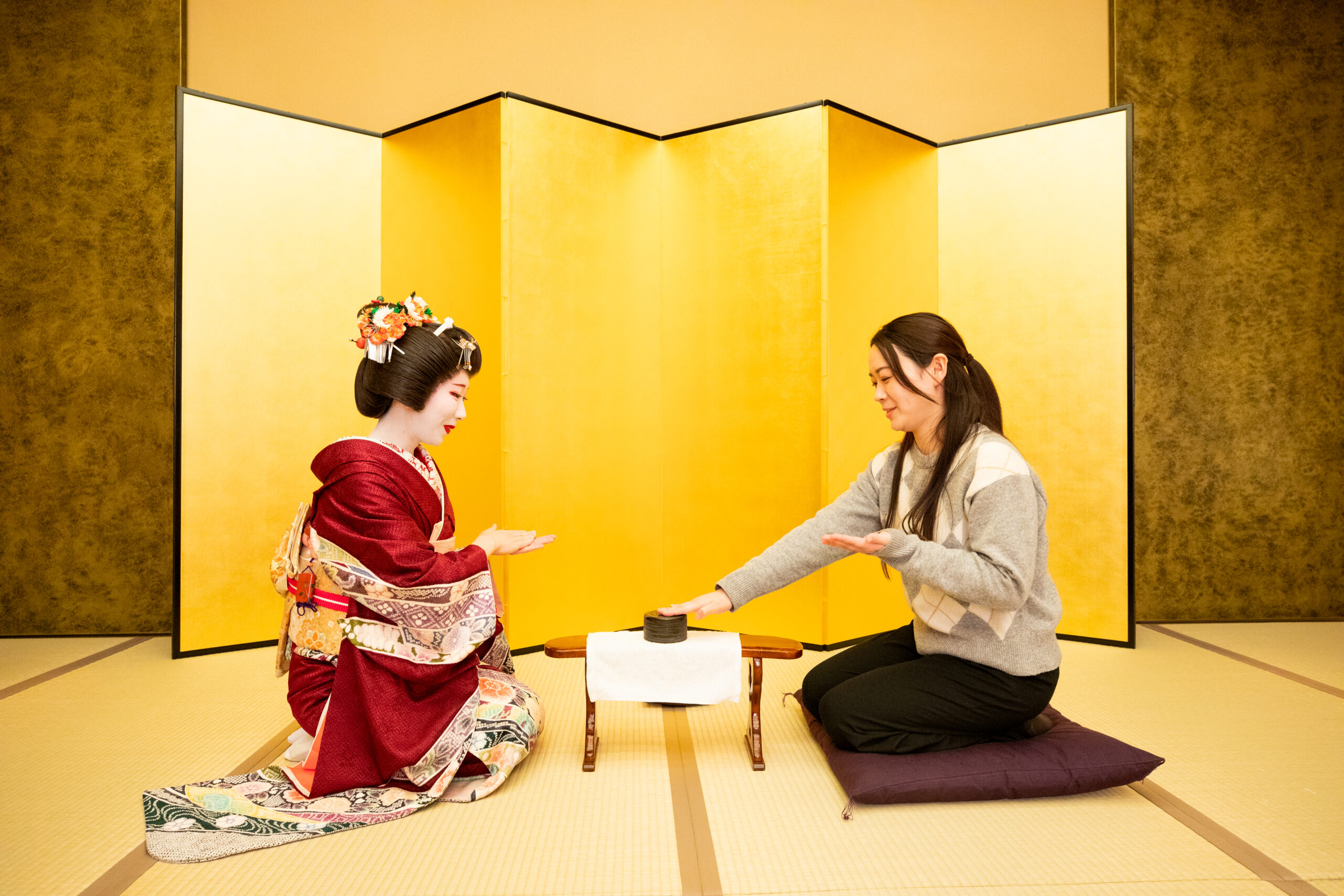
- The hakama (袴) — a small wooden piece that sits on top of the kyōsoku. The hakama is the only thing players take, return, and pass back and forth. Nothing else sits on the kyōsoku during play.
The sake cup (sakazuki) is not part of the game. Many English-language guides describe Konpira Fune Fune as a game involving a cup that players lift, tap, or hide. That is wrong. The cup never enters the game. The cup appears only at the very end of a round, as the forfeit — the loser drinks from it. Until that moment, it is not on the kyōsoku.
You also need:
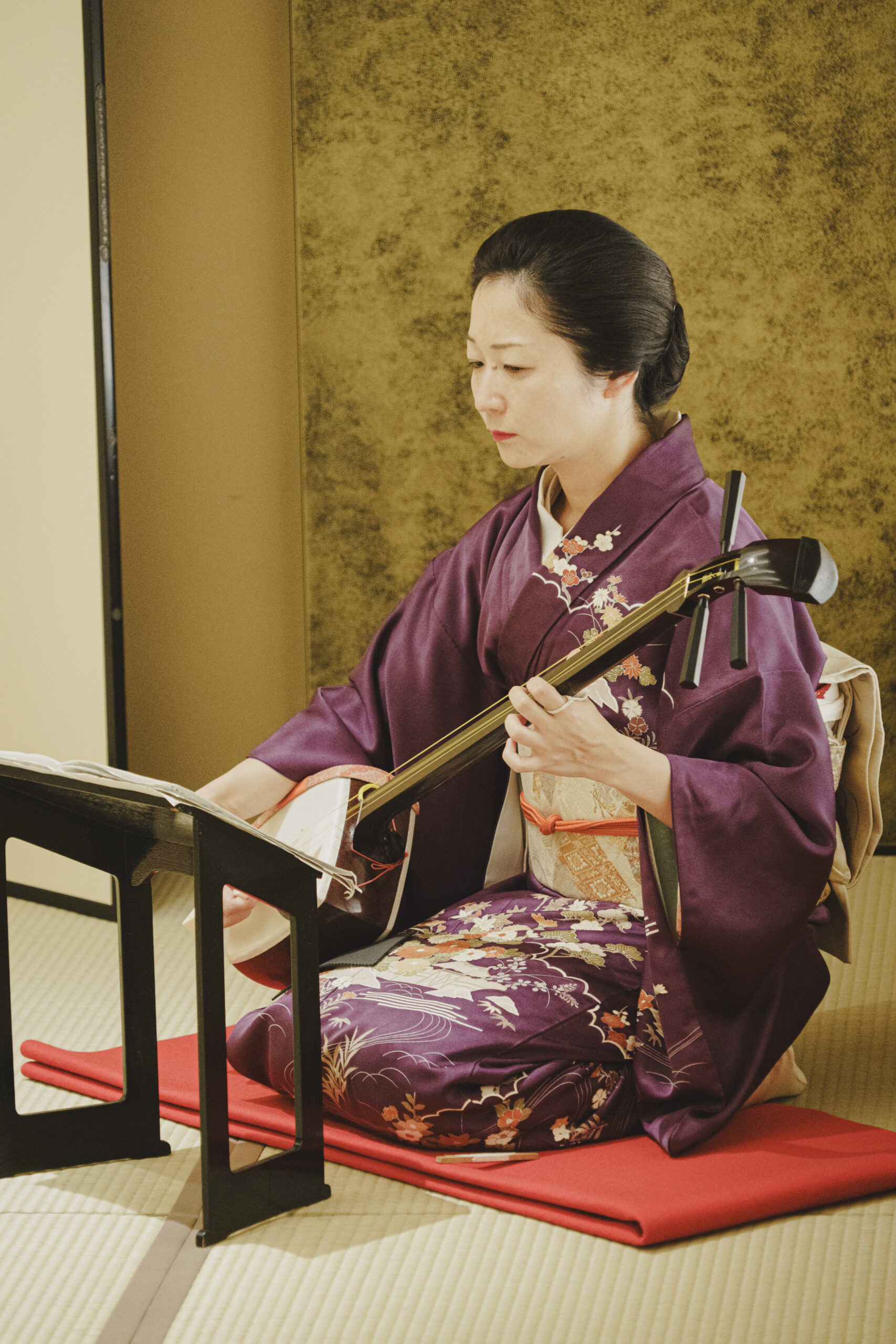
- A geisha singing Konpira Fune Fune, ideally with a second geisha playing the shamisen
- A small lacquered sakazuki cup — kept aside, ready for whoever loses the round to drink from. Not on the playing surface.
The Two Hand Shapes
There are only two hand shapes you ever need:
- Open palm (パー / pā) — used when the hakama is on your side of the kyōsoku. You place your open palm on top of the hakama.
- Closed fist (グー / gū) — used when the hakama has been taken to the other side. You tap the empty surface of the kyōsoku where the hakama used to sit.
The whole game is built on this single rule: the shape of your hand must match what is in front of you. Hakama present → open palm. Hakama absent → closed fist.
How a Round Plays Out
- The geisha begins to sing Konpira Fune Fune at a moderate tempo.
- The two players take turns. On each beat, one player extends their hand to the kyōsoku and either places an open palm on the hakama, or taps the empty kyōsoku with a closed fist.
- At any point during your turn, you may take the hakama across to your side and hold it in front of you. This is the trap. Your opponent now has to switch to a closed fist, because the hakama is gone from their side.
- The hakama can be pushed back across at any time, and your opponent has to switch back to an open palm.
- A player may keep the hakama on their side for up to three consecutive turns; on the fourth turn it must be returned. (This is the traditional rule; some houses play with a slightly looser cap.)
- The geisha steadily speeds up the song. Mistakes appear — open palm on an empty kyōsoku, closed fist on a hakama, or simply missing the beat. The first player to make a mistake loses the round.
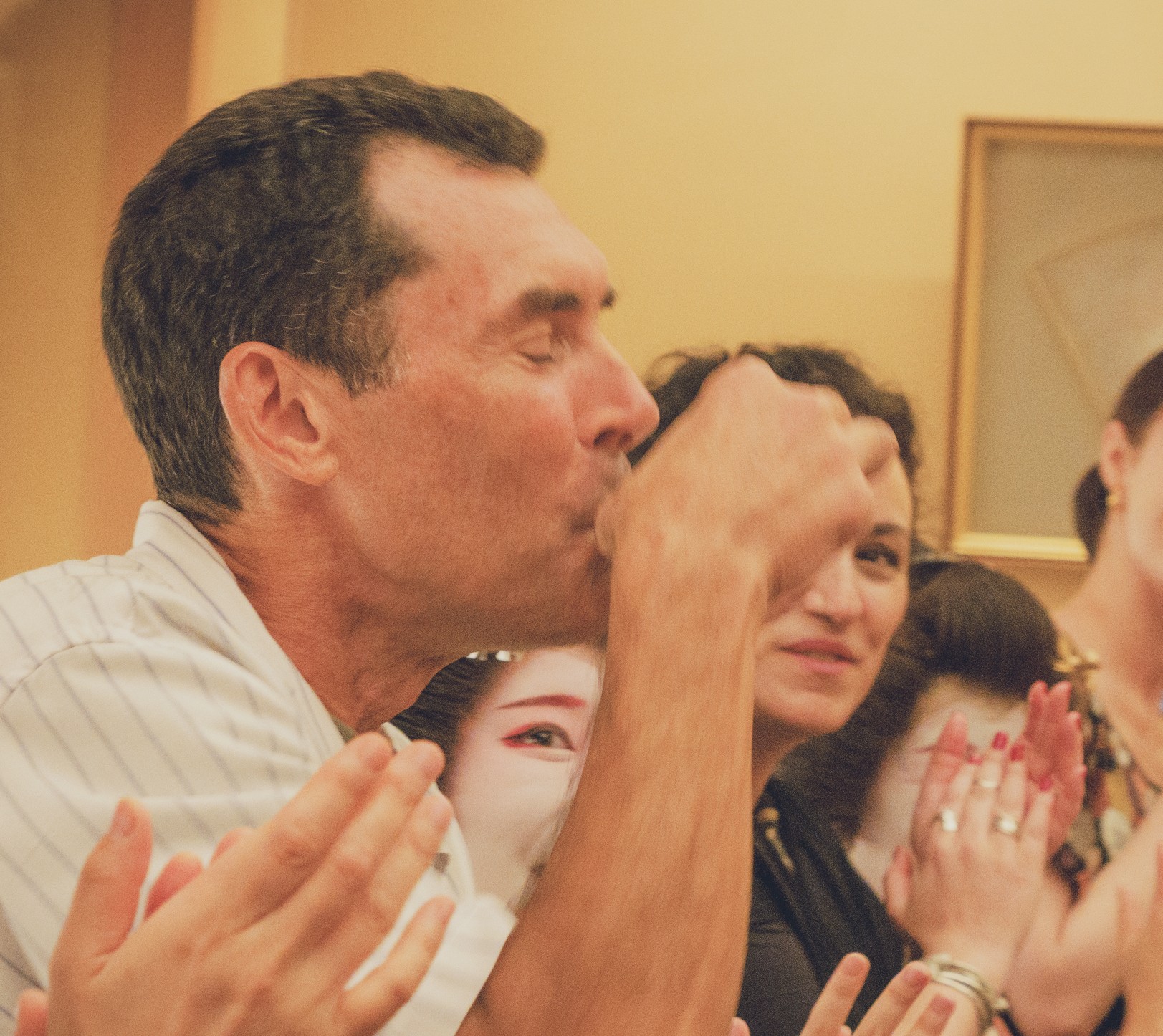
- Now the cup appears. The loser drinks one full small sakazuki cup — not a sip. In a relaxed setting it can be tea, soft drink, or beer; by tradition it is sake. The cup is small (a typical sakazuki holds well under a shot). After the forfeit, play resumes — the cup is set aside again, and the next round uses only the kyōsoku and hakama.
What Beginners Get Wrong
- Hesitating. The rhythm is the metronome. Even a wrong shape on the beat looks more graceful than the right shape half a second late.
- Watching the hakama instead of your opponent’s hand. The hakama is the obvious cue, but skilled players will move it at the last possible moment and you will only catch the change in their wrist.
- Trying to be polite. First-time guests often hold back to let the geisha “win.” The geisha will see this and accelerate until you cannot keep up. The game only works when both sides play seriously.
If this is your first time playing in Japan, the geisha will walk through the rules at a slow tempo before the round begins. You do not need to know the song — you only need to follow the beat.
Play Konpira Fune Fune at Asakusa Miyakodori
A working ozashiki (a private gathering with geisha) where Konpira Fune Fune is played almost every evening — live shamisen, traditional dance, English support. Reserve a Tea House plan or a private 1-, 2-, or 3-hour ozashiki. No introduction required.
The Song: Lyrics in Japanese, Romaji, and English
The full song has many regional variants, but the version most commonly sung in Tokyo’s geisha districts is short, easy to repeat, and built for acceleration.
For the full lyrics with romaji, a line-by-line English reading, and what the words actually mean, see our Konpira Fune Fune lyrics guide.
Original Japanese
金毘羅船々 追風(おいて)に帆かけて
シュラシュシュシュ
まわれば四国は 讃州那珂の郡(ぐん)
象頭山金毘羅大権現
一度まわれば
Romaji
Konpira fune-fune
Oite ni ho kakete
Shura-shu-shu-shu
Mawareba Shikoku wa
Sanshū Naka no gun
Zōzu-san Konpira Daigongen
Ichido mawareba
English Translation (Sense Translation)
The Konpira ships, the Konpira ships,
Hoisting their sails to the following wind —
Shura-shu-shu-shu (most often heard as the sound of the wind in the rigging).
If you round the cape, you’ll come to Shikoku,
To the Naka district of Sanshū Province,
Where Konpira Daigongen sits on Mount Zōzu.
Round it once, and…
The song is technically open-ended; the geisha can repeat the Ichido mawareba (“Round it once”) line indefinitely, looping back to the start, each time slightly faster than before. The accelerando is the entire dramatic structure — the lyrics are almost a pretext for the rhythm.
A small note for travelers: Shura-shu-shu-shu is onomatopoeia most often explained as sails snapping in the wind — some hear the waves against the hull. It is not a real word, and it has no meaning outside this song. When the geisha leans into those four syllables, the room often joins in.
Our newest hangyoku (trainee geisha) takes on Konpira Fune Fune. Watch the tempo climb until neither player can keep up.
The Edo History: From Konpira Pilgrimage to Asakusa Tea House
The Konpira shrine itself is much older than the game. Mount Zōzu in Kagawa Prefecture has been a sacred site since at least the Heian period (794–1185), but it was the Edo period that made Konpira a household word. Pilgrimage routes opened, woodblock prints of the climb up Mount Zōzu became popular, and the song traveled along with the pilgrims.
Who Carried the Song into the Hanamachi
The connecting tissue between the shrine song and the geisha world was the maritime merchants — shipping brokers, sake wholesalers, salt traders — who used Kotohira-gu’s blessing to protect their cargo. These men were also the wealthiest patrons of the hanamachi, Tokyo’s flower districts. They brought the song into the tea houses, the geisha picked it up, the shamisen players arranged it, and within a generation it had become a standard.
By the late nineteenth century, Konpira Fune Fune was no longer associated with any one region. It was simply the Tokyo geisha game — the first one a hangyoku (apprentice) typically encountered, and the one most often used to break the ice with a new guest.
Asakusa’s Specific Place in the Story
Asakusa hanamachi is one of Tokyo’s six historical kagai (geisha districts) and traces its founding to the Edo middle period. While other Tokyo districts — Shimbashi, Akasaka, Kagurazaka, Mukōjima, Yoshichō — each developed their own house style, Asakusa was always known as a working-class, performance-heavy district closely tied to the kabuki theater on the same street. Konpira Fune Fune, with its fast rhythm and physical comedy, fits the Asakusa register perfectly. It is still the game most often played at Asakusa tea houses today.
Miyakodori, a working geisha tea house founded in 1950, has been part of this Asakusa tradition for three generations. The okami, Chikage, learned Konpira Fune Fune as a hangyoku and has played it almost daily ever since — though, importantly, no one formally “taught” it to her. The game travels between geisha by being in the room.
How Geisha Learn the Game (the Honest Answer)
There is no Konpira Fune Fune curriculum.
This is the part most Western coverage of the geisha world misses. There is no graded syllabus, no separate “Konpira class,” no certificate at the end. Konpira Fune Fune is absorbed the way kitchen recipes are absorbed — by being in the room, watching it played hundreds of times before you ever sit at the kyōsoku yourself, and by being corrected with a smile the first dozen times you slip.
A hangyoku (apprentice) does extensive formal training — but the formal track is in dance, shamisen, song, tea ceremony, manners, the speech register of the ozashiki, and the careful choreography of pouring and serving. Konpira Fune Fune is not a separate item on that list. It travels through everyday play, between geisha, across the room, in the same way the working vocabulary of the hanamachi travels.
Komaaki, a jikata geisha at Miyakodori, has spoken publicly about her training in this way:
“What I struggled with as an apprentice was the things particular to this house — the manners, the way of moving on tatami. You walk into an ozashiki and you know you have to do something, but you don’t know what. Konpira Fune Fune was actually one of the easier things, because at least the rules are explicit.”
— Komaaki (jikata geisha, Miyakodori interview, April 2026)
There is also a deeper layer that guests rarely see. The geisha is not just playing the game — she is reading the room. She is gauging the guest’s reflexes, deciding how fast to take the song, watching to see whether the guest is having fun or starting to feel exposed. A skilled geisha will lose deliberately to a guest who is uncertain, and play to win against a guest who is enjoying the duel. The game is a tool for hospitality before it is a competition.
This is the part the foreign-language internet almost always misses. Konpira Fune Fune in a tourist video looks like a drinking game. In the ozashiki it is closer to a conversation — one where the geisha holds the tempo of the room in her left hand.
Practice, filmed. Our newest geisha works through tosenkyo with a senior. The captions score each throw as the fan lands — 0pt, 1pt, minus 1pt, 10pt — which is how the counting actually works when guests play it.
Other Ozashiki Games You’ll Encounter
Konpira Fune Fune is the entry point. It is not the only game played at a Tokyo geisha tea house. A typical evening at Asakusa Miyakodori might cycle through three or four of the following:
Tora Tora (虎々)
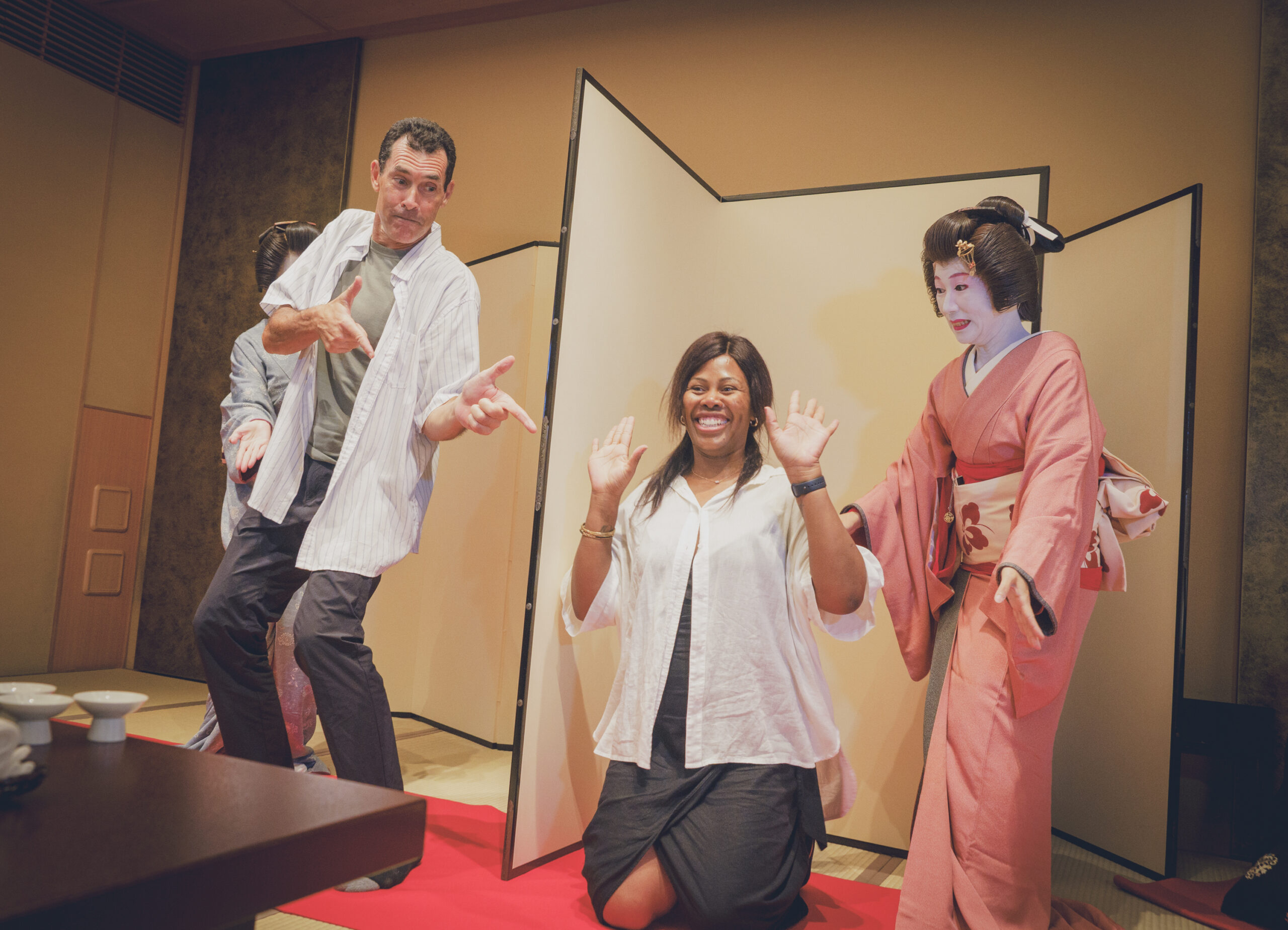
A behind-the-screen rock-paper-scissors based on the kabuki play Kokusen’ya Kassen. Three figures — a tiger, an elderly woman (the mother of the warrior Watōnai), and a samurai with a spear — beat each other in a cycle. Two players hide behind a folding screen, strike a pose simultaneously, and the screen is lifted. It is the most physical of the games.
Tōsenkyō (投扇興)
A precision game from the Edo period, in which players throw a folding fan at a butterfly-shaped target perched on a small wooden pillow. The position in which the fan, target, and pillow fall is scored against a meijō-hyō — a chart of poetic names borrowed from The Tale of Genji or the Hyakunin Isshu. It is the most visually elegant game and is especially popular with foreign guests.
Omawari-san (おまわりさん)
A drum-and-rock-paper-scissors hybrid. The winner of each round strikes a small drum twice; the loser spins in place. The song accelerates. After three losses, the loser drinks. The comedy comes from spinning while increasingly drunk.
Ohiraki-san (おひらきさん)
A standing balance game. Two players face off, play rock-paper-scissors, and the loser steps their feet a little farther apart. Whoever falls over first loses. (Note: ohiraki in Japanese normally means “to close a gathering,” so the name is a small joke.)
Annual Tradition Performances You Are Unlikely to See — But Should Know Exist
Beyond the everyday parlor games, the Asakusa hanamachi has two performance traditions that occur exactly once a year, almost never witnessed by visiting guests, but anchored deeply in the working calendar of the district:
- O-bake (お化け) — On Setsubun, the eve of the lunar spring (February 3rd), Asakusa geisha form small groups of two or three and travel between ozashiki in elaborate costumes. The word o-bake in everyday Japanese means “ghost,” but in the geisha world it is the in-house industry term for this once-a-year costumed performance. Recent years have layered pop-cultural references — Mario, Matsuken Samba — onto classical dance, with geisha switching costumes mid-performance behind a folding screen. Setsubun itself is a traditional rite of seasonal exorcism (yakubarai); o-bake carries that meaning forward in playful, theatrical form.
- Kumi-odori (組踊り) — During the May Sanja Matsuri, Asakusa’s largest shitamachi festival, the geisha contribution is a kumi-odori, a coordinated group dance involving seven or eight performers mixing tachikata (dancers) and jikata (musicians). In peak years, the schedule was tight enough that the group traveled by truck between engagements. The word kumi-odori literally means “ensemble dance” and exists in other Japanese performance contexts; in the Asakusa hanamachi it specifically refers to this Sanja Matsuri performance.
You will not normally encounter either tradition during a tea-house booking. But knowing they exist is part of seeing the ozashiki you do attend in its real context: a single window onto a much larger seasonal calendar that the geisha in front of you are quietly carrying.
Where to Play Konpira Fune Fune in Tokyo
You cannot, strictly speaking, play Konpira Fune Fune by yourself. The game requires a singing geisha and a shamisen player, and that means a working hanamachi tea house. There are only a small number of venues in Tokyo where this is possible without an introduction from an existing patron.
Asakusa Miyakodori — Private Plans Recommended
Miyakodori offers four formats. The honest recommendation: for Konpira Fune Fune at its best, take a private plan. The Tea House plan exists for first-time visitors on a tighter budget who want to try the game itself, but the depth of play, the conversation around the game, and the freedom to keep going for a second or third round all unlock when you have a private ozashiki.
- 75-min Tea House plan (¥17,600 per person) — shared seating; three geisha perform and host the gathering (with shamisen accompaniment); Konpira Fune Fune is the only game played in this format, plus a seasonal dance, a Q&A, and matcha with seasonal sweets. Filming during the session is welcome, with a dedicated photo time at the end.
- 1-hour Private plan (from ¥34,000 per person) — your own ozashiki; two geisha for parties up to 6 guests (three for parties of 7+); Konpira Fune Fune plus one or two additional games depending on tempo.
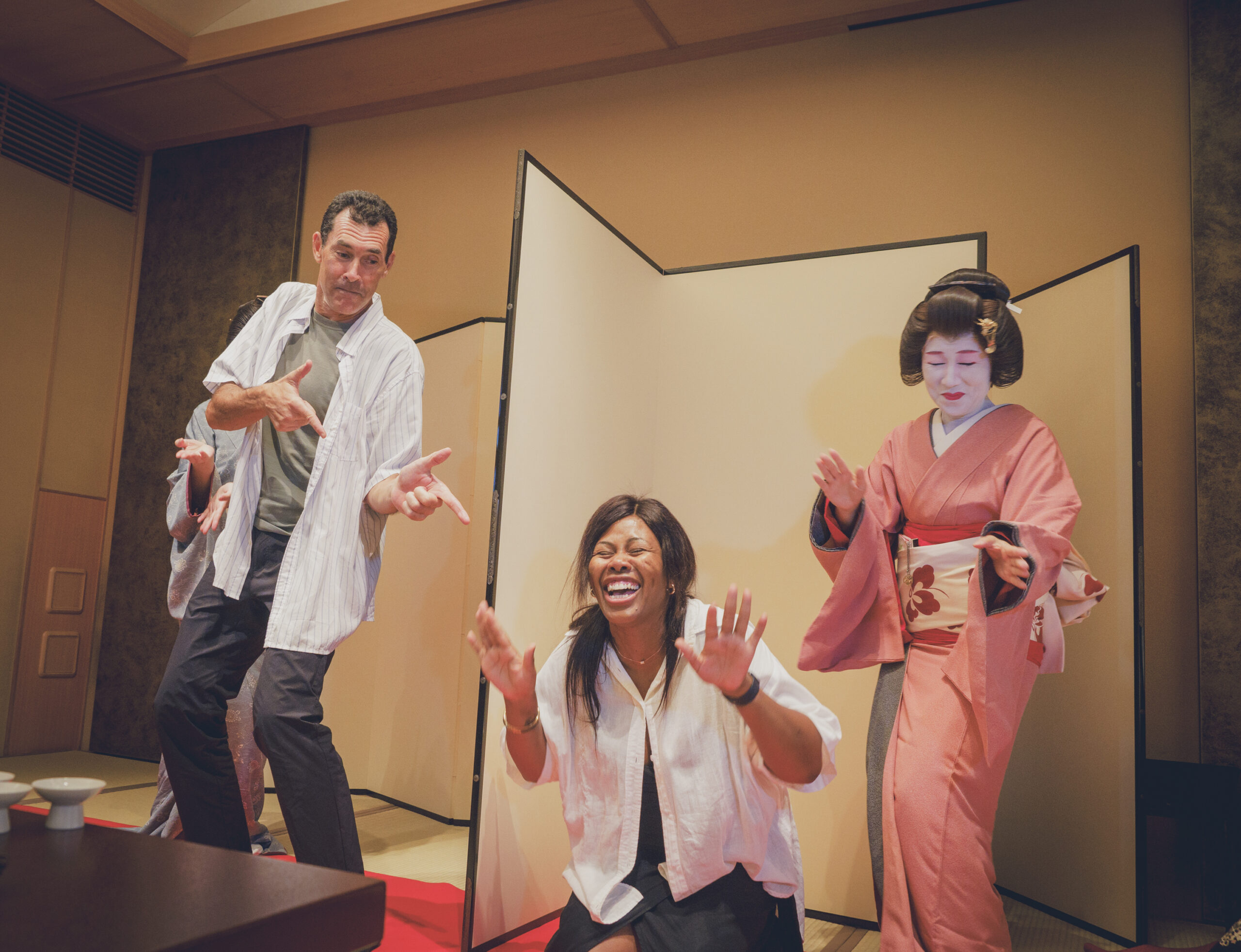
- 2-hour Signature plan (from ¥45,000 per person) — your own ozashiki; two geisha for parties up to 5 (scales for 6+); Konpira Fune Fune plus several other ozashiki games (Tora Tora, Omawari-san, Tōsenkyō); free-flow drinks. The okami’s recommended format.
- 3-hour Full Course (from ¥106,000 per person, kaiseki dinner included) — three geisha for parties up to 5 (four or more for parties of 6+); recommended for groups of 6+, anniversaries, or when you want the fullest evening.
Reservations are taken online for all formats; English support is provided throughout. The Tea House plan is currently offered at a special campaign price (20% off the regular ¥22,000).
Manners While Playing
Two small things to know going in. Both come from the ozashiki code of conduct that the geisha are trained in from their first days:
- Pour for your geisha when she pours for you. Reciprocal pouring — she pours your sake or beer, you pour hers — is one of the warmest threads of ozashiki communication, not a violation of etiquette. Foreign guests sometimes hesitate, thinking pouring is the geisha’s exclusive job. It isn’t. Pouring back is welcomed, expected, and one of the small pleasures the evening is built around.
- The honorific o- is everywhere. In the ozashiki, it is not “beer” but o-beer; not “shamisen” but o-shamisen; not “tea” but o-cha. You do not need to imitate this — the geisha simply talks this way. It is a small marker of the world you have stepped into.
These details do not affect the game itself. They affect how the room feels around it.
Frequently Asked Questions
Q: Is this the “geisha cup game” from TikTok?
Yes. The game shown in viral videos under names like “geisha cup game,” “slap game,” or “cup and egg game” is Konpira Fune Fune. The wooden piece players grab is called a hakama, not a cup — the sake cup appears only as the forfeit at the end of a round. If a clip shows someone snatching an actual cup, that is a casual home adaptation, not the way it is played at an ozashiki.
Q: Is Konpira Fune Fune always a drinking game?
No. The forfeit is traditionally one small sakazuki cup of sake, but at Miyakodori the geisha will adjust to whatever the guests are drinking — beer, tea, or a soft drink. International guests, designated drivers, and guests not drinking alcohol play exactly the same way; only the cup contents change.
Q: Can I play if I don’t speak Japanese?
Yes. The game has no Japanese-language requirement. The geisha will demonstrate the two hand shapes (open palm / closed fist) in front of you and walk through one slow round before the real song begins. English support is provided throughout the Tea House plan and all private plans.
Q: How fast does the song actually get?
A skilled jikata geisha will roughly double the tempo from the opening verse to the closing one. The song typically accelerates over four or five repetitions, capped by a final extremely fast round. Most guests last two or three rounds before making their first mistake. This is normal — the okami says even hangyoku miss at the highest tempos.
Q: How long does a typical Konpira Fune Fune round last?
A single round is short — usually 20 to 40 seconds at a moderate tempo. A full Konpira Fune Fune segment within an ozashiki (multiple rounds, alternating players) takes about 10 to 15 minutes. On the private 1-, 2-, and 3-hour plans it is one of three or four games typically played across the evening; on the 75-minute Tea House plan, Konpira Fune Fune is the only game in the format.
Q: What’s the difference between Konpira Fune Fune and Tora Tora?
Konpira Fune Fune is a rhythm-and-mirror game played seated at a kyōsoku, requiring you to mirror what is in front of you on the beat. Tora Tora is a rock-paper-scissors-style pose game played behind a folding screen, with three character figures (tiger, elderly woman, samurai). Konpira Fune Fune is sit-down and rhythmic; Tora Tora is stand-up and physical. Both are typically played in the same evening on private plans.
Q: Do I need to bring anything?
No. The kyōsoku, hakama, the sakazuki cup used for the forfeit, the shamisen, and the song are all provided by the tea house. Casual to smart-casual dress is fine — and if you’d like to come in kimono, you’re warmly welcomed. The ozashiki is built for it.
Q: Is Konpira Fune Fune played in Kyoto too?
Yes, but the Kyoto version is sung at a slightly slower base tempo and is more often paired with maiko (apprentice geisha) rather than full geisha. The Tokyo Asakusa version, with its faster rhythm and theater-influenced playfulness, is the version most travelers describe as the “Konpira Fune Fune” they remember from Japan.
Q: Can I take photos and videos during the game?
On private plans (1-hour and longer), photos and videos are entirely up to you — capture anything, anytime. Only live-streaming is asked to be avoided. On the Tea House plan (shared seating), a simple host (MC) guides the session; filming during the session is welcome, and there is a dedicated photo time near the end (about two photos per group).
Booking & Final Note
Konpira Fune Fune is a small game with a long memory. Over a century and a half of pilgrims, merchants, geisha, and apprentices have passed it forward, almost unchanged, to the ozashiki you might step into tonight in Asakusa.
If you would like to play it yourself: the Tea House plan at Asakusa Miyakodori is the entry-point format for first-time visitors on a tighter budget. For the fuller experience — multiple games, conversation across the kyōsoku with your own geisha, kaiseki dining, and a closing tejime led by your geisha — our private plans are the recommended format.
The okami’s only request: come ready to play. The game will lose to you a few times to start, then it will start to win. That is the point.
Reserve Your Asakusa Ozashiki (Geisha Banquet) at Miyakodori
Konpira Fune Fune is played at an ozashiki — which raises the practical question of how you get into one. Our guide to the five ways to see a geisha in Tokyo compares every route by cost and certainty.
Play Konpira Fune Fune at a working ozashiki (a private gathering with geisha) — Miyakodori, founded in 1950, the only remaining machiai-chaya in Asakusa. Your own private tatami room (on the 1-, 2-, or 3-hour plans), live shamisen, classical dance, multiple parlor games, English interpretation throughout. Direct booking — no introduction required.
Sources & References
- Asakusa Miyakodori Official Website: https://en.miyakodori-geisha.com/
- Asakusa Geisha Association (Asakusa Kenban): https://asakusakenban.com/
- Konpira Fune Fune game mechanics (kyōsoku / hakama terminology, three-consecutive-take rule, “one full sakazuki” forfeit, no specialized curriculum) — direct correction by Miyakodori operator, 2026-05
- Komaaki interview, Miyakodori, April 2026 — apprentice training quote
- Senior member of the Asakusa Geisha Association interview, May 2026 — annual o-bake and kumi-odori traditions
- Kotohira-gu (Konpira Shrine) historical and pilgrimage background — public-domain reference


- What's New in Tokyo 2026: New Attractions & Openings Guide
- How Long Is a Geisha Experience? (Tokyo Ozashiki Guide)
Ozashiki Parlor Games: How to Play Konpira Funefune & Tora-Tora
Geisha Show on Netflix: The Makanai and the Real World of Geisha
Karyukai: The Flower and Willow World of Geisha — Japan’s Geisha Culture Explained
Authentic Geisha Outfit Guide: Traditional Japan Costume Arts
What Is a Hanamachi? Meaning, Structure & Japan’s Geisha Districts Explained
Yoshiwara: History, Location & Legacy of Japan’s Famous District
Comment ( 0 )
Trackbacks are closed.

No comments yet.